The Technique of My Musical Language: A Modern Companion
About This Digital Edition
This is a scholarly companion to Olivier Messiaen's La technique de mon langage musical (1944), in the English translation by John Satterfield (1956).
Messiaen's treatise is among the most significant documents of twentieth-century compositional thought. In it, he systematically explains the rhythmic, melodic, and harmonic techniques that define his unique musical language—including his celebrated modes of limited transposition, added values, nonretrogradable rhythms, and their interrelationships.
Purpose
This digital edition provides:
- Orientation to the structure of Messiaen's original text
- Modern scholarly summaries of each chapter, using contemporary music-theoretical terminology
- Reference tools for quick lookup during composition or analysis
It is designed to make Messiaen's ideas accessible and practically useful, particularly for composers who wish to have his techniques "ready-to-hand."
What This Is Not
This is not a transcription or reproduction of Messiaen's text. The original remains under copyright (held by Éditions Alphonse Leduc, Paris). Readers seeking Messiaen's own words—his distinctive prose style, his theological reflections, his poetic formulations—should obtain the original publication.
Structure
Part I: The Original Text
Structural orientation only: table of contents, chapter outlines, and information about obtaining the original.
Part II: Modern Summary & Analysis
Each of the nineteen chapters summarized in formal academic English, using contemporary music-theoretical vocabulary. Where Messiaen's 1944 terminology differs from current usage, equivalences are noted. Musical examples are referenced by number; readers should consult Volume 2 of the original publication.
Part III: Reference Apparatus
Cross-indexed reference tools organized for practical use: concept index, technique summaries, quick-reference tables, and multiple pathways into the material.
Part IV: Technique of Your Musical Language
A composer's workbook for developing your own systematic self-knowledge. Messiaen's treatise is not merely a catalog of his techniques—it is a demonstration of rigorous compositional self-observation. Part IV provides templates and prompts for documenting your own rhythmic, melodic, harmonic, and formal vocabulary, following Messiaen's method of identifying sources, extracting principles, and tracking evolution. The goal is not to imitate Messiaen's language but to develop the same depth of understanding about your own.
A Note on Terminology
Messiaen wrote before the widespread adoption of pitch-class set theory, before the standardization of metric theory terminology, and within a specifically French pedagogical tradition. This companion translates his ideas into the vocabulary of contemporary English-language music theory where appropriate, while preserving the distinctiveness of his concepts. For example:
- His "modes of limited transpositions" relate to what set theorists call symmetric scales or sets with transpositional symmetry
- His "added values" connect to concepts of metric displacement and asymmetric grouping
- His "nonretrogradable rhythms" are palindromic or temporally symmetric structures
Such bridging is offered not to reduce Messiaen's thought to other frameworks, but to help readers situate his innovations within the broader landscape of music theory.
Obtaining the Original
Messiaen, Olivier. La technique de mon langage musical. 2 vols. Paris: Alphonse Leduc, 1944.
English translation: Satterfield, John. The Technique of My Musical Language. Paris: Alphonse Leduc, 1956.
Available from music retailers and academic libraries. Éditions Alphonse Leduc is now part of Hal Leonard Europe.
Use the search function (🔍) or the sidebar to navigate.
About the Original Text
Bibliographic Information
Original French Edition: Messiaen, Olivier. La technique de mon langage musical. 2 vols. Paris: Alphonse Leduc, 1944.
English Translation: Satterfield, John, trans. The Technique of My Musical Language. Paris: Alphonse Leduc, 1956.
Structure of the Original
The treatise consists of two volumes:
Volume 1: Text (approximately 70 pages)
- Preface
- Nineteen chapters organized into three broad areas: Rhythm, Melody, and Harmony
- Catalogue of the composer's works (as of 1944)
Volume 2: Musical Examples
- 384 musical examples referenced throughout the text
- Drawn primarily from Messiaen's own compositions
- Essential for understanding the treatise; the text frequently refers to specific examples
Dedication
The work is dedicated to Guy Bernard-Delapierre.
Translator's Note
John Satterfield's English translation was prepared in Chapel Hill, North Carolina, with acknowledgment to Carl Baxter, Robert Gould, and Frank Justice for critical reading of the manuscript. Satterfield notes that departures from literal translation were made only where idiomatic differences between French and English required them.
How to Obtain
The original publication remains in print and is available through:
- Academic music libraries
- Music retailers specializing in scores and pedagogical materials
- Éditions Alphonse Leduc (now part of Hal Leonard Europe)
Copyright Status
The original text and translation remain under copyright. This companion provides scholarly summary and analysis but does not reproduce Messiaen's text. Readers seeking his distinctive voice, theological reflections, and poetic formulations should consult the original.
Future Editions
Should permissions be obtained from the rights holders, a full transcription may be added to Part I of this companion. Inquiries regarding permissions should be directed to Hal Leonard Europe / Éditions Alphonse Leduc.
Detailed Table of Contents
This preserves the complete structure from the original, including all subsections.
Front Matter
- Introduction to the English Translation — p. 5
- Preface — p. 7
Part I: Rhythm (Chapters I–VII)
Chapter I — The Charm of Impossibilities and the Relation of the Different Subject Matters — p. 13
Chapter II — Rāgavardhana, Hindu Rhythm — p. 14
- Ametrical Music — p. 14
- Rāgavardhana — p. 14
Chapter III — Rhythms with Added Values — p. 16
- Added Value — p. 16
- Use of the Added Value — p. 16
- Rhythmic Preparations and Descents — p. 17
- Relation to Added Notes — p. 17
Chapter IV — Augmented or Diminished Rhythms and Table of These Rhythms — p. 18
- Augmented or Diminished Rhythms — p. 18
- Addition and Withdrawal of the Dot — p. 18
- A Table of Some Forms of Augmentation or Diminution of a Rhythm — p. 18
- Inexact Augmentations — p. 19
Chapter V — Nonretrogradable Rhythms — p. 20
- Retrograde Rhythms — p. 20
- Nonretrogradable Rhythms — p. 20
- Relation of Nonretrogradable Rhythms and Modes of Limited Transpositions — p. 21
Chapter VI — Polyrhythm and Rhythmic Pedals — p. 22
- Superposition of Rhythms of Unequal Length — p. 22
- Superposition of a Rhythm upon Its Different Forms of Augmentation and Diminution — p. 23
- Superposition of a Rhythm upon Its Retrograde — p. 23
- Rhythmic Canons — p. 24
- Canon by the Addition of the Dot — p. 25
- Canon of Nonretrogradable Rhythms — p. 26
- Rhythmic Pedal — p. 26
Chapter VII — Rhythmic Notations — p. 28
- First Notation — p. 28
- Second Notation — p. 28
- Third Notation — p. 28
- Fourth Notation — p. 29
- Some Metrical Rhythms — p. 30
Part II: Melody (Chapters VIII–XII)
Chapter VIII — Melody and Melodic Contours — p. 31
- Intervals — p. 31
- Melodic Contours — p. 31
- Folk Songs — p. 32
- Plainchant — p. 33
- Hindu Ragas — p. 33
Chapter IX — Bird Song — p. 34
Chapter X — Melodic Development — p. 35
- Elimination — p. 35
- Interversion of Notes — p. 35
- Change of Register — p. 36
Chapter XI — Song-Sentence, Binary and Ternary Sentences — p. 37
- Song-Sentence — p. 37
- Commentary — p. 38
- Binary Sentence — p. 38
- Ternary Sentence — p. 38
- List of Melodic Periods — p. 39
Chapter XII — Fugue, Sonata, Plainchant Forms — p. 40
- Fugue — p. 40
- Sonata — p. 40
- Development of Three Themes, Preparing a Final Issued from the First — p. 41
- Variations of the First Theme, Separated by Developments of the Second — p. 42
- Plainchant Forms — p. 44
- Psalmody and Vocalise — p. 45
- Kyrie — p. 45
- Sequence — p. 46
Part III: Harmony (Chapters XIII–XIX)
Chapter XIII — Harmony, Debussy, Added Notes — p. 47
- Added Notes — p. 47
- Added Sixth and Added Augmented Fourth — p. 47
- Relation of Added Notes and Added Values — p. 48
- Use of Added Notes — p. 48
Chapter XIV — Special Chords, Clusters of Chords, and a List of Connections of Chords — p. 50
- The Chord on the Dominant — p. 50
- The Chord of Resonance — p. 50
- The Chord in Fourths — p. 50
- Effects of Resonance — p. 51
- Clusters of Chords — p. 51
- A Look at Other Styles — p. 52
- Natural Harmony — p. 52
- A List of Connections of Chords — p. 53
Chapter XV — Enlargement of Foreign Notes, Upbeats and Terminations — p. 55
- The Pedal Group — p. 55
- The Passing Group — p. 56
- The Embellishment Group — p. 56
- Upbeats and Terminations — p. 56
Chapter XVI — Modes of Limited Transpositions — p. 58
- Theory of the Modes of Limited Transpositions — p. 58
- First Mode of Limited Transpositions — p. 59
- Second Mode of Limited Transpositions — p. 59
- Third Mode of Limited Transpositions — p. 60
- Modes 4, 5, 6, and 7 — p. 61
- Relation of Modes of Limited Transpositions and Nonretrogradable Rhythms — p. 62
Chapter XVII — Modulations of These Modes and Their Relation to the Major Tonality — p. 64
- Relation to the Major Tonality — p. 64
- Modulation of a Mode to Itself — p. 65
- Modulation of a Mode to Another Mode — p. 65
Chapter XVIII — Relation of These Modes to Modal, Atonal, Polytonal, and Quarter-Tone Music — p. 67
Chapter XIX — Polymodality — p. 68
- Two Superposed Modes — p. 68
- Three Modes Superposed — p. 69
- Polymodal Modulation — p. 69
Appendix
- Catalogue of Works — p. 71
Part I: Rhythm (Chapters I–VII)
Conceptual Overview: Liberating Time
Messiaen's rhythmic thinking offers something radical: a systematic path away from metric tyranny without descending into unmeasured chaos. This isn't about rejecting meter because it's "traditional"—it's about recognizing that metric regularity represents one organizational mode among many, and often not the most interesting one.
The Core Insight: Precision Without Periodicity
The crucial distinction runs through everything: ametric ≠ unmeasured. Messiaen demands absolute rhythmic precision—every duration exact, every relationship calculated—while refusing metric periodicity. Think of it as replacing the heartbeat with the breath: exact durations that don't recur in predictable cycles, temporal organization that refuses to settle into the comfort of the expected downbeat.
This distinction opens compositional territory that most rhythmic innovation misses. Stravinsky gave us irregular meters—but still meters, still barlines creating periodic cycles even if asymmetrical. Cage gave us unmeasured duration—but often at the cost of rhythmic precision. Messiaen found the sweet spot: rhythms as precisely articulated as Bach, but freed from metric cages.
Two Transformation Systems, Not One
Here's what's easily missed: Messiaen gives you two complete transformation systems operating in parallel, and their interaction creates the magic.
System 1: Additive/Subtractive (Non-proportional)
- Added values: inserting small durations to disrupt symmetry
- Dot addition/withdrawal: 1.5× transformations creating irrational relationships
- These create temporal limp, rhythmic unevenness, metric resistance
System 2: Multiplicative/Divisive (Proportional)
- Classical augmentation/diminution: 2×, 3×, 4× and their inverses
- Maintains rhythmic Gestalt while changing time-scale
- Creates family relationships between rhythms at different speeds
Most composers use one or the other. Messiaen uses both simultaneously, creating rhythms that transform through multiple operations at once. A rhythm can be doubled (proportional) while having a sixteenth-note added to one value (non-proportional), creating transformations that are neither simple augmentation nor simple variation—they're hybrid mutations.
Your compositional opportunity: Don't just add values OR augment—combine them. Take a simple rhythm, augment it by 3×, then add a sixteenth-note to the third value. Now you have something that relates to the original but defies simple categorization. Build an entire piece from this kind of compound transformation, and you'll generate variety while maintaining unity through shared source material.
Symmetry as Compositional Power
The palindromic rhythms (nonretrogradables) aren't just clever tricks—they're structural tools with profound implications. When a rhythm reads the same forwards and backwards, it exists outside directional time. It has no inherent beginning or ending, no built-in trajectory from "here" to "there."
This creates music that suggests the eternal, the contemplative, the suspended. Messiaen connected this to theology (timelessness, transcendence), but you don't need his Catholic framework to use the technique's power. Palindromic structures create formal symmetry, anchor asymmetrical surroundings, and provide moments of temporal stasis within otherwise directional music.
Your compositional opportunity: Build a piece where asymmetrical, directional rhythms gradually transform toward palindromic structure—temporal movement resolving into temporal stasis. Or do the inverse: break symmetry progressively, creating increasing directionality and momentum. The palindrome becomes a formal goal or departure point, not just a local effect.
Prime Numbers as Rhythmic DNA
The consistent use of prime-numbered groupings (5, 7, 11, 13) isn't arbitrary—it's strategic resistance to metric assimilation. Primes can't be evenly divided, can't nest into duple or triple metric frameworks without remainder. They create maximal metric friction.
But here's the deeper principle: indivisibility creates memorability. A group of seven feels like seven, not like almost-eight or three-plus-four. Its primeness makes it coherent, un-subdivided, a rhythmic atom. When you build complex rhythms from prime-numbered cells, each cell maintains identity even in dense textures.
Your compositional opportunity: Build an entire rhythmic language from prime numbers. Let 5 be your basic "measure," but never let it become metric—vary the internal subdivision (3+2, 2+3, 2+1+2, etc.). Add 7 as a secondary structural unit. Occasionally use 11 or 13 for extended phrases. You'll create music that constantly suggests regularity (groups feel complete) while never becoming predictable (no periodic return).
Polyrhythm: Independence, Not Just Layering
Chapter VI reveals the culmination: multiple independent rhythmic streams, each with its own logic, operating simultaneously. But notice the sophistication—this isn't just "3 against 2" or basic polyrhythm. Messiaen layers:
- Different rhythmic periods (one rhythm cycles every 9 values, another every 10)
- Different transformation rates (one voice in augmentation, another in diminution)
- Different structural types (forward rhythm against its retrograde, asymmetrical against palindromic)
The rhythmic pedal concept is especially powerful: one rhythm repeating ostinato while surrounding material constantly changes. This creates temporal stratification—one layer provides cyclic continuity while others provide developmental variety. It's the rhythmic equivalent of a held organ pedal note under changing harmonies, but in the time domain.
Your compositional opportunity: Don't think "polyrhythm = mathematical ratios." Think "polyrhythm = independent temporal logics operating simultaneously." Create one voice that uses only prime-numbered durations in additive rhythm. Create another that uses only augmentation of a single cell. Create a third that's palindromic. Layer them. The result isn't generic complexity—it's structured complexity where each layer has its own intelligibility.
The Notation Problem: Embrace the Compromise
Chapter VII's honesty about notation is liberating: there's no perfect solution. Every notational choice involves compromise between conception and legibility, between theoretical purity and practical performability.
This is actually compositional freedom disguised as limitation. You can:
- Notate in "false meter" (conventional barlines contradicting actual rhythm) if that helps performers
- Use rhythmic signs or proportional notation for soloists who can handle it
- Embrace metric changes á la Stravinsky when that's clearest
- Mix systems within a single piece based on what works for each passage
The key insight: notation serves performance, not theory. Your ametric conception remains valid even when notated in contradictory meters. The score is instructions for producing sounds, not a visual representation of your mental image.
Your compositional opportunity: Stop agonizing over "correct" notation. Try multiple notational approaches for the same passage. Show it to performers and ask what's clearest. Accept that your conception may not be fully notatable—the gap between thought and notation is normal, not a failure.
The Rāgavardhana Seed: Analysis as Composition
Perhaps the most important methodological lesson lives in Chapter II: Messiaen takes one Indian rhythmic pattern, analyzes it obsessively, extracts three compositional principles (added values, inexact augmentation, palindromic structure), and builds three entire chapters of technique from that one seed.
This is generative analysis—not describing what's already there, but extracting principles that generate new material. Any rhythm, melody, or sound can be analyzed this way: What makes this compelling? What structural feature creates that effect? Can I extract a principle and apply it elsewhere?
Your compositional opportunity: Take any rhythm that fascinates you—from a Brahms intermezzo, a Indian tāla, a jazz pattern, a bird song, whatever—and analyze it to death. Find the structural principles that make it work. Extract those principles. Apply them to completely different material. You've now transformed influence into technique, listening into composing.
Beyond Messiaen: The Unexplored Territories
His system suggests extensions he didn't fully explore:
Asymmetrical retrogrades: What if you retrograde only part of a rhythm? Or retrograde the durations but not the articulations?
Fractional augmentation: He uses 1.5× (dot addition) and 2×, 3×, 4×. What about 1.25×, 1.75×, 2.5×? Irrational ratios like √2× or φ×?
Nested transformations: Apply added values to an already-augmented rhythm, then make the result nonretrogradable through symmetrical addition. Chain transformations to create lineages of related-but-distinct rhythms.
Temporal canons with transformation: Start a canon where the following voice is simultaneously in diminution AND retrograde. Or where each successive voice undergoes greater augmentation (×2, ×3, ×4...).
Statistical applications: Use his transformations stochastically—each note has a probability of receiving an added value, creating "clouds" of rhythmic variants around a core pattern.
The Spiritual Dimension: Optional But Generative
Messiaen connected these techniques to theology—temporal paradoxes suggesting the eternal, mathematical structures embodying divine order. You don't have to share his faith to recognize the core insight: technical rigor can serve expression.
The palindrome becomes timelessness. The prime number becomes indivisible unity. The added value becomes the unexpected gift, grace disrupting law. Whether you hear these as theological metaphors or purely musical effects, the techniques themselves remain powerful.
Your compositional opportunity: What might YOUR rhythmic techniques express? Urban polyrhythms suggesting simultaneous lives in a city? Natural cycles (tides, seasons, growth) embodied in gradually transforming periodicities? Psychological states—obsession (endless repetition with minute variation), fragmentation (progressive elimination), integration (multiple rhythms converging toward unison)?
Technical innovation serves expressive purpose. The question isn't whether to have expressive intent, but what you want to express and how technique can embody it.
Practice: Exercises for Rhythmic Exploration
These exercises move from simple to complex. Work with a metronome, drum machine, or steady pulse—ametric doesn't mean unmeasured, and you need precision to feel how these techniques work.
Level 1: Added Values
Exercise 1.1: Single Addition Start with four quarter-notes (♩ ♩ ♩ ♩). Add a sixteenth-note after the second quarter-note. Tap both versions against a steady pulse. Feel how the addition displaces everything after it.
Exercise 1.2: Three Mechanisms Take the rhythm ♩ ♩ ♩ (three quarter-notes). Create three variants:
- Add a sixteenth-note (inserted between beats)
- Add a sixteenth-rest (silence inserted)
- Add a dot to the middle note (♩ ♩. ♩)
Tap all four versions. Notice how each addition creates different character while sharing the "limping" quality.
Exercise 1.3: Added Value Chains Write an 8-beat rhythm. Create a "chain" of five variants, each adding one small value to the previous version. By the fifth variant, the rhythm should be substantially longer and more complex—but still audibly related to the original.
Level 2: Augmentation and Diminution
Exercise 2.1: Classical Proportions Write a simple 4-note rhythm. Create versions at:
- 2× (classical augmentation)
- 3× (triple augmentation)
- 0.5× (classical diminution)
Play all four in sequence. Hear how the rhythmic "shape" remains while time-scale changes.
Exercise 2.2: Dot Addition/Withdrawal Take a rhythm of four undotted notes. Add dots to all notes (1.5× augmentation). Then take a rhythm of four dotted notes and remove all dots (0.667× diminution). These non-integer transformations create relationships that feel related but not obviously proportional.
Exercise 2.3: Hybrid Transformation Take a 4-note rhythm. First augment it by 2×. Then add a sixteenth-note to the third value. This compound transformation (proportional + non-proportional) creates something that defies simple categorization. Create three different hybrid transformations of the same source rhythm.
Level 3: Nonretrogradable Rhythms
Exercise 3.1: Simple Palindrome Build a 5-note palindrome: choose the outer pair (they must match), choose the inner pair (they must match), choose the center value (free). Example: ♪ ♩ ♩. ♩ ♪. Tap it forwards and backwards—it should sound identical.
Exercise 3.2: Extended Palindrome Build a longer nonretrogradable rhythm (9-11 values) following the same principle: work outward from the center, ensuring values at equal distances from center are identical. The center value is your axis of symmetry.
Exercise 3.3: Breaking Symmetry Take your palindrome from 3.2. Add a single sixteenth-note somewhere off-center. The rhythm is no longer nonretrogradable—tap it forwards and backwards to hear the difference. Notice how the added value creates directionality where none existed.
Level 4: Prime Number Groupings
Exercise 4.1: The Feel of Primes Tap groups of 5 against a steady quarter-note pulse. Then groups of 7. Then groups of 11. Notice how these refuse to "lock in" to the pulse—they constantly shift phase relationship.
Exercise 4.2: Internal Subdivision Take a group of 7 sixteenth-notes. Find at least four different internal subdivisions:
- 2+2+3
- 3+2+2
- 2+3+2
- 3+4
Tap each. The total is always 7, but the character changes completely. Primes are indivisible into equal parts, but divisible many ways into unequal parts.
Exercise 4.3: Prime-Based Phrase Write a 4-phrase melody where phrase lengths are 5, 7, 5, and 11 sixteenth-notes. No phrase length divides evenly into any other. Perform it—notice how it refuses to become metric despite having clear phrase structure.
Level 5: Polyrhythm
Exercise 5.1: Unequal Cycles Create two rhythmic patterns: one of 5 sixteenth-notes, one of 7 sixteenth-notes. Loop both simultaneously (use two hands, or record one and play against it). They realign after 35 sixteenth-notes—but notice all the shifting alignments along the way.
Exercise 5.2: Rhythm Against Retrograde Write a non-palindromic rhythm. Play it in one hand while playing its retrograde in the other hand simultaneously. The forward and backward versions create counterpoint with themselves.
Exercise 5.3: Rhythmic Pedal Create a 5-beat rhythmic ostinato. Loop it continuously in one hand. In the other hand, play freely—different rhythms, varying phrase lengths, rests. The ostinato provides continuity while the free voice provides variety. This is rhythmic pedal in action.
Level 6: Rhythmic Canon
Exercise 6.1: Simple Rhythmic Canon Write a rhythm. Start it in one voice; after 2 beats, start the same rhythm in a second voice. After 2 more beats, add a third voice. Let all three continue to the end. This is basic rhythmic canon.
Exercise 6.2: Canon by Augmentation Write a 4-note rhythm. Voice 1 plays it at normal speed. Voice 2 enters playing the same rhythm at 2× augmentation. The two voices diverge in time-scale while sharing material.
Exercise 6.3: Canon by Dot Addition Write a rhythm of undotted notes. Voice 1 plays it as written. Voice 2 plays the same rhythm with dots added to all notes (1.5× stretching). This creates canon at an irrational ratio—voices share the rhythm but never align the same way twice.
Level 7: Integration and Notation
Exercise 7.1: Complete Rhythmic Étude Write a 16-bar piece for single-line instrument (or tap/clap) that uses:
- At least three added values
- At least one augmentation or diminution
- At least one nonretrogradable section (minimum 5 values)
- Groupings based on prime numbers
- No regular metric feel
Exercise 7.2: Notation Experiment Take your étude from 7.1. Notate it three different ways:
- Without barlines (Messiaen's "first notation")
- With changing time signatures (Stravinsky's method)
- With regular barlines and accents/syncopation ("false meter")
Show all three to a performer. Which is most readable? Does "readable" mean the same thing as "accurate to your conception"?
Exercise 7.3: Polyrhythmic Texture Write a three-voice texture where:
- Voice 1: palindromic rhythm, repeating
- Voice 2: prime-number groupings with added values
- Voice 3: a single rhythm in progressive augmentation (each repetition slower)
Each voice has its own temporal logic. The combination creates structured complexity.
Level 8: The Rāgavardhana Method
Exercise 8.1: Generative Analysis Find a rhythm that fascinates you—from any source (classical, jazz, folk, pop, bird song, speech). Analyze it obsessively:
- What are its durations?
- Is it symmetrical or asymmetrical?
- Does it use any added values?
- What are its grouping structures?
- What makes it compelling?
Exercise 8.2: Principle Extraction From your analysis in 8.1, extract 2-3 compositional principles. Not "this rhythm goes ♩ ♪ ♩"—but deeper: "this rhythm places its longest value off-center" or "this rhythm groups in 3+3+2" or "this rhythm is almost palindromic except for one added value."
Exercise 8.3: Principle Application Apply your extracted principles to completely different material. If your source rhythm placed its longest value off-center, write five new rhythms that do the same. You've now transformed listening into technique, analysis into composition—exactly Messiaen's method with rāgavardhana.
Looking Forward: The Parametric Connection
As you work through these exercises, keep one eye on what's coming in the harmony chapters:
| Rhythm | Harmony (to come) |
|---|---|
| Added values | Added notes |
| Nonretrogradable rhythms | Modes of limited transposition |
| Polyrhythm | Polymodality |
| Rhythmic pedal | Pedal group |
These aren't just analogies—they're manifestations of the same structural principles across different parameters. When you reach the harmony chapters, you'll find that everything you learned about rhythmic transformation has a pitch-domain counterpart. The "charm of impossibilities" operates in both dimensions.
Your Rhythmic Signature
After working through these exercises, document in Part IV (the composer's workbook):
- Which added-value placements feel most natural to you?
- Do you gravitate toward palindromic or directional rhythms?
- Which prime numbers appeal most?
- How complex do your polyrhythmic textures tend to get?
- What transformation types (additive vs. multiplicative) dominate your practice?
This self-knowledge is the beginning of understanding your own rhythmic language—not Messiaen's techniques applied generically, but your personal relationship to temporal organization discovered through systematic exploration.
The Real Freedom
Messiaen's rhythmic system isn't a cage of rules—it's a liberation through structure. By replacing metric periodicity with systematic transformation, he didn't abandon organization for chaos. He traded one kind of order (metric recurrence) for another (parametric transformation).
This is the path forward: not "free rhythm" (which often means vague rhythm), but precisely articulated, systematically organized, non-metric rhythm. Time liberated from the barline's tyranny but disciplined by transformational logic.
Your rhythm can be as complex as you need it to be, as simple as the music requires, always exact, never metrically predictable. That's not a limitation. That's freedom.
Chapter I: The Charm of Impossibilities and the Relation of the Different Subject Matters
Original: Pages 1–2 in Satterfield translation Musical Examples: References throughout Volume 2
Overview
This opening chapter functions as both aesthetic manifesto and structural roadmap. Messiaen establishes his central organizing principle—what he terms the "charm of impossibilities"—and maps the relationships among rhythm, melody, and harmony that structure his entire compositional system. The chapter articulates his commitment to synthesis: honoring historical tradition while pursuing contemporary innovation, and grounding technical rigor in religious expression.
Key Concepts
This chapter introduces five foundational concepts that structure Messiaen's musical language:
- The Primacy of Melody - Melody as the fundamental element with rhythm and harmony as servants
- Historical Synthesis - Integration of materials from multiple traditions into a coherent personal language
- The Charm of Impossibilities - Aesthetic principle where structural constraints create perceptual paradoxes
- Parametric Analogies - Techniques transferable across different musical domains
- Religious Expression Through Technical Means - Mathematical rigor serving as a vehicle for religious sentiment
The Primacy of Melody
Definition: The assertion that melody, not harmony or rhythm, constitutes the fundamental element and point of departure in musical composition.
Messiaen's Treatment: Messiaen positions melody as sovereign, with rhythm and harmony serving as "faithful servants" rather than co-equal parameters. This hierarchy inverts the traditional academic emphasis on harmony as the generative foundation. He argues that melodic truth exists in a latent state, with harmonies emerging as consequences of melodic motion rather than predetermined progressions generating melodies.
Modern Context: This stance anticipates post-tonal thinking about the autonomy of musical parameters and prefigures the late-20th-century move away from harmony-centric analysis. In contemporary terms, Messiaen privileges linear (horizontal) organization over vertical sonority, though he does not thereby reduce harmony to mere byproduct—his complex chord structures demonstrate sophisticated vertical thinking that complements rather than contradicts melodic primacy.
Examples: Throughout Volume 2, melodic lines are presented as generative elements with harmonic support following melodic logic.
Historical Synthesis
Definition: The conscious integration of materials and techniques from multiple historical periods and cultural traditions into a coherent personal language.
Messiaen's Treatment: Messiaen explicitly rejects wholesale abandonment of tradition, arguing instead for remembering, observing, augmenting, and supplementing historical rules. He identifies specific traditions to draw upon: medieval plainchant, Hindu rhythmic systems (tālas), innovations by Debussy, and contemporary practices. This synthesis operates through addition rather than replacement—old forms coexist with new techniques.
Modern Context: Messiaen's approach represents an early articulation of what would later be recognized as musical postmodernism or pluralism—the eclectic combination of disparate stylistic elements. His method differs from neoclassicism (which tends toward stylistic homogeneity within single works) and anticipates multiculturalism in music theory. Contemporary scholars might frame this as intercultural compositional practice or historical polystylism.
Examples: The treatise itself demonstrates this synthesis by devoting chapters to plainchant forms (Chapter XII), Hindu rhythm (Chapter II), and Debussy's harmonic innovations (Chapter XIII).
The Charm of Impossibilities
Definition: The aesthetic principle that musical pleasure and voluptuousness derive from mathematical and structural constraints that create perceptual paradoxes—systems that possess internal symmetries preventing certain transformations.
Messiaen's Treatment: Messiaen identifies two primary "impossibilities" that generate this charm:
- Transpositional limitation: Modal systems that, due to internal symmetry, cannot be transposed beyond a limited number of positions before returning to the same pitch-class content
- Retrograde equivalence: Rhythmic patterns that, due to symmetrical construction, sound identical when reversed in time
These impossibilities share an underlying principle: symmetrical organization creates equivalence classes under transformation, collapsing what would normally be distinct musical objects into identity. Messiaen finds this quality both mathematically elegant and sensuously appealing—"voluptuous" is his term. He explicitly connects this to religious expression, suggesting that these structured impossibilities can convey contemplative and exalted states.
Modern Context: Contemporary music theory recognizes these structures through the concepts of:
-
Limited transposition: Modes exhibiting pitch-class set symmetry, formalized in pitch-class set theory as sets with high degrees of symmetrical partitioning. Messiaen's modes of limited transposition are specific instances of symmetrical collections (the whole-tone scale is Mode 1, the octatonic scale is Mode 2).
-
Palindromic or nonretrogradable rhythm: Structures exhibiting retrograde invariance, analyzed in metric theory and formal analysis as temporal symmetries. These relate to mathematical concepts of temporal reflection and invariance under time-reversal operations.
The aesthetic claim—that symmetry produces charm—represents Messiaen's distinctive contribution. While symmetry has long been recognized as structurally significant, Messiaen elevates it to a guiding compositional principle explicitly linked to sensual and spiritual experience.
Examples: Chapter V develops nonretrogradable rhythms; Chapter XVI develops modes of limited transposition.
Parametric Analogies
Definition: The structural principle that techniques applicable in one musical domain (rhythm, pitch, mode) can find analogous application in another through shared mathematical properties.
Messiaen's Treatment: Messiaen observes that his two central impossibilities—limited transposition and nonretrogradability—operate in different domains (vertical/pitch vs. horizontal/time) but exhibit parallel logic. Both involve symmetrical structures that collapse transformational possibilities. He extends this analogical thinking to other parametric pairs:
- Rhythmic added values (temporal augmentation) ↔ harmonic added notes (vertical augmentation)
- Polyrhythm (temporal layering) ↔ polymodality (pitch-class layering)
This cross-domain mapping suggests that Messiaen conceives his musical language as a unified system where operations can be transferred across parameters, not merely a collection of isolated techniques.
Modern Context: This approach anticipates integral serialism and parametric thinking in post-war modernism, where compositional operations are applied uniformly across multiple musical dimensions. Messiaen's analogies prefigure the systematic parametric organization found in works by Boulez, Stockhausen, and others. Contemporary music theory recognizes these relationships through transformation theory and the study of musical isomorphisms—structural similarities across different domains.
Examples: Chapters III and XIII develop the added-value/added-note analogy; Chapters VI and XIX develop the poly-rhythm/polymodality analogy.
Religious Expression Through Technical Means
Definition: The conviction that mathematical rigor and technical sophistication in musical construction can serve as vehicles for expressing religious sentiment and theological truth.
Messiaen's Treatment: Messiaen explicitly states his goal: music that provides refined sensory pleasure while expressing religious sentiments, particularly those associated with Catholic theology. The charm of impossibilities serves both purposes—offering aural voluptuousness through mathematical elegance while suggesting the contemplative and transcendent through structural paradox. This is not program music or text-setting but rather an attempt to embody spiritual states in abstract musical organization.
Modern Context: Messiaen's position is distinctive in 20th-century music. While many composers pursued technical innovation (the Second Viennese School, serialists) or religious expression (Pärt, Górecki), few argued as explicitly for their integration. His stance challenges both the secularization of modernist music and the simplification sometimes associated with spiritual or mystical compositional approaches. Contemporary scholars recognize this as a key aspect of Messiaen's reception: his technical innovations cannot be separated from his theological commitments.
Examples: Numerous works cited in the Catalogue demonstrate this integration, particularly the organ works based on Catholic liturgical texts.
Relationship to Other Chapters
This chapter functions as an overture, previewing techniques developed in detail later:
- Chapter II (Hindu Rhythm): First instance of historical synthesis, introducing non-Western temporal organization
- Chapter III (Added Values): First rhythmic technique, extended analogically in Chapter XIII (Added Notes)
- Chapter V (Nonretrogradable Rhythms): First impossibility—temporal symmetry and retrograde invariance
- Chapter VI (Polyrhythm): Temporal layering, analogous to Chapter XIX (Polymodality)
- Chapter XIII (Debussy, Added Notes): Harmonic techniques, continuing historical synthesis
- Chapter XVI (Modes of Limited Transposition): Second impossibility—pitch-class symmetry and transpositional limitation
- Chapter XIX (Polymodality): Pitch layering, completing the analogical system
The chapter's roadmap structure means it must be understood retrospectively—its full significance emerges only after studying the techniques it previews.
Summary
Chapter I establishes the conceptual and aesthetic foundations for Messiaen's entire treatise. By asserting melodic primacy, advocating historical synthesis, and introducing the organizing principle of "impossible" symmetrical structures, Messiaen positions his work as both technically innovative and spiritually purposeful. The chapter's significance lies not only in its specific claims but in its revelation of Messiaen's systematic thinking—his conviction that rhythm, melody, and harmony can be organized through parallel operations, unified by mathematical elegance and directed toward transcendent expression.
For contemporary readers, the chapter provides essential context: Messiaen's techniques are not arbitrary innovations but components of a coherent aesthetic program where structural impossibility generates sensual charm and theological meaning.
Chapter II: Rāgavardhana, Hindu Rhythm
Original: Pages 13–15 in Satterfield translation
Musical Examples:


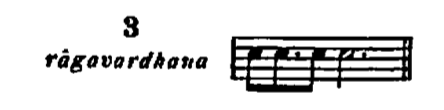
Overview
This chapter introduces the first of Messiaen's non-Western sources: the rhythmic systems of ancient India, particularly the deçî-tâlas catalogued by thirteenth-century theorist Çârngadeva. By analyzing the rāgavardhana rhythm and deriving compositional principles from its structure, Messiaen begins developing his technique of rhythmic transformation and establishes foundations for concepts elaborated in subsequent chapters. The chapter exemplifies his method of historical synthesis—drawing from distant traditions to generate contemporary compositional techniques.
Key Concepts
This chapter introduces four foundational concepts related to Hindu rhythmic systems:
- Ametrical Music - Music organized by precise rhythmic values rather than regular metric framework
- Hindu Rhythmic Systems (Deçî-Tâlas) - The 120 rhythmic patterns catalogued by Çârngadeva
- Rāgavardhana Analysis - Detailed analysis extracting compositional principles from a specific Hindu rhythm
- Prime Number Rhythms - Rhythmic patterns based on prime-number quantities that resist metric division
Ametrical Music
Definition: Music organized by precise rhythmic values and patterns rather than by regular metric framework (measures with recurring accent patterns and equal durational units).
Messiaen's Treatment: Messiaen distinguishes between measured music (organized by bar-lines, regular beats, and metric hierarchy) and ametrical music (organized by exact durational values without recurring metric structures). He advocates replacing conventional metric thinking—concepts of measure and beat—with awareness of short durational values (such as the sixteenth-note) and their free multiplicative combinations. This shift necessitates precise rhythmic rules in place of metric conventions. Messiaen notes that bar-lines in his examples serve only to mark periods or delineate phrase endings and accidentals, not to establish metric accent patterns.
Modern Context: Contemporary music theory distinguishes between metric and ametric organization, recognizing that Western common-practice music privileges metric hierarchy (strong/weak beat organization within measures) while many non-Western traditions and twentieth-century Western composers explore ametric alternatives. Messiaen's position anticipates the development of additive rhythm theory, where durations are conceived as combinations of basic pulse units rather than divisions of metric spans. His approach parallels other modernist rejections of traditional meter (Stravinsky's irregular barring, Varèse's rhythmic blocks, Carter's metric modulation) while grounding this rejection in systematic rules derived from non-Western practice.
The terminology "ametrical" itself requires clarification: Messiaen does not mean rhythmically free or unmeasured (like unmeasured preludes or cadenzas) but rather precisely measured without metric regularity. Contemporary theorists might use terms like "non-isochronous," "additive rhythm," or "asymmetrical rhythm."
Examples: All examples in this chapter demonstrate ametric construction; Example 1 specifically illustrates Stravinsky's ametric procedure.
Hindu Rhythmic Systems (Deçî-Tâlas)
Definition: The collection of 120 rhythmic patterns catalogued by Çârngadeva in his thirteenth-century treatise, representing formalized rhythmic structures from Indian classical music tradition.
Messiaen's Treatment: Messiaen cites Çârngadeva's system as documented in the Encyclopédie de la musique et dictionnaire du conservatoire (Lavignac/Laurencie, 1913–1931), accessing this tradition through French musicological scholarship rather than direct study of Sanskrit sources or performance practice. He focuses specifically on rāgavardhana (number 93 in Çârngadeva's catalogue, though Messiaen references it as connected to number 24, simhavikrîdita).
Messiaen treats these patterns as compositional resources—fixed rhythmic structures that can be analyzed, transformed, and integrated into Western compositional practice. He is interested in their structural properties (augmentation/diminution patterns, retrograde relationships, additive organization) rather than their cultural context, performance tradition, or aesthetic functions within Indian music.
Modern Context: Contemporary ethnomusicology and music theory recognize that Messiaen's engagement with Indian rhythm involves significant recontextualization. The deçî-tâlas function within complex systems of tāla (metric cycles), layakari (tempo relationships), and tihāi (rhythmic cadential formulas) in actual Indian classical practice. Messiaen extracts individual rhythmic patterns from this system and analyzes them through Western concepts (augmentation, diminution, retrograde) that may not align with Indian theoretical categories.
This represents a common pattern in early twentieth-century Western engagement with non-Western music: appropriation of isolated elements rather than systematic understanding of complete musical systems. Later composers and theorists (particularly those studying with Indian musicians directly) developed more nuanced cross-cultural approaches. Nevertheless, Messiaen's Hindu rhythm chapter represents an important early instance of Western art music systematically incorporating non-Western rhythmic resources, influencing subsequent composers like Boulez, Stockhausen, and Xenakis.
Examples: Examples 2–5 analyze rāgavardhana.
Rāgavardhana Analysis
Definition: The specific Hindu rhythm (deçî-tâla) that Messiaen analyzes to extract compositional principles, consisting of a pattern involving quarter-notes, eighth-notes, and dotted values.
Messiaen's Treatment: Messiaen identifies several structural features within rāgavardhana:
-
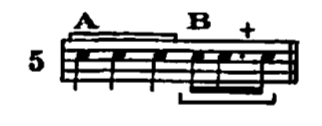
Asymmetrical augmentation/diminution: The rhythm contains both quarter-notes (A) and eighth-notes (B) in the pattern where A undergoes progressive diminution while B remains constant (Example 1, referencing Stravinsky's similar technique with simhavikrîdita).
-
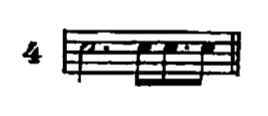
Added values: When reversed (Example 4), the rhythm reveals a classic diminution of three quarter-notes followed by three eighth-notes, but with an added dot on the second eighth-note. This dot—a small added value—disrupts what would otherwise be a straightforward diminution, introducing metric imbalance. This added dot opens the concept of augmentation and diminution through addition or withdrawal of small values (the dot) rather than proportional scaling.
-
Nonretrogradable structure: Fragment B of the rhythm, when isolated, forms a nonretrogradable (palindromic) rhythm—it reads the same forwards and backwards (Example 5).
From these observations, Messiaen extracts three general principles that become fundamental to his rhythmic language:
- Small values can be added to any rhythm to transform its metric balance (developed in Chapter III)
- Rhythms can undergo asymmetrical augmentation/diminution following complex formal patterns (developed in Chapter IV)
- Rhythms impossible to retrograde exist and possess special structural properties (developed in Chapter V)
Modern Context: Contemporary analysis would recognize these as distinct transformational operations on rhythmic structures:
-
Added values represent non-proportional rhythmic transformation—altering duration by addition rather than multiplication. This differs from traditional augmentation (2x, 3x) and diminution (1/2, 1/3), introducing irrational relationships between original and transformed versions.
-
Asymmetrical augmentation/diminution can be understood through transformation theory as partial application of scalar operations—some elements scale while others remain invariant, creating complex proportional relationships.
-
Nonretrogradable rhythms are temporal palindromes, possessing retrograde invariance. Set theory and transformational theory recognize palindromic structures as exhibiting symmetry under retrograde operation (R), where R(x) = x.
Messiaen's analysis method itself deserves note: he reverse-engineers compositional techniques from existing patterns. Rather than accepting rāgavardhana as a complete, culturally-embedded structure, he dissects it to understand how it might have been constructed, then generalizes these constructive principles into compositional rules. This analytical approach—seeking generative processes behind surface patterns—characterizes his entire treatise.
Examples: Examples 2–5 provide the complete analysis: Example 2 presents simhavikrîdita (related pattern), Example 3 presents rāgavardhana itself, Example 4 shows its retrograde revealing the added-value structure, Example 5 isolates the nonretrogradable fragment.
Prime Number Rhythms
Definition: Rhythmic patterns based on prime-number quantities (five, seven, eleven, thirteen, etc.) that inherently resist division into equal metric units.
Messiaen's Treatment: Messiaen briefly notes that the variety found in ancient Greek rhythmic patterns and plainchant neumes instills a predilection for prime-number rhythms. While not developed extensively in this chapter, the reference suggests that prime-numbered groupings—because they cannot be evenly subdivided—naturally produce ametric results and resist metric regularity. This connects to his broader project of destabilizing metric predictability.
Modern Context: Contemporary metric theory recognizes that prime-numbered durations and groupings create metric dissonance when placed against duple or triple metric frameworks. Composers working with additive rhythm (Bartók's "Bulgarian rhythms," Nancarrow's temporal canons, Reich's phase patterns) often employ prime numbers to generate metric complexity and avoid simple periodic structures.
The mathematical properties of prime numbers—their indivisibility—create rhythmic structures that resist metric assimilation. A group of seven cannot be parsed into twos or threes without remainder; a span of eleven pulses cannot align with duple or triple metric frameworks. Messiaen's interest in primes connects to his broader aesthetic of "impossibilities"—structures whose mathematical properties create perceptual and formal consequences.
Examples: This concept is mentioned but not illustrated with specific examples in this chapter.
Relationship to Other Chapters
Chapter II functions as the first technical chapter, establishing principles developed throughout the rhythmic section:
-
Chapter I (Charm of Impossibilities): The discovery of nonretrogradable structure within rāgavardhana exemplifies the first "impossibility" previewed in Chapter I.
-
Chapter III (Rhythms with Added Values): The added dot in rāgavardhana's retrograde leads directly to systematic exploration of added values.
-
Chapter IV (Augmented or Diminished Rhythms): The asymmetrical augmentation/diminution observed in rāgavardhana becomes the basis for more complex proportional transformations.
-
Chapter V (Nonretrogradable Rhythms): Fragment B of rāgavardhana introduces palindromic rhythmic structures, developed comprehensively in Chapter V.
-
Chapter VII (Rhythmic Notations): The notational issues mentioned (precise values, bar-lines marking periods not measures) receive fuller treatment.
Additionally, this chapter establishes Messiaen's method of historical synthesis announced in Chapter I—appropriating techniques from distant traditions (here, thirteenth-century Indian theory) to generate contemporary compositional resources. This same approach governs his treatment of plainchant (Chapter XII) and Debussy (Chapter XIII).
Summary
Chapter II serves multiple functions: it introduces Messiaen's first non-Western source, establishes the principle of ametric organization, and derives three fundamental rhythmic techniques (added values, complex augmentation/diminution, nonretrogradable structures) from analysis of a single Hindu rhythm. The chapter exemplifies Messiaen's analytical method—extracting generative principles from existing patterns—and demonstrates his approach to historical synthesis—appropriating elements from distant traditions as compositional resources. While modern perspectives recognize the limitations of this cross-cultural appropriation (extracting isolated patterns without systematic understanding of their original contexts), the chapter represents an important early instance of Western art music systematically engaging non-Western rhythmic materials. For Messiaen, rāgavardhana functions as a conceptual seed from which major aspects of his rhythmic language germinate, making this brief chapter foundational to the entire rhythmic system developed in Chapters III–VII.
Chapter III: Rhythms with Added Values
Original: Pages 16–17 in Satterfield translation
Musical Examples:

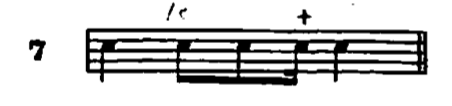
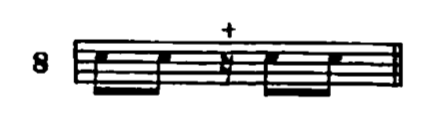
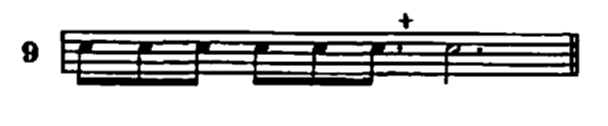
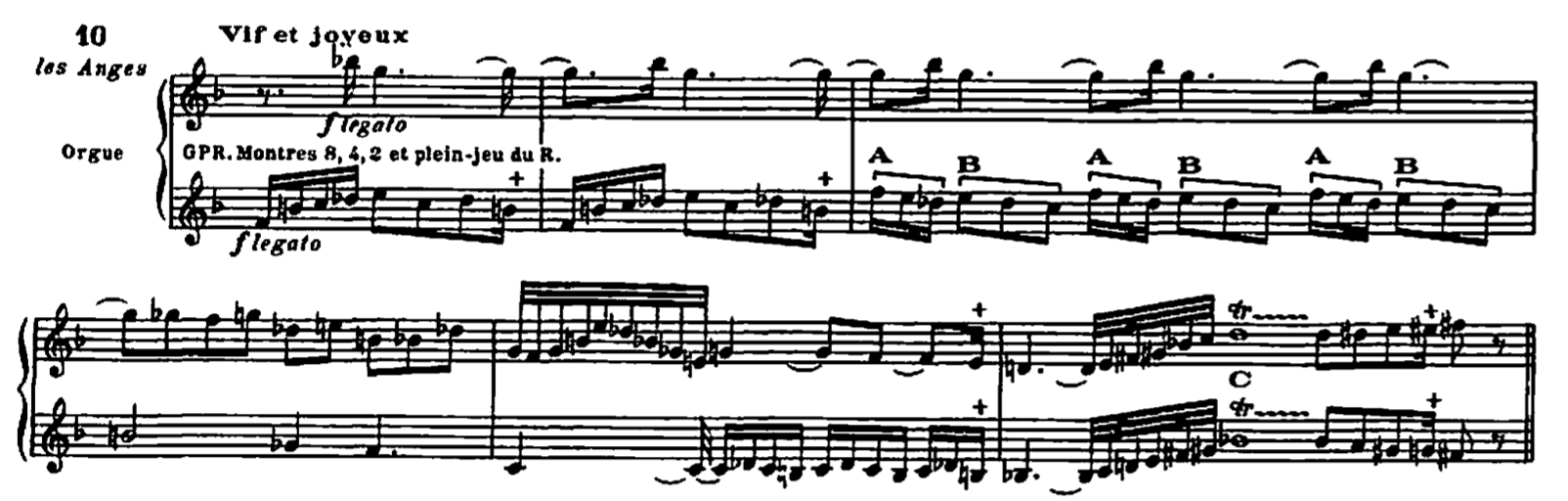

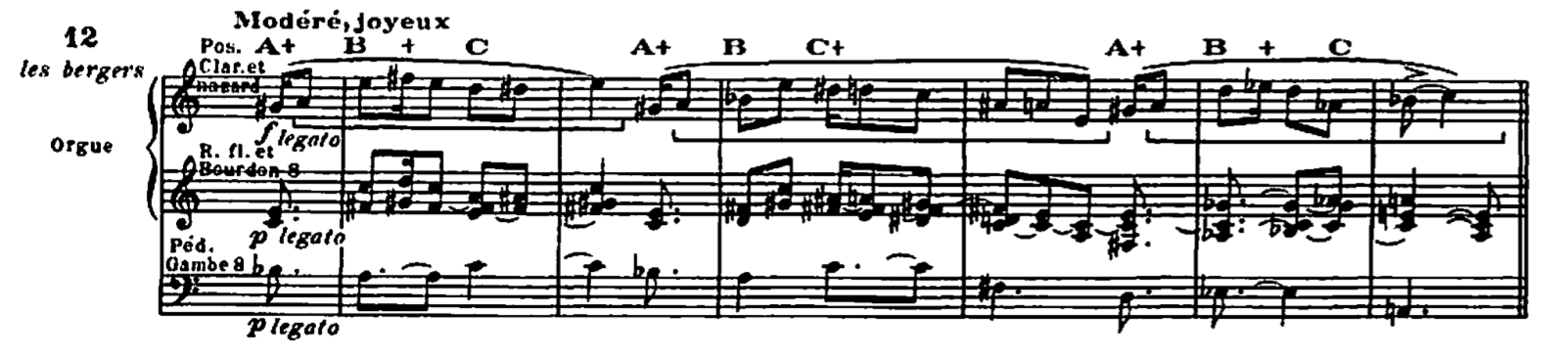
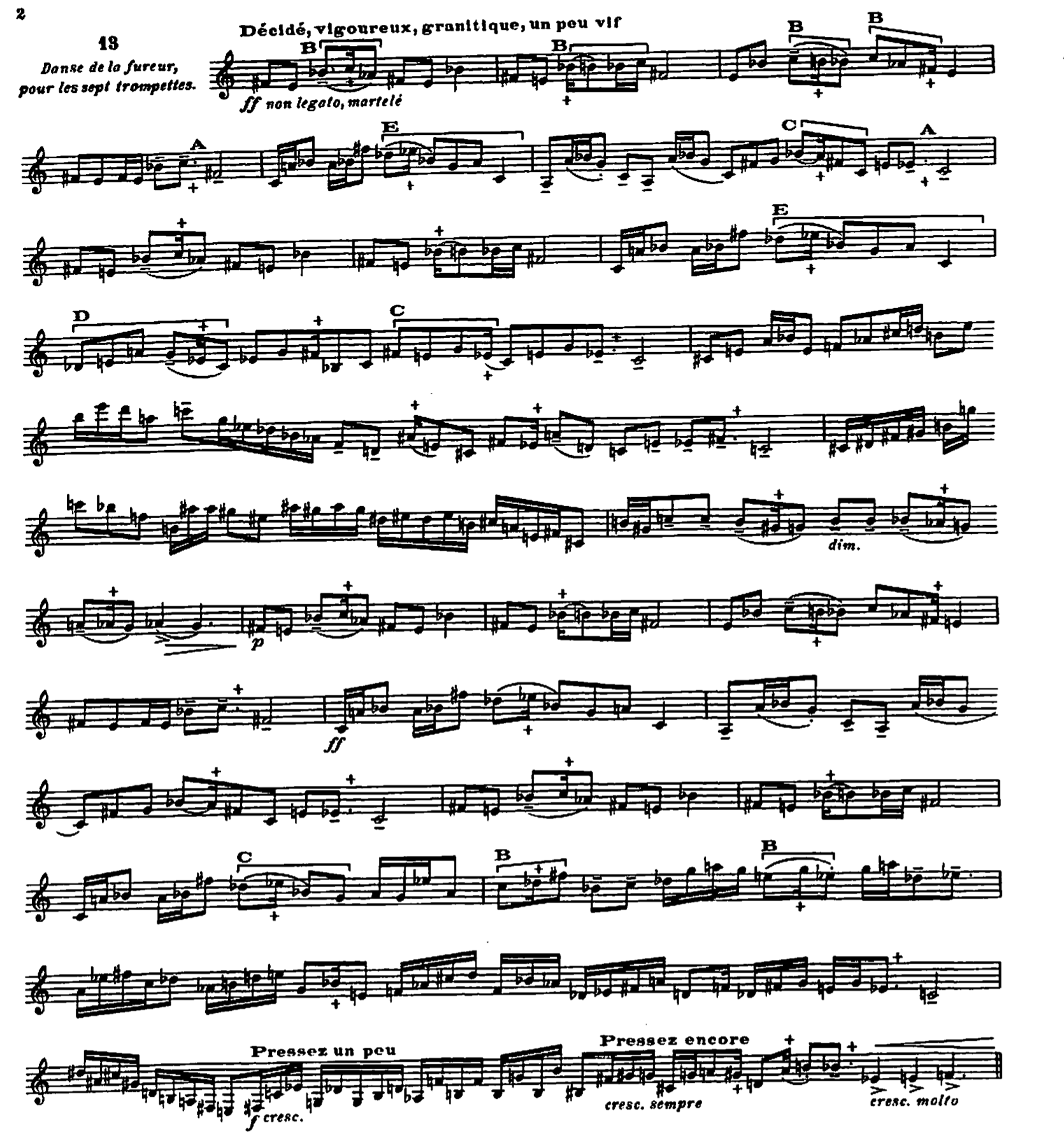
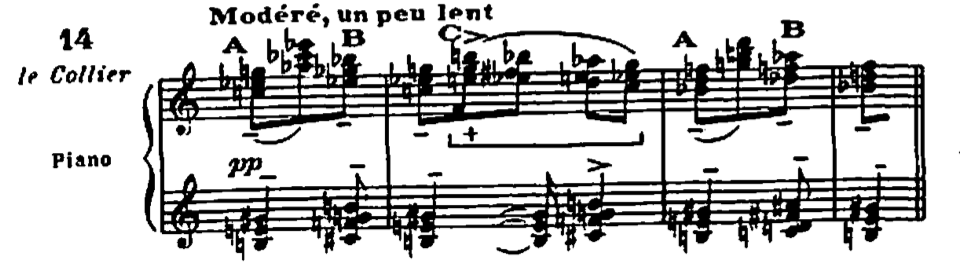
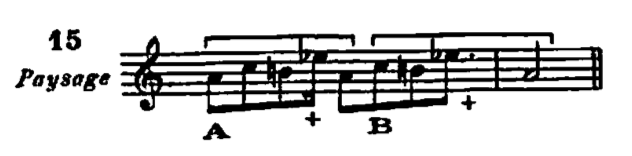



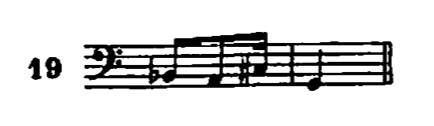
Overview
This chapter systematically develops the technique of added values—one of Messiaen's most characteristic and influential rhythmic innovations. Building directly from the analysis of rāgavardhana in Chapter II, Messiaen transforms the observation of a single added dot into a comprehensive compositional method. The technique involves augmenting rhythmic patterns through the addition of small durational values (notes, rests, or dots) rather than through proportional multiplication. This creates subtle metric disturbances that resist regular periodicity while maintaining rhythmic precision. The chapter also establishes crucial parametric analogies, connecting rhythmic added values to harmonic added notes (developed in Chapter XIII) and to melodic preparations and descents (developed in Chapter XV).
Key Concepts
This chapter introduces four foundational concepts related to rhythmic added values:
- Added Value (Valeur Ajoutée) - Short durational values added to rhythms creating asymmetrical augmentation
- Prime Number Groupings - Rhythmic patterns organized in prime-numbered quantities
- Rhythmic Preparations and Descents - Temporal gestures analogous to melodic upbeats and terminations
- Connection to Added Notes - Parametric analogy between rhythmic added values and harmonic added notes
Added Value (Valeur Ajoutée)
Definition: A short durational value—realized through a note, rest, or dot—added to any rhythm, creating asymmetrical augmentation that disrupts metric regularity without destroying rhythmic definition.
Messiaen's Treatment: Messiaen defines added value through operational procedure: start with a simple, often symmetrical rhythm, then augment it by adding a small value. He demonstrates three mechanisms:
- Addition by note: Insert an additional short note into the rhythmic pattern (Example 7)
- Addition by rest: Insert an additional short rest into the rhythmic pattern (Example 8)
- Addition by dot: Extend one note within the pattern through dotting (Example 9)
Crucially, Messiaen notes that in practice, the original simple rhythm almost never appears unmodified—the added value is present from the outset, not perceived as a subsequent alteration. The analytical separation of "original rhythm" and "added value" represents compositional process, not listener experience. The technique produces rhythmic patterns that suggest regularity but constantly evade it, creating what Messiaen describes as metric imbalance.
The added values are typically small relative to the basic rhythmic unit (often a sixteenth-note added to eighth-note-based patterns) but their placement creates significant perceptual effects—disrupting expected downbeats, extending or compressing phrase lengths, and preventing rhythmic patterns from establishing predictable periodicity.
Modern Context: Contemporary rhythm theory recognizes added values as a species of non-proportional augmentation. Traditional augmentation multiplies all durations by a constant factor (2x, 3x, etc.), producing isomorphic relationships—the augmented version preserves all proportional relationships of the original. Added values create non-isomorphic transformations—the relationship between original and modified versions cannot be expressed as simple scalar multiplication.
This technique anticipates later developments in rhythmic complexity:
- Metric modulation (Elliott Carter): Added values can function as pivot durations enabling tempo/metric shifts
- Irrational rhythms (Ferneyhough, new complexity): Added values represent early exploration of non-integer durational relationships
- Additive processes (Reich, Glass): Though minimalist additive processes operate differently, they share the principle of rhythmic transformation through addition rather than multiplication
The added value technique also relates to rhythmic "spreading" or "deformation"—taking regular patterns and introducing calibrated irregularity. This creates music that hovers between regularity and irregularity, metric and ametric, fostering a particular kind of temporal ambiguity that characterizes much of Messiaen's rhythmic language.
Examples: Examples 6–9 demonstrate basic added value operations; subsequent examples (10–19) show applications in musical contexts.
Prime Number Groupings
Definition: Rhythmic patterns organized in prime-numbered quantities (five, seven, eleven, thirteen, etc.) that inherently resist subdivision into equal metric units.
Messiaen's Treatment: Throughout the chapter's examples, Messiaen consistently employs prime-number groupings. Example 10 features five eighth-notes plus a sixteenth-note (added value). Example 13 references the sixth mode of limited transpositions with rhythmic divisions of seven eighth-notes, eight eighth-notes, and seven eighth-notes—where the sevens represent prime groupings complicated by added values. The fragment from Quatuor pour la fin du Temps (Example 13) demonstrates added values creating groups of five, seven, eleven, and thirteen sixteenth-notes.
Messiaen explicitly connects prime numbers to his "predilection for these numbers" mentioned in Chapter II. Prime-numbered groups resist metric assimilation because they cannot be evenly divided—a span of seven cannot be organized into twos or threes without remainder, preventing easy metric parsing and reinforcing ametric character.
Modern Context: Contemporary metric theory analyzes prime-numbered groupings through concepts of metric consonance and dissonance (Lerdahl/Jackendoff) and non-isochronous periodicity (London). Prime numbers create maximal metric dissonance when set against duple or triple metric frameworks—they share no common factors, preventing alignment.
Composers working with additive rhythm frequently exploit prime numbers: Bartók's "Bulgarian rhythms" (2+2+3, 2+3+2, 3+2+2), Nancarrow's temporal canons with prime-number ratios, and Xenakis's stochastic distributions often emphasize prime-numbered structures. The mathematical indivisibility of primes translates to rhythmic structures that resist reduction to simpler metric schemes, maintaining complexity and avoiding predictable periodicity.
Examples: Example 10 (five plus one), Example 13 (five, seven, eleven, thirteen).
Rhythmic Preparations and Descents
Definition: Temporal gestures in which a rhythmic preparation precedes an accent and a rhythmic descent follows it, analogous to melodic upbeats and terminations.
Messiaen's Treatment: Messiaen establishes an explicit parametric analogy between melodic and rhythmic domains. Just as melodies employ upbeats (anacrusis, preparation) leading to strong notes and terminations (descents) following them, rhythms can employ temporal preparations before accented moments and temporal descents after them. Added values modify the character of these preparations and descents:
- Elongated preparations: Adding values to preparatory figures stretches the approach to the accent, increasing tension or anticipation (Examples 12, 14, 17)
- Slackened descents: Adding values to descending figures extends their penultimate notes, retarding resolution and prolonging the descent (Examples 12, 13, 15, 16, 17)
- Retarded final descents: Adding values to final descending gestures can cause them to lose momentum, creating endings that dissipate rather than conclude forcefully (Examples 18–19)
Messiaen demonstrates that added values transform not merely the durational profile of these gestures but their rhetorical character—affecting force, grandeur, serenity, and overall phrase shape. A descent that would normally conclude decisively can, through tripling of its penultimate value (Example 18), lose force and finish with diminished energy.
Modern Context: This concept represents rhythmic application of concepts traditionally associated with melody and harmony. Contemporary theory recognizes this as cross-parametric mapping—transferring structural functions from one musical dimension to another.
The preparation-accent-descent model derives from traditional phrase theory (antecedent-consequent, tension-resolution) but Messiaen applies it specifically to temporal organization rather than tonal relationships. This anticipates later work on musical gesture and phrase rhythm (Berry, Rothstein, Hasty) that analyzes temporal shape independent of harmonic function.
The analogy also connects to Messiaen's broader systematic thinking: operations applicable in one domain find parallel application in others. This same analogical method governs his treatment of added rhythmic values and added harmonic notes (Chapter XIII), polyrhythm and polymodality (Chapters VI and XIX), and ultimately links all parameters of his musical language.
Examples: Examples 12–19 demonstrate various applications to preparations and descents, with Examples 18–19 showing extreme retardation of final descents.
Connection to Added Notes
Definition: The parametric analogy between rhythmic added values and harmonic added notes—both techniques involve augmentation through addition rather than substitution or multiplication.
Messiaen's Treatment: Messiaen explicitly recalls Chapter I's promise to relate values added to rhythms with notes added to chords, stating this relationship will receive fuller treatment in Chapter XIII. The analogy operates at multiple levels:
- Operational parallel: Just as a simple rhythm receives additional durational values, a simple chord receives additional pitch-classes
- Perceptual parallel: Just as added values create metric imbalance, added notes create harmonic ambiguity or enrichment
- Aesthetic parallel: Both techniques produce complexity through augmentation rather than through fundamental alteration of basic structures
The added note technique (developed fully in Chapter XIII on Debussy's harmony) involves taking triadic or seventh-chord structures and adding foreign tones that become integral coloristic elements rather than dissonances requiring resolution. Similarly, added values augment rhythmic structures without functioning as embellishments to be eliminated—they are constitutive of the rhythm's identity.
Modern Context: This parametric analogy represents Messiaen's systematic approach to musical language—conceiving rhythm, melody, and harmony as domains governed by parallel principles rather than as independent parameters requiring separate theoretical frameworks.
Contemporary music theory recognizes such analogies through concepts of:
- Transformational isomorphism: Operations in different domains sharing mathematical structure
- Cross-domain mapping: Systematic relationships between parametric spaces
- Unified compositional systems: Theoretical frameworks applying consistent operations across multiple musical dimensions (serial technique, spectralism, etc.)
Messiaen's added value/added note analogy anticipates integral serialism's application of serial operations to rhythm, dynamics, articulation, and other parameters beyond pitch. However, Messiaen's approach remains less systematic—he identifies suggestive parallels rather than enforcing strict isomorphisms.
Examples: Harmonic examples appear in Chapter XIII; rhythmic examples throughout Chapter III suggest the analogy.
Relationship to Other Chapters
Chapter III occupies a central position in Messiaen's rhythmic theory and extends its influence into harmonic domains:
-
Chapter I (Charm of Impossibilities): The preview of the relationship between added rhythmic values and added harmonic notes is fulfilled here and in Chapter XIII.
-
Chapter II (Rāgavardhana): The added dot observed in rāgavardhana's retrograde (Example 4 of Chapter II) provides the conceptual seed for the entire added value technique.
-
Chapter IV (Augmented or Diminished Rhythms): Added values represent one type of rhythmic transformation; Chapter IV explores proportional augmentation/diminution, creating complementary approaches to rhythmic modification.
-
Chapter V (Nonretrogradable Rhythms): Added values can be incorporated into palindromic structures, affecting their symmetrical properties.
-
Chapter VI (Polyrhythm): Added values create temporal complexity within single rhythmic layers; polyrhythm creates complexity through simultaneous independent layers—complementary approaches to rhythmic density.
-
Chapter XIII (Harmony, Debussy, Added Notes): The parametric analogy established here receives full harmonic development—added values find their vertical counterpart in added sixth, ninth, eleventh, and thirteenth chords.
-
Chapter XV (Enlargement of Foreign Notes, Upbeats, Terminations): The discussion of rhythmic preparations and descents in this chapter connects to melodic upbeats and terminations in Chapter XV, demonstrating Messiaen's cross-parametric thinking.
The added value technique also influences Messiaen's actual compositional practice extensively. Many of his most characteristic rhythmic gestures employ added values, and the technique becomes central to his mature rhythmic language in works like Vingt regards sur l'enfant-Jésus, Turangalîla-Symphonie, and the late organ works.
Summary
Chapter III transforms an analytical observation from Chapter II into a comprehensive compositional technique. The added value method—augmenting rhythms through addition of small durational values rather than proportional multiplication—provides Messiaen with a systematic means of creating rhythmic complexity that resists metric regularity while maintaining precise organization. The chapter's significance extends beyond the specific technique: it demonstrates Messiaen's method of parametric analogy (connecting rhythmic and harmonic domains), his integration of prime-number groupings with added values, and his conception of rhythm as possessing gestural shapes (preparations, accents, descents) parallel to melodic structures. The added value technique becomes one of Messiaen's most recognizable innovations, influencing subsequent generations of composers and establishing a model for non-proportional rhythmic transformation.
For contemporary readers, the chapter illustrates how systematic compositional thinking can generate rich musical surfaces from simple operational principles—adding small values creates metric ambiguity, temporal elasticity, and rhythmic character that distinguishes Messiaen's music from both metric regularity and unmeasured freedom.
Chapter IV: Augmented or Diminished Rhythms and a Table of These Rhythms
Original: Pages 18–19 in Satterfield translation
Musical Examples:



Overview
This chapter complements Chapter III by exploring proportional rhythmic transformations—traditional augmentation and diminution—alongside their interaction with added values. Where Chapter III addressed non-proportional transformation through addition or subtraction of small durational increments, Chapter IV examines multiplicative scaling of rhythmic patterns. Messiaen develops a systematic taxonomy of augmentation and diminution procedures, presents them in tabular form for compositional reference, and introduces the concept of inexact augmentation where multiple rhythmic layers undergo different rates of transformation simultaneously. The chapter demonstrates that proportional and non-proportional transformations can combine to create complex rhythmic variants, and shows how extreme augmentation or diminution can generate either very long values (approaching stasis) or very short values (approaching perceptual limits).
Key Concepts
This chapter introduces four foundational concepts related to proportional rhythmic transformations:
- Classical Augmentation and Diminution - Proportional scaling of rhythmic patterns by constant multiplicative factors
- Addition and Withdrawal of the Dot - Hybrid transformation combining proportional scaling with non-proportional modification
- Systematic Table of Augmentation and Diminution Forms - Comprehensive taxonomy of transformation procedures
- Inexact Augmentations - Simultaneous layers undergoing different rates of transformation
Classical Augmentation and Diminution
Definition: Proportional scaling of all durational values in a rhythmic pattern by a constant multiplicative factor, preserving the pattern's internal proportional relationships while changing its absolute temporal span.
Messiaen's Treatment: Messiaen positions classical augmentation and diminution as one approach among many for rhythmic transformation. He references Bach's practice in canonic writing—thematic material systematically doubled (augmentation) or halved (diminution)—but treats this as a foundation to be extended rather than a complete method.
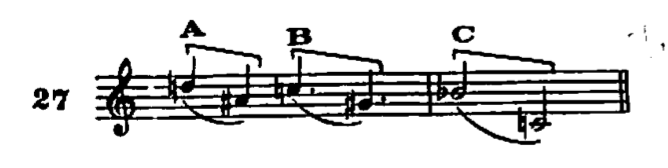
In Messiaen's taxonomy, classical augmentation appears as one option: addition of the values to themselves (2x multiplication). Example 20 demonstrates this clearly: rhythm A spans five sixteenth-notes, rhythm B (augmentation of A) spans five eighth-notes (each value doubled), rhythm C spans five quarter-notes (varied double augmentation, where values are quadrupled). The statement of the rhythm followed immediately by its augmentation or diminution creates a particular temporal effect—recognition of the same pattern at different time-scales.
Messiaen notes that augmentation can occur in more complex forms beyond simple doubling, and that diminution permits inverse operations (halving, but also reduction by other factors). The key characteristic of classical augmentation/diminution is proportional uniformity—all elements scale by the same factor, maintaining rhythmic Gestalt while altering tempo or time-scale.
Modern Context: Contemporary music theory recognizes proportional augmentation/diminution as rhythmic transformation preserving similarity under scaling. In mathematical terms, these operations constitute similarity transformations in the temporal domain—the rhythmic contour remains invariant (all proportional relationships preserved) while absolute magnitude changes.
This relates to:
- Metric modulation: Elliott Carter's technique of using augmentation/diminution ratios to pivot between tempi
- Temporal perception: Psychoacoustic research on rhythm recognition across different time-scales (rhythms remain recognizable when proportionally scaled within certain limits)
- Canonic technique: Renaissance and Baroque canons per augmentationem and per diminutionem represent historical precedents
- Fractal rhythms: Self-similar temporal structures at multiple scales (explored by composers like Ligeti and Ferneyhough)
Messiaen's innovation lies not in the technique itself—which has deep historical roots—but in systematizing it alongside non-proportional transformations (added values) and partial applications (inexact augmentations), creating a comprehensive toolkit of rhythmic transformation procedures.
Examples: Example 20 demonstrates simple, varied, and complex augmentation.
Addition and Withdrawal of the Dot
Definition: A hybrid transformation combining proportional scaling with non-proportional modification, achieved by adding dots to (or removing dots from) note values during augmentation or diminution.
Messiaen's Treatment: Messiaen identifies augmentation by dot addition and diminution by dot withdrawal as particularly interesting procedures. Example 21 demonstrates augmentation by dotting: a simple rhythm in part A receives dots on all notes in part B, creating an augmentation that multiplies values by 1.5 (the effect of dotting) rather than by 2 (simple doubling). This represents a middle ground between identity and classical augmentation. The cross marking indicates the added value component.
Example 22 shows the inverse: diminution by dot withdrawal. A dotted rhythm loses its dots, reducing each value to two-thirds of its original duration (since a dotted value equals 1.5× the undotted value, removing the dot creates a 2/3 reduction).
This technique demonstrates Messiaen's systematic thinking: if dots can be added to create added values (Chapter III), and if rhythms can be proportionally scaled (classical augmentation/diminution), then dots can be added or removed as part of the scaling process, creating proportional transformations that are not integer multiples. The 1.5× and 0.667× ratios create intermediate degrees of augmentation and diminution unavailable through simple doubling or halving.
Modern Context: Contemporary theory would recognize these as rational (but non-integer) augmentation/diminution ratios. The transformation factor of 3:2 (dotted to undotted) or 2:3 (undotted to dotted) creates proportional relationships analogous to the sesquialtera proportion in Renaissance mensural theory.
This anticipates later explorations of:
- Irrational rhythms: Non-integer proportional relationships (triplets, quintuplets, septuplets against regular divisions)
- Tempo relationships: Complex ratios between simultaneous tempi or between sections
- Proportional notation: Scores specifying durations through spatial relationships rather than conventional note values
The dot addition/withdrawal technique also connects to Messiaen's added value concept—the dot functions simultaneously as a proportional multiplier (1.5×) and as an added small value (half the original note's duration). This dual nature makes dotting a bridge between proportional and additive transformation logics.
Examples: Example 21 (augmentation by dot addition), Example 22 (diminution by dot withdrawal).
Systematic Table of Augmentation and Diminution Forms
Definition: A comprehensive taxonomy of rhythmic transformation procedures organized by transformation type and degree, providing a compositional reference for generating rhythmic variants.
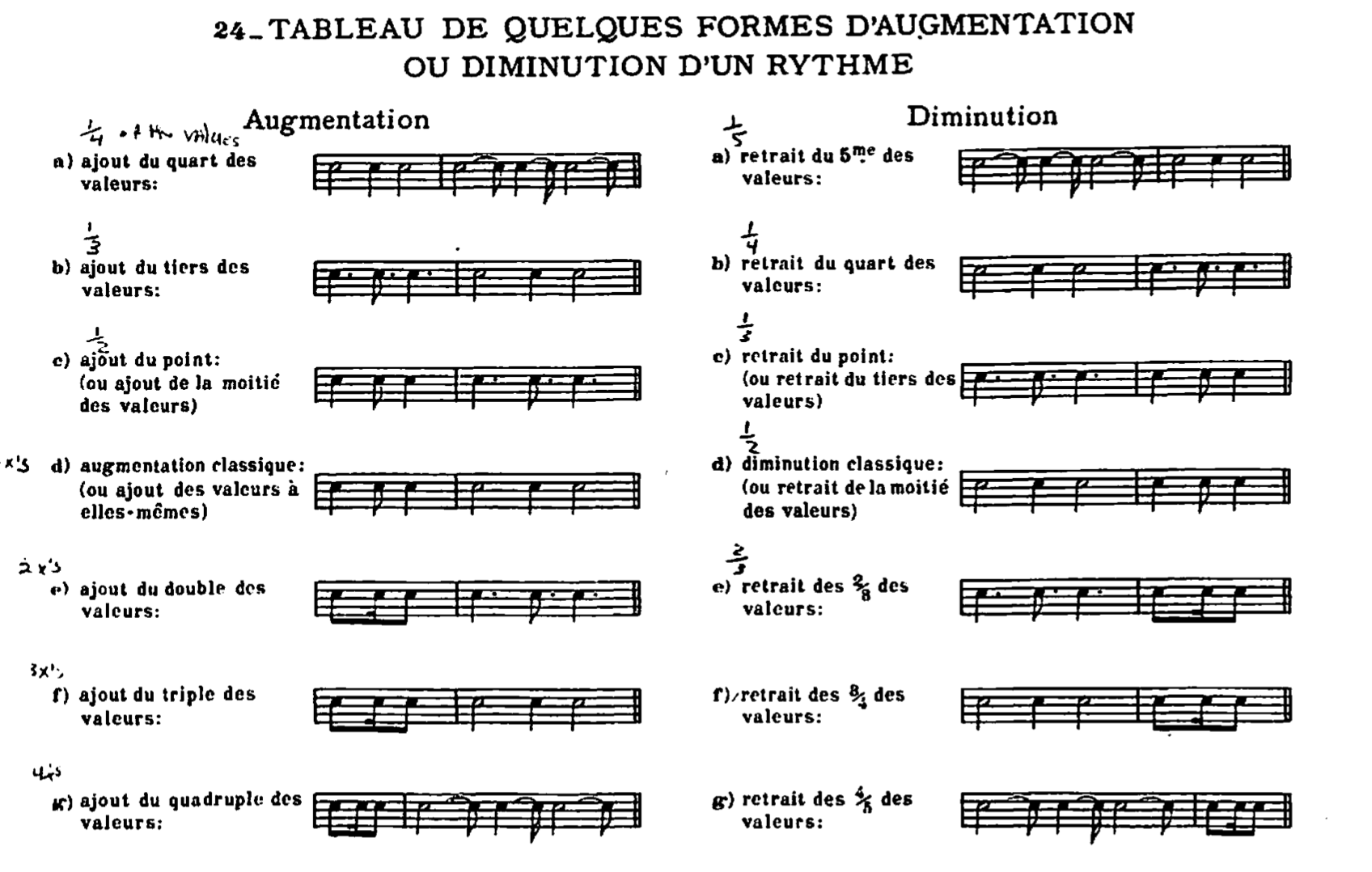
Messiaen's Treatment: Messiaen constructs a table cataloguing multiple augmentation and diminution procedures applied to a single initial rhythm (long, short, long). The table systematizes transformation options:
Augmentation procedures:
- a) Addition of a quarter of the values (1.25× multiplication)
- b) Addition of a third of the values (1.333× multiplication)
- c) Addition of the dot / addition of half the values (1.5× multiplication)
- d) Classic augmentation / addition of values to themselves (2× multiplication)
- e) Addition of twice the values (3× multiplication)
- f) Addition of three times the values (4× multiplication)
- g) Addition of four times the values (5× multiplication)
Diminution procedures (inverse operations):
- a) Withdrawal of a fifth of the values (0.8× multiplication)
- b) Withdrawal of a quarter of the values (0.75× multiplication)
- c) Withdrawal of the dot / withdrawal of a third of the values (0.667× multiplication)
- d) Classic diminution / withdrawal of half the values (0.5× multiplication)
- e) Withdrawal of two-thirds of the values (0.333× multiplication)
- f) Withdrawal of three-fourths of the values (0.25× multiplication)
- g) Withdrawal of four-fifths of the values (0.2× multiplication)
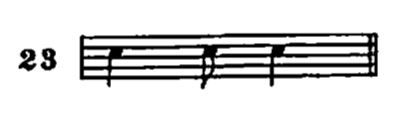
Each row shows the original rhythm, then the transformation—organized to facilitate quick reference during composition. Examples 23–24 illustrate the table's application: each entry on the left shows the normal rhythm then its augmentation; each entry on the right shows the normal rhythm then its diminution.
Messiaen notes that he limits the table to avoid excessively long or short values that would be impractical—extreme augmentation produces values approaching stasis, extreme diminution produces values approaching the limits of performability and perceptibility. He bases all transformations on the same initial rhythm to demonstrate the range of variants obtainable from a single source.
Modern Context: This table represents an early instance of systematic transformation cataloguing in twentieth-century composition. Similar systematic approaches appear in:
- Serial technique: Matrices cataloguing all transpositions, retrogrades, inversions, and retrograde-inversions of tone rows
- Transformation theory: David Lewin's formalization of musical transformations as mathematical operations
- Compositional algorithms: Computer-assisted composition using transformation tables and rules
The table also reflects Messiaen's pedagogical orientation—his treatise functions as a composition manual, not merely theoretical description. The systematic presentation invites composers to use the table as a reference, selecting transformation degrees appropriate to specific compositional situations.
The choice of transformation factors (quarters, thirds, halves, doubles, triples, etc.) reflects common mathematical ratios and their musical practicality. These ratios appear frequently in music: 1.5× (dotted notes), 2× (octave doubling, augmentation), 3× (triple meter relationships), etc. Messiaen's systematization makes explicit what composers might approach intuitively.
Examples: Examples 23–24 demonstrate multiple transformations from the table.
Inexact Augmentations
Definition: Simultaneous rhythmic layers undergoing different rates of augmentation or diminution, creating complex proportional relationships between voices rather than uniform scaling across all parts.
Messiaen's Treatment: Messiaen distinguishes inexact augmentation from classical canonic technique. In Bach's canons, when one voice presents augmented material, the augmentation applies uniformly—all voices involved in the augmentation scale by the same factor. In inexact augmentation, different rhythmic streams scale independently and by different factors.
Example 25 demonstrates: rhythm B represents inexact augmentation of rhythm A, where the expected augmentation would produce a dotted quarter-note but Messiaen presents something else. Example 26 shows another instance where the normal augmentation would be straightforward doubling, but inexact augmentation produces different results.
Example 27 presents a more complex case: at the cross marking, an added value appears; rhythm B augments rhythm A while rhythm C simultaneously augments rhythm B. The normal augmentation would follow specific proportions, but inexact augmentation allows independent scaling.
Messiaen notes that very inexact augmentations or diminutions eventually create rhythmic variants rather than true augmentations—when the proportional relationships depart significantly from simple ratios, the connection to the original rhythm becomes attenuated, and the result functions as a new, independent rhythmic pattern rather than a clear transformation of the source.
Modern Context: Inexact augmentation anticipates several later developments:
- Polytempo music: Simultaneous layers at different, often incommensurable tempi (Ives, Nancarrow, Stockhausen's Gruppen)
- Metric modulation networks: Carter's technique of independent tempo streams modulating at different rates
- Temporal canons: Canons where voices proceed at different tempi, creating complex phase relationships (Nancarrow's player piano studies)
- Spectral rhythm: Grisey and Murail's application of spectral proportions to temporal organization
Contemporary music theory recognizes that inexact augmentation creates what might be termed "deformed similarity"—the transformed version maintains some but not all proportional relationships with the original. This generates intermediate states between repetition (exact transformation) and variation (free departure).
Messiaen's observation that extreme inexactness produces variants rather than augmentations proper raises fundamental questions about rhythmic identity and transformation: at what point does a transformation become so extreme that it severs the perceptual/structural connection to its source? This parallels debates in pitch theory about the limits of motivic transformation and variation.
Examples: Examples 25–27 demonstrate various degrees of inexact augmentation, with Example 27 also incorporating added values (Chapter XIII reference indicates harmonic context).
Relationship to Other Chapters
Chapter IV complements and extends earlier rhythmic chapters while setting up later developments:
-
Chapter II (Rāgavardhana): The asymmetrical augmentation/diminution observed in simhavikrîdita (Example 1 of Chapter II) prefigures inexact augmentation—one element scales while another remains invariant.
-
Chapter III (Added Values): This chapter presents proportional transformation as a complement to Chapter III's non-proportional transformation. The two techniques combine in dot addition/withdrawal procedures and in examples incorporating both augmentation and added values (Example 27).
-
Chapter V (Nonretrogradable Rhythms): Augmentation and diminution can apply to palindromic rhythms, preserving their retrograde invariance while changing their time-scale.
-
Chapter VI (Polyrhythm): Inexact augmentation creates a specific type of polyrhythmic texture—simultaneous layers at different time-scales or rates of transformation.
-
Chapter VII (Rhythmic Notations): Practical issues of notating extreme augmentations or diminutions, and representing inexact augmentations clearly, relate to notational concerns addressed in Chapter VII.
-
Chapter XIII (Harmony, Debussy, Added Notes): Example 27 references the six-four chord with added sixth and augmented fourth, demonstrating interaction between rhythmic and harmonic transformation techniques. The analogy between rhythmic augmentation/diminution and harmonic expansion/contraction extends the parametric thinking established in Chapters I and III.
The table format itself becomes a model for systematic presentation—later chapters may employ similar cataloguing approaches for other techniques.
Summary
Chapter IV systematizes proportional rhythmic transformation, distinguishing it from the non-proportional added values technique of Chapter III while showing how both approaches can combine. By cataloguing multiple augmentation and diminution ratios in tabular form, Messiaen provides composers with a practical reference for generating rhythmic variants at different time-scales. The introduction of inexact augmentation—where simultaneous rhythmic layers scale at different rates—extends transformation thinking beyond uniform operations to complex proportional relationships. The chapter demonstrates Messiaen's characteristic method: taking a traditional technique (classical augmentation/diminution from canonic practice), systematizing its possibilities, extending it through combination with other techniques (added values, inexact scaling), and presenting the results as a compositional toolkit. For contemporary readers, the chapter illustrates how systematic transformation thinking can generate rich rhythmic variety from single source patterns, and how proportional and non-proportional transformation logics can interact.
The table of augmentation and diminution forms represents an early instance of algorithmic thinking in composition—explicitly cataloguing transformation operations as a menu of compositional options. Together with Chapter III, this chapter establishes Messiaen's comprehensive approach to rhythmic transformation: addition/subtraction of small values (non-proportional) and multiplication/division by various factors (proportional), both applicable individually and in combination to generate temporal complexity while maintaining structural coherence.
Chapter V: Nonretrogradable Rhythms
Original: Pages 20–21 in Satterfield translation
Musical Examples:


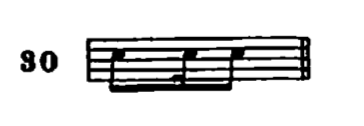


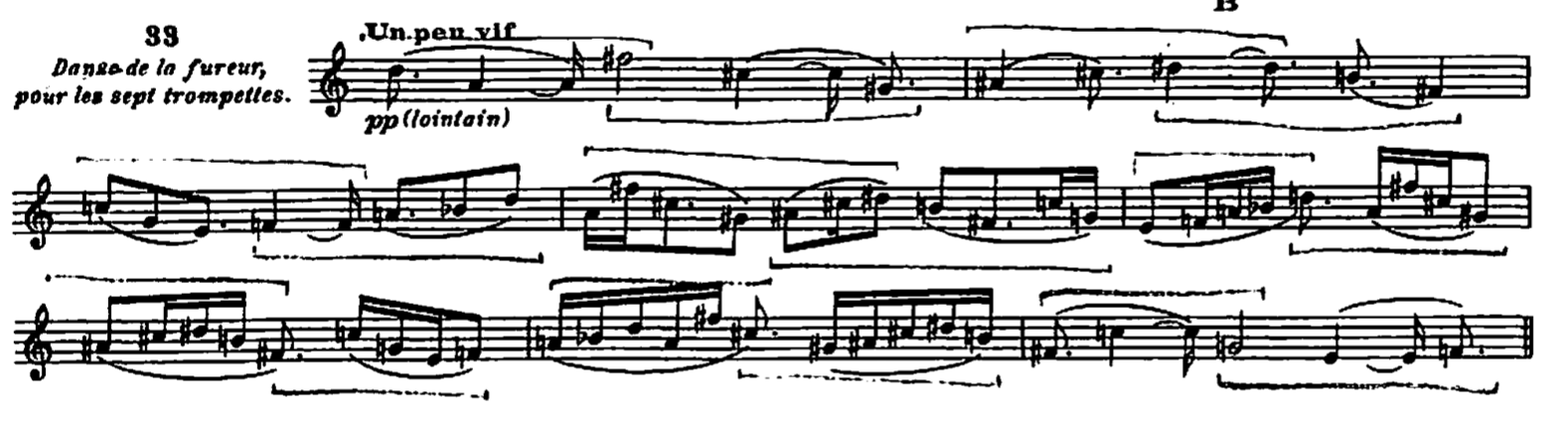

Overview
This chapter develops the first of Messiaen's two central "impossibilities" announced in Chapter I—rhythmic structures that cannot be retrograded because they are palindromic, reading identically forwards and backwards. Building from the nonretrogradable fragment discovered within rāgavardhana (Chapter II), Messiaen systematizes the construction of temporal palindromes and establishes their crucial relationship to the modes of limited transposition. The chapter articulates the fundamental analogy undergirding his entire system: nonretrogradable rhythms realize in the horizontal (temporal) direction what modes of limited transposition realize in the vertical (pitch) direction—both are symmetrical structures whose internal organization prevents certain transformations, creating the "charm of impossibilities." This chapter also reveals Messiaen's theological aesthetic, arguing that these mathematical impossibilities produce perceptual effects of tonal ubiquity, temporal unity, and ultimately spiritual transcendence.
Key Concepts
This chapter introduces four foundational concepts related to nonretrogradable rhythms:
- Retrograde Rhythms - Temporal reversal of rhythmic patterns creating inversions in the temporal domain
- Nonretrogradable Rhythms (Palindromic Rhythms) - Symmetrical structures that read identically forwards and backwards
- Relation of Nonretrogradable Rhythms and Modes of Limited Transpositions - Fundamental analogy between temporal and pitch-class symmetries
- Central Common Values - Pivot points serving as axes of symmetry in palindromic structures
Retrograde Rhythms
Definition: The temporal reversal of a rhythmic pattern, reading from right to left what would normally be read from left to right, creating an inversion in the temporal domain analogous to horizontal reflection.
Messiaen's Treatment: Messiaen begins by establishing retrograde as a standard contrapuntal procedure that, when applied to rhythm alone, produces curious value reversals. Example 28 presents a complex rhythmic formula combining augmented rhythms, added values, inexact augmentations and diminutions, and interpretation of rāgavardhana—a typical instance of his rhythmic practice incorporating multiple techniques simultaneously. The total duration spans thirteen quarter-notes (a prime number). Within this formula, all fragment B elements represent diminution or augmentation of fragment A elements, and added values appear at cross markings.
Example 29 demonstrates the formula's retrograde: the order of values completely reverses, with diminutions becoming augmentations and vice versa. This transformation illustrates that retrograde operation on complex rhythms produces substantial reorganization—what was initially a diminution of some element becomes an augmentation in retrograde form, creating a new rhythmic character while preserving (in reverse) the original's durational sequence.
Messiaen notes that Chapter VI will explore superposition of a rhythm upon its retrograde, creating a particular species of polyrhythmic texture where forward and backward versions of the same material sound simultaneously.
Modern Context: Retrograde represents one of the classical contrapuntal transformations, historically applied primarily to pitch sequences (cancrizans or crab canon) but applicable to any ordered sequence. Contemporary music theory recognizes retrograde as a member of the standard transformational set: transposition (T), inversion (I), retrograde (R), and retrograde-inversion (RI).
In twelve-tone technique, retrograde forms are systematically catalogued in the tone row matrix alongside prime, inversion, and retrograde-inversion forms. Messiaen's application of retrograde to rhythm alone—independent of pitch retrograde—represents a parametric separation characteristic of his approach: each musical dimension (rhythm, pitch, harmony) can undergo independent transformations.
The observation that retrograde operation reverses augmentation/diminution relationships has implications for rhythmic perception: retrograded rhythms may sound qualitatively different even when their durational sequences are preserved (in reverse order), since the temporal trajectory—whether values are expanding or contracting—affects perception of phrase shape and direction.
Examples: Examples 28–29 demonstrate a complex rhythmic formula and its retrograde.
Nonretrogradable Rhythms (Palindromic Rhythms)
Definition: Rhythmic structures that, due to symmetrical organization around a central value, read identically forwards and backwards, possessing retrograde invariance such that the retrograde operation produces the original pattern.
Messiaen's Treatment: Messiaen defines nonretrogradable rhythms through their defining property: whether read from right to left or left to right, the order of values remains identical. Example 30 provides the simplest instance: outer values identical, middle value free. This creates a three-element palindrome (A-B-A) where the outer values frame a central pivot.
Example 31 demonstrates that all three-value rhythms disposed in this manner (outer values identical, middle value free) are inherently nonretrogradable. The principle extends beyond three values: any rhythm divisible into two groups where one group is the retrograde of the other, with a central common value connecting them, creates a nonretrogradable structure (Example 32).
Example 32 shows a longer nonretrogradable rhythm where group B retrogrades group A, and a quarter tied to a sixteenth-note (a central value whose duration equals five sixteenth-notes) serves as the pivot connecting the two mirrored groups. Example 33 demonstrates a succession of nonretrogradable rhythms, showing how these structures can be deployed sequentially, and Example 34 presents a melodic movement that undergoes important rhythmic variants while maintaining nonretrogradable properties.
The construction principle is architectural: build outward from a central value (or central point between two values), adding durational values symmetrically to create mirrored wings. The central value functions as an axis of symmetry—values at equal distances from this axis must be identical for the structure to remain palindromic.
Modern Context: Contemporary music theory recognizes nonretrogradable rhythms as temporal palindromes—structures exhibiting bilateral symmetry in the time domain. These can be analyzed through:
- Symmetry operations: Nonretrogradable rhythms are invariant under retrograde transformation R, where R(x) = x. This represents a fixed point under R.
- Group theory: Palindromic structures form a subset of all rhythmic structures closed under retrograde operation, constituting a mathematical subgroup.
- Formal linguistics: Palindromes appear across multiple domains (words, DNA sequences, visual patterns) as instances of mirror symmetry, suggesting deep cognitive and aesthetic significance.
Nonretrogradable rhythms relate to other palindromic musical structures:
- Pitch palindromes: Melodic lines that retrograde themselves (though these are rarer due to harmonic implications)
- Formal palindromes: Arch forms (ABCBA) in larger-scale structures (Bartók, Berg)
- Harmonic palindromes: Chord progressions that mirror themselves (I-IV-V-IV-I)
The aesthetic and perceptual properties of palindromes have long fascinated composers. Palindromic structures can create:
- Temporal stasis: The absence of directional motion (no beginning vs. ending)
- Formal balance: Perfect symmetry suggesting completion and closure
- Perceptual ambiguity: Difficulty determining temporal direction when listening
Messiaen explicitly connects palindromic structure to aesthetic effect: the "charm of impossibilities" derives partly from the perceptual peculiarity of structures that sound the same regardless of temporal direction, suggesting a music outside normal temporal flow.
Examples: Examples 30–34 demonstrate various nonretrogradable constructions from simple to complex.
Relation of Nonretrogradable Rhythms and Modes of Limited Transpositions
Definition: The fundamental analogy between temporal (horizontal) and pitch (vertical) symmetries in Messiaen's system, establishing that nonretrogradable rhythms and modes of limited transposition are parallel manifestations of the same mathematical principle operating in different musical dimensions.
Messiaen's Treatment: This section articulates the core theoretical insight of Messiaen's treatise. He recalls Chapter I's promise to examine the relationship between these two impossibilities and provides the systematic explanation:
Modes of limited transposition cannot be transposed beyond a certain number of positions without returning to the same pitch-class content because they lack polytonality—they exist in the modal atmosphere of several keys simultaneously and contain within themselves small transpositions. These modes cannot be transposed because they are, in a sense, already in multiple keys at once through their symmetrical construction.
Nonretrogradable rhythms cannot be retrograded because they contain within themselves small retrogradations—the internal mirroring means that retrograding the whole produces the same pattern, since local retrograde relationships are already built into the structure.
The analogy operates precisely:
- Modes of limited transposition: Symmetry in the vertical direction (pitch-class space) → transpositional limitation
- Nonretrogradable rhythms: Symmetry in the horizontal direction (temporal succession) → retrograde limitation
Both represent structures where internal symmetry collapses what would normally be distinct transformations into identity. The modes are "divisible into symmetrical groups" (their pitch-class collections can be partitioned into symmetrical subsets), and "the symmetry of the rhythmic groups is a retrograde symmetry" (the temporal structure mirrors itself around a central axis).
Messiaen emphasizes the completeness of the analogy: both techniques create impossibilities through symmetry, both involve internal repetition of transformational relationships that prevent external application of those same transformations, and both frame a central value common to each group (the last note of each modal group connects to the first of the following group; the central durational value connects the two mirrored rhythmic groups).
Theological and Aesthetic Implications: Messiaen then articulates his aesthetic philosophy. The modal and rhythmic music employing these impossibilities will not interest the listener at a concert who lacks time for theoretical inspection and reflection. However, the listener will submit to the "strange charm of impossibilities" manifesting as:
- Tonal ubiquity in the nontransposition: The sense that the mode exists everywhere harmonically, not localized to a single key
- Unity of movement in the nonretrogradation: The temporal unity of beginning and ending being confused because they are identical, suggesting timelessness
These effects lead progressively toward a "theological rainbow"—Messiaen explicitly connects mathematical impossibility to spiritual transcendence. The music seeks edification and theory, implying that understanding the structural impossibilities deepens appreciation of their aesthetic and theological significance.
Modern Context: This analogy represents Messiaen's most sophisticated theoretical contribution. Contemporary music theory recognizes several important aspects:
-
Parametric isomorphism: Messiaen identifies a structural parallel between operations in different musical domains (pitch vs. time). This anticipates transformation theory's recognition that similar mathematical structures can govern multiple musical parameters.
-
Symmetry as compositional principle: Messiaen elevates symmetry from an occasional feature to a systematic organizing principle. This prefigures later composers' exploitation of symmetry (Bartók's axis system, spectral music's harmonic-timbral symmetries, minimalism's palindromic processes).
-
Limitation as aesthetic resource: Rather than viewing limitations (inability to transpose, inability to retrograde) as constraints to be overcome, Messiaen embraces them as sources of distinctive aesthetic qualities. This represents an inversion of traditional compositional values that prize maximal transformational freedom.
-
Cross-domain unity: The analogy suggests that Messiaen conceives his musical language as a unified system rather than a collection of independent techniques—pitch and rhythm governed by parallel principles.
-
Mathematical aesthetics: Messiaen's claim that mathematical properties (symmetry, invariance) produce specific perceptual and spiritual effects represents a Pythagorean worldview—mathematical relationships as sources of beauty and meaning.
Contemporary theorists might analyze these structures through:
- Neo-Riemannian theory: Symmetrical divisions of the octave (which generate modes of limited transposition)
- Transformation theory: Structures invariant under specific transformations
- Cognitive music theory: Perceptual effects of symmetrical vs. asymmetrical patterns
- Spectral analysis: Harmonic vs. inharmonic spectra (symmetrical vs. asymmetrical pitch structures)
The theological dimension remains distinctive. While many composers employ mathematical structures, few articulate explicit connections between mathematical properties and spiritual transcendence as directly as Messiaen. His position reflects his Catholic faith and his conviction that musical structures can embody and communicate theological truths.
Examples: The analogy is conceptual; specific musical examples of modes of limited transposition appear in Chapters XVI–XIX, while examples of nonretrogradable rhythms appear throughout this chapter.
Central Common Values
Definition: The durational values or pitch-classes that function as pivot points or axes of symmetry in palindromic structures, connecting mirrored sections and serving as the structural center around which symmetry organizes.
Messiaen's Treatment: In nonretrogradable rhythms, the central common value is the durational value around which the palindrome is constructed—the middle element in odd-numbered palindromes, or the point of reflection in even-numbered palindromes. This value is "common" because it belongs equally to both halves of the mirrored structure, serving as the axis of symmetry.
Similarly, in modes of limited transposition, the last note of each symmetrical group is common with the first of the following group—these pitch-classes serve as pivot points connecting the modal segments. These common values frame the symmetrical groups and enable their interlocking structure.
The concept of "central common value" emphasizes that symmetrical structures require anchor points—elements that either sit at the center of the palindrome or connect adjacent symmetrical segments. These values are structural, not merely decorative—they define the axes around which symmetry operates.
Modern Context: Contemporary theory recognizes pivot elements in various contexts:
- Modulation: Common tones or chords connecting two keys
- Set theory: Pitch-classes shared between different sets
- Transformation theory: Fixed points under transformations (elements that map to themselves)
- Symmetry analysis: Axes of reflection or rotation in symmetrical structures
The central value in a palindrome represents a fixed point under retrograde transformation—it occupies the temporal center and maps to itself when the structure is reversed. This is analogous to the axis of a visual palindrome or the center point of a geometrical mirror reflection.
Examples: Example 32 explicitly identifies the quarter tied to a sixteenth-note as the central common value connecting the two retrograded groups.
Relationship to Other Chapters
Chapter V represents a culmination and pivot point in the treatise:
-
Chapter I (Charm of Impossibilities): This chapter fulfills Chapter I's preview of the first impossibility—rhythms that cannot be retrograded—and establishes the fundamental analogy with modes of limited transposition (the second impossibility).
-
Chapter II (Rāgavardhana): The nonretrogradable fragment discovered in rāgavardhana (Example 5 of Chapter II) provides the seed from which this entire chapter develops.
-
Chapters III–IV (Added Values, Augmentation/Diminution): Examples 28–29 demonstrate that nonretrogradable structures can incorporate added values and proportional transformations—the techniques combine rather than exclude each other.
-
Chapter VI (Polyrhythm and Rhythmic Pedals): The superposition of a rhythm upon its retrograde (previewed here) receives development in Chapter VI as a species of polyrhythmic texture.
-
Chapters XVI–XIX (Modes of Limited Transposition, etc.): The analogy established here receives its pitch-domain realization in the harmonic chapters, where modes of limited transposition are developed systematically.
The chapter also marks a transition from primarily technical exposition to more explicit aesthetic and theological reflection. Messiaen's discussion of "tonal ubiquity," "unity of movement," and "theological rainbow" reveals the spiritual motivations underlying his technical innovations.
Summary
Chapter V develops the first of Messiaen's two central "impossibilities"—nonretrogradable rhythms—and establishes the fundamental analogy between temporal and pitch-class symmetries that structures his entire compositional system. By demonstrating that rhythmic palindromes cannot be retrograded (because they already contain their own retrograde within their structure) and connecting this temporal impossibility to the transpositional limitations of symmetrical pitch-class collections, Messiaen reveals the deep unity of his musical thinking. The chapter moves beyond technical instruction to articulate aesthetic and theological significance: these mathematical impossibilities produce perceptual effects of temporal unity and tonal ubiquity that, Messiaen argues, can lead listeners toward spiritual transcendence.
For contemporary readers, the chapter illustrates how symmetry can function as a primary compositional principle, how operations in different musical domains can be governed by parallel mathematical structures, and how technical innovation and spiritual expression can be integrated rather than opposed. The nonretrogradable rhythm becomes not merely a compositional technique but an embodiment of Messiaen's vision of music as existing outside normal temporal flow, suggesting the eternal through structures that possess no inherent temporal direction—music that begins and ends at the same moment, pointing beyond time toward the timeless.
Chapter VI: Polyrhythm and Rhythmic Pedals
Original: Pages 22–27 in Satterfield translation
Musical Examples:
- Example 35
- Example 36
- Example 37
- Example 38
- Example 39
- Example 40
- Example 41
- Example 42
- Example 43
- Example 44
- Example 45
- Example 46
- Example 47
- Example 48
- Example 49
- Example 50
- Example 51
- Example 52
- Example 53
- Example 54
- Example 55
- Example 56
- Example 57
- Example 58
- Example 59
- Example 60
- Example 61
- Example 62
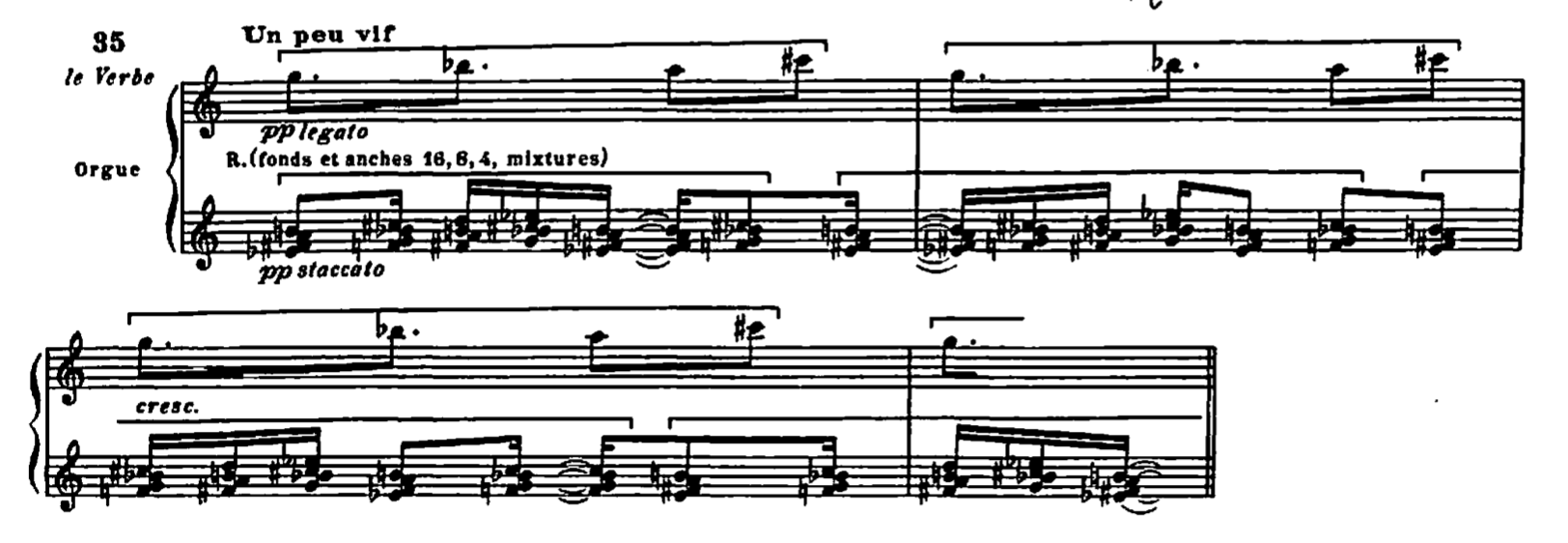


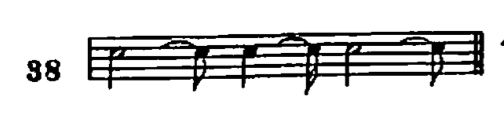
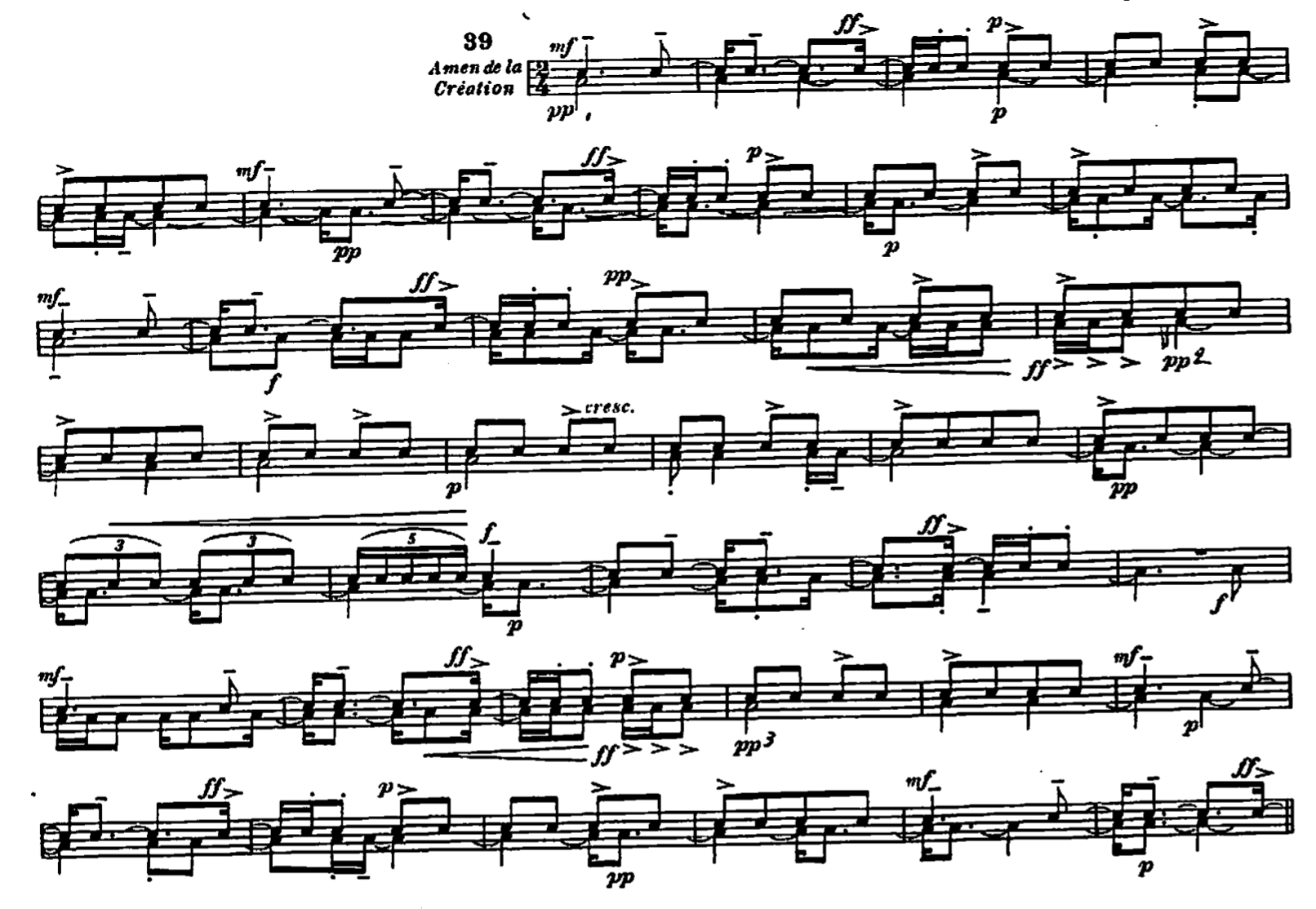

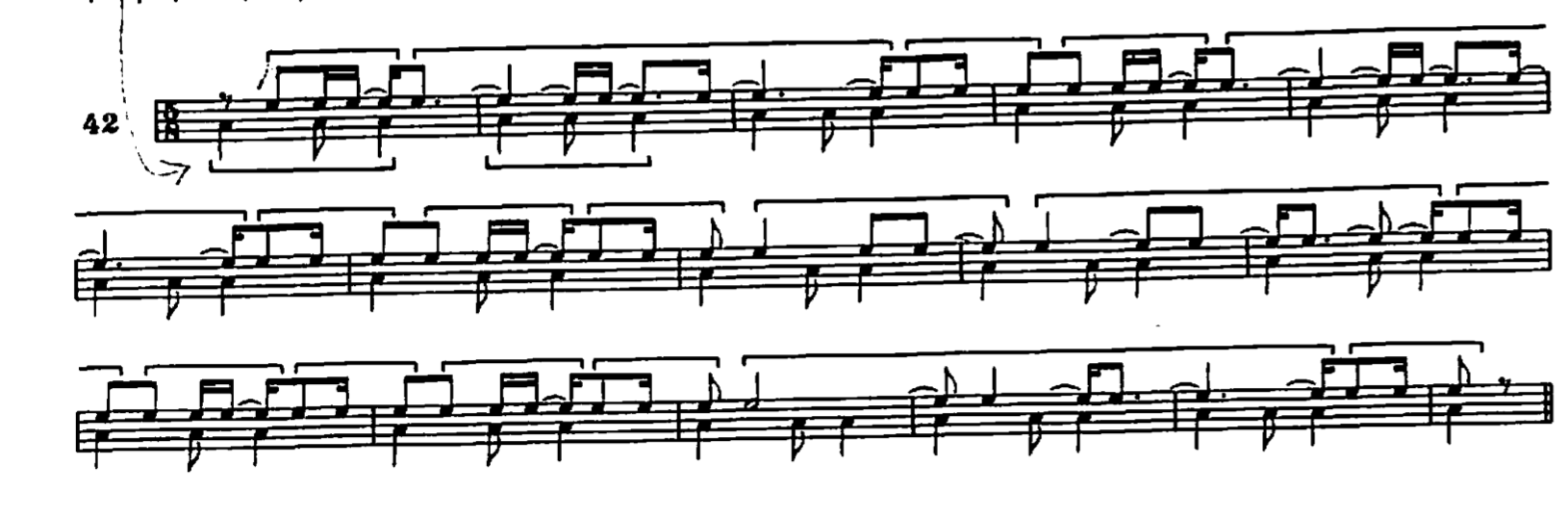
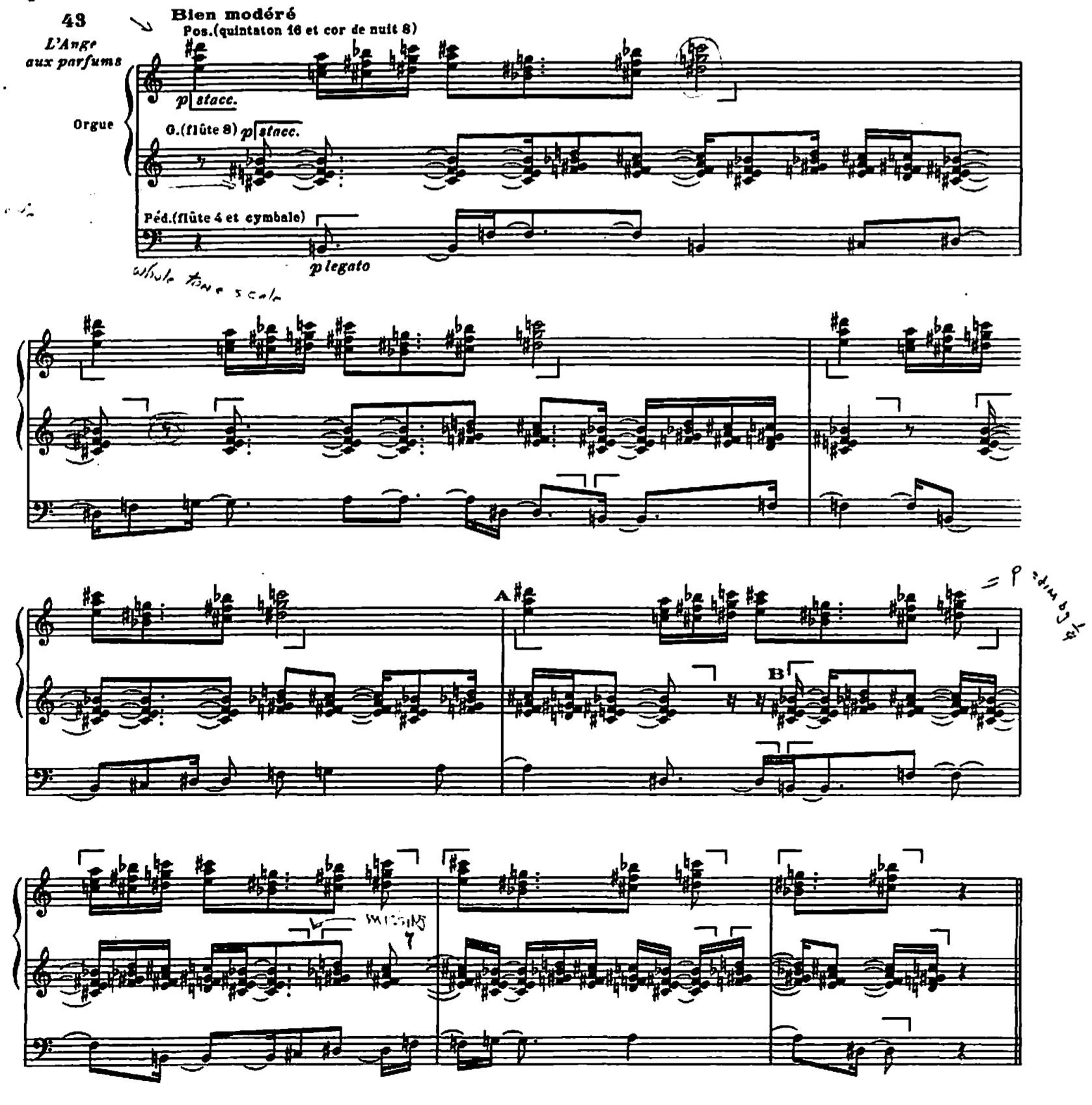


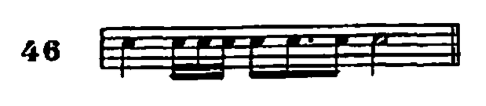
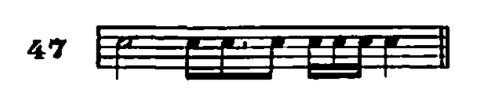
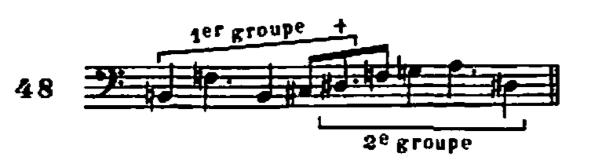
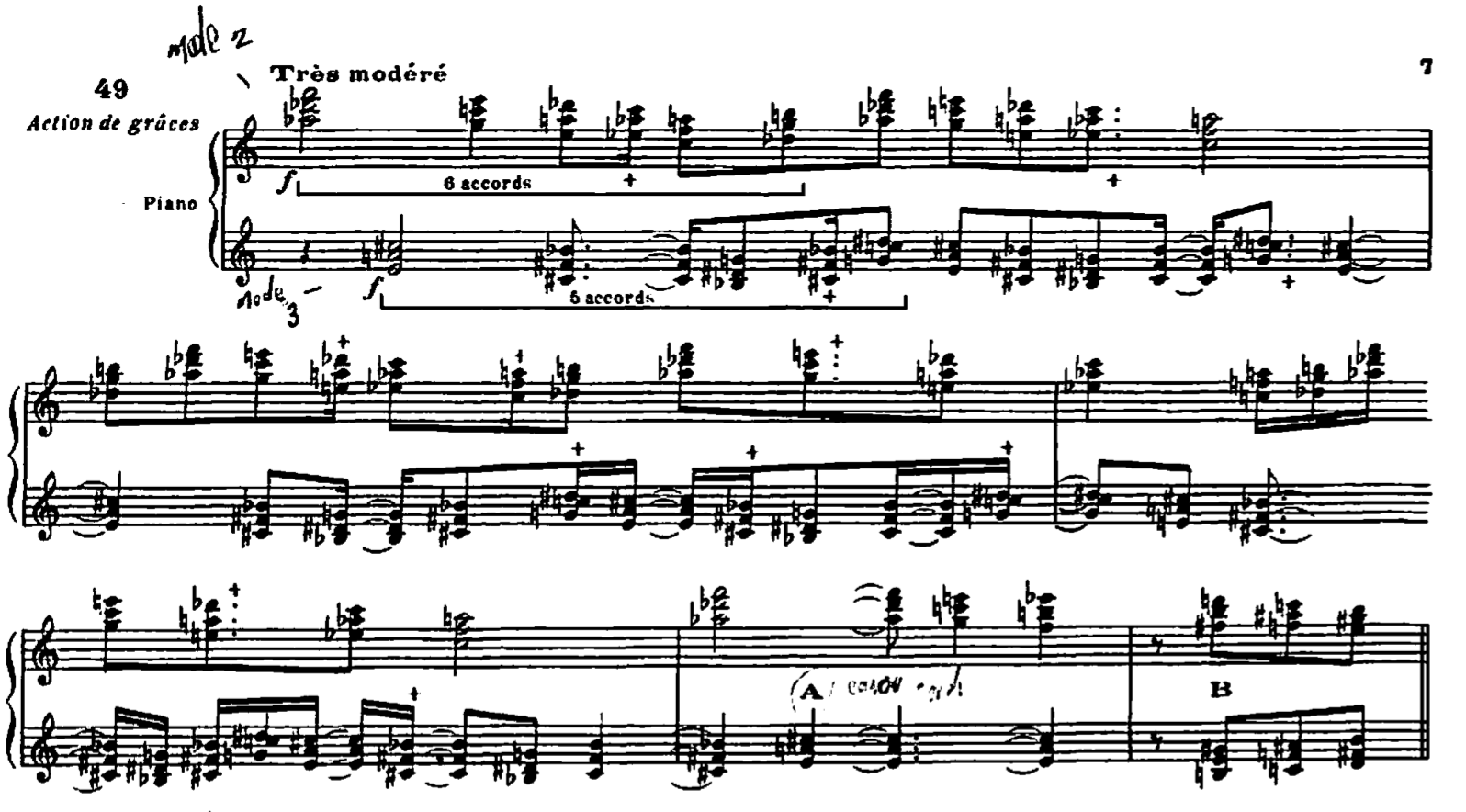
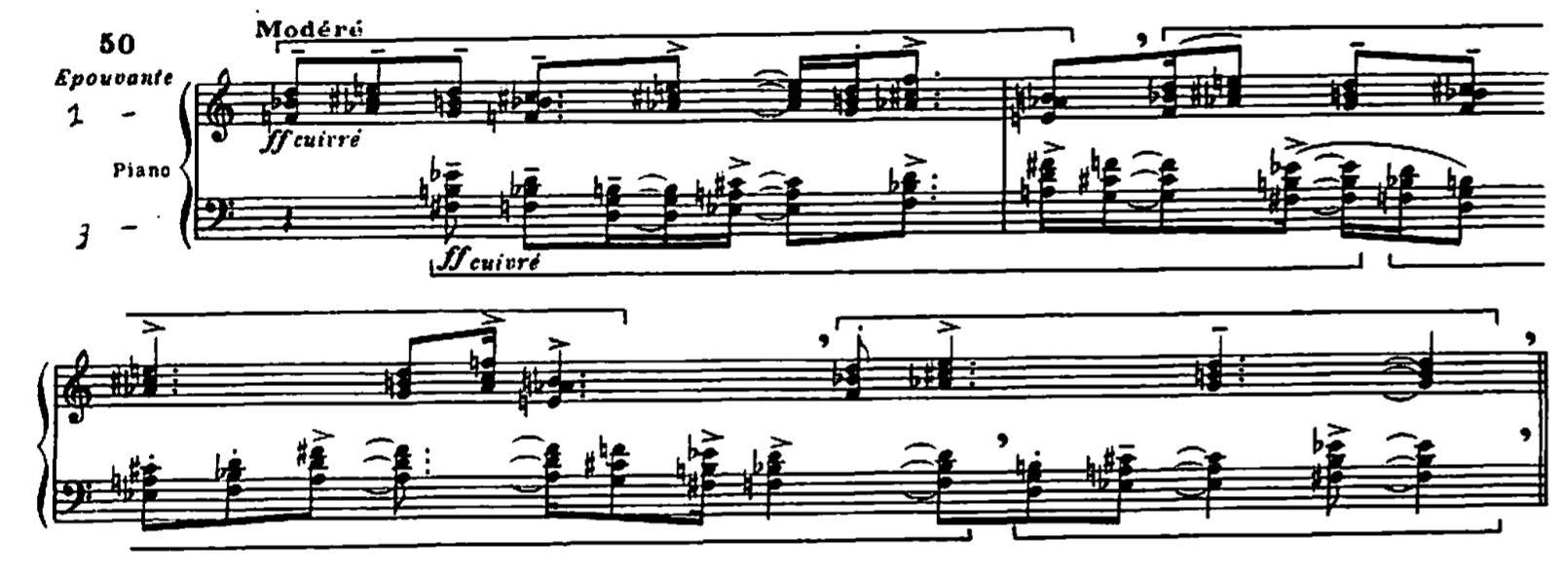

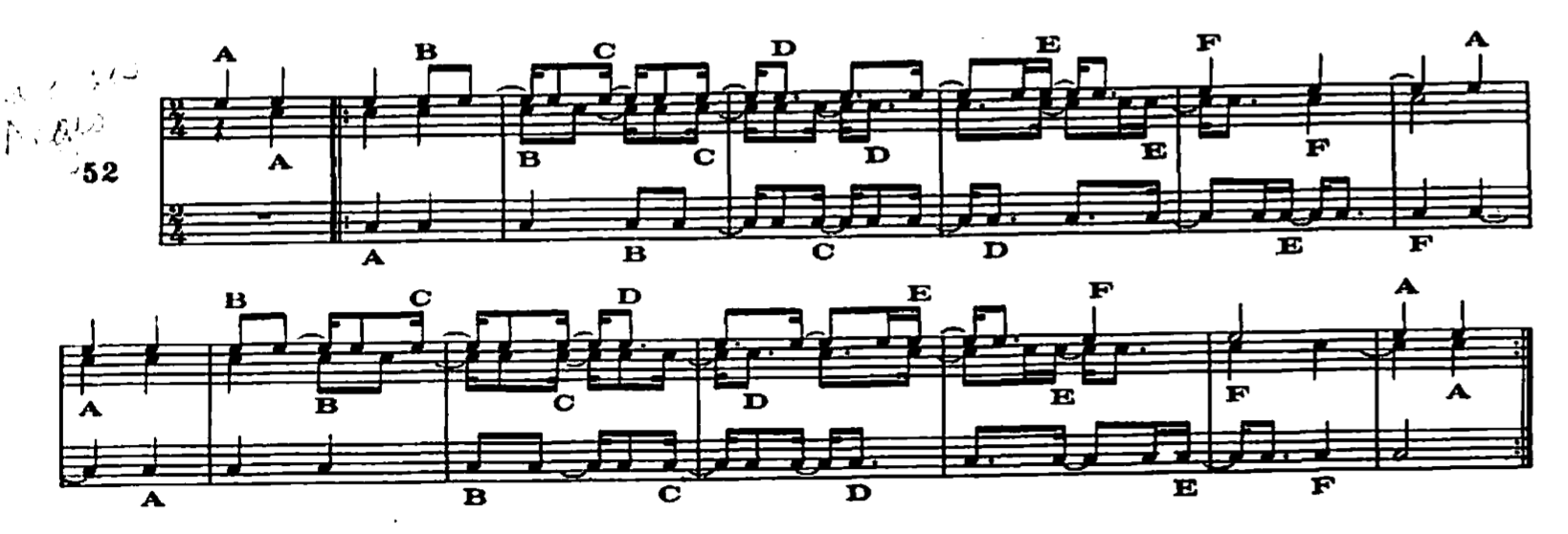


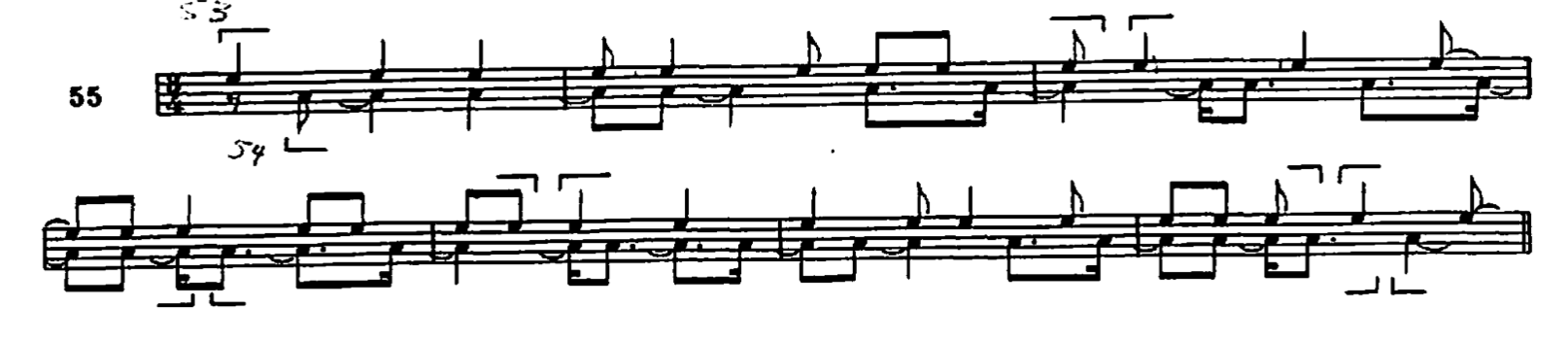

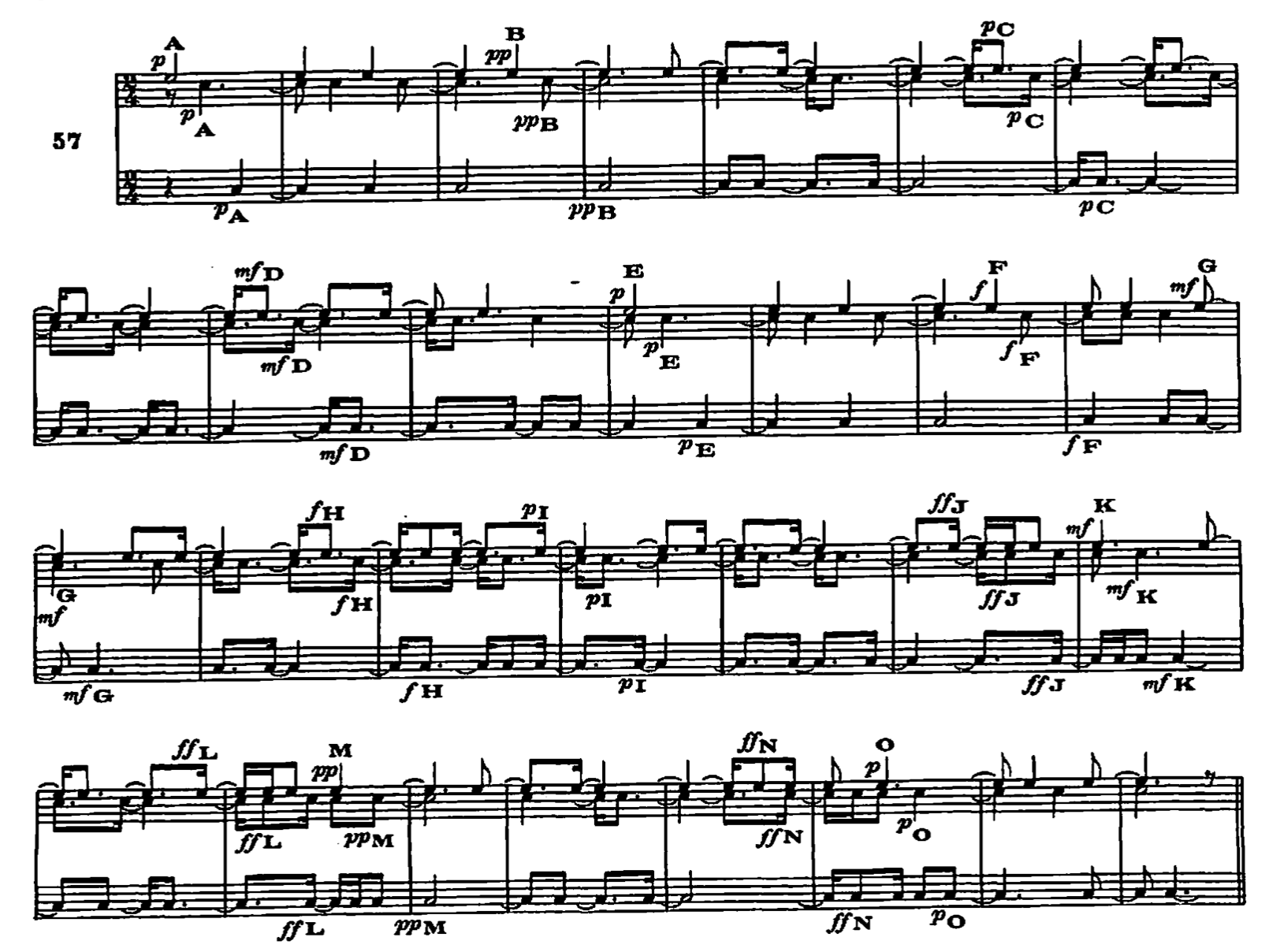

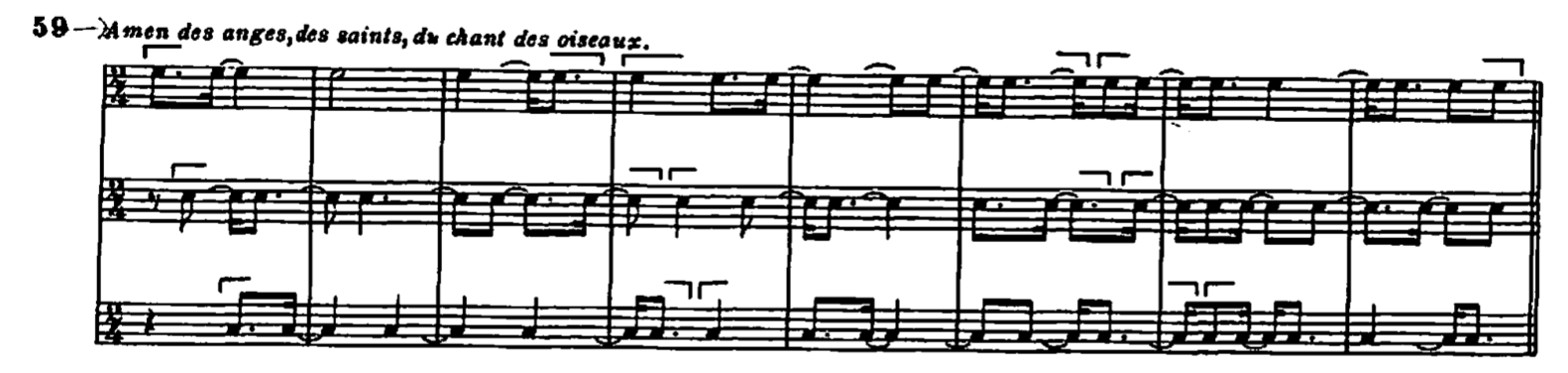



Overview
This chapter synthesizes the rhythmic techniques developed in Chapters II–V, demonstrating how they combine to create complex polyrhythmic textures. Messiaen systematically explores superposition—the simultaneous layering of multiple independent rhythmic streams—moving from simple two-layer polyrhythms through canonic constructions to the distinctive concept of rhythmic pedal. The chapter reveals how added values, augmentation/diminution, nonretrogradable structures, and rhythmic canons can operate simultaneously in different voices, creating temporal complexity that defies traditional metric organization. The rhythmic pedal concept—a pattern repeating ostinato-fashion while surrounding it with different rhythms—anticipates the parametric analogy with polymodality (Chapter XIX) and demonstrates Messiaen's thinking about independence and interaction between musical layers. An important metanotational issue emerges: Messiaen acknowledges that his complex polyrhythms often require "gathering into meter" for practical notation, even though this contradicts his ametric conception—a tension between compositional intent and notational convention addressed further in Chapter VII.
Key Concepts
This chapter introduces eight foundational concepts related to polyrhythm and rhythmic pedals:
- Gathering into Meter - Notational practice of organizing ametric music within conventional metric frameworks
- Superposition of Rhythms of Unequal Length - Layering patterns of different durations that cycle until realignment
- Superposition upon Different Forms of Augmentation - Presenting patterns at multiple time-scales simultaneously
- Superposition upon Its Retrograde - Layering a pattern with its temporal reversal
- Rhythmic Canons - Contrapuntal structures with rhythmic imitation independent of pitch
- Canon by the Addition of the Dot - Canonic structures where voices progressively augment through dotting
- Canon of Nonretrogradable Rhythms - Canons where all voices employ palindromic rhythms
- Rhythmic Pedal - Patterns repeating ostinato-fashion independent of surrounding activity
Gathering into Meter
Definition: The notational practice of organizing ametric polyrhythmic music within conventional metric frameworks (measures with time signatures) to facilitate performance, even though this metric notation contradicts the music's underlying ametric conception.
Messiaen's Treatment: Messiaen introduces this chapter by acknowledging a fundamental notational problem: superposing several complicated rhythms often necessitates "gathering" them into one meter for practical purposes. This involves writing ametric rhythms—which have no inherent relation to conventional meter—within a normal meter system using syncopations to produce slurs, dynamics, and accents exactly where desired, thereby creating the intended effect despite the contradictory metric notation.
This practice has the fault of contradicting the composer's rhythmic conception. Messiaen notes that certain examples cannot be written otherwise, and that for reader comprehension, he will notate each rhythm separately (as conceived, without measure) before showing how they combine afterward (gathered into meter).
This represents a pragmatic compromise between compositional theory and performative necessity. Messiaen's ametric thinking—organizing by precise durational values rather than metric hierarchy—requires notational translation into conventional metric systems that performers can read. The result is music whose notated meter (barlines, time signatures) does not reflect its actual rhythmic organization.
Modern Context: This issue remains central to twentieth- and twenty-first-century rhythmic notation. Composers working with ametric, polymetric, or highly complex rhythmic structures face similar choices:
- Metric notation of ametric music: Using conventional barlines and time signatures as organizational conveniences while relying on accents, articulations, and phrasing to convey actual rhythmic intent (Stravinsky, Bartók, Carter)
- Proportional notation: Abandoning conventional metric notation entirely in favor of spatial/temporal representations where distance equals duration (Cage, Feldman, Ligeti)
- Multiple simultaneous meters: Notating each layer in its own meter, requiring performers to coordinate despite different barlines (Ives, Nancarrow, Carter)
- Metric modulation notation: Using nested tuplets and tempo relationships to represent complex proportions within conventional metric frameworks (Carter, Ferneyhough)
Contemporary music theory recognizes the distinction between notated meter (visual/symbolic) and performed meter (actual temporal organization). Performers of Messiaen must learn to read through the notational meter to realize the underlying ametric conception—understanding that barlines are organizational conveniences, not indicators of metric accent.
This notational tension also reflects broader questions about the relationship between score and sound, notation and conception, visual representation and aural reality. Messiaen's acknowledgment of the problem demonstrates his awareness that musical ideas may exceed notational systems' capacity to represent them clearly.
Examples: This issue pervades all examples in this chapter, though Messiaen addresses it most explicitly in the introduction and promises fuller treatment in Chapter VII.
Superposition of Rhythms of Unequal Length
Definition: The simultaneous layering of two or more rhythmic patterns of different durations, repeated cyclically until they realign at their common multiple, creating polyrhythmic textures where layers phase in and out of synchronization.
Messiaen's Treatment: Messiaen identifies this as the simplest and "most childish" form of polyrhythm—two rhythms of unequal length repeated until their combination returns to the starting configuration. Example 35 demonstrates: one rhythm spans ten sixteenth-notes (using added values and dot addition/withdrawal techniques from Chapter IV), another spans nine sixteenth-notes. The upper part requires nine repetitions, the lower part requires ten repetitions before both return simultaneously to their starting point (their common multiple: 90 sixteenth-notes, or least common multiple of 9 and 10).
Examples 36–37 show further instances: rhythmic successions employing diminution by withdrawal of two-thirds (producing triplets and quintuplets, each totaling one quarter-note) and augmentation by addition of a fourth combined with diminution by withdrawal of a fifth.
Example 39 demonstrates gathering this into 2/4 meter while repeating the superposition. The second rhythmic succession (lower part) is much shorter than the first (upper part), creating a situation where the shorter pattern cycles multiple times against each statement of the longer pattern.
This technique creates temporal complexity through differential periodicity—patterns cycling at different rates produce continually changing vertical alignments. The music exhibits both local rhythmic variety (different alignments at each moment) and large-scale cyclic structure (eventual return to starting alignment).
Modern Context: This polyrhythmic approach has deep historical roots and widespread application:
- African and Afro-Caribbean music: Polyrhythmic textures based on simultaneous patterns of different lengths (3 against 2, 4 against 3, etc.) creating "timeline patterns"
- Minimalist phase music: Reich's phase pieces where identical patterns played at slightly different tempi gradually move out of and back into phase (though Reich's process differs from Messiaen's fixed-length cycling)
- Medieval isorhythm: Color (pitch pattern) and talea (rhythmic pattern) of different lengths cycling through each other in motet tenors
- Mathematical music: Composers using least common multiples to determine large-scale formal structures (Nancarrow, Xenakis)
Contemporary rhythm theory analyzes these structures through concepts of:
- Rhythmic period: The span before patterns realign (LCM of component lengths)
- Phase relationships: The continually changing alignments between layers
- Hypermetric structure: Large-scale metric organization generated by cycling patterns
The technique creates temporal non-alignment—simultaneous layers operating with different periodicities, preventing establishment of unified metric hierarchy. This reinforces Messiaen's ametric aesthetic while creating rhythmic richness through controlled complexity.
Examples: Examples 35–39 demonstrate various applications with different length relationships and transformations.
Superposition upon Different Forms of Augmentation and Diminution
Definition: Polyrhythmic textures created by simultaneously presenting a rhythmic pattern at multiple time-scales—original, augmented, and/or diminished versions layered vertically.
Messiaen's Treatment: Example 40 proposes a basic rhythm. Example 41 joins some forms of augmentation and diminution from the Chapter IV table (Example 24), creating a series of transformations. Example 42 combines this series with repetitions of the initial rhythm, gathering the whole into 5/8 meter. Brackets in the upper part mark the different augmentation/diminution forms; the lower part repeats the initial rhythm.
This creates a specific species of polyrhythm where all layers derive from the same source material but operate at different time-scales. The original rhythm and its proportionally transformed versions sound simultaneously, creating temporal stratification—the same pattern unfolding at multiple rates.
Modern Context: This technique relates to several compositional approaches:
- Temporal counterpoint: Independent voices moving at different speeds but derived from shared material (Renaissance proportional canons, Nancarrow's tempo canons)
- Fractal music: Self-similar structures appearing at multiple time-scales (Ligeti's rhythmic structures in piano études)
- Metric modulation: Carter's technique of using tempo relationships to create proportional connections between sections, though Messiaen applies this simultaneously rather than successively
The simultaneous presentation of original and transformed versions creates what might be termed "temporal heterophony"—multiple versions of the same musical idea sounding together but at different rates, analogous to heterophonic textures where multiple versions of a melody sound with slight variations.
This also demonstrates Messiaen's systematic approach: having catalogued augmentation/diminution forms in Chapter IV, he now shows how they can combine vertically. The technique enriches single-layer rhythmic variety (Chapter IV) through multi-layer interaction.
Examples: Examples 40–42 demonstrate the technique systematically.
Superposition upon Its Retrograde
Definition: The simultaneous layering of a rhythmic pattern with its temporal reversal, creating polyrhythmic texture where one voice proceeds forward while another proceeds backward through the same durational sequence.
Messiaen's Treatment: Example 43 presents what Messiaen calls a "curious mixture of timbres" that superposes different rhythms and modes while combining polymodality and polyrhythm. The upper staff presents a rhythm in Mode 2 (octatonic scale), middle staff presents Mode 3, and bass (pedal part) uses the whole-tone scale. Rhythmically, the right hand repeats a rhythm (Example 46) while the left hand repeats its retrograde (Example 47).
The superposition occurs "several times consecutively," with elements an eighth-note farther apart each time—the retrograde relationship maintains throughout but with progressive phase shifting. The bass presents a nonretrogradable rhythm (Chapter V) divisible into two groups with a central common value.
Example 48 identifies the three simultaneous rhythms: three rhythmic pedals where the second is the retrograde of the first and the third is nonretrogradable. This creates a complex texture where forward motion, backward motion, and temporal palindrome coexist.
Modern Context: Simultaneous presentation of a pattern and its retrograde represents sophisticated temporal counterpoint. This technique relates to:
- Contrapuntal inversion: Simultaneous presentation of a subject and its inversion in fugue, though Messiaen applies this to rhythm rather than pitch
- Temporal canons: Canons where voices move in opposite temporal directions (rare but explored by some modernist composers)
- Transformation theory: Simultaneous presentation of a musical object and its transformation under some operation (here, retrograde)
The perceptual effect is complex: listeners may not consciously recognize the retrograde relationship, but the resulting texture possesses a particular temporal symmetry. Since retrograde reverses the order of durations, long-to-short progressions in one voice align with short-to-long progressions in the other, creating complementary temporal trajectories.
The example also demonstrates Messiaen's integration of multiple techniques: polyrhythm (three independent layers), polymodality (three different modes), retrograde relationship, and nonretrogradable structure—all operating simultaneously. This represents the culmination of his systematic approach: individual techniques combine to create rich, multi-dimensional complexity.
Examples: Examples 43–48 demonstrate the complete technique with modal and timbral dimensions integrated.
Rhythmic Canons
Definition: Contrapuntal structures where multiple voices present the same rhythmic pattern in temporal displacement (imitation), independent of whether melodic canon occurs—pure rhythmic counterpoint without necessary pitch imitation.
Messiaen's Treatment: Messiaen emphasizes that rhythmic canons may exist without melodic canons—rhythm alone can be treated contrapuntally. Example 49 demonstrates: upper staff (right hand) repeats a melodic and harmonic succession of six chords; lower staff (left hand) repeats a different melodic and harmonic succession of five chords. These are "entirely independent of the rhythmic canon established between the two hands at a quarter-note's distance"—the rhythmic imitation occurs at the quarter-note interval while melodic/harmonic content remains independent.
At point A, the canon ends. The example employs added values (at crosses), superposition of modes of limited transposition (Mode 3 over Mode 2), and use of the sixth mode creating modal modulation and placing the passage in A major.
Example 50 presents another instance: superposition of Mode 2 (upper) over Mode 3 (lower), no melodic canon, but rhythmic canon at a quarter-note's distance. Brackets mark rhythmic divisions facilitating perception of the canon.
Example 51 recalls the typical rhythmic formula from Chapter V (Example 28), which Example 52 treats in triple canon gathered into 2/4 meter. Letters A–F indicate small rhythmic divisions; reproducing these letters over each part of Example 52 facilitates viewing the triple canon. The latter occurs twice in the example, with reprise indicating infinite repeatability.
Modern Context: Rhythmic canon represents the application of contrapuntal principles to rhythm independent of pitch. This separates two traditionally linked parameters:
- Traditional canon: Both pitch and rhythm imitate (Bach, Palestrina)
- Rhythmic canon: Only rhythm imitates, pitch remains independent (Messiaen's innovation)
- Pitch canon without rhythmic canon: Rare but theoretically possible
This parametric independence anticipates serial and post-serial techniques where pitch, rhythm, dynamics, and articulation undergo independent transformations. Messiaen's rhythmic canons demonstrate that contrapuntal thinking—imitation, temporal displacement, voice independence—can apply to any musical parameter.
Contemporary music theory recognizes this through concepts of:
- Parametric counterpoint: Contrapuntal relationships in non-pitch domains
- Temporal canons: Imitative structures based purely on temporal relationships (Nancarrow)
- Transformation networks: Systematic relationships between musical objects regardless of specific parametric content
The triple canon (Example 52) represents particular complexity—three voices in rhythmic imitation, each delayed by the same interval, creating dense temporal layering. This anticipates the rhythmic complexity of post-war European modernism (Boulez, Stockhausen) while remaining grounded in traditional contrapuntal thinking.
Examples: Examples 49–52 demonstrate various rhythmic canons from simple two-voice to complex triple canon.
Canon by the Addition of the Dot
Definition: Canonic structures where each successive voice presents an augmented version of the preceding voice through dot addition (1.5× multiplication), creating canons where imitative voices progressively slow down.
Messiaen's Treatment: Messiaen proposes writing rhythmic canons by augmentation or diminution using the forms from Chapter IV's table. He tries canon by dot addition: Example 53 presents a proposing rhythm spanning thirteen eighth-notes (prime number). Example 54 responds with all values dotted (1.5× augmentation).
Example 55 combines three repetitions of the proposing rhythm with two repetitions of the responding rhythm, gathered into 3/4 meter. Brackets mark each repetition.
Example 56 presents a rhythmic succession exploiting all augmentation and diminution forms from Chapter IV's table (Article 3), with letters A–O indicating which transformation each segment employs:
- A: initial rhythm
- B: addition of a quarter of values
- C: withdrawal of a fifth of values
- D: withdrawal of a fourth of values
- E: addition of a third of values
- F: classic diminution
- G: addition of the dot
- H: withdrawal of the dot
- I: classic augmentation
- J: withdrawal of three-fourths of values
- K: addition of twice the values
- L: withdrawal of two-thirds of values
- M: addition of four times the values
- N: withdrawal of four-fifths of values
- O: addition of three times the values, forming a final recall of the initial rhythm
Example 57 treats this succession in triple canon gathered into 2/4 meter, with letters marking rhythmic divisions over each part to facilitate comprehension.
Modern Context: Canon by dot addition creates a specific species of augmentation canon where the augmentation ratio is 3:2 (dotted to undotted). This produces intermediate tempo relationships between voices—not the simple 2:1 or 3:1 ratios of traditional augmentation but the sesquialtera proportion (3:2).
This relates to:
- Renaissance proportional canons: Mensuration canons where different voices read the same notation in different mensural interpretations
- Tempo canons: Nancarrow's canons at complex tempo ratios including irrational proportions
- Metric modulation: Carter's use of proportional relationships to pivot between tempi
The systematic exploitation of all Chapter IV transformation types in canon (Example 56–57) demonstrates Messiaen's algorithmic thinking—systematically working through all possibilities within a defined system. This anticipates computer-assisted composition and systematic exploration of compositional possibility spaces.
Examples: Examples 53–57 demonstrate dot-addition canons and comprehensive transformation canons.
Canon of Nonretrogradable Rhythms
Definition: Canonic structures where all voices employ palindromic rhythms, creating imitative textures where each voice is internally symmetrical (nonretrogradable) while voices enter in temporal displacement.
Messiaen's Treatment: Messiaen recalls Example 33 from Chapter V—a succession of nonretrogradable rhythms (one per measure). Example 58 presents this material. Example 59 treats it in triple canon gathered into 2/4 meter, with each nonretrogradable rhythm bracketed for clarity.
This creates a distinctive texture: each individual voice possesses retrograde invariance (no inherent temporal direction), yet the voices enter successively in traditional canonic fashion. The combination of internal palindromic symmetry with external canonic imitation produces music simultaneously stable (palindromic voices) and dynamic (imitative entries).
Modern Context: Canons of nonretrogradable rhythms represent a sophisticated combination of two temporal symmetry types:
- Internal symmetry: Each voice is palindromic
- External symmetry: Voices imitate each other through time-delay
This creates nested symmetries—palindromes within canonic structure. The perceptual effect is unusual: the lack of inherent temporal direction in individual voices (due to palindromic structure) combines with the clearly directed temporal unfolding of canonic entries.
This technique demonstrates that Messiaen's various innovations combine rather than exclude: palindromic rhythms (Chapter V) can participate in canonic structures (Chapter VI), showing the compositional system's internal coherence and flexibility.
Examples: Examples 58–59 demonstrate triple canon of nonretrogradable rhythms.
Rhythmic Pedal
Definition: A rhythmic pattern repeating ostinato-fashion, indefatigably, independent of other rhythmic activity surrounding it, functioning as a temporal anchor analogous to harmonic pedal points.
Messiaen's Treatment: Messiaen introduces the rhythmic pedal as a rhythm that repeats itself indefatigably without concern for the rhythms surrounding it. This can accompany music of entirely different rhythm or mingle with other pedals.
Example 60 presents a complex texture: clarinet sings principal melody (transposing down an octave from notation), violin's light formulas create secondary counterpoint, cello harmonics two octaves above notation form a first rhythmic pedal whose "airy sonority envelops and unifies all the rest in its mysterious halo." Example 61 provides this pedal's rhythm.
The pedal divides into two nonretrogradable rhythms (A and B), the second composed of two groups where one retrogrades the other, with a central common value at the cross (actually a half-note coined in four eighth-notes, unchanged in retrograde). The rhythm repeats several times consecutively, constituting a rhythmic pedal. The quoted fragment contains three expressions: X, Y, Z (first two expressions plus beginning of third). The rhythmic pedal of fifteen values occurs simultaneously with a melodic pedal of five notes; there is disproportion between rhythm and melody.
Example 62 presents the piano's second rhythmic pedal. Example 60 describes complex multi-layered structure: melodic pedal (five notes) concurrent with rhythmic pedal (fifteen values) concurrent with harmonic pedal (twenty-nine chords forming unexpected rhythmic variants). Messiaen notes: "Rhythmicize your harmonies!" quoting Paul Dukas's pedagogical advice.
The harmonic analysis reveals sophisticated modal construction: chords employ "dominant with appoggiaturas" (stained-glass window effect from Chapter XIV), use Mode 3 (measures 1-4) and Mode 2 (measures 5-6), and the melodic pedal uses whole-tone scale, which can be tolerated when mixed with harmonic combinations foreign to it.
Modern Context: The rhythmic pedal concept extends traditional harmonic pedal points (sustained bass notes) into the temporal domain. This creates:
- Temporal stratification: Multiple independent temporal layers operating simultaneously
- Ostinato textures: Repeating patterns providing structural continuity
- Polyrhythmic complexity: Independent periodicities creating rich temporal interaction
The technique relates to:
- Isorhythm: Medieval repeating rhythmic patterns (taleae) cycling through melodic patterns (colores) of different lengths
- Minimalist loops: Repeating patterns of different lengths cycling against each other (Reich, Glass), though minimalism typically employs simpler patterns
- Stravinsky's ostinatos: Repeating rhythmic/melodic cells providing structural foundations
- Polymetric layers: Multiple simultaneous metric streams (Ives, Carter)
Messiaen's description of disproportion between rhythmic pedal (fifteen values), melodic pedal (five notes), and harmonic pedal (twenty-nine chords) creates a three-dimensional polyrhythmic structure where pitch-repetition rate, durational-pattern repetition rate, and harmonic-succession rate all differ. This represents maximum parametric independence—each musical dimension operates with its own periodicity.
The connection to Chapter XIX's polymodality (previewed through the reference to treating pedal-groups) demonstrates Messiaen's systematic parametric thinking: operations applicable to rhythm (pedals, superposition, independence) find analogous application to harmony (polymodal superposition, modal pedals, modal independence).
The Dukas quotation—"Rhythmicize your harmonies!"—encapsulates Messiaen's integrated approach: rhythm and harmony should not operate independently but should interact, with harmonic successions possessing their own rhythmic profiles. This challenges traditional harmonic thinking where chord progressions follow voice-leading logic separate from rhythmic considerations.
Examples: Examples 60–62 demonstrate complex multi-layered rhythmic pedal textures with melodic and harmonic dimensions integrated.
Relationship to Other Chapters
Chapter VI represents a synthetic culmination of the rhythmic section, integrating all previous techniques:
-
Chapter II (Rāgavardhana): The complex polyrhythmic formulas employ principles derived from Hindu rhythm, and Examples 51–52 explicitly reference the Chapter V formula that itself derives from rāgavardhana analysis.
-
Chapter III (Added Values): Added values appear throughout (marked by crosses), demonstrating that polyrhythmic textures incorporate this non-proportional transformation.
-
Chapter IV (Augmented or Diminished Rhythms): Examples 40–42 superpose different augmentation/diminution forms; Examples 56–57 systematically employ all transformations from the Chapter IV table in canonic structure.
-
Chapter V (Nonretrogradable Rhythms): Examples 43–48 incorporate nonretrogradable bass rhythms; Examples 58–59 create canons of nonretrogradable rhythms; Examples 60–62 employ nonretrogradable structures within rhythmic pedals.
-
Chapter VII (Rhythmic Notations): The gathering-into-meter issue introduced here receives fuller treatment in Chapter VII.
-
Chapters XIII–XIV (Harmony, Added Notes, Special Chords): Examples 43 and 60–62 demonstrate integration of rhythmic techniques with harmonic innovations (modes of limited transposition, added notes, appoggiatura chords).
-
Chapter XIX (Polymodality): The polymodal textures in Examples 43 and 60–62 preview the systematic treatment of simultaneous modes in Chapter XIX. The analogy between polyrhythm and polymodality—both involving simultaneous independent layers—extends the parametric thinking established throughout the treatise.
The chapter also marks a transition from purely technical exposition to integrated musical examples showing how techniques combine in actual compositional practice. Examples 43 and 60–62 present substantial musical passages rather than isolated demonstrations, revealing how Messiaen's systematic innovations generate rich musical surfaces.
Summary
Chapter VI synthesizes the preceding rhythmic chapters, demonstrating how added values, augmentation/diminution, nonretrogradable structures, and canonic imitation combine to create complex polyrhythmic textures. By systematically exploring superposition of rhythms of unequal length, rhythms at different time-scales, rhythms and their retrogrades, and various canonic structures, Messiaen constructs a comprehensive polyrhythmic practice. The introduction of rhythmic pedal—patterns repeating ostinato-fashion independent of surrounding rhythmic activity—establishes the concept that will find harmonic parallel in polymodality (Chapter XIX), demonstrating the parametric analogies governing his entire system.
The chapter's examples progress from simple two-layer polyrhythms through increasingly complex multi-dimensional structures where rhythm, melody, and harmony operate with independent periodicities, creating temporal stratification characteristic of Messiaen's mature style. The acknowledgment of notational tension—that complex polyrhythms often require "gathering into meter" despite their ametric conception—reveals practical compromises between theoretical innovation and performative reality.
For contemporary readers, this chapter illustrates how systematic combination of relatively simple techniques (adding values, scaling proportions, palindromic construction, canonic imitation) can generate extraordinary rhythmic complexity, and how parametric independence (each musical dimension operating according to its own logic) creates rich, multi-layered textures. The rhythmic pedal concept, with its disproportion between melodic, rhythmic, and harmonic periodicity, represents a distinctively modern approach to musical texture—stratified, non-hierarchical, and resistant to unified metric reduction. Together with the preceding five chapters, Chapter VI completes Messiaen's rhythmic system: a comprehensive toolkit for generating precise, complex, ametric temporal organization through systematic procedures rather than intuitive improvisation.
Chapter VII: Rhythmic Notations
Original: Pages 28–30 in Satterfield translation
Musical Examples:
Supplementary Examples:








Overview
This brief but essential chapter addresses the practical problem of notating ametric rhythms within conventional notational systems. Messiaen presents four distinct notational strategies, each with specific advantages and limitations, reflecting the tension between compositional conception and performative reality. The chapter acknowledges that no single notation perfectly captures ametric complexity—composers must choose among compromises based on practical considerations like performer ability, ensemble size, and the specific rhythmic relationships being notated. The supplementary examples demonstrate that Messiaen occasionally employs traditional metric rhythms that do not follow his systematic innovations, revealing a pragmatic eclecticism alongside theoretical rigor. This chapter functions as both practical manual and theoretical reflection on the limits of musical notation—the gap between compositional thought and its visual/symbolic representation.
Key Concepts
This chapter introduces five foundational concepts related to rhythmic notation:
- First Notation: Exact Values Without Measure - Preserving ametric conception by avoiding metric frameworks
- Second Notation: Metric Changes (Stravinsky's Method) - Frequent time signature changes to accommodate rhythmic irregularity
- Third Notation: Short Measures with Rhythmic Signs - Hybrid system combining metric framework with precise durational notation
- Fourth Notation: False Meter with Exact Accentuation - Conventional metric notation with performance indications to produce intended effect
- Some Metrical Rhythms (Supplementary Examples) - Traditional metric rhythms not following systematic innovations
First Notation: Exact Values Without Measure
Definition: Notating precise durational values without barlines (except to mark periods or accidentals), preserving the ametric conception by avoiding any metric framework that might suggest regular accent patterns.
Messiaen's Treatment: This notation writes exact values while saving barlines only to indicate periods and to make an end to the effect of accidentals (sharps, flats, etc.). Messiaen identifies this as evidently the best notation for the composer since it represents the exact expression of musical conception—what the composer actually imagines rhythmically, unmediated by metric conventions.
It is excellent for one performer alone or a few performers in a group. Messiaen notes that interpreters who feel strained by the rhythms can mentally count all short values (sixteenth-notes, for example) but only at the beginning of their work. This procedure could make performance disagreeably dull and would become a puzzle; performers ought, in course of time, to keep in themselves the feeling for the values without more, which will permit them to observe dynamics, accelerations, retards—all that makes an interpretation alive and sensitive.
Messiaen has used this first notation in organ works (La Nativité du Seigneur, Les Corps glorieux), vocal works (Poèmes pour Mi for voice and piano), Chants de terre et de ciel, and several movements of Quatuor pour la fin du Temps.
Modern Context: This notation represents the most theoretically pure approach—no compromise with metric convention. It anticipates later developments in notational reform:
- Proportional notation: Scores where spatial distance represents temporal duration (Cage, Feldman, Ligeti), though Messiaen still uses conventional note values rather than spatial representation
- Beamed groupings without barlines: Contemporary practice of organizing rhythms through beaming alone without metric framework (new complexity composers, spectral composers)
- Performer responsibility: Requiring performers to internalize temporal values rather than relying on metric framework—demanding high technical and musical sophistication
The pedagogical advice—that performers should initially count subdivisions but eventually develop direct feeling for values—reflects important insights about rhythmic performance practice. Metric counting can be a crutch that prevents direct rhythmic understanding; performers must ultimately internalize temporal relationships independently of metric subdivision.
This notation works best for solo or small chamber ensembles where performers can maintain temporal coordination through listening and individual temporal control. It becomes impractical in larger ensembles lacking conductor, where metric frameworks facilitate coordination.
Examples: No specific examples provided; Messiaen references works using this notation.
Second Notation: Metric Changes (Stravinsky's Method)
Definition: Gathering ametric rhythms into normal measures but frequently changing time signatures to accommodate rhythmic irregularity, piling up metric changes to represent rhythmic complexity.
Messiaen's Treatment: In orchestral contexts, when all performers play the same rhythms and these rhythms gather into normal measures, one can pile up metric changes—the approach Stravinsky employed in Le Sacre du Printemps. These changes of meter are very tiring for the orchestra conductor.
Messiaen used this second notation in his Offrandes oubliées.
Modern Context: This represents Stravinsky's solution to notating irregular rhythms within metric frameworks—constantly changing the meter to match rhythmic accent patterns. The technique creates:
- Additive rhythm notation: Each measure's duration determined by the specific rhythmic pattern it contains rather than by recurring metric scheme
- Metric irregularity: Prevents establishment of predictable metric hierarchy while maintaining measure-by-measure organization
- Conductor challenges: Rapid metric changes require constant attention to changing beat patterns and subdivisions
Contemporary composers continue using this approach (Bartók's "Bulgarian rhythms," Carter's metric modulations, Birtwistle's irregular meters), though it shares the same fundamental compromise as Messiaen's fourth notation—using metric notation for ametric music.
The technique works best when:
- All performers share the same rhythm (homophonic textures, orchestral tutti)
- Rhythmic patterns are relatively brief (allowing frequent metric adjustment)
- A conductor coordinates the ensemble
It becomes unwieldy with extended passages in irregular meters or complex polyrhythmic textures where different parts would require different meters.
Examples: No specific examples provided; Messiaen references Offrandes oubliées.
Third Notation: Short Measures with Rhythmic Signs
Definition: Dividing music into short measures with equal or unequal beats, using special rhythmic signs placed above beats to indicate exact durations, creating a hybrid system combining metric framework with precise durational notation.
Messiaen's Treatment: When performers play the same rhythms and these rhythms do not gather into normal meters, it is necessary to divide the music into short measures. A numeral written at the head of each measure indicates the number of beats in it. These beats are equal or unequal in duration; it is necessary then to have recourse to some rhythmic signs placed above the beats to indicate their exact duration.
In the orchestral version of Poèmes pour Mi, upon advice of Roger Désormière (orchestra conductor and inventor of these signs), Messiaen used specific rhythmic signs (Example 63) and their doublings (Example 64), with which one can notate the most difficult rhythms.
This notation necessitates preliminary agreement between musicians and conductor and a rather forbidding effort at first reading. The thing is nevertheless very possible.
Modern Context: This represents an innovative hybrid notation attempting to bridge metric and ametric organization. The system creates:
- Flexible beat lengths: Each measure contains a specified number of beats, but beat durations vary according to the signs
- Visual clarity: Signs above the staff provide quick visual reference for beat durations
- Conductor coordination: The conductor can show beat patterns while signs specify exact durations
This anticipates later notational innovations:
- Time-unit box notation: Systems where boxes contain specified durations (Cage, Feldman)
- Metric modulation notation: Carter's use of changing tempo relationships indicated through proportional relationships
- Contemporary conductor's scores: Specialized notations designed for conductor reference separate from performer parts
The requirement for preliminary agreement between musicians and conductor acknowledges that this notation requires ensemble training—performers must learn the system before applying it. The initial difficulty suggests this notation serves specialized contexts (contemporary music ensembles, performances with extended rehearsal time) rather than general use.
Examples: Examples 63–64 demonstrate the rhythmic signs and their doublings.
Fourth Notation: False Meter with Exact Accentuation
Definition: Writing ametric rhythms in conventional metric notation (normal meters, regular barlines) but using syncopations and performance indications (slurs, dynamics, accents) to produce the intended rhythmic effect, accepting the contradiction between notated meter and actual rhythm.
Messiaen's Treatment: This is the easiest notation for performers since it disarranges their habits in no way. It consists of writing in normal meter a rhythm which has no relation to it, using syncopations. This procedure is indispensable when having several musicians perform a superposition of several rhythms, complicated and very different from each other.
In order to produce the effect, it suffices to multiply the indications of slurs, dynamics, and especially accents exactly where one wants them. This notation is false since it is in contradiction to the rhythmic conception of the composer, but if the performers observe the indicated accents well, the listener hears the true rhythm.
Messiaen used this notation in several movements of Quatuor pour la fin du Temps.
Examples 65–69 demonstrate the approach:
- Example 65: A rhythmic fragment as conceived by the composer (first notation)
- Example 66: Third notation—the same fragment with rhythmic signs
- Example 67: Second notation—another fragment with metrical changes
- Example 68: Another fragment as conceived (first notation)
- Example 69: The same written in false meter with exact accentuation (fourth notation)
Messiaen emphasizes that whether music is measured or not, values there are always notated very exactly—the performer has then only to play the values indicated.
Modern Context: This represents the most pragmatic compromise—accepting notational falsification for performative practicality. This approach:
- Preserves performer comfort: Musicians read familiar metric notation using established skills
- Relies on interpretive markings: Accents, dynamics, articulations convey actual rhythmic intent despite contradictory metric notation
- Facilitates coordination: In complex polyrhythmic textures where different parts require different meters, a single false meter simplifies score reading and conductor coordination
This represents standard practice for much twentieth-century music:
- Stravinsky's later works: Often use regular meters with extensive syncopation and accent markings to produce irregular effects
- Jazz notation: Regular meters with syncopation and swing markings to produce complex rhythmic effects
- Contemporary orchestral music: Frequently employs this compromise for practical reasons
The admission that this notation is "false"—in contradiction to compositional conception—reveals Messiaen's awareness of notation's limitations. The score becomes a set of instructions for producing sounds rather than a representation of musical ideas. Notation functions pragmatically (communicating to performers) rather than theoretically (representing compositional thought).
The critical point is Messiaen's insistence on exact values—regardless of notational method, the precise durational relationships must be maintained. The notation may be compromised, but the rhythmic precision is not.
Examples: Examples 65–69 demonstrate the same material in different notational systems, facilitating comparison.
Some Metrical Rhythms (Supplementary Examples)
Definition: Traditional metric rhythms that do not follow Messiaen's systematic innovations, demonstrating that his compositional practice includes both his theoretical system and more conventional procedures.
Messiaen's Treatment: In appendix to the rhythm chapters, Messiaen provides supplementary examples that "do not at all obey the laws of my rhythmic system." Examples A–G demonstrate:
- Impressionistic character (A, B, C, D): Short tied to long (at the cross in Example C) creates Debussy-like essence contrasting with Stravinsky-like sonorities elsewhere
- Bird style (E, F): References Chapter IX on bird song
- Resonance effects (G): References Chapter XIV, Article 4
- Inexact augmentations (X, Y, Z): Allied to rhythmic variants of a Jolivet pattern, Y being inexact augmentation of X, Z being inexact augmentation of Y (Chapter IV, Article 4)
This section reveals important aspects of Messiaen's compositional practice:
- Eclecticism: His actual compositions employ both systematic innovations and traditional procedures
- Stylistic references: Debussy-like and Stravinsky-like passages coexist with his own innovations
- Pragmatic flexibility: The theoretical system does not constrain all compositional choices
Modern Context: This acknowledgment is theoretically significant. Many composers' treatises present systematic theories as if they govern all compositional activity. Messiaen's candor—admitting that some music does not follow his system—demonstrates intellectual honesty and compositional flexibility.
This reflects a mature understanding of the relationship between theory and practice:
- Theory as toolkit: Systematic innovations provide resources, not constraints
- Style as synthesis: Personal voice emerges from combining systematic procedures, historical references, and intuitive choices
- Compositional freedom: No obligation to systematize all musical decisions
The references to Debussy, Stravinsky, and Jolivet (a contemporary French composer) also position Messiaen within a lineage—acknowledging influences and connections rather than claiming absolute originality.
Examples: Supplementary Examples A–G demonstrate non-systematic rhythmic writing.
Relationship to Other Chapters
Chapter VII functions as practical coda to the rhythmic section:
-
Chapter II (Rāgavardhana): The ametric conception developed from Hindu rhythm requires notational strategies that avoid metric implication.
-
Chapters III–VI (Added Values, Augmentation/Diminution, Nonretrogradable Rhythms, Polyrhythm): All these techniques create rhythmic complexity that challenges conventional metric notation, necessitating the four notational strategies.
-
Chapter VI (Polyrhythm): The "gathering into meter" problem introduced in Chapter VI receives systematic treatment here through the four notational approaches.
-
Chapter IX (Bird Song): The supplementary examples reference bird style, previewing this melodic chapter.
-
Chapter XIV (Special Chords): References to resonance effects and stained-glass window techniques connect rhythmic and harmonic innovations.
The chapter also marks a transition from rhythmic to melodic chapters (VIII–XII), serving as both conclusion to the rhythmic section and acknowledgment that notation mediates between compositional conception and performative realization across all musical parameters.
Summary
Chapter VII addresses the fundamental problem of notating ametric rhythms within conventional notational systems, presenting four distinct strategies that represent different compromises between compositional conception and performative practicality. The first notation (exact values without measure) most faithfully represents ametric conception but works only for solo or small ensembles; the second (metric changes) follows Stravinsky's solution but taxes conductors; the third (rhythmic signs) offers an innovative hybrid but requires ensemble training; the fourth (false meter with exact accentuation) provides maximum practicality but contradicts compositional intent. Messiaen's pragmatic acknowledgment that no notation is perfect—each serves specific contexts and involves specific compromises—demonstrates mature understanding of notation's limitations. The supplementary examples revealing non-systematic rhythmic writing show that theoretical innovations do not constrain all compositional choices, reflecting intellectual honesty and compositional flexibility.
For contemporary readers, this chapter illustrates the persistent gap between musical thought and its notation, the necessity of choosing notational strategies based on practical performance contexts, and the understanding that scores function as instructions for producing sounds rather than perfect representations of compositional ideas. The chapter's conclusion—that regardless of notational method, exact durational values must be maintained—emphasizes that rhythmic precision is non-negotiable even when notation requires compromise. This completes Messiaen's rhythmic section: seven chapters developing a comprehensive ametric rhythmic system (Chapters II–VI) framed by aesthetic foundations (Chapter I) and practical notational considerations (Chapter VII), creating a complete theoretical and practical framework for rhythmic innovation grounded in systematic procedures, historical synthesis, and theological purpose.
Part II: Melody (Chapters VIII–XII)
Conceptual Overview: The Sovereignty of Line
If the rhythm section liberates time, the melody section reclaims line as music's primary expressive vehicle. This isn't nostalgia for Romantic melody—it's something more radical: melody as generator rather than decoration, melody that creates its own harmonic context rather than fitting into predetermined progressions, melody that synthesizes centuries of tradition into personal voice.
The Deforming Prism: Influence Without Imitation
Messiaen's most important methodological gift might be this phrase: "the deforming prism of our language." He doesn't claim originality by rejecting influence—he claims originality through transformation so complete that sources become unrecognizable.
This is the opposite of quotation, pastiche, or neoclassical borrowing. It's metabolic appropriation—consuming source material, digesting it completely, producing something new that contains the nutrition of the original but none of its form.
Look at his sources for melodic material:
- 13th-century trouvère (Adam de la Halle)
- Baroque master (Rameau)
- Classical genius (Mozart)
- Romantic impressionist (Ravel)
- Nationalist modernists (Bartók, Falla)
- Contemporary colleagues (Jolivet)
- Russian folk songs
- French folk songs
- Hindu ragas
- Gregorian chant
- Bird vocalizations
This isn't eclecticism for its own sake—it's systematic search for melodic universals. What makes a melody compelling? Not style, not idiom, not historical period—something deeper. Messiaen hunts for that underlying power, extracts it, recombines it.
Your compositional opportunity: Stop thinking "I shouldn't be influenced by X because it's too different from Y." Start thinking "What makes this Bartók melody compelling? What makes this raga memorable? What makes this plainchant timeless?" Extract the structural principle, not the surface style. Then apply that principle to completely different material.
A Ravel-esque melodic contour can receive Hindu rhythmic treatment, be harmonized with Messiaen's modes, and sound like none of its sources. That's not contradiction—it's synthesis.
Melodic Supremacy: Reclaiming Hierarchy
The assertion that melody is sovereign might seem conservative—isn't modernism supposed to treat all parameters equally? But Messiaen's melodic primacy is actually radical in context.
In 1944, composition pedagogy centered on harmony. You learned chord progressions, voice-leading rules, figured bass. Melody was what you added on top—a lyrical flourish over structural harmony. Even in serial music, the row is often harmonically conceived—simultaneities and vertical intervals driving the organization.
Messiaen inverts this: melody generates harmony, not the other way around. The harmony must be "true"—wanted by the melody, emerging from melodic necessity. This isn't naïve—it requires sophisticated understanding of how melodic intervals, contours, and trajectories imply harmonic contexts.
Think about what this means practically:
- You don't start with a chord progression and add melody
- You don't harmonize a melody with stock progressions
- You write the melody first, then discover what harmonies it demands
- The melody's intervallic content, its characteristic leaps, its registral trajectory—all these generate harmonic implications that you fulfill
Your compositional opportunity: Write melodies first. Complete melodies, fully formed, before thinking about harmony. Then ask: what does this melody want harmonically? What chords emerge from its characteristic intervals? What bass motion does its contour suggest?
If your melody emphasizes tritones, maybe it wants harmonies built on that interval. If it circles around one pitch, maybe that pitch becomes a pedal. If it leaps wildly, maybe it wants sparse harmony that doesn't compete. Let the melody teach you its harmonic needs.
Three Transformations, Infinite Possibilities
The developmental chapter (X) gives you three core operations:
1. Elimination: Progressive reduction toward essential core Take an eight-note theme → reduce to four notes → reduce to two notes → reduce to one
2. Interversion: Reordering pitch content while preserving pitch-class collection The notes stay the same, but their sequence changes—same ingredients, different recipe
3. Registral change: Extreme octave displacement creating textural transformation Low becomes high, high becomes low, wide leaps create new character
These aren't just three techniques—they're three dimensions of transformation space. You can apply them independently (eliminate some notes) or in combination (eliminate, then transpose remaining notes to new octaves, then reorder them). Each combination creates different relationship to the source.
Your compositional opportunity: Think of melodic development as navigating transformation space. Plot a path through it:
- Start with complete theme
- Eliminate toward essential gesture (moving along elimination axis)
- When you reach minimum, begin interversion (moving along reordering axis)
- When you've exhausted reorderings, apply registral displacement (moving along register axis)
- You've now traveled through three-dimensional transformation space, creating a developmental trajectory that's systematic yet surprising
Or go multidimensional simultaneously: eliminate while reordering while changing register. The combination creates transformation that's neither simple reduction nor simple variation—it's mutation.
Bird Song: Nature as Teacher
The bird song chapter is easy to misunderstand. Messiaen isn't suggesting you literally transcribe bird calls (though he did that obsessively later). The deeper principle is this: listen to non-human music.
Birds don't think in phrases, periods, or sentences. They don't worry about tonal coherence or thematic development. They sing volleys, trills, vocalises—patterns organized by some logic we don't fully understand but can hear as compelling.
This creates melodies that:
- Use unpredictable intervals (wide leaps, unusual jumps)
- Have irregular phrase lengths (no four-bar tyranny)
- Employ extreme registers (birds sing higher than we do)
- Feature rapid ornamental passages (virtuosic by default)
- Resist metric regularity (ametric by nature)
These aren't just programmatic effects—they're structural principles for melodic construction. Bird-style writing means: melody freed from human conventions of singability, phrase balance, and comfortable intervals.
Your compositional opportunity: Study any non-human sound that fascinates you—not just birds. Whale song. Wolf howls. Insect sounds. Machine noises. Urban soundscapes. What makes them compelling despite (because of?) not being "musical" in conventional sense?
Extract their organizational principles:
- Repeated cells with minute variation (insects)
- Long sustained tones with microtonal inflection (whales)
- Gradually evolving textures (wind, water)
- Sudden explosions from silence (thunder)
Apply these to melody. You're not imitating the sounds—you're adopting their temporal/registral/intervallic logics.
Sentence Structures: Local Form
The sentence chapter (XI) gives you formal containers for melodic material. Three basic types—song-sentence (ABA'), binary (ABAB'), ternary (AA'B'A'A')—but infinite variations.
The key insight: sentences organize small-scale form. They're bigger than phrases, smaller than movements. They're the intermediate level of organization that connects melodic gestures to complete pieces.
Most composers either write phrase-by-phrase (local) or movement-by-movement (global), missing this intermediate level. Messiaen shows you how to think in sentence-sized chunks—8-32 measures of organized material that function as units within larger structures.
Your compositional opportunity: Don't just write "a piece." Write a sentence (complete small-form structure), then another sentence, then another. Each sentence has its own internal logic (theme-development-return, or theme-commentary alternation, or arch form). Then arrange sentences into larger form.
This creates music that's coherent at multiple scales:
- Phrase level: melodic gestures
- Sentence level: small-form structures
- Movement level: arrangement of sentences
Each level has its own organizing principles. This prevents the common problem of music that's either too fragmented (incoherent phrase succession) or too monolithic (one idea stretched too thin).
Plainchant Forms: Liturgical Blueprints
The substantial treatment of plainchant forms (XII) reveals something crucial: liturgical forms as compositional models. Anthem, alleluia, psalmody, Kyrie, sequence—each has distinctive organizational principles developed over centuries of liturgical practice.
These aren't just historical curiosities—they're proven formal solutions to specific expressive problems:
Anthem: Single-voice melody with periodic cadential formulae (creates forward motion through recurring punctuation)
Alleluia: Jubilatory vocalise expressing spiritual joy (extends single syllable through elaborate melisma—pure vocal expression freed from text)
Psalmody: Rapid syllabic declamation punctuated by melodic cadences (balances textual clarity with melodic interest)
Kyrie: Nine invocations organized 3×3 (ABA + CDC + EFE) with final expansion (embodies Trinitarian theology through formal structure)
Sequence: Popular-style canticle with repeated periods (AABBCCetc.) all ending on same pitch (creates varied melodic surface over consistent cadential goal)
You don't need to be Catholic (or even religious) to use these formal principles. They're templates for organizing melodic motion, regardless of expressive purpose.
Your compositional opportunity: Take any plainchant form structure and apply it to non-liturgical content:
- Alleluia structure for instrumental piece: one instrumental "vocalise" (long, ornate line without harmonic change) expressing pure sonic joy
- Kyrie structure for abstract work: 9 sections organized 3×3 with any symbolic meaning (or none—pure formal architecture)
- Sequence structure for melody with variations: same melodic ending for each phrase, but different approaches each time
- Psalmody structure for text-setting: rapid delivery with periodic melodic punctuation
The forms work because they're structurally sound, not because they're sacred.
Terminal Development: Goal-Directed Form
The sonata-allegro discussion in Chapter XII reveals Messiaen's most radical formal idea: recapitulation is obsolete. The piece builds toward climactic arrival, not symmetrical return.
This is teleological form—music as journey toward goal rather than departure-and-return. The entire piece becomes preparation for climactic moment where complete theme finally emerges, or where all developmental threads converge, or where maximum intensification is reached.
Think about the implications:
- No need to "recapitulate" material you already heard
- Entire developmental process can build toward something new
- The end isn't return but arrival
- Formal trajectory is asymmetrical: building tension, not balancing sections
Your compositional opportunity: Write a piece where the "main theme" doesn't appear complete until the end. Everything before is:
- Fragments of the theme (incomplete, hints)
- Developmental variations (transformations before stating original)
- Preparation (building harmonic/registral/textural context)
When theme finally arrives complete, it's been earned. The entire piece has been moving toward that moment. This creates different kind of satisfaction than traditional ABA—not balance but culmination.
Catalog as Pedagogy
The extensive catalogs in Chapters VIII and XI—melodic contours, cadential formulae, periods from diverse sources—aren't just demonstrations. They're compositional problem-sets.
Each example suggests: "Here's a possibility. Now make your own."
Messiaen shows you:
- How tritone resolves downward (72) → Try upward resolution, or no resolution
- How major sixth descends (73) → Try ascending, or repeated, or as pedal
- How Moussorgsky's contour becomes cadence (75-76) → Take any melody you love, extract its contour, make it your cadence
- How Ravel-influence transforms (138-139) → Take any influence, put it through your prism
The catalog format teaches by exemplification rather than prescription. He's not saying "use these formulae"—he's saying "here's how I developed mine; now develop yours."
Your compositional opportunity: Create your own catalogs:
- 10 melodic cadence formulae based on sources you love
- 15 intervals with characteristic resolutions
- 20 melodic contours extracted from any music (Western, non-Western, historical, contemporary)
- 25 phrase structures derived from diverse forms
Having your own catalog means having a resource library. When you need a melodic gesture, you don't start from scratch—you adapt something from your catalog, transforming it for current context.
Multi-Source Synthesis: The Real Innovation
The deepest lesson runs through everything: maximum source diversity + complete stylistic transformation = personal voice.
Most composers either:
- Work within one tradition (becoming skillful but derivative)
- Work against all tradition (becoming original but incoherent)
Messiaen does neither. He works with and through maximum diversity. He takes Adam de la Halle (13th c.) + Rameau (18th c.) + Ravel (20th c.) + Hindu ragas + bird songs + plainchant, puts them through his deforming prism (modes of limited transposition + rhythmic techniques + characteristic harmonies), and produces music that sounds like none of its sources but all of their power.
This isn't quotation. It isn't pastiche. It isn't neoclassicism or world music fusion. It's synthetic originality—originality through comprehensive synthesis rather than revolutionary rejection.
Your compositional opportunity: Stop treating influences as problems. Embrace maximum diversity:
- Medieval + jazz + Indonesian gamelan + Appalachian folk
- Bach + Coltrane + Indian classical + minimalism
- Whatever fascinates you, from any era, any culture, any tradition
But don't quote. Don't imitate. Extract structural principles, transform completely, synthesize into personal language. Your influences show not through style but through structural DNA—the underlying organizational principles that make music compelling.
Practical Path Forward
If this seems overwhelming, start with one month of focused practice:
Week 1 - Sources: Choose three melodic sources from completely different traditions (baroque, folk, non-Western). Transcribe one melody from each. Analyze what makes each compelling.
Week 2 - Extraction: From each analysis, extract one structural principle (intervallic preference, rhythmic organization, contour type). These are now yours to use in any context.
Week 3 - Transformation: Write three new melodies, each using all three principles simultaneously. They should sound like none of the sources.
Week 4 - Form: Organize your three melodies into sentence structures (song-sentence, binary, ternary). Now you have three complete small forms.
Month 2: Combine sentences into larger forms. Apply developmental techniques (elimination, interversion, registral change). Add plainchant-derived structures if desired.
Month 3: Build complete pieces. Let melodies generate harmonies. Use terminal development instead of recapitulation. Incorporate bird-style passages for contrast.
By month three, you have personal melodic language—recognizably yours, yet synthesizing diverse sources through complete transformation.
The Sovereignty Claim
Messiaen's assertion that melody is sovereign might be his most important gift. Not because rhythm and harmony don't matter—they obviously do—but because prioritizing melody changes everything.
When melody leads:
- Harmony becomes responsive (emerging from melodic necessity)
- Rhythm becomes pliant (serving melodic flow)
- Form becomes trajectory (following melodic logic)
- Texture becomes support (enhancing melodic line)
This creates music where line is primary expressive vehicle, where melodic gesture carries meaning, where the tune matters most.
In an era that often privileges:
- Harmonic innovation (jazz, spectral music)
- Rhythmic complexity (new complexity, minimalism)
- Timbral exploration (electroacoustic, sound art)
- Formal experimentation (open form, aleatoric)
Messiaen reminds us: melody can still be central. The line that sings, that can be hummed, that lodges in memory—this isn't conservative or regressive. It's one valid priority among many, and for certain expressive purposes, it's the right one.
Your melody can be as complex as you need (wide intervals, extreme registers, intricate rhythm), as simple as music requires (stepwise motion, singable range, clear meter), derived from any source (historical, cultural, natural), transformed through any technique (elimination, interversion, registral displacement).
What matters is this: the line leads. Everything else follows.
That's not limitation. That's liberation—liberation to reclaim melody as primary expressive vehicle in musical culture that sometimes forgets its power.
Chapter VIII: Melody and Melodic Contours
Original: Pages 31–33 in Satterfield translation
Musical Examples:
- Example 70
- Example 71
- Example 72
- Example 73
- Example 74
- Example 75
- Example 76
- Example 77
- Example 78
- Example 79
- Example 80
- Example 81
- Example 82
- Example 83
- Example 84
- Example 85
- Example 86
- Example 87
- Example 88
- Example 89
- Example 90
- Example 91
- Example 92
- Example 93
- Example 94
- Example 95
- Example 96
- Example 97
- Example 98
- Example 99
- Example 100
- Example 101
- Example 102
- Example 103
- Example 104
- Example 105
- Example 106
- Example 107
- Example 108
- Example 109
- Example 110
- Example 111
- Example 112
- Example 113
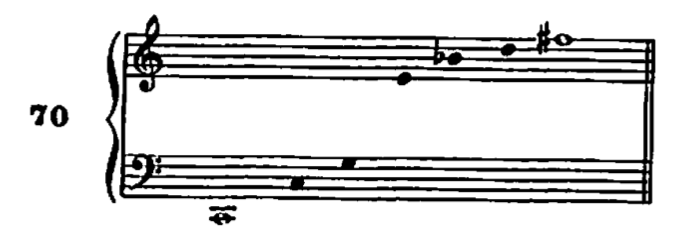
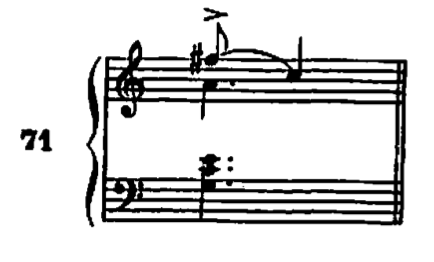
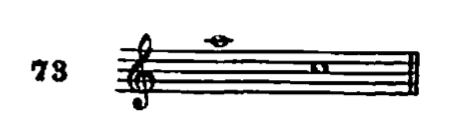
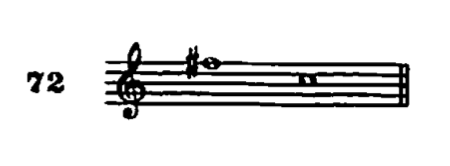

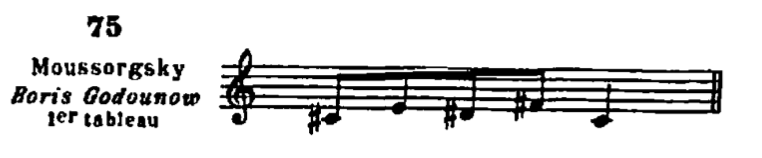
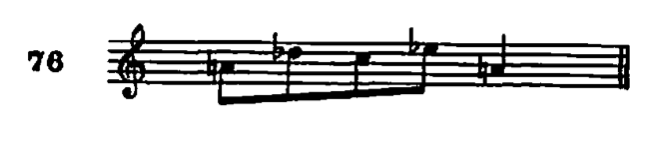
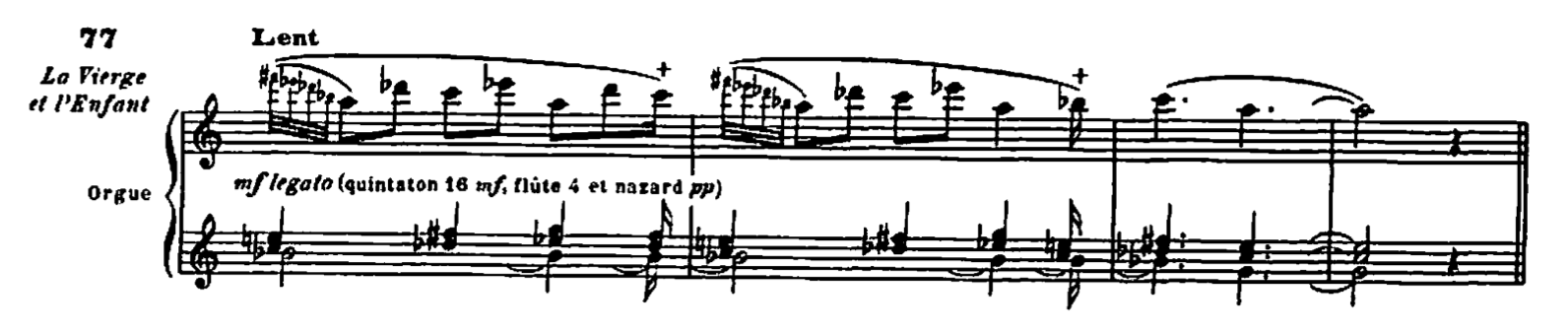







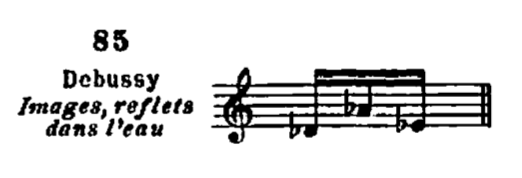
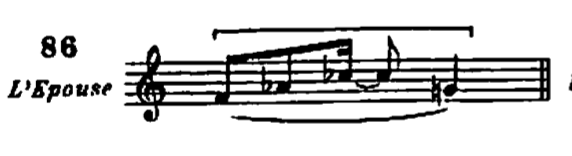

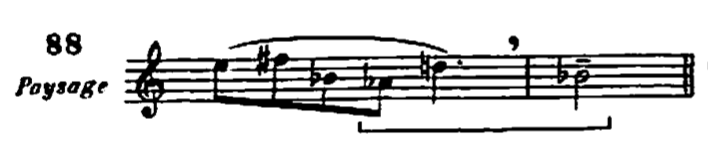





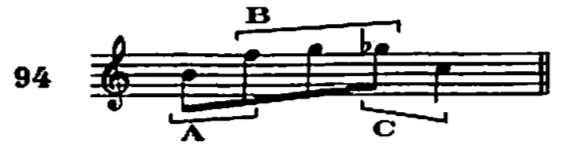




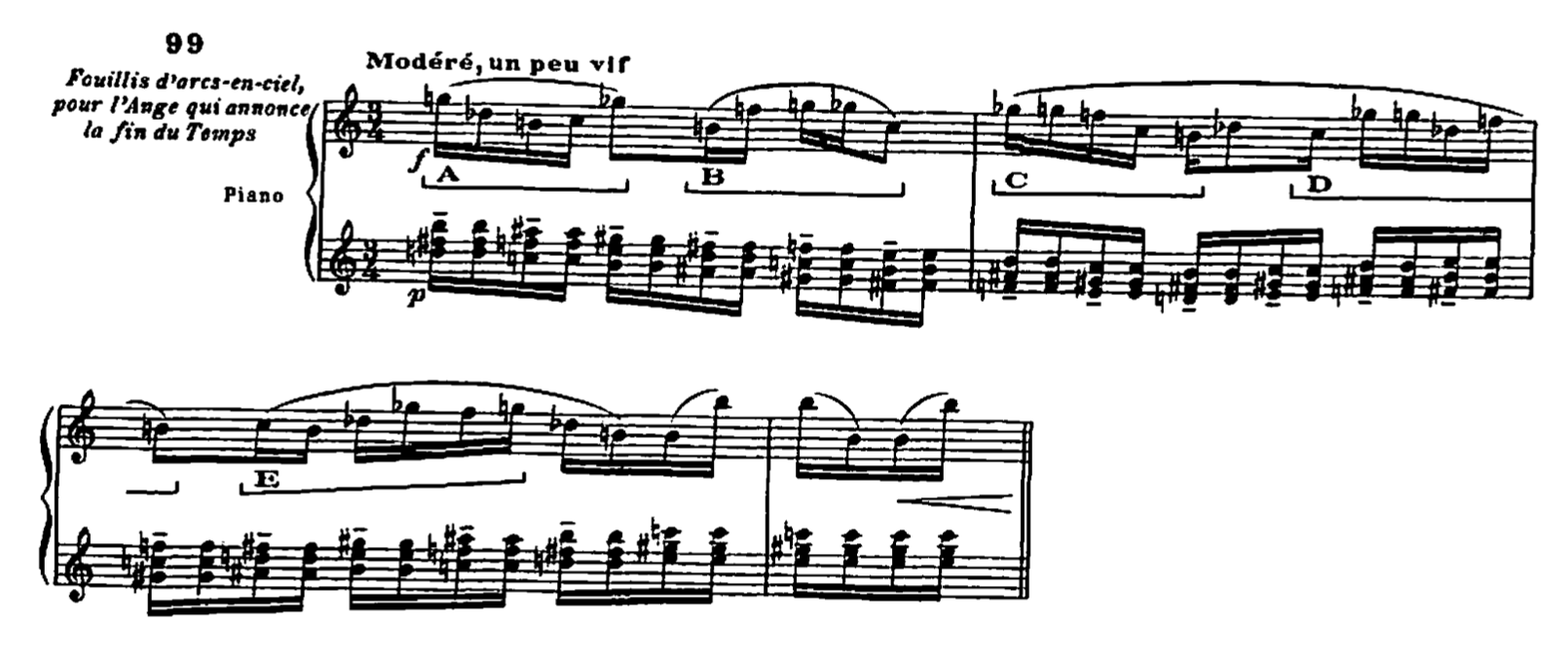

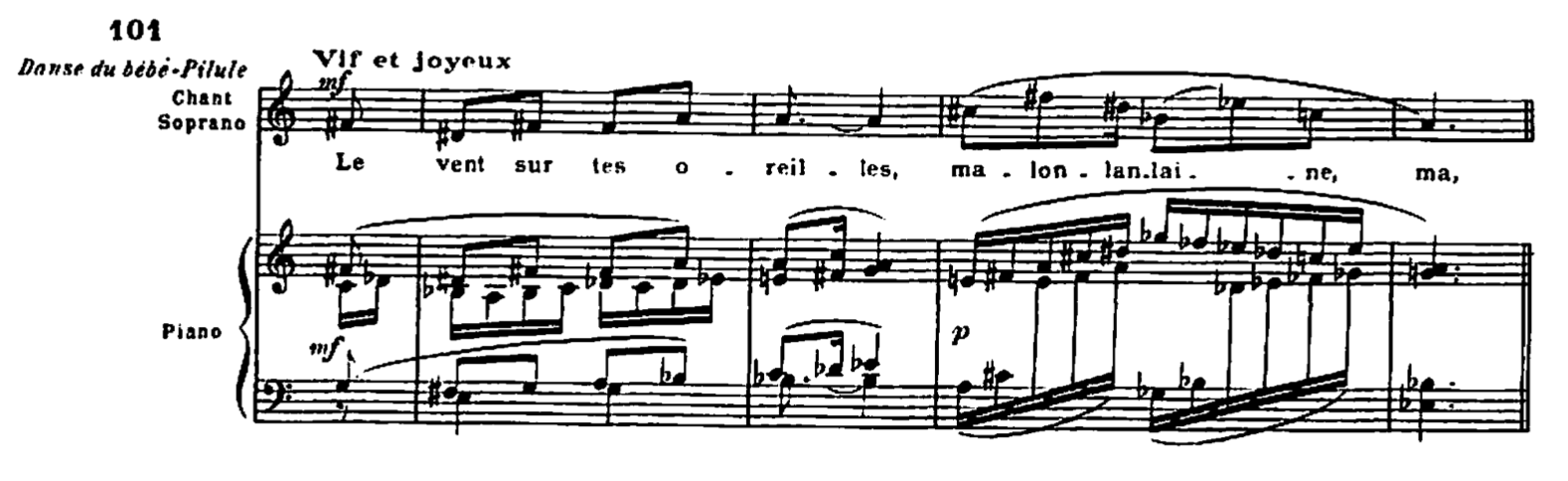
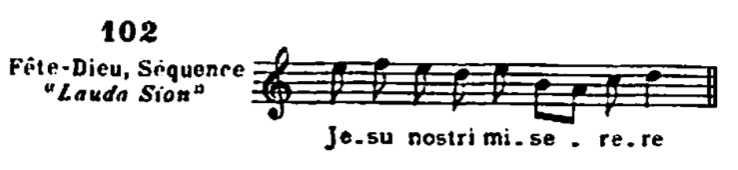
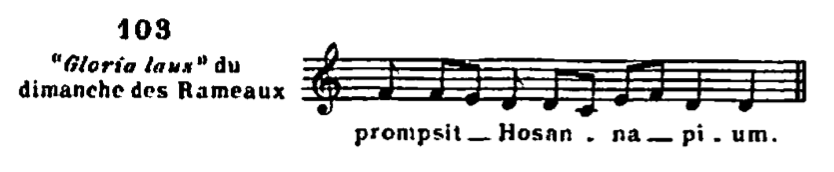
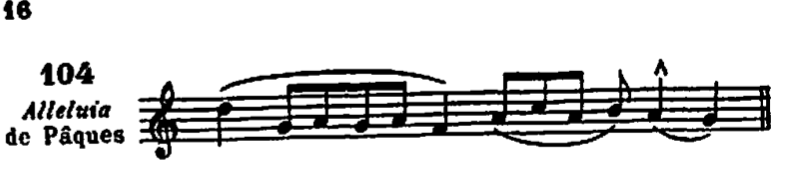
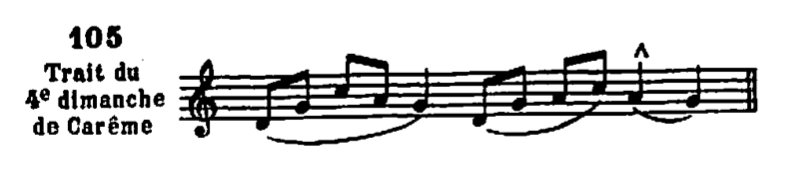
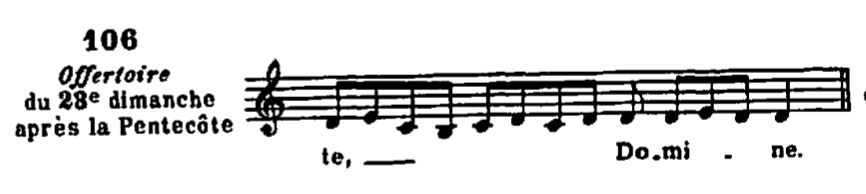
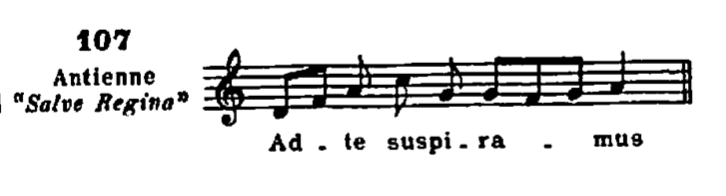

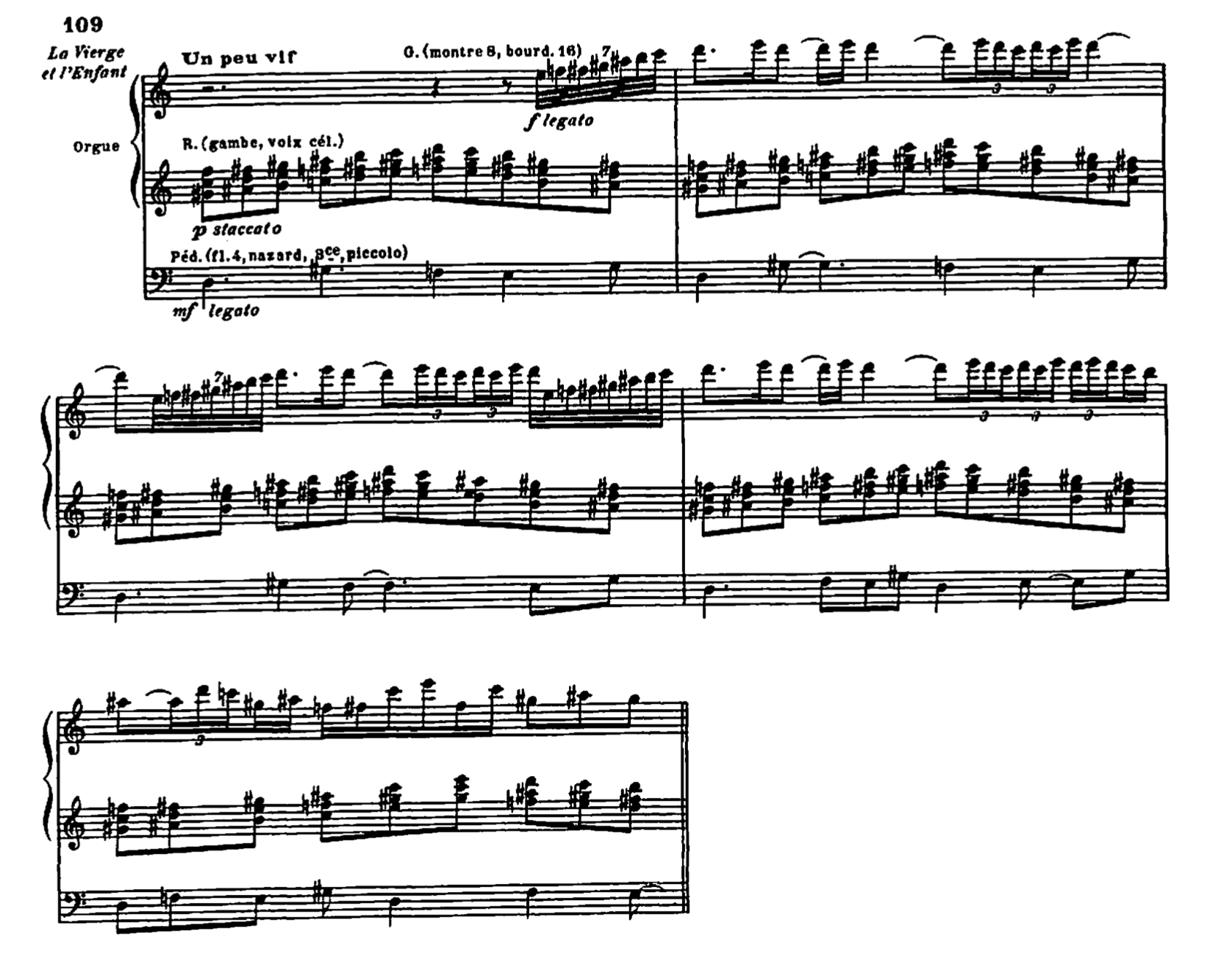


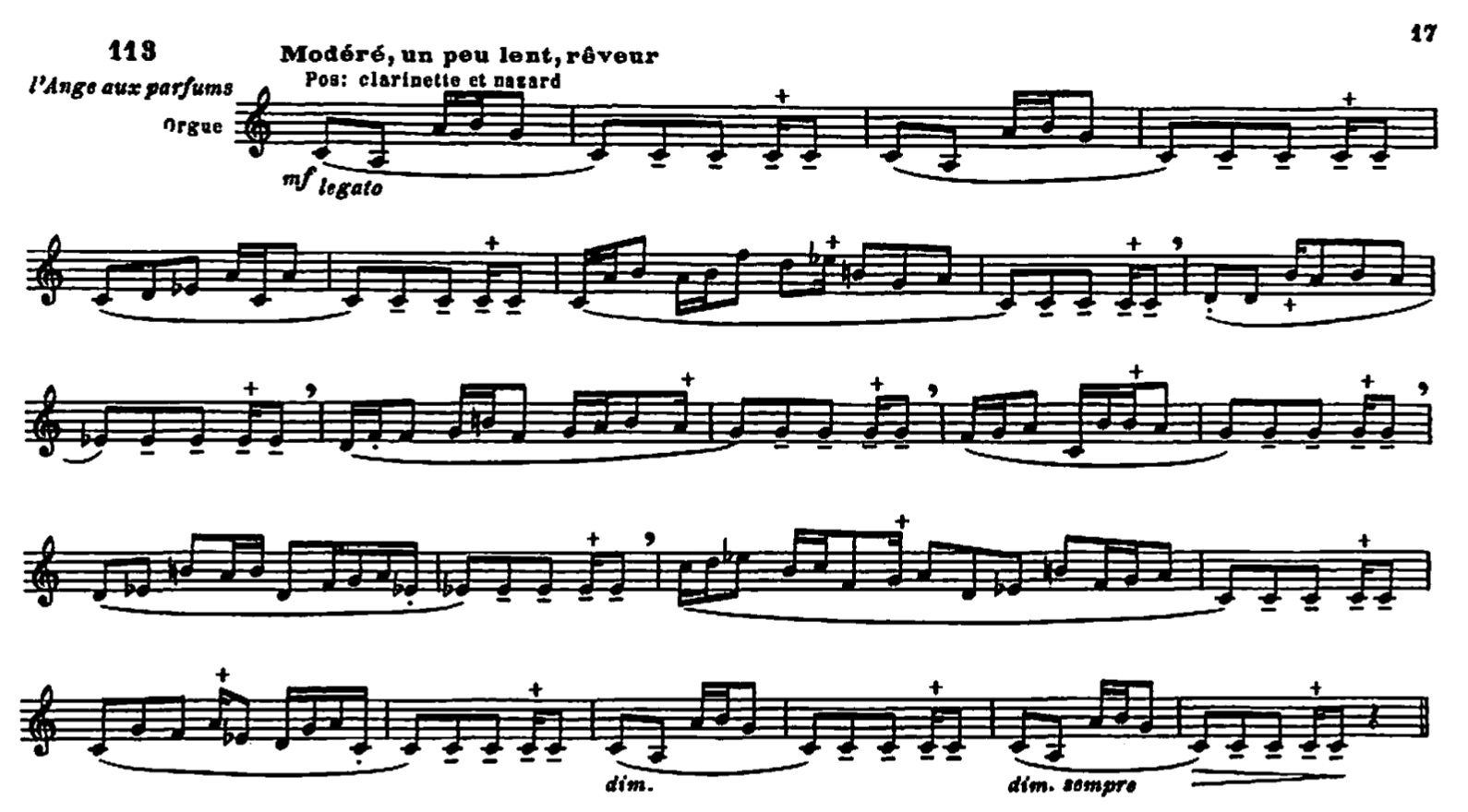
Overview
This chapter initiates the treatise's melodic section by establishing fundamental principles of interval choice and melodic contour construction. Messiaen begins by reaffirming melody's supremacy—it is the noblest element of music and the principal aim of investigation, with rhythm remaining pliant and giving precedence to melodic development. He invokes Paul Dukas's pedagogical principle that harmony must be chosen to be "true"—wanted by the melody and its outcome. The chapter then systematically explores intervallic preferences (descending augmented fourths and major sixths), melodic cadential formulas derived from historical models (Moussorgsky, Grieg, Debussy), folk song influences (Russian and French), plainchant contours, and Hindu ragas. This synthetic approach—drawing from Western art music, folk traditions, liturgical repertoire, and non-Western sources—demonstrates Messiaen's method of historical synthesis applied to melody, paralleling his approach to rhythm in Chapter II. The chapter functions as a catalog of melodic resources rather than a systematic theory, identifying preferred intervals, characteristic contours, and source materials that inform Messiaen's melodic practice.
Key Concepts
This chapter introduces six foundational concepts related to melody and melodic contours:
- Melodic Supremacy and Harmonic Truth - Melody as primary generative element with harmony chosen to fulfill melodic implications
- Intervallic Preferences: Descending Augmented Fourth and Major Sixth - Specific intervals forming foundational elements of melodic language
- Melodic Cadence Formulas - Characteristic patterns derived from historical models functioning as closural gestures
- Folk Song Influences - Melodic characteristics from Russian and French folk traditions
- Plainchant Contours - Melodic patterns derived from Gregorian chant and liturgical traditions
- Hindu Ragas - Melodic modes from Indian classical music providing non-Western resources
Melodic Supremacy and Harmonic Truth
Definition: The hierarchical principle that melody constitutes the primary generative element in musical composition, with rhythm serving melodic development and harmony chosen to fulfill melodic implications—harmony must be "true" in the sense of being wanted by and emerging from the melody.
Messiaen's Treatment: Messiaen opens by declaring melodic supremacy: melody is the noblest element of music and may be the principal aim of investigation. He quotes Paul Dukas's pedagogical advice to students about intervals and their choice: work melodically, with rhythm remaining pliant and giving precedence to melodic development, and harmony chosen being "true"—that is to say, wanted by the melody and the outcome of it.
This reiterates the hierarchical relationship established in Chapter I: melody is sovereign, rhythm and harmony are "faithful servants." Dukas's counsel emphasizes that harmonic choices should emerge from melodic implications rather than being imposed from external voice-leading rules or progressional formulas. The melody generates its own harmony through its intervallic content, contour, and expressive trajectory.
Modern Context: This represents a melodically-centered compositional philosophy contrasting with:
- Harmonic-centric approaches: Traditional theory emphasizing chord progression and voice-leading as generative (Rameau, Fux, figured bass practice)
- Contrapuntal approaches: Equal-voice polyphony where no single line dominates (Renaissance counterpoint, Bach fugues)
- Serial approaches: Treating all parameters as equal and subject to systematic organization (Schoenberg, Webern, Boulez)
Messiaen's melodic primacy aligns more closely with:
- Romantic melodic thinking: Melody as primary expressive vehicle (Chopin, Schumann)
- Debussy's approach: Melody generating its own harmony through modal implications
- Folk and non-Western traditions: Where melodic systems (modes, ragas, maqamat) determine harmonic contexts
Contemporary music theory recognizes that different compositional philosophies privilege different parameters. Messiaen's explicit melodic hierarchy represents a conscious choice positioning him within a melodic rather than harmonic or contrapuntal tradition.
The concept of harmonic "truth"—harmony wanted by the melody—suggests organic relationships between melodic and harmonic dimensions rather than their mechanical combination. This anticipates his discussion of added notes (Chapter XIII) where harmonic color emerges from melodic necessity.
Examples: The principle governs all melodic examples in this chapter, though it is stated conceptually rather than demonstrated through specific examples.
Intervallic Preferences: Descending Augmented Fourth and Major Sixth
Definition: Specific melodic intervals that Messiaen identifies as particularly expressive and characteristic, forming foundational elements of his melodic language—the descending augmented fourth (tritone) and the descending major sixth.
Messiaen's Treatment: Messiaen encroaches upon Chapter XIII's harmonic domain to recall that a fine ear clearly perceives an F-sharp in the natural resonance of low C (Example 70). This F-sharp is endowed with attraction toward C, which becomes its normal resolution (Example 71). This establishes the descending augmented fourth as the first interval to choose (Example 72).
He notes the importance of the added sixth in the perfect chord (foreseen by Rameau and established by Debussy, referenced in Chapter XIII) and that Mozart, "that great melodist," often used the descending major sixth. Therefore, Messiaen chooses that interval anew (Example 73).
Finally, certain returning chromatic formulas would be the joy of Béla Bartók (Example 74).
Modern Context: The intervallic choices reflect both acoustic and stylistic considerations:
Descending augmented fourth (tritone):
- Acoustically justified through the harmonic series—the 11th partial creates a neutral interval approximating the tritone
- Historically significant as the diabolus in musica, requiring careful treatment in traditional counterpoint
- Modernist revaluation—Scriabin, Bartók, and Stravinsky exploit tritone relationships structurally and harmonically
- In Messiaen's system, the descending resolution (F# to C) inverts the traditional augmented fourth requiring upward resolution, creating a distinctive melodic gesture
Descending major sixth:
- The added sixth chord (major triad with added sixth) produces the sixth as a characteristic melodic interval when arpeggiated or when melody moves from root to sixth
- Mozart's frequent use provides historical precedent
- Debussy's impressionistic harmony emphasizes added-note sonorities including sixths
- The interval's open, consonant quality contrasts with the tritone's tension, providing melodic variety
Contemporary pitch-class set theory recognizes both intervals as distinctive sonorities:
- Tritone (interval class 6): Maximally dissonant in traditional theory, divides the octave symmetrically
- Major sixth (interval class 9): Consonant, often functions as upper extension in tertian harmony
Messiaen's identification of these intervals as characteristic reflects his synthesis of acoustic reasoning (harmonic series justification for tritone), historical precedent (Mozart's sixths, Rameau/Debussy's added sixths), and personal preference. The combination of tensional tritone and open sixth provides melodic palette spanning maximum contrast.
The reference to Bartók's chromatic formulas connects Messiaen's practice to contemporary folk-influenced modernism, acknowledging shared interest in chromatic inflection within modal frameworks.
Examples: Examples 70–74 demonstrate the acoustic basis and melodic applications of these preferred intervals.
Melodic Cadence Formulas
Definition: Characteristic melodic patterns functioning as closural gestures, derived from historical models and adapted to Messiaen's harmonic language—recurring contours that signal phrase endings or structural articulations.
Messiaen's Treatment: Messiaen identifies several cadential formulas:
-
Five-note opening from Moussorgsky's Boris Godounov (Example 75): Used as basis for first melodic cadence formula (Example 76), applied with added values (Chapter III) and harmonies from Mode 2 (Chapter XVI), shown in Example 77. Further uses appear in Examples 78–79.
-
Grieg's Chanson de Solveig (Example 80): Serves as point of departure for a theme (Example 81), with other uses in Examples 82–84.
-
Debussy's three-note opening from Reflets dans l'eau (Example 85): Engenders numerous melodic contours (Examples 86–89).
-
Descending augmented fourths (Example 90) and descending major sixths (Example 91).
-
Returning chromatic formulas (Example 92), bracketed to show the returning chromaticisms, incorporating added values and rāgavardhana interpretation (Chapter II), shown in Example 93.
-
Formula containing returning chromaticism in B with two intervals of diminished fifth in A and C (Example 94)—the diminished fifth, harmonically equivalent to augmented fourth. Uses appear in Examples 95–99.
Example 99 develops the formula through contrary motion (A), normal motion (B), retrograde motion (D), and interversion of notes in C and E. This references Chapter X's discussion of melodic development and superposes Modes 5 and 6 (Chapter XVI).
Modern Context: Melodic cadence formulas represent identifiable contour patterns functioning similarly to harmonic cadences—gestures signaling closure or articulation. This relates to:
- Clausulae: Medieval cadential formulas with characteristic melodic patterns
- Galant schemata: Eighteenth-century stock melodic-harmonic patterns (Gjerdingen)
- Melodic archetypes: Recurring contour patterns appearing across repertoires (Narmour's implication-realization theory)
Messiaen's practice of deriving formulas from specific historical works (Moussorgsky, Grieg, Debussy) demonstrates compositional intertextuality—conscious reference to and transformation of existing materials. This differs from unconscious stylistic absorption; Messiaen explicitly acknowledges sources and shows their transformation through his techniques (added values, modal harmonization, rhythmic treatment).
Contemporary music theory recognizes melodic contour as a significant structural feature independent of specific pitch content. Contour analysis (Friedmann, Morris) shows that intervallic direction patterns (up-down-up, descending stepwise, etc.) function as recognizable shapes even when exact intervals change. Messiaen's formulas operate primarily through contour—the specific pitches matter less than the directional pattern and characteristic intervals.
The transformation techniques applied to these formulas (contrary motion, retrograde, interversion) demonstrate that melodic material can undergo operations similar to rhythmic transformations (Chapter IV–V), extending parametric thinking to the melodic domain.
Examples: Examples 75–99 systematically present source materials and their transformations into Messiaen's melodic cadences.
Folk Song Influences
Definition: Melodic characteristics derived from folk music traditions, particularly Russian and French folk songs, providing Messiaen with modal resources and characteristic contours distinct from Western art music conventions.
Messiaen's Treatment: Messiaen identifies remarkable melodies in old French songs and especially Russian folklore, advocating remembering them and passing them through the "deforming prism of our language." The Russian song Point n'était de vent ("There was no wind") haunted his youth; he finds in it the five notes of Boris that inspired the first formula of melodic cadence (Example 100).
One can also create false folk songs without forgetting the "little refrain in onomatopes" (Example 101).
Modern Context: This represents Messiaen's engagement with folk sources, paralleling his use of Hindu rhythm (Chapter II) and plainchant (discussed later in this chapter). His approach involves:
- Source identification: Recognizing specific folk melodies with distinctive characteristics
- Analytical extraction: Identifying the essential features (modal content, characteristic intervals, contour patterns)
- Stylistic transformation: Passing sources through the "deforming prism" of his personal language—reharmonizing, rhythmicizing, and recontextualizing folk materials
The phrase "deforming prism" is significant—Messiaen does not claim faithful preservation of folk sources but rather their transformation through his compositional lens. This represents a different relationship to folk material than:
- Nationalist composers (Bartók, Kodály): Systematic collection, transcription, and analysis of folk music with efforts toward authentic preservation
- Quotation practice (Ives, Berio): Direct quotation of folk melodies in art music contexts
- Neoclassicism (Stravinsky): Stylistic evocation without necessarily using actual folk melodies
Messiaen's approach more closely resembles Debussy's transformation of gamelan influences—absorption and reinterpretation rather than quotation or ethnographic fidelity.
The creation of "false folk songs" (Example 101) demonstrates that folk characteristics can be abstracted into generative principles—modal content, characteristic intervals, simple phrase structures, onomatopoetic elements—and applied to create new melodies in folk style without being actual folk melodies. This anticipates later practices of "imaginary folklore" (Ligeti's Hungarian Rock, Janáček's invented folk materials).
Examples: Examples 100–101 demonstrate Russian folk influence and false folk song creation.
Plainchant Contours
Definition: Melodic patterns derived from Gregorian chant and other plainchant traditions, representing a vast repository of modal melodic writing that Messiaen adapts to his compositional practice.
Messiaen's Treatment: Messiaen identifies plainchant as an "inexhaustible mine of rare and expressive melodic contours" (Examples 102–107). He proposes making use of them while forgetting their modes and rhythms for the use of ours.
A single example of this transformation: from a fragment of the Introit de Noël (Example 108) he draws a transformed version (Example 109). The transformation employs the strange choice of timbres, Mode 6 (Chapter XVI), repetitions of melodic dominant, final melodic descent, foundation of chords repeating themselves in groups of eleven eighth-notes, and rhythmic variations of the shrill carillon of the pedal accentuate the change.
Example 110 shows the pedal carillon based upon a fragment in which he recognizes the first formula of melodic cadence (Example 76), noting it sounds an octave higher than notation. Messiaen emphasizes that more than to melodic contours of plainchant, he will apply himself to its forms: Anthems, Alleluias, Psalmodics, Kyrie, Sequence, etc., which will be treated at length in Chapter XII.
Modern Context: Plainchant represents one of the most significant influences on Messiaen's melodic language. His approach involves:
- Contour extraction: Taking the melodic shapes and characteristic gestures from plainchant
- Modal and rhythmic transformation: Recontextualizing plainchant melodies in his modes of limited transposition (rather than church modes) and his rhythmic system (rather than traditional chant rhythm)
- Formal influence: Beyond melodic contours, plainchant forms provide structural models (detailed in Chapter XII)
This parallels other twentieth-century engagements with plainchant:
- Debussy: Modal harmony and melodic freedom influenced by chant
- Stravinsky: Chant-based works (Symphony of Psalms, Mass)
- Pärt: Tintinnabuli style drawing on medieval sacred music
- Post-Vatican II sacred music: Revival of chant-influenced composition
Messiaen's Catholic faith makes plainchant a particularly significant source—it represents both musical resource and liturgical/spiritual tradition. His transformation of plainchant parallels his treatment of Hindu rhythm—respectful appropriation and adaptation rather than preservation or quotation.
The specific transformation demonstrated (Examples 108–109) shows how radically he reconceives source material: the chant fragment becomes embedded in complex harmonic (Mode 6), timbral (strange choice of timbres), rhythmic (groups of eleven, rhythmic variations), and textural (repeated chords, carillon pedal) contexts far removed from monophonic liturgical chant. The melodic contour persists, but everything else transforms.
Examples: Examples 102–110 demonstrate plainchant sources and transformations.
Hindu Ragas
Definition: Melodic modes from Indian classical music, characterized by specific pitch collections, characteristic phrases, ornamentations, and expressive associations, providing Messiaen with additional non-Western melodic resources.
Messiaen's Treatment: Messiaen observes that Hindu music abounds in curious, exquisite, unexpected melodic contours which native improvisers repeat and vary following raga rules. He provides two ravishing examples ending on repeated notes (Examples 111–112).
A theme uniting added value (Chapter III) and Hindu melodic color appears in Example 113, with added values marked by crosses.
Modern Context: This represents Messiaen's second major engagement with Indian music (after Chapter II's rhythmic focus). His approach to ragas differs from his rhythmic appropriation:
- Rhythmic borrowing (Chapter II): Specific patterns (rāgavardhana) analyzed structurally and transformed into compositional principles
- Melodic borrowing (Chapter VIII): General acknowledgment of raga characteristics and expressive contours without systematic analysis of raga theory
This reflects the complexity of raga systems. Ragas involve:
- Pitch collections: Specific scale patterns (ascent and descent may differ)
- Characteristic phrases (pakad): Identifying melodic gestures
- Ornamentations: Specific gamaka (pitch inflections) and phrase elaborations
- Temporal and expressive associations: Time of day, season, emotional character (rasa)
Messiaen's engagement with ragas appears more impressionistic than his rhythmic borrowing—appreciating their expressive contours and unexpected melodic shapes without systematically analyzing their theoretical structure. This may reflect:
- Available sources: 1940s French musicology provided better documentation of rhythmic structures (Çârngadeva's tāla lists) than raga performance practice
- Complexity of raga system: Performance-based tradition requiring direct study with practitioners
- Melodic vs. rhythmic appropriation: Easier to extract rhythmic patterns as fixed structures than to systematically adapt improvisatory melodic traditions
Later composers developed more systematic engagements with ragas (La Monte Young, Terry Riley, minimalists studying with Indian musicians), but Messiaen's 1944 approach represents an early Western art music acknowledgment of raga as melodic resource.
The combination of added values with "Hindu melodic color" (Example 113) demonstrates cross-parametric synthesis—rhythmic techniques from one tradition (Hindu tāla analysis) combined with melodic characteristics from the same tradition, recontextualized within Messiaen's harmonic language.
Examples: Examples 111–113 demonstrate raga-influenced melodies and their integration with Messiaen's rhythmic techniques.
Relationship to Other Chapters
Chapter VIII initiates the melodic section and connects to multiple other chapters:
-
Chapter I (Charm of Impossibilities): The assertion of melodic supremacy fulfills Chapter I's declaration that melody is sovereign, with rhythm and harmony as servants.
-
Chapter II (Rāgavardhana): The Hindu raga section extends the engagement with Indian music from rhythmic to melodic domains.
-
Chapter III (Added Values): Added values are applied to melodic formulas (Examples 77, 93, 113), demonstrating that rhythmic techniques enhance melodic expression.
-
Chapter X (Melodic Development): Example 99's discussion of contrary motion, normal motion, retrograde, and interversion previews transformational techniques developed systematically in Chapter X.
-
Chapter XII (Fugue, Sonata, Plainchant Forms): The plainchant discussion here focuses on melodic contours; Chapter XII addresses formal structures derived from plainchant.
-
Chapter XIII (Harmony, Debussy, Added Notes): The intervallic discussion of augmented fourths and major sixths connects to harmonic structures (added sixth chords, tritone relationships) developed in the harmony chapters. The reference to harmonic "truth" anticipates detailed harmonic discussion.
-
Chapter XVI (Modes of Limited Transpositions): Multiple examples reference modes (Mode 2 in Example 77, Mode 6 in Example 109, Modes 5 and 6 in Example 99), showing melodic contours harmonized within symmetrical modal collections.
The chapter establishes methodological patterns for the melodic section: drawing from multiple historical and cultural sources (Western art music, folk traditions, plainchant, non-Western music), extracting characteristic features, and transforming them through Messiaen's systematic techniques. This parallels the rhythmic section's synthetic approach.
Summary
Chapter VIII establishes fundamental principles for Messiaen's melodic practice, beginning with the assertion of melodic supremacy and Dukas's counsel that harmony must be "true" to melodic implications. By identifying preferred intervals (descending augmented fourth and major sixth), systematically cataloguing melodic cadence formulas derived from Moussorgsky, Grieg, and Debussy, and acknowledging influences from folk song, plainchant, and Hindu ragas, Messiaen constructs a synthetic melodic language drawing from diverse sources. The chapter functions more as resource catalog than systematic theory—unlike the rhythmic section's progressive development of transformational techniques, the melodic section presents a collection of characteristic intervals, contours, and source materials that inform compositional practice. The transformations demonstrated (added values applied to melodies, modal reharmonization, contrary motion and retrograde operations) show that melodic material can undergo systematic manipulation analogous to rhythmic transformation.
For contemporary readers, this chapter illustrates how composers construct personal melodic languages through synthesis—consciously drawing from and transforming multiple traditions rather than working within a single stylistic framework. The invocation of historical precedent (Mozart's sixths, Debussy's three-note figures) combined with non-Western resources (Hindu ragas) and liturgical traditions (plainchant) demonstrates the eclectic foundation of modernist melodic practice. Messiaen's phrase about passing folk song through the "deforming prism of our language" encapsulates his appropriative method—acknowledging sources while claiming the right to transform them substantially. This chapter begins establishing melody as the generative element that rhythm serves and harmony fulfills, positioning melodic thinking at the center of Messiaen's compositional philosophy.
Chapter IX: Bird Song
Original: Page 34 in Satterfield translation
Musical Examples:
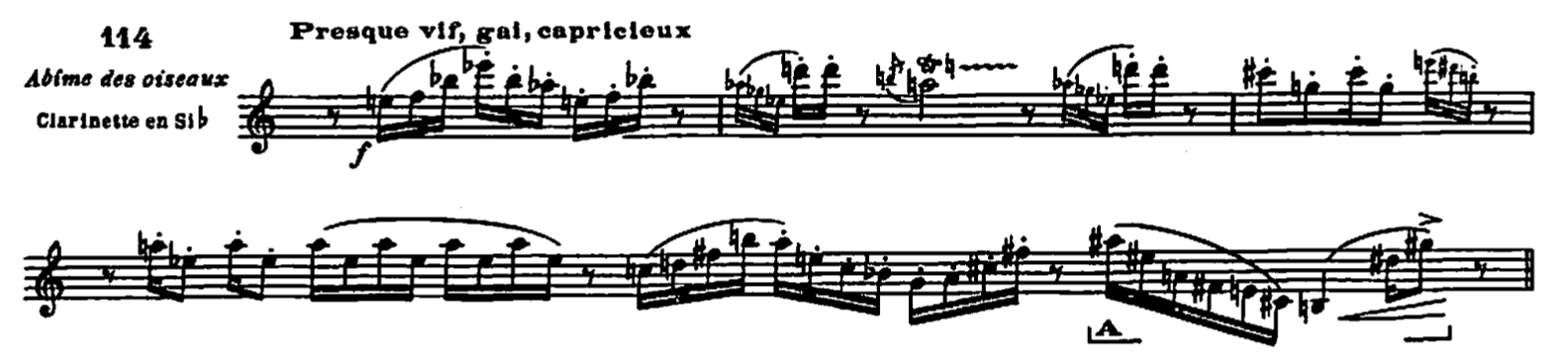
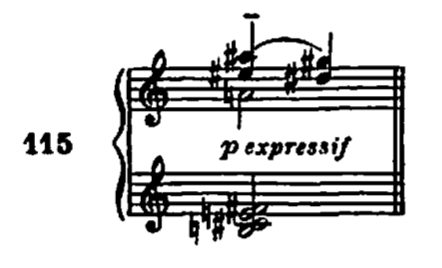


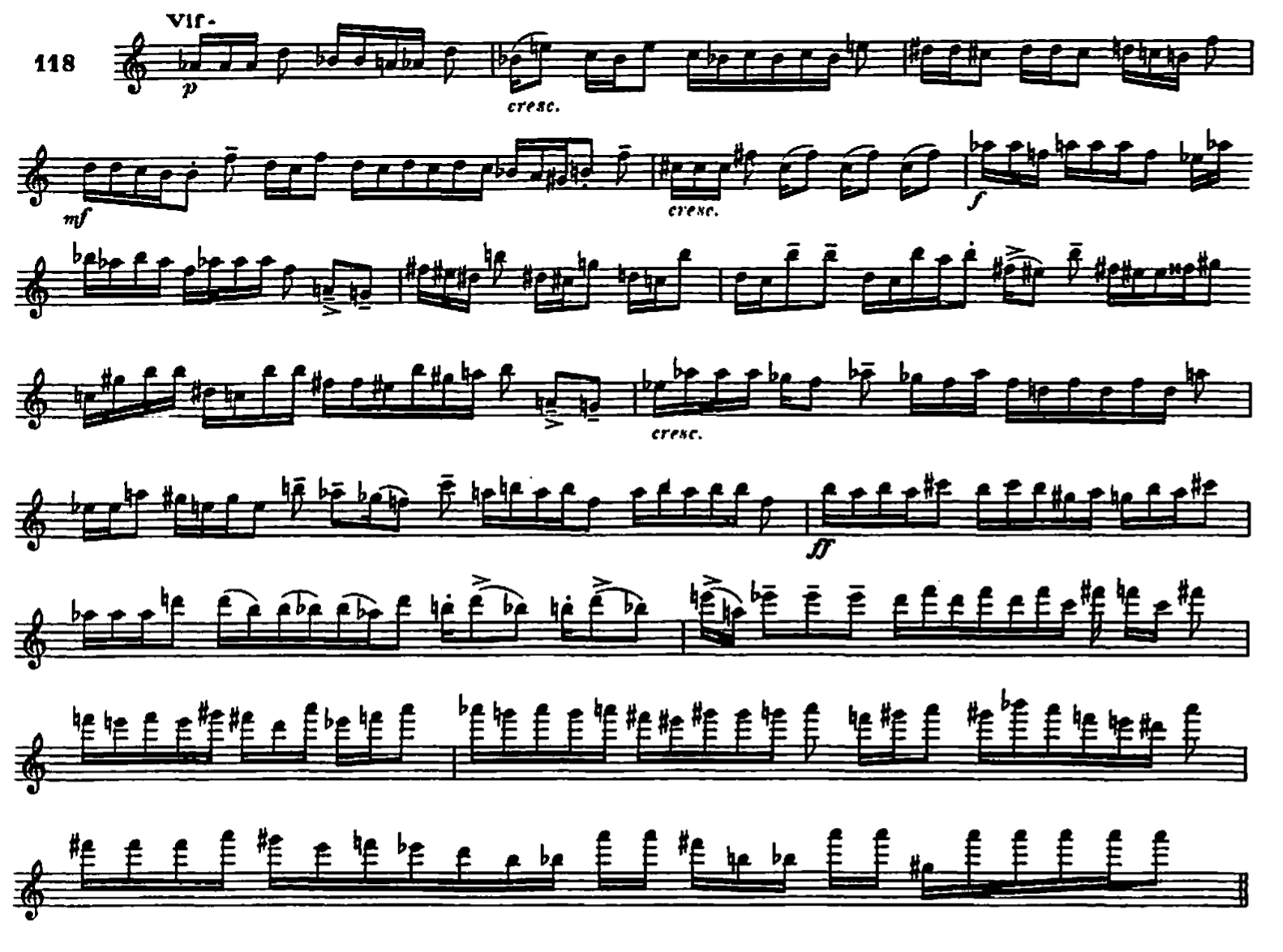
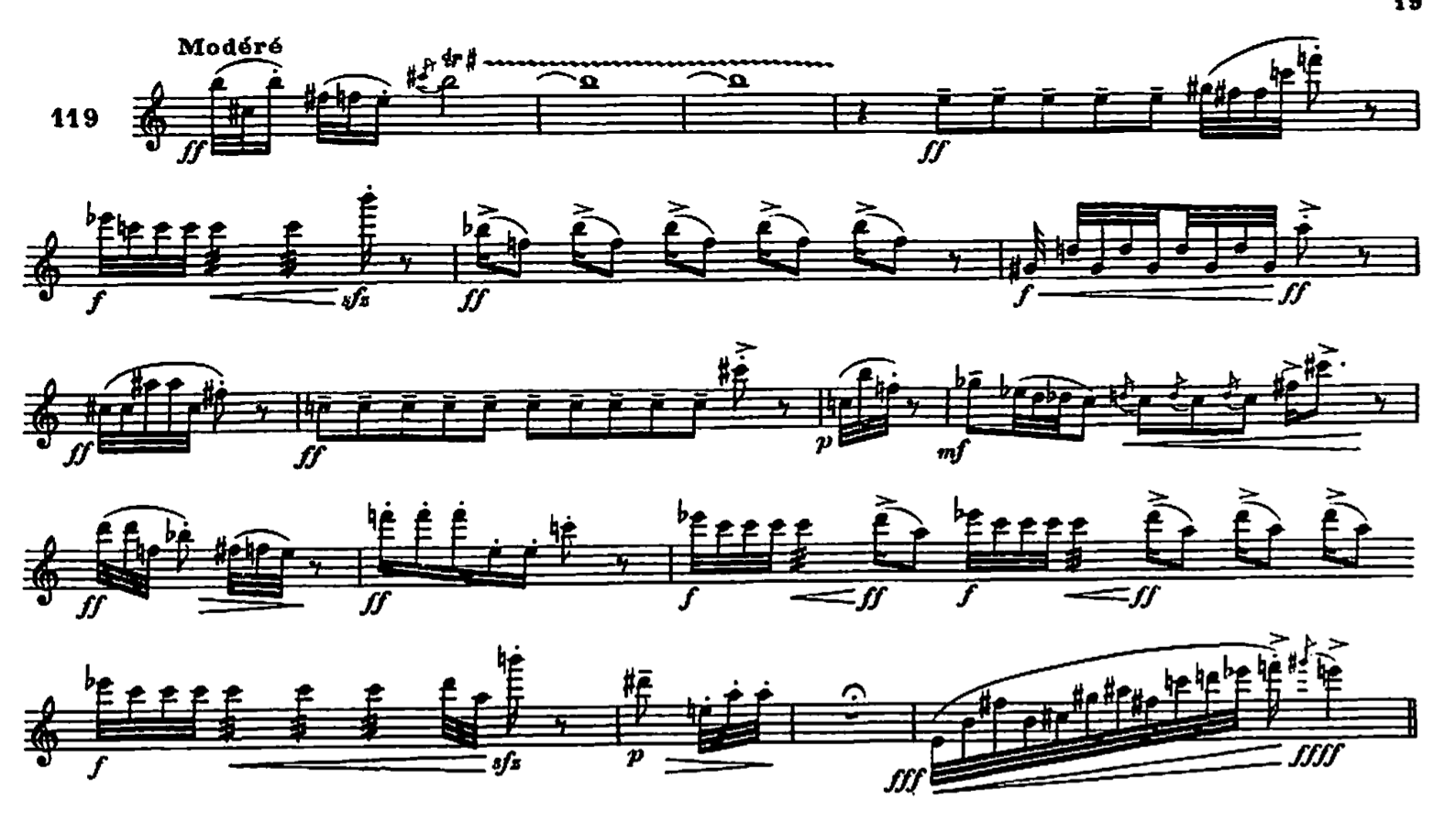
Overview
This brief but seminal chapter introduces one of Messiaen's most distinctive and enduring sources: bird song. Beginning with Paul Dukas's pedagogical counsel—"Listen to the birds. They are great masters"—Messiaen acknowledges the incomparable nature of avian music while justifying his transcription and transformation of bird vocalizations into composed material. The chapter articulates both aesthetic admiration (birds as masters of refined rhythmic pedals, fantasy-surpassing melodic contours) and pragmatic methodology (transcription, transformation, interpretation). Messiaen's engagement with bird song represents a unique position in twentieth-century music: neither programmatic imitation nor abstract appropriation, but rather a systematic incorporation of natural sound patterns as primary melodic resources. This chapter plants seeds that will dominate his later compositional career—from the 1950s onward, bird song becomes increasingly central, culminating in massive ornithological works like Catalogue d'oiseaux (1956–58) and Des canyons aux étoiles... (1971–74). In 1944, however, bird song appears as one melodic source among many (folk song, plainchant, ragas), not yet the consuming preoccupation of his mature period.
Key Concepts
This chapter introduces five key concepts related to bird song as melodic source:
-
Birds as Great Masters - The aesthetic and pedagogical principle positioning birds as teachers and models for composers
-
Microtonal Intervals and the Problem of Transcription - The methodological challenge of notating bird vocalizations using intervals smaller than the semitone
-
Bird Style (Genre d'oiseau) - A compositional genre characterized by melodies inspired by and modeled on bird vocalizations
-
Transcription, Transformation, and Interpretation - The three-stage methodology for converting bird vocalizations into composed material
-
Volleys and Trills - Characteristic vocal patterns in bird song featuring rapid sequences and alternations
Birds as Great Masters
Definition: The aesthetic and pedagogical principle that bird vocalizations represent exemplary music worthy of serious study and emulation, positioning birds as teachers and models for human composers.
Messiaen's Treatment: Messiaen opens with Dukas's directive: "Listen to the birds. They are great masters." He confesses not having awaited this advice to admire, analyze, and notate some songs of birds. Through their songs' mixture, birds make "extremely refined jumbles of rhythmic pedals"—their melodic contours, especially those of merles (blackbirds), surpass human imagination in fantasy.
This establishes several key ideas:
- Birds as teachers: Not merely objects of imitation but sources of compositional wisdom
- Rhythmic sophistication: Birds naturally create complex polyrhythmic textures ("jumbles of rhythmic pedals")
- Melodic fantasy: Bird contours exceed human invention in unpredictability and variety
- Serious study required: Admiration, analysis, and notation—systematic engagement, not casual listening
Modern Context: Messiaen's position on bird song is distinctive in music history:
Historical precedents:
- Renaissance and Baroque: Programmatic bird imitations (cuckoo calls, nightingale songs) as decorative effects (Janequin's Le Chant des oiseaux, Couperin's Le Rossignol)
- Romantic era: Bird songs as pastoral symbols (Beethoven's Pastoral Symphony, Wagner's Siegfried)
- Impressionism: Atmospheric evocation of natural sounds (Debussy's Prélude à l'après-midi d'un faune)
Messiaen's approach differs:
- Systematic transcription: Detailed notation of actual bird vocalizations rather than stylized imitations
- Primary material: Bird songs as compositional substance, not programmatic decoration
- Aesthetic elevation: Birds as "masters" worthy of emulation, not merely subjects for imitation
Later developments:
- Electroacoustic music: Recording and processing natural sounds (Ferrari, Westerkamp)
- Spectralism: Analysis of natural timbres and sound spectra (Grisey, Murail)
- Ecological music: Engagement with environmental sounds and acoustic ecology (Oliveros, Schafer)
Contemporary ornithology and bioacoustics recognize bird song as learned, culturally transmitted behavior exhibiting regional dialects, individual variation, and complex structural organization. Messiaen's intuition that bird songs merit serious musical study anticipates scientific understanding of avian vocal complexity.
The concept of "rhythmic pedals" connects bird song to the technique developed in Chapter VI—repeating patterns operating independently of surrounding activity. Messiaen hears natural birdsong polyphony as analogous to his compositional polyrhythm.
Examples: The principle is stated conceptually; specific bird songs appear in subsequent examples.
Microtonal Intervals and the Problem of Transcription
Definition: The methodological challenge of notating bird vocalizations that employ intervals smaller than the semitone—pitches falling between conventional Western tuning system's categories, requiring compromise or transformation in transcription.
Messiaen's Treatment: Messiaen notes that birds use "untempered intervals smaller than the semitone," and since "it is ridiculous servilely to copy nature," he intends to give examples of melodies of the "bird" genre which will be "transcription, transformation, and interpretation of the volleys and trills of our little servants of immaterial joy."
This establishes his methodological position:
- Acknowledgment of microtonal reality: Birds sing in intervals unavailable in equal temperament
- Rejection of literal copying: "Ridiculous to servilely copy nature"—transcription requires interpretation
- Three-stage process: Transcription (hearing and notating), transformation (adapting to compositional system), interpretation (creative realization)
- Genre rather than imitation: "Bird" genre—stylistic category inspired by birds, not ornithological documentation
Modern Context: The microtonal problem is fundamental to transcribing non-Western music, natural sounds, and any pitch phenomena not conforming to equal temperament:
Transcription challenges:
- Pitch quantization: Rounding microtonal pitches to nearest semitone loses information
- Temporal quantization: Notating fluid, unmeasured rhythms in conventional notation imposes metric frameworks
- Timbral reduction: Piano or orchestra cannot reproduce avian vocal timbres
Alternative approaches:
- Spectral notation: Representing sounds through frequency/amplitude graphs rather than conventional notation
- Microtonal notation: Using quarter-tones, sixth-tones, or cent deviations (Boulez, Ferneyhough)
- Recording: Electroacoustic works preserve actual sounds without notational mediation
Messiaen's solution—"transformation and interpretation"—acknowledges that transcription is inherently creative, not documentary. The notation represents a human composer's understanding and adaptation of bird vocalization, not the vocalization itself. This reflects sophisticated understanding of notation's limitations and the necessary gap between natural sound and musical representation.
The phrase "ridiculous to servilely copy nature" also positions Messiaen against naive mimesis—art transforms and interprets rather than merely reproducing. This aligns with broader modernist aesthetics rejecting literal representation in favor of creative transformation.
The characterization of birds as "little servants of immaterial joy" reveals theological dimension—birds serve divine creation through their song, and their music participates in spiritual transcendence. This connects to Messiaen's Catholic faith and his view of nature as divine manifestation.
Examples: The transcriptions that follow (Examples 114–119) represent Messiaen's transformations rather than literal bird song transcriptions.
Bird Style (Genre d'oiseau)
Definition: A compositional genre or stylistic category characterized by melodies inspired by and modeled on bird vocalizations, incorporating their rhythmic freedom, melodic unpredictability, ornamental complexity, and characteristic contours while adapting them to Messiaen's compositional system.
Messiaen's Treatment: Messiaen provides several examples of the "bird" genre:
Example 114: Drawn from Quatuor pour la fin du Temps, demonstrating the first instance.
Example 115: "In A, an arpeggio on the dominant chord with appoggiaturas (Chapter XIV, article 1)"—showing harmonic context for bird-style melody.
Example 116: References Chapter VI, Article 7, Example 60 (Liturgie de cristal) from the Quatuor; describes "the so fanciful melody of the clarinet, particularly typical of the bird style." This represents the merle (blackbird) call.
Example 117: "Four ornamental variations of a theme and its 'commentary' (see Chapter XI, article 2) which were suggested to me by the improvisations of a merle"—demonstrating how bird songs inspire formal variation structures.
Example 118: "The vehement tirralirra, always higher, of the lark"—capturing the ascending, excited character of lark vocalizations.
Example 119: "Hymn of the sparrows at daybreak"—depicting dawn chorus.
Modern Context: The concept of "bird style" represents Messiaen's distinctive contribution—a recognizable compositional genre with specific characteristics:
Stylistic features:
- Rhythmic freedom: Irregular, unpredictable rhythmic patterns avoiding metric regularity
- Melodic leaps: Wide intervallic jumps and rapid register changes
- Ornamental density: Trills, grace notes, rapid figurations suggesting avian vocal agility
- Registral extremes: High tessitura, particularly in wind instruments (clarinet, flute)
- Repetition and variation: Obsessive reiteration of motives with slight variations, mimicking territorial song
Instrumentation associations:
- Clarinet: Frequently used for blackbird (merle)
- Violin harmonics: Delicate, high-pitched bird calls
- Piano: Percussive attacks, rapid articulation
- Flute: Airy, high register bird songs
The reference to Liturgie de cristal from the Quatuor is significant—this movement features clarinet bird song over cello harmonic ostinato and piano rhythmic pedal, creating a dawn-chorus texture that became archetypal for Messiaen's bird-song compositions.
The merle (blackbird) appears twice (Examples 116, 117), indicating its importance as Messiaen's favorite bird. Later works feature extensive blackbird transcriptions, and Messiaen identified strongly with this species—the blackbird as the "musician-bird," most musical and improvisatory.
The connection to Chapter XI (melodic development, variation) shows that bird songs are not static transcriptions but materials for compositional development—themes to be varied, elaborated, and transformed through traditional formal procedures.
Examples: Examples 114–119 demonstrate various birds and contexts for bird-style writing.
Transcription, Transformation, and Interpretation
Definition: The three-stage methodology for converting bird vocalizations into composed musical material—hearing and notating the source (transcription), adapting it to compositional systems (transformation), and realizing it creatively within specific musical contexts (interpretation).
Messiaen's Treatment: This tripartite process represents Messiaen's practical approach:
-
Transcription: Field observation, listening, and initial notation of bird songs—attempting to capture pitch contours, rhythmic patterns, and characteristic gestures despite limitations of conventional notation and equal temperament.
-
Transformation: Adapting transcribed material to fit compositional systems:
- Quantizing microtonal pitches to semitones or incorporating them into modes of limited transposition
- Applying rhythmic techniques (added values, augmentation/diminution)
- Harmonizing bird melodies using characteristic chords and modal structures
- Adjusting for instrumental limitations and possibilities
-
Interpretation: Creative realization in specific compositional contexts:
- Varying bird songs through traditional developmental techniques (Chapter X–XI)
- Combining multiple bird songs in polyrhythmic textures
- Integrating bird material with non-bird material
- Expressive shaping for performance
Modern Context: This methodology represents sophisticated understanding of the relationship between source material and artistic result. It parallels approaches in:
- Ethnomusicology: Transcription and analysis of non-Western music requiring similar transformation stages
- Electroacoustic composition: Transformation of recorded natural sounds through processing
- Jazz transcription: Notating improvised solos requires similar interpretive decisions
The three-stage process acknowledges that artistic use of natural materials is never neutral or transparent—it necessarily involves selection, adaptation, and creative intervention. This reflects mature compositional thinking about source materials and transformation.
Later in his career, Messiaen's transcription methods became increasingly systematic:
- Field work: Extensive observation and recording expeditions
- Detailed notebooks: Careful notation with location, date, time of day
- Species identification: Precise ornithological classification
- Catalogue works: Catalogue d'oiseaux (1956–58) as systematic documentation
However, even his most "documentary" works remain artistic interpretations—piano transcriptions cannot and do not claim to reproduce bird songs literally but rather to evoke their character and capture their essential musical features.
Examples: All examples in this chapter represent the results of this three-stage process rather than literal transcriptions.
Volleys and Trills
Definition: Characteristic vocal patterns in bird song—volleys referring to rapid sequences of repeated or varied notes, and trills to rapid alternations between pitches, both representing high-speed articulations beyond typical human vocal capacity.
Messiaen's Treatment: Messiaen identifies "volleys and trills" as characteristic features of bird vocalizations that he seeks to capture in his transcriptions. These represent the most distinctive and technically demanding aspects of bird song—rapid articulations requiring virtuosic instrumental technique to approximate.
Volleys might manifest as:
- Rapid repeated notes
- Quick descending or ascending scales
- Series of short motives in quick succession
Trills appear as:
- Rapid alternations between two pitches
- Extended ornamental passages
- Tremolo-like effects
Modern Context: The emphasis on volleys and trills highlights rhythmic and articulatory aspects of bird song as much as pitch content. This connects to:
- Virtuoso instrumental writing: Demanding rapid articulation and technical facility
- Ornamental tradition: Baroque and Classical ornamentation employing trills and rapid figures
- Modernist instrumental extension: Exploring extreme registers, rapid articulations, and technical limits
Contemporary ornithology recognizes these patterns as characteristic of certain species:
- Wrens: Extremely rapid, complex songs
- Thrushes: Varied phrases with virtuosic passages
- Warblers: Rapid, chattering vocalizations
Messiaen's focus on these patterns emphasizes bird song's rhythmic and articulatory sophistication rather than just melodic contour, connecting to his broader emphasis on rhythm as a primary compositional parameter.
Examples: Volleys and trills appear throughout the bird-style examples, particularly in the rapid figurations and ornamental passages.
Relationship to Other Chapters
Chapter IX connects bird song to multiple aspects of Messiaen's system:
-
Chapter I (Charm of Impossibilities): Birds embody the ideal of "refined" and "fantasy-surpassing" music that Messiaen seeks—music of charming impossibility.
-
Chapter VI (Polyrhythm and Rhythmic Pedals): Bird songs create "extremely refined jumbles of rhythmic pedals"—natural polyrhythmic textures analogous to Messiaen's compositional technique. Example 60 from Chapter VI (Liturgie de cristal) is explicitly identified as bird style.
-
Chapter VII (Rhythmic Notations): References to Chapter VII's bird-style examples (E, F) in supplementary materials confirm bird song's integration into multiple compositional contexts.
-
Chapter VIII (Melody and Melodic Contours): Bird song represents one melodic source among others (folk song, plainchant, ragas), contributing characteristic intervals and contours to Messiaen's melodic vocabulary.
-
Chapter X (Melodic Development): Example 117's reference to "ornamental variations of a theme and its commentary (Chapter XI, article 2)" shows bird songs as materials for traditional developmental procedures.
-
Chapter XI (Song-Sentence, Binary and Ternary Sentences): The chapter on form and phrase structure will address how bird-inspired material organizes into larger formal units.
-
Chapter XIV (Special Chords, Clusters, Connections): Example 115 references "dominant chord with appoggiaturas (Chapter XIV, article 1)"—showing bird melodies harmonized with characteristic chord types.
The chapter marks an important expansion of Messiaen's source materials—bird song joins Hindu rhythm, folk melody, and plainchant as non-art-music sources integrated into his compositional practice. This reflects the synthetic, eclectic nature of his modernism.
Summary
Chapter IX introduces bird song as a primary melodic source, establishing both aesthetic admiration (birds as "great masters" of rhythm and melody) and practical methodology (transcription, transformation, and interpretation). By acknowledging the microtonal reality of bird vocalizations while rejecting "servile copying," Messiaen positions his bird-style writing as creative transformation rather than documentary transcription. The examples demonstrate characteristic features—rhythmic freedom, melodic fantasy, ornamental density, registral extremes—that define the "bird" genre within his compositional practice. This brief chapter plants seeds for what becomes a consuming preoccupation in Messiaen's later career: from the 1950s onward, ornithology and bird-song transcription increasingly dominate his compositional activity, culminating in massive works like Catalogue d'oiseaux, La fauvette des jardins, and Des canyons aux étoiles....
For contemporary readers, this chapter illustrates how composers can systematically engage with natural sound sources—neither through naive imitation nor abstract appropriation, but through a sophisticated process of listening, analysis, transformation, and creative realization. Messiaen's integration of bird song represents a unique position in twentieth-century music: unlike programmatic uses (decorative imitation) or electroacoustic approaches (recording and processing), he translates avian vocalizations into composed, notated music for traditional instruments while claiming birds themselves as teachers and models. The theological dimension—birds as "little servants of immaterial joy"—reveals how natural sound sources connect to Messiaen's Catholic faith and his conception of music as participating in divine creation. This chapter demonstrates that modernist innovation can draw from natural phenomena as readily as from historical traditions or theoretical systems, expanding the range of materials available for art music beyond the boundaries of Western musical culture.
Chapter X: Melodic Development
Original: Pages 35–36 in Satterfield translation
Musical Examples:

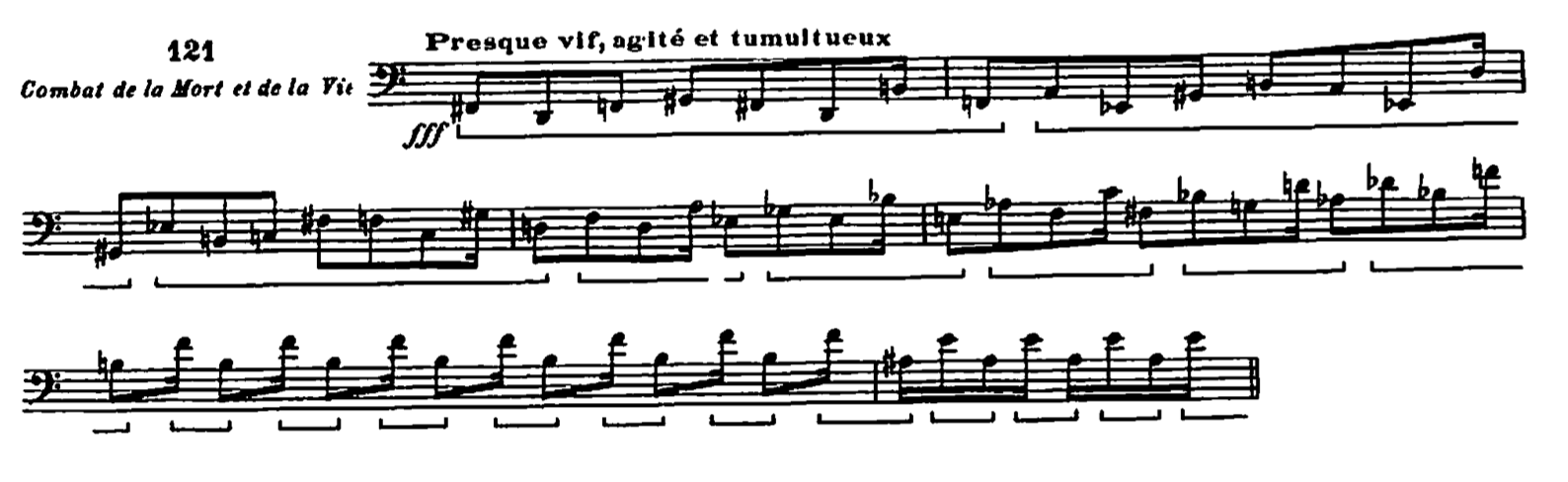
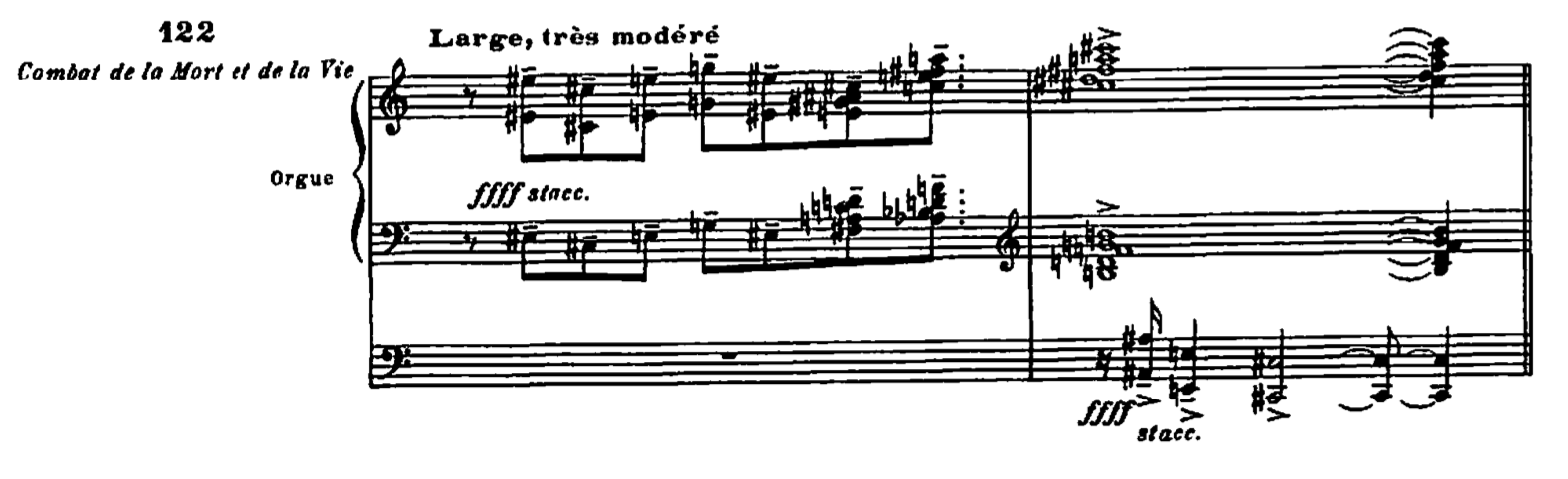
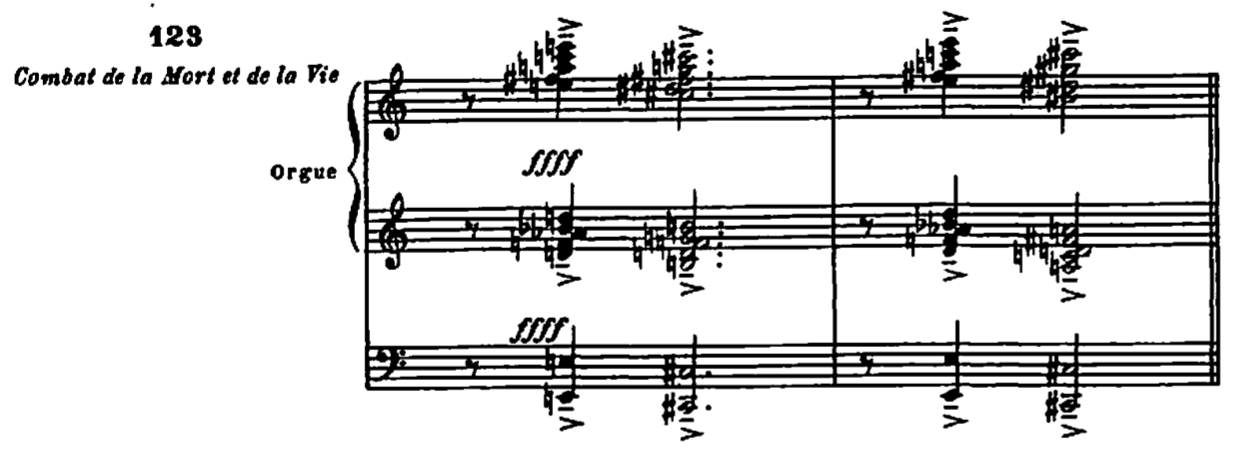
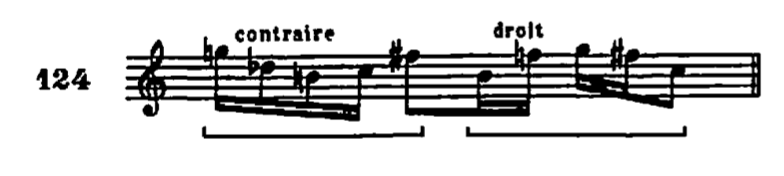

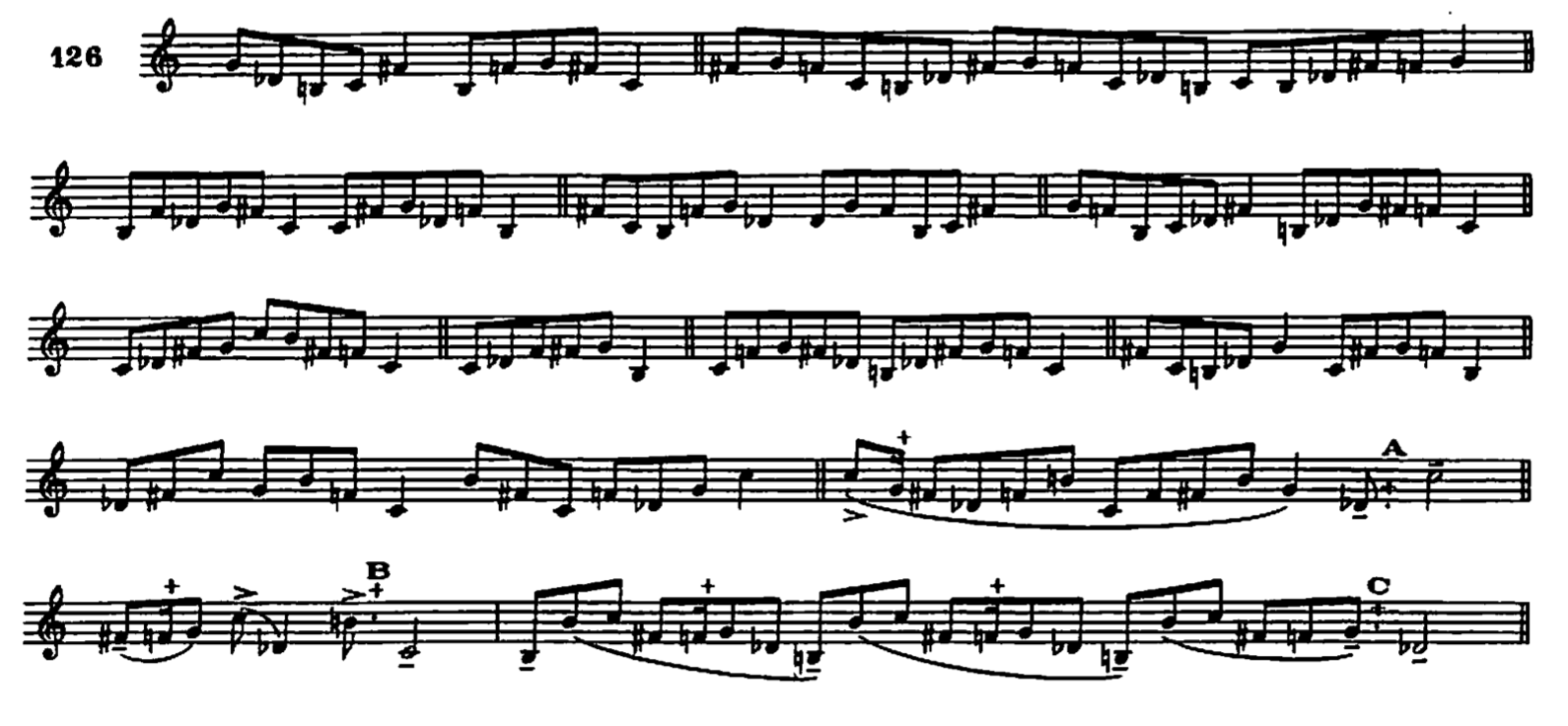


Overview
This concise chapter systematizes melodic transformation procedures, demonstrating that melodies—like rhythms (Chapters IV–V)—can undergo systematic development through specific operations. Messiaen identifies three primary techniques: elimination (progressive reduction of thematic material), interversion of notes (reordering pitch content), and change of register (extreme octave displacement). By invoking historical models (Beethoven's Fifth Symphony development, Vincent d'Indy's analytical writings, Alban Berg's Lyric Suite, André Jolivet's Mana) while demonstrating these techniques with his own materials, Messiaen positions his melodic practice within a developmental tradition extending from Classicism through modernism. The chapter's brevity belies its significance—these transformation procedures, combined with the modes of limited transposition (harmonically) and rhythmic techniques (temporally), create a complete parametric system where melody, rhythm, and harmony undergo parallel transformational operations. This represents the extension of systematic thinking from rhythm (where it is most developed, Chapters II–VII) to melody, reinforcing the treatise's underlying principle of unified compositional logic across parameters.
Key Concepts
This chapter introduces three key melodic transformation procedures:
-
Elimination - Progressive reduction of thematic material through successive removal of notes, concentrating material toward essential elements
-
Interversion of Notes - Reordering pitches within a melodic fragment while maintaining pitch-class content, creating variants through different sequences
-
Change of Register - Dramatic octave displacement moving low notes to extreme treble and high notes to extreme low register
Elimination
Definition: A developmental procedure consisting of repeating a thematic fragment while progressively removing notes from it, concentrating the material toward essential elements through successive reduction until reaching a schematic state—often a single note or minimal gesture.
Messiaen's Treatment: Messiaen credits Beethoven with creating melodic development through elimination, citing the first movement of the Fifth Symphony in C minor as an immortal model. This procedure is the basis of all thematic life, consisting of repeating a theme fragment while successively taking away from it a part of its notes up to concentration upon itself—reduction to a schematic state, shrunken by strife, by crisis.
Vincent d'Indy explained this technique well in his Cours de composition musicale. Messiaen proposes a theme (Example 120) and develops it by elimination (Example 121). The thematic fragments are bracketed, showing progression: eight notes, then four notes, then two notes. On this basis, a veritable flood of chords in sixteenth-notes ascends that cannot be quoted—afterwards, the theme is cut in two (Example 122) and developed once more by elimination (Example 123), borrowing harmonies from the chord of resonance (Chapter XIV).
Amplification is the procedure exactly opposite to elimination—building up rather than reducing material.
Modern Context: Elimination represents one of the fundamental developmental procedures in Western tonal music, particularly from Beethoven forward:
Historical precedents:
- Beethoven: Fifth Symphony's famous four-note motive subjected to constant fragmentation and reduction
- Wagner: Leitmotif fragmentation in Ring cycle
- Brahms: Developing variation systematically reducing thematic material
- Schoenberg: Developing variation theory formalizing motivic reduction
Theoretical frameworks:
- Grundgestalt theory (Schoenberg): All musical material derives from a basic shape subjected to variation, fragmentation, and reduction
- Developing variation: Continuous transformation of basic ideas through progressive alteration
- Liquidation (Schoenberg): Process of eliminating characteristic features to prepare cadences or transitions
Messiaen's approach maintains the traditional concept while applying it to melodic material within his modal/rhythmic systems rather than tonal contexts. The technique works particularly well with his added values and augmentation/diminution procedures—elimination can occur through:
- Removing notes (pitch reduction)
- Removing rhythmic values (temporal reduction)
- Combined pitch and rhythmic reduction
The reference to d'Indy's Cours de composition musicale (1903–1905) positions Messiaen within French pedagogical tradition. D'Indy, a student of Franck and founder of the Schola Cantorum, emphasized systematic developmental procedures and cyclical form—influences evident in Messiaen's thinking.
The "veritable flood of chords in sixteenth-notes" that "cannot be quoted" indicates that elimination serves dramatic purposes—the reduction creates tension and anticipation, with the eliminated material replaced by harmonic activity that eventually resolves or transforms into the next developmental stage.
Amplification as the inverse procedure suggests that thematic material can also develop through accretion—adding notes, expanding fragments, building from minimal materials toward complex statements. This parallels the rhythmic technique of augmentation (Chapter IV) applied to melodic content.
Examples: Examples 120–123 systematically demonstrate elimination applied to original material.
Interversion of Notes
Definition: A transformational procedure involving reordering the pitches within a melodic fragment—changing the sequence of notes while maintaining the same pitch-class content, creating melodic variants that share intervallic material but present it in different configurations.
Messiaen's Treatment: Messiaen notes that this procedure, analyzed by Marcel Dupré in his Traité d'improvisation, had already been foreseen in Chapter VIII. Taking the fragment previously used in contrary and normal movement (Example 124), he finds all the notes of Mode 5 (Example 125) and presents them in a large number of different orders (Example 126), noting that combinations could be multiplied. In the last two reorderings, added values appear at crosses and descents are elongated by dot addition (Chapter III).
Modern Context: Interversion represents a specific type of pitch-class transformation distinct from traditional variation techniques:
Comparison with other techniques:
- Transposition: Changes pitch level, preserves interval sequence
- Inversion: Reflects intervals around an axis, changes interval directions
- Retrograde: Reverses temporal order, preserves pitch sequence backwards
- Interversion: Reorders pitches, changes both interval sequence and temporal relationships
Theoretical frameworks:
- Twelve-tone technique: Row forms (prime, retrograde, inversion, retrograde-inversion) represent systematic reorderings, though interversion is more flexible than serial transformations
- Set theory: Pitch-class sets can be presented in any order; interversion explores this reordering freedom
- Combinatoriality: Different orderings of the same pitch-class collection create distinct melodic profiles while maintaining harmonic identity
Dupré's Traité d'improvisation (1925) addresses organ improvisation techniques, including melodic transformation procedures. This reference connects Messiaen to French organ tradition and improvisation pedagogy—skills central to his work as organist at La Trinité.
The connection to Mode 5 (Example 125) demonstrates that interversion works particularly well within symmetrical collections (modes of limited transposition). Since these modes contain limited pitch-class content, reordering creates variety while maintaining modal unity. This represents a compositional solution to the limitation of symmetrical modes—though transpositionally limited, they permit extensive reordering.
The integration of added values and dot addition (Chapter III) shows that interversion combines with rhythmic techniques—the reordered pitches receive varied rhythmic treatment, creating further developmental possibilities. This represents multi-parametric transformation: pitch reordering (melodic) + added values (rhythmic) + modal consistency (harmonic).
The notation that "combinations could be multiplied" indicates that interversion generates a large number of variants from limited source material—a systematic procedure for creating variety within constraints. This reflects algorithmic thinking: given a pitch-class set, generate all (or many) possible orderings.
Examples: Examples 124–126 demonstrate the technique, showing one melodic fragment reordered extensively while maintaining Mode 5 content.
Change of Register
Definition: A developmental technique involving dramatic octave displacement of thematic material, moving low notes to extreme treble and treble notes to extreme low register through abrupt leaps, creating maximal registral contrast and textural transformation.
Messiaen's Treatment: Messiaen describes this as: "the low notes of the theme pass to the extreme treble, the treble to the extremely low, in abrupt leaps." He cites Alban Berg's use of this procedure in the Suite lyrique and passages from André Jolivet's Mana bearing evidence of analogous preoccupations (Example 127).
Augmentation combined with change of register will communicate "crushing power" to the theme (Example 128).
Modern Context: Change of register represents a twentieth-century developmental technique particularly associated with expressionism and modernist instrumental writing:
Historical development:
- Late Romantic: Occasional registral extremes for dramatic effect (Mahler, Strauss)
- Expressionism: Systematic exploitation of registral extremes (Schoenberg's Pierrot Lunaire, Berg's operas and chamber works)
- Post-war modernism: Registral displacement as primary developmental parameter (Webern, Boulez, Stockhausen)
Compositional applications:
- Klangfarbenmelodie: Timbre melody through registral/instrumental change (Schoenberg, Webern)
- Pointillism: Notes distributed across extreme registers creating disjunct textures
- Registral streaming: Different registers functioning as independent layers
Berg's Lyric Suite (1925–26) represents a key work in the development of this technique—thematic material undergoes systematic registral transformation, with extreme leaps creating expressive intensity. Messiaen's citation acknowledges Berg's influence and positions himself within the Second Viennese School's developmental tradition, despite his different harmonic language.
Jolivet (1905–1974), Messiaen's contemporary and founding member (with Messiaen) of La Jeune France group (1936), shared interests in non-Western music, ritualistic elements, and systematic compositional procedures. The reference to Mana (1935)—a set of piano pieces exploring magical/ritual themes—indicates shared aesthetic concerns and mutual influence within French modernist circles.
The combination of augmentation with registral change creating "crushing power" demonstrates the expressive potential of combining transformational techniques. Augmentation alone slows the theme, increasing its temporal weight; registral displacement to extremes adds spatial/registral weight; together they create maximum intensification—the theme becomes monumental, overwhelming.
This connects to Messiaen's interest in expressing "noble sentiments" and "religious sentiments exalted by theology" (Chapter I). The combination of temporal augmentation and spatial displacement can evoke transcendence, grandeur, or divine power—technical means serving theological/expressive ends.
Examples: Examples 127–128 demonstrate registral displacement and its combination with augmentation.
Relationship to Other Chapters
Chapter X integrates melodic transformation with previously developed techniques:
-
Chapter I (Charm of Impossibilities): Developmental procedures serve the broader aesthetic of creating complex, voluptuous music expressing religious sentiments—technique enables transcendence.
-
Chapter III (Added Values): Interversion examples (Example 126) incorporate added values and elongated descents through dot addition, showing melodic and rhythmic transformations operating simultaneously.
-
Chapter IV (Augmented or Diminished Rhythms): Elimination can involve rhythmic as well as melodic reduction; augmentation combines with registral change (Example 128) to create expressive intensification.
-
Chapter VIII (Melody and Melodic Contours): Interversion was "foreseen" in Chapter VIII (Example 99 discussed contrary motion, normal motion, retrograde, and interversion), making this chapter a systematic development of techniques previewed earlier.
-
Chapter XIV (Special Chords): Example 123 borrows harmonies from "chord of resonance" (Chapter XIV), demonstrating that melodic development occurs within specific harmonic contexts defined by characteristic chord types.
-
Chapter XVI (Modes of Limited Transposition): Interversion examples maintain Mode 5 content (Example 125–126), showing that pitch reordering preserves modal identity—developmental variety within symmetrical constraints.
The chapter demonstrates that melody, like rhythm, can undergo systematic transformation through defined operations (elimination, interversion, registral displacement). This extends the parametric thinking developed in rhythmic chapters to melodic domain, reinforcing the treatise's underlying principle: all musical parameters can be organized through parallel systematic procedures.
The invocation of Beethoven, d'Indy, Berg, and Jolivet positions Messiaen within a developmental tradition spanning Classicism to modernism—not revolutionary rejection but synthetic evolution.
Summary
Chapter X systematizes melodic transformation, identifying three primary developmental procedures: elimination (progressive reduction toward essential elements, modeled on Beethoven's Fifth Symphony), interversion (reordering pitches within a melodic fragment while maintaining pitch-class content, following Dupré's improvisation teachings), and change of register (extreme octave displacement creating textural and expressive transformation, influenced by Berg's Lyric Suite and Jolivet's Mana). By demonstrating how these techniques combine with rhythmic procedures (added values, augmentation) and harmonic structures (modes of limited transposition, characteristic chords), Messiaen reveals his multi-parametric compositional thinking—melody, rhythm, and harmony undergo parallel transformational operations within a unified systematic framework.
The chapter's brevity reflects its focused purpose: establishing that melodic material, like rhythmic material, can be subjected to systematic development through defined operations rather than intuitive variation. For contemporary readers, this chapter illustrates how traditional developmental thinking (Beethoven's motivic fragmentation, Brahmsian developing variation) can be adapted to non-tonal contexts through modal and rhythmic systems, and how modernist techniques (Berg's registral extremes, twelve-tone reordering principles) can be integrated with historical procedures to create a synthetic developmental practice.
The combination of techniques—elimination + interversion, augmentation + registral change—demonstrates that the power of systematic transformation lies not in individual operations but in their combination and interaction. Messiaen's developmental procedures serve both structural and expressive purposes: creating coherent large-scale forms through motivic unity while generating the variety and intensification necessary for dramatic and spiritual expression. This chapter completes the foundational exposition of melodic technique, preparing for the following chapters on formal structures (Chapter XI) and historical forms (Chapter XII) that will show how these developmental procedures organize into complete compositional architectures.
Chapter XI: Song-Sentence, Binary and Ternary Sentences
Original: Pages 37–39 in Satterfield translation
Musical Examples:

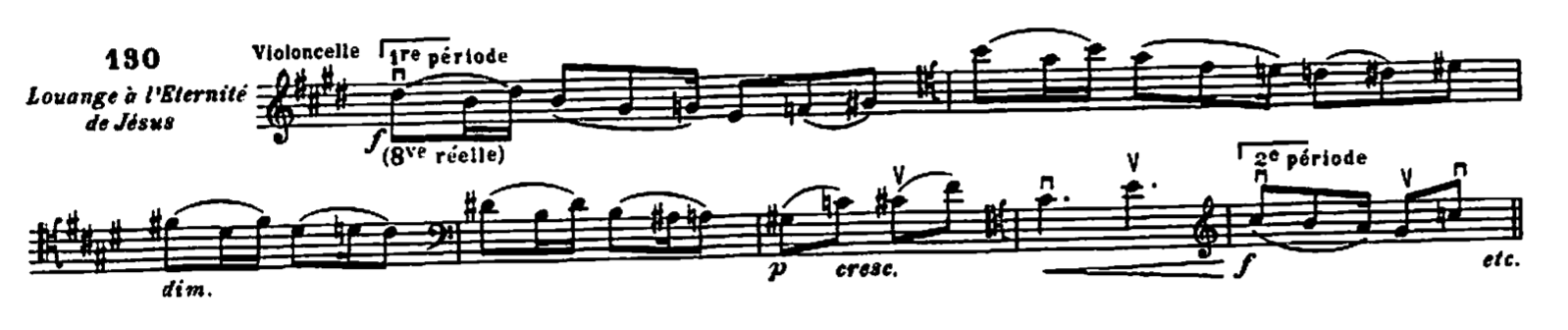

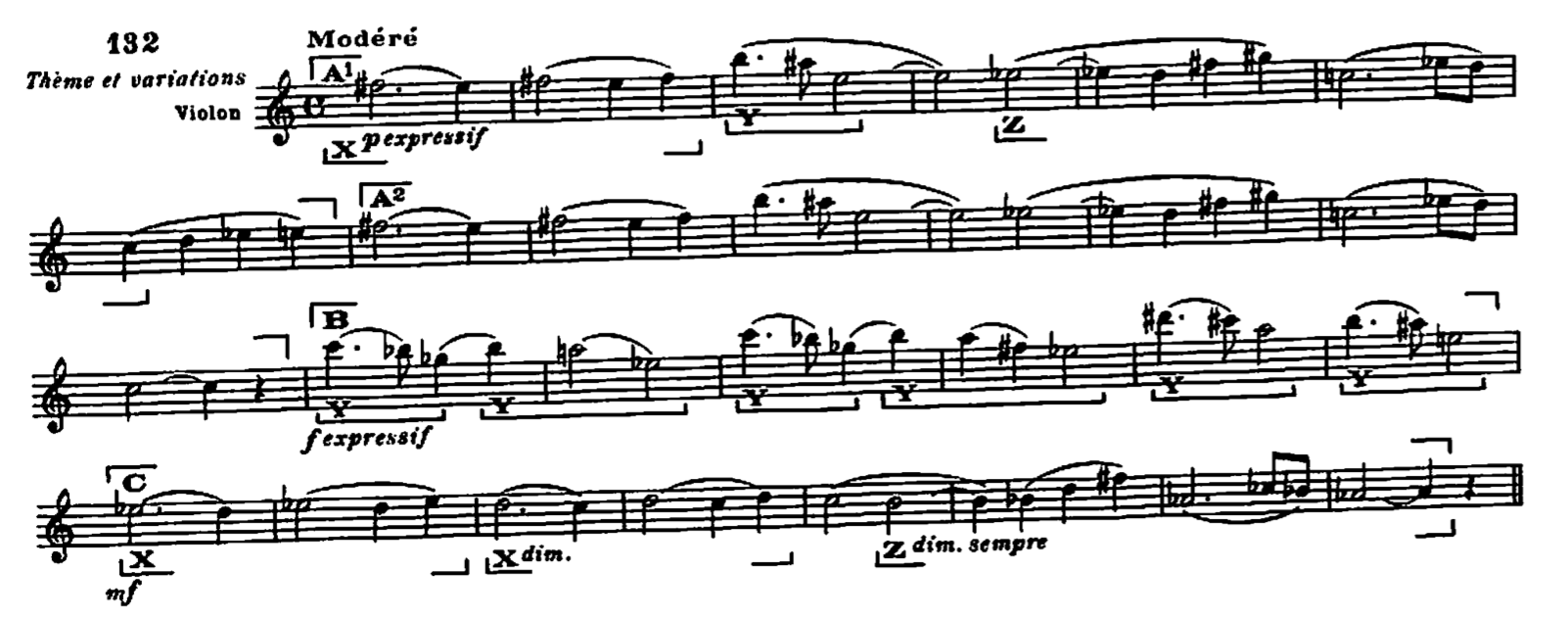
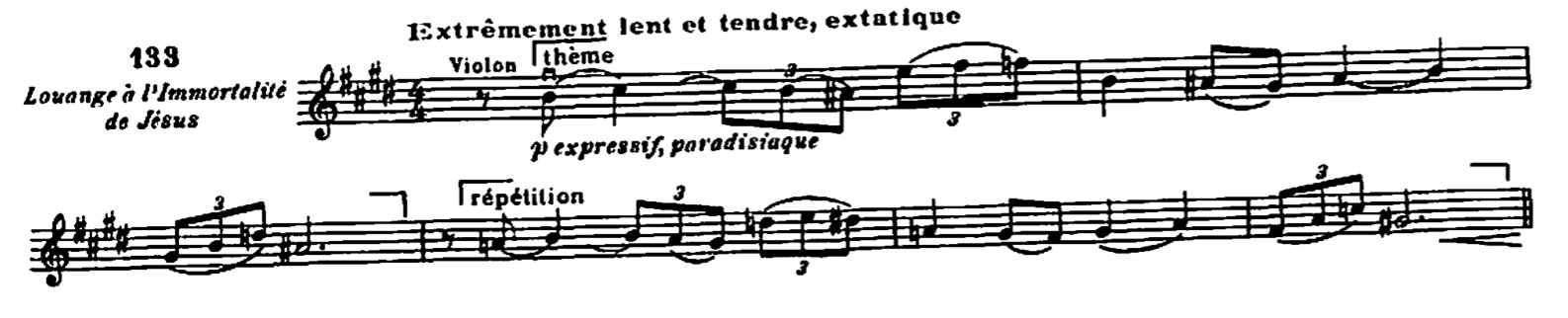

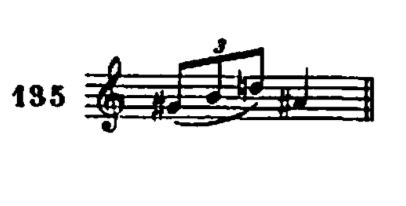
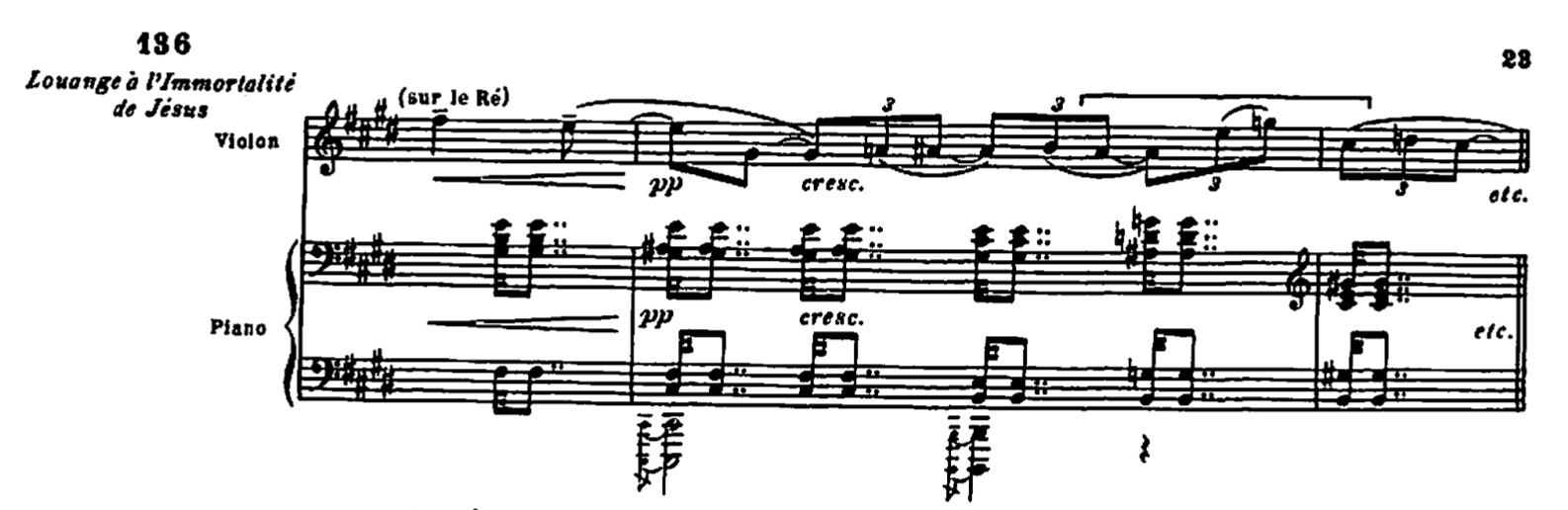
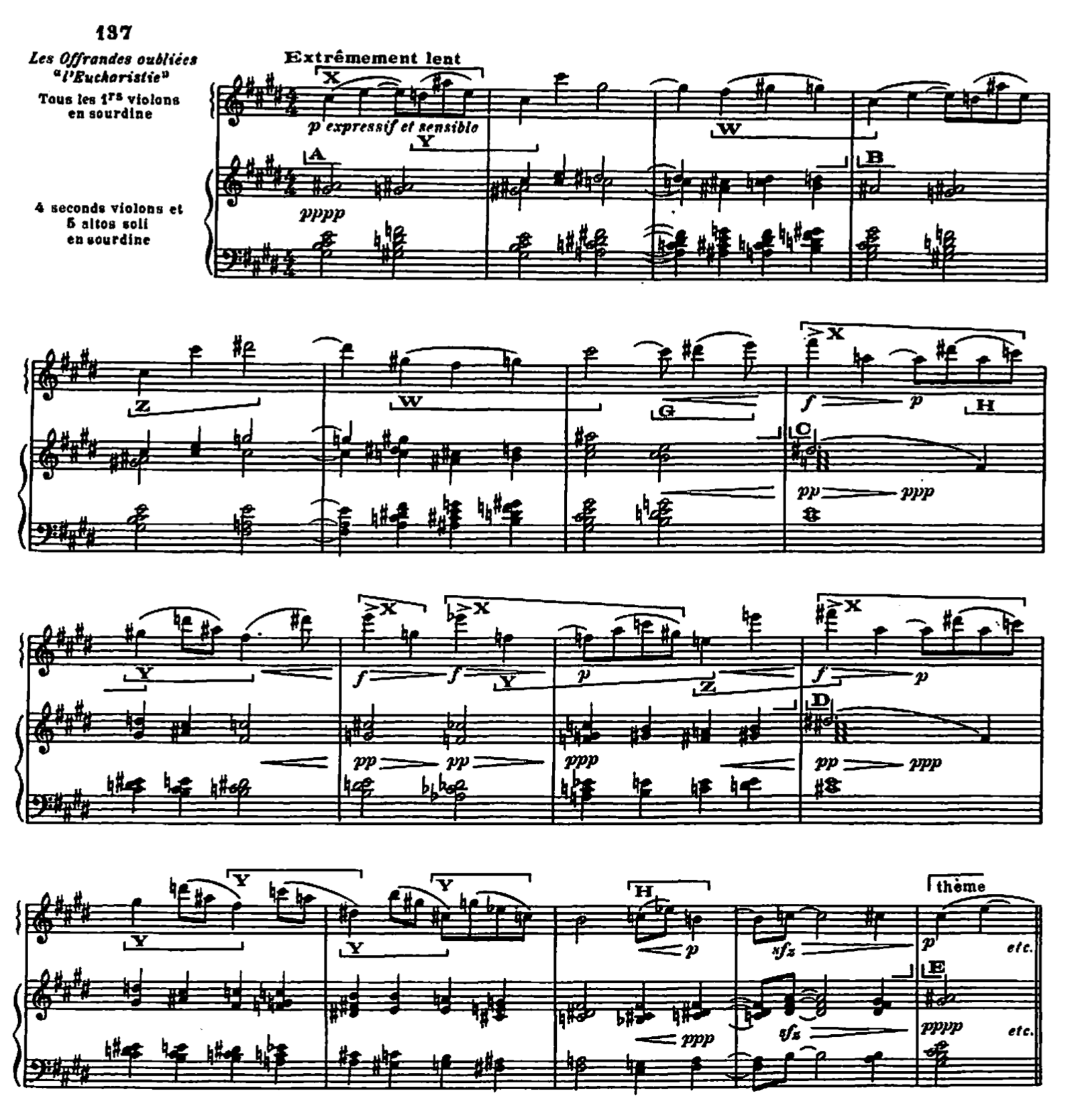




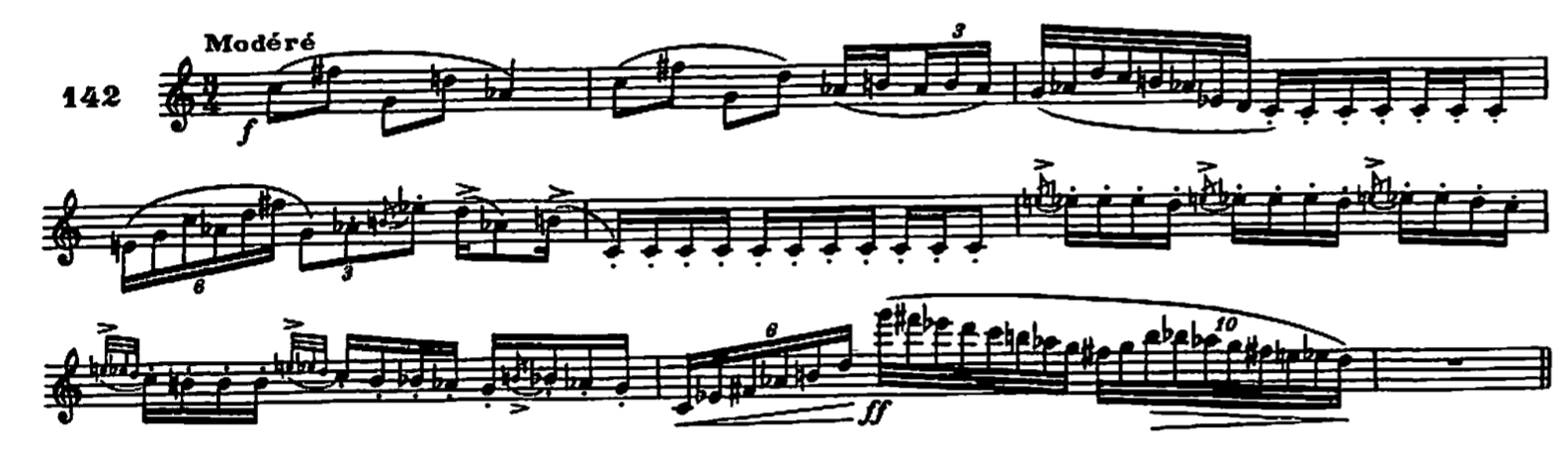
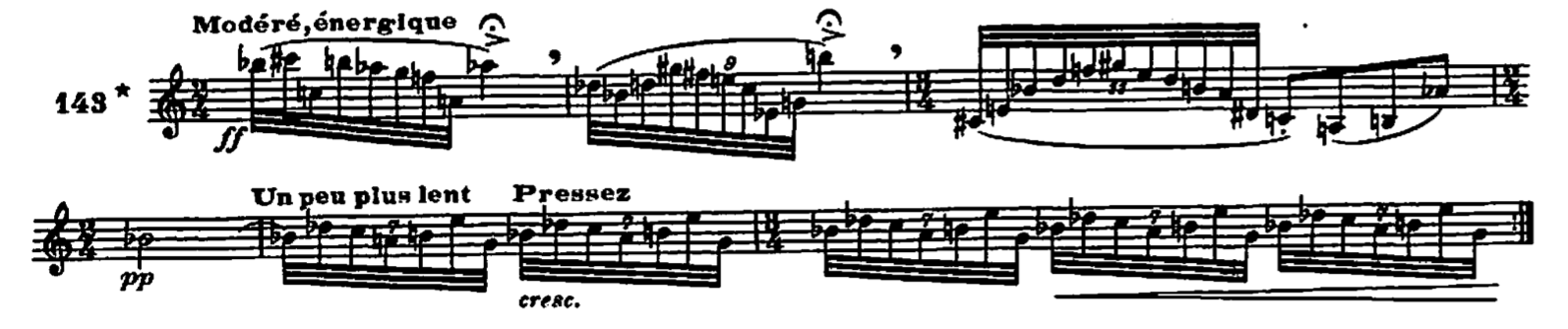



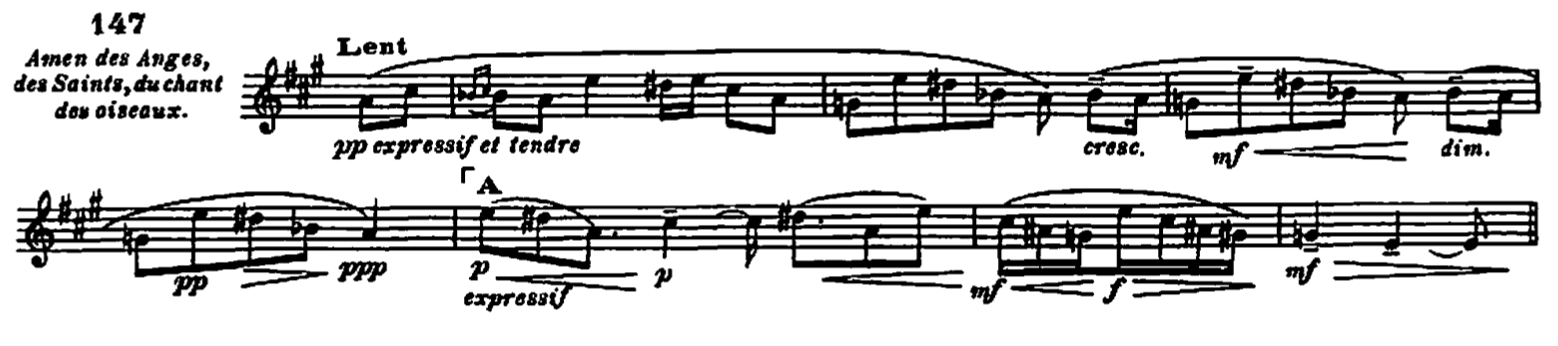


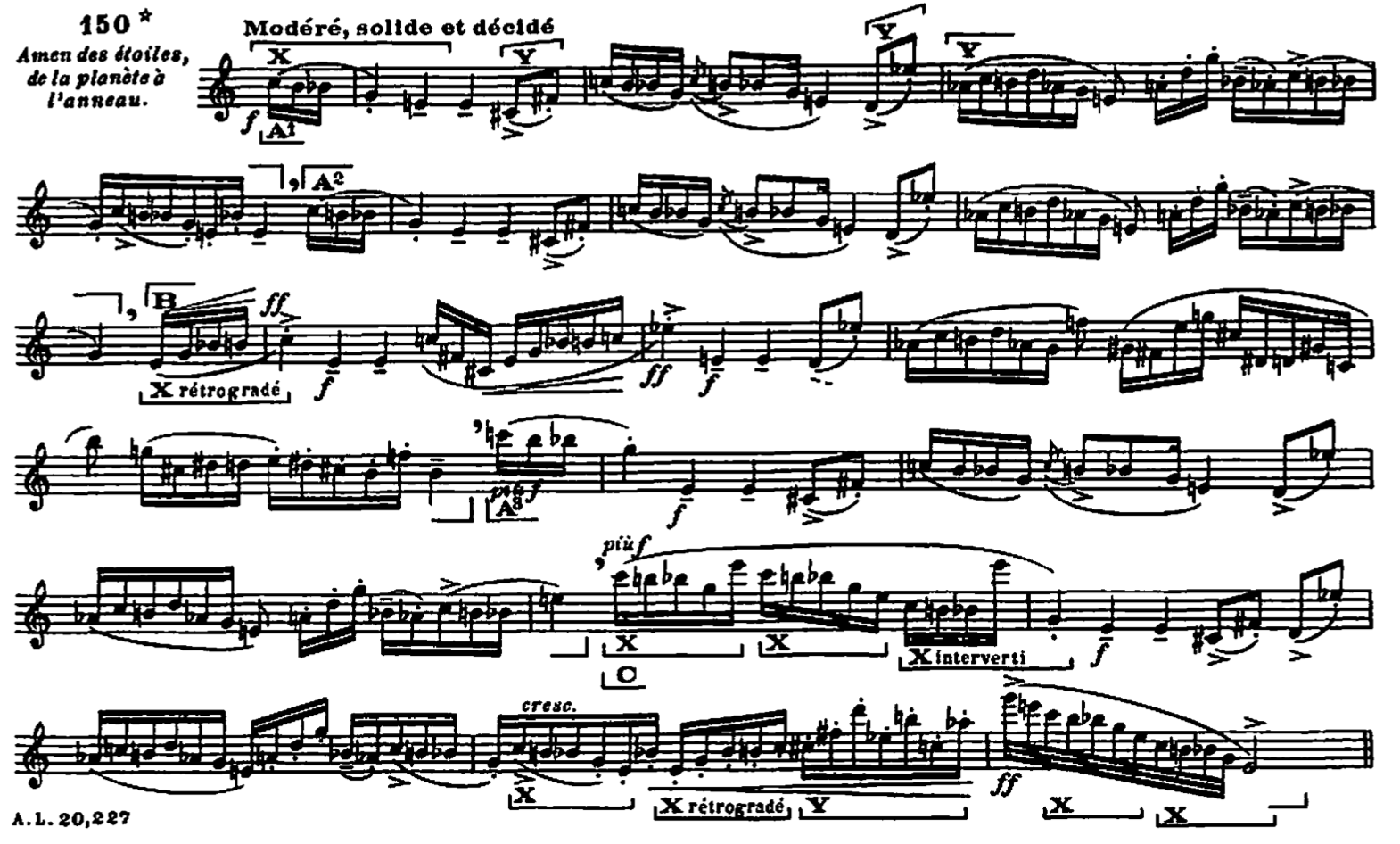
Overview
This chapter systematizes phrase structure and small-scale formal organization, establishing how melodic periods combine into complete musical sentences. Drawing on Vincent d'Indy's Cours de composition musicale and Marcel Dupré's Traité d'improvisation, Messiaen identifies three fundamental sentence types: song-sentence (antecedent-consequent structure with middle period), binary sentence (two commentaries framing theme statements), and ternary sentence (theme-consequent-commentary-consequent-theme creating five-part arch). The chapter then provides an extensive catalog of melodic periods (Examples 138–150), demonstrating how diverse historical models—Ravel, Adam de la Halle, Mozart, Manuel de Falla, Bartók, Jolivet, Hindu music, Russian songs, Rameau—can be transformed through the "deforming prism" of Messiaen's language. This represents the application of traditional formal thinking (period structure, antecedent-consequent relationships) to melodic material derived from eclectic sources and organized within Messiaen's modal-rhythmic systems. The chapter bridges between local melodic construction (Chapters VIII–X) and large-scale forms (Chapter XII), showing how phrases organize into sentences that can then organize into complete movements or works.
Key Concepts
This chapter introduces six key concepts related to formal organization of melodic sentences:
-
The Musical Sentence as Succession of Periods - The fundamental principle that sentences comprise successions of distinct periods organized around a central theme
-
Song-Sentence (Phrase Musicale) - A three-period structure with theme, middle period, and final period creating ABA' form
-
Commentary (Commentaire) - Melodic development of theme fragments through rhythmic, melodic, and harmonic variation
-
Binary Sentence - A four-period structure alternating theme and commentary in ABAB' pattern
-
Ternary Sentence - A five-period structure creating symmetrical arch form with central commentary flanked by thematic statements
-
List of Melodic Periods (Catalog of Historical Models) - Extensive catalog demonstrating transformation of diverse historical sources through Messiaen's compositional language
The Musical Sentence as Succession of Periods
Definition: The fundamental principle that musical sentences comprise successions of distinct periods, with the theme typically constituting the first period and serving as the synthesis of elements contained within the sentence.
Messiaen's Treatment: Messiaen defines the musical sentence as a succession of periods, with the theme as the synthesis of elements contained in the sentence—it generally constitutes the first period. Sentences can comprise:
- One, two, or three different periods
- Four different periods (square sentence)
- A suite of ornamental variations of a theme and its commentary (Chapter IX reference)
- Plainchant forms (Chapter XII reference)
- Sentences growing or decreasing, with longer and longer or shorter and shorter periods
He notes that one can find infinite forms of diverse sentences. For analytical work, he chooses three characteristic sentences: song-sentence (cited by d'Indy), binary and ternary sentences (discussed in detail in Dupré's Traité d'improvisation).
Modern Context: This represents traditional period-phrase-sentence hierarchy adapted to Messiaen's compositional practice:
Classical formal theory:
- Phrase: Basic melodic unit (typically 2–4 measures)
- Period: Two or more phrases in antecedent-consequent relationship
- Sentence: Larger unit comprising multiple periods
Historical precedents:
- Classical phrase structure: Antecedent-consequent periods (Haydn, Mozart)
- Romantic sentence expansion: Extended periods, asymmetrical structures (Brahms, Wagner)
- Formenlehre tradition: German formal theory systematizing structural archetypes (A.B. Marx, Schoenberg)
Messiaen's approach maintains traditional formal categories while applying them to non-tonal material. His sentences operate through:
- Modal unity: Periods unified by shared mode rather than tonal key relationships
- Rhythmic coherence: Added values, nonretrogradable structures, rhythmic pedals creating temporal unity
- Melodic development: Elimination, interversion, registral change transforming thematic material
The reference to "infinite forms of diverse sentences" acknowledges that these three sentence types (song, binary, ternary) represent archetypes, not exhaustive categories. Actual compositional practice produces hybrid forms, extended structures, and novel combinations.
The invocation of d'Indy and Dupré positions Messiaen within French pedagogical tradition—both were major figures in French conservatory training and composition teaching. This demonstrates that Messiaen's innovations build on systematic formal education rather than rejecting it.
Examples: The principle governs all examples; specific sentence types appear in subsequent sections.
Song-Sentence (Phrase Musicale)
Definition: A three-period structure comprising (a) theme functioning as antecedent and consequent, (b) middle period inflected toward the dominant, and (c) final period as an issue of the theme—analogous to the classical period with antecedent-consequent structure but extended through a middle developmental section.
Messiaen's Treatment: The song-sentence divides into:
- Theme (antecedent and consequent)
- Middle period, inflected toward the dominant
- Final period, an issue of the theme
Example 129 presents the theme (antecedent). Example 130 shows the theme repeated with different melodic descent (consequent), followed by the middle part, exceptionally long and divisible into three periods. Example 131 demonstrates that after a cadence in B major (key of the dominant), an ascent with crescendo leads to the final period over the six-four chord in E major, the initial key, ending in absolute pianissimo.
Example 132 provides another instance. In detail:
- A¹: Antecedent of the theme
- A²: Consequent of the theme
- B: Middle period, developing fragment Y (bracketed in the theme); Y is repeated six times upon different degrees—first time melodic variant, second time rhythmic variant
- C: Final period, an issue of the theme; repeats X twice and Z once upon other degrees; Y, developed in the middle period, is absent here
Modern Context: The song-sentence represents Messiaen's adaptation of the classical period structure:
Classical analogy:
- Antecedent phrase: Establishes material, often ending with half cadence
- Consequent phrase: Answers antecedent, typically ending with authentic cadence
- Song-sentence: Expands this through middle period (like development in sonata form) before final period (recapitulation-like return)
This creates a miniature ABA' structure:
- A (theme: antecedent + consequent)
- B (middle period: developmental)
- A' (final period: return/resolution)
The "inflection toward the dominant" in the middle period reflects traditional tonal practice, though Messiaen's modal context transforms this—the dominant functions more as contrast or tension point than as true dominant in functional harmonic sense.
The developmental middle period employs techniques from Chapter X (elimination, interversion, registral change) to vary and extend thematic material. The repetition of fragment Y "six times upon different degrees" demonstrates systematic variation—same material at different pitch levels (transposition), with alternating melodic and rhythmic variants.
The final period's omission of Y (material developed in the middle) creates formal closure through return to original material (X and Z) without middle-period material, analogous to recapitulation omitting development-section themes.
The dynamic shaping—crescendo leading to final period, then ending "in absolute pianissimo"—demonstrates expressive use of dynamics for formal articulation, with the soft ending creating contemplative closure rather than triumphant conclusion.
Examples: Examples 129–132 systematically demonstrate song-sentence structure and its components.
Commentary (Commentaire)
Definition: A melodic development of the theme in which theme fragments are repeated in the initial key upon different degrees, or in other keys, and are varied rhythmically, melodically, and harmonically—the commentary can also develop elements foreign to the theme while presenting them with certain agreement of accent.
Messiaen's Treatment: The commentary is a melodic development where theme fragments repeat in the initial key upon different degrees or in other keys, varied rhythmically, melodically, and harmonically. The commentary can also develop elements foreign to the theme but presenting them with certain agreement of accent.
The middle period of Example 132 (Thème et variations) is a commentary. Binary and ternary sentences alternate theme and commentaries.
Modern Context: Commentary represents Messiaen's term for what traditional theory calls:
- Development: Working out of thematic material (sonata form)
- Episode: Contrasting material (rondo, fugue)
- Variation: Transformation of theme preserving essential features
Distinctive features of Messiaen's commentary:
- Transpositional treatment: Fragments repeated "upon different degrees"—systematic transposition within modal context
- Multi-parametric variation: Rhythmic, melodic, AND harmonic transformation simultaneously
- Foreign elements permitted: Commentary need not derive exclusively from theme, but foreign elements must show "certain agreement of accent"—rhythmic profile or character must cohere
The phrase "agreement of accent" suggests that even when melodic/harmonic material is new, rhythmic character must relate to the theme. This reflects Messiaen's emphasis on rhythm as unifying parameter—new melodies can appear if rhythmically consistent with thematic character.
The reference to Example 132's middle period as commentary demonstrates that commentary functions as middle or developmental section within larger sentence structures.
Examples: Example 132's middle period exemplifies commentary; other examples appear in binary and ternary sentences.
Binary Sentence
Definition: A four-period structure comprising (a) theme, (b) first commentary modulating more or less and inflected toward the dominant of the initial key, (c) theme, (d) second commentary concluding upon the tonic of the original key—creating an ABAB' structure with thematic statements framing developmental sections.
Messiaen's Treatment: The binary sentence divides into:
- Theme
- First commentary, modulating more or less, inflected toward dominant of initial key
- Theme
- Second commentary, concluding upon tonic of original key
Example 133 presents the binary sentence: theme and its repetition a degree lower with harmonic variation. Example 134 shows the first commentary. Example 135, built entirely upon this theme fragment, uses Mode 2 from X to X (Chapter XVI)—afterwards, restatement of the theme.
Example 136 presents the second commentary developing the same fragment as the first. Departing from a lower point, it rises higher and ends in the initial key in the extreme treble.
Modern Context: Binary sentence structure creates alternating stability (theme statements) and development (commentaries):
Formal analogies:
- Rondo form: ABACA... alternating ritornello (theme) and episodes (commentaries)
- Verse-chorus: Pop song form alternating verses (commentaries with new text) and choruses (thematic returns)
- Variation form: Theme followed by varied versions
The modulation to dominant in first commentary followed by return to tonic in second commentary reflects traditional tonal practice adapted to modal context. In Messiaen's system:
- "Dominant" may refer to modal inflection rather than V chord
- "Modulation" may mean mode change rather than key change
- "Tonic" represents initial modal center rather than tonal tonic
The use of Mode 2 "from X to X" (Example 135) demonstrates modal consistency—the commentary remains within a single transposition of the mode throughout, creating harmonic unity despite melodic development.
The registral trajectory—second commentary "rises higher" and ends "in the extreme treble"—creates formal intensification and climax through registral ascent (combining with the change-of-register technique from Chapter X).
Examples: Examples 133–136 systematically demonstrate binary sentence structure and its components.
Ternary Sentence
Definition: A five-period structure comprising (a¹) theme, (a²) consequent of the theme, (b¹) commentary, (b²) consequent of the commentary inflected toward the dominant, (c¹) theme, (c²) consequent of the theme—creating a symmetrical arch form A-A'-B-A-A' with central commentary flanked by thematic statements.
Messiaen's Treatment: The ternary sentence divides into:
- Theme
- Consequent of the theme
- Commentary
- Consequent of the commentary, inflected toward dominant
- Theme
- Consequent of the theme
Example 137 demonstrates ternary sentence structure:
- A: The theme
- B: Consequent of the theme; fragment W ends antecedent and consequent in normal motion (first) and contrary motion (second)
- G: Fragment leading to commentary at C, which starts out upon X (rhythm of the head of the theme) and H and develops fragments X, Y, Z
- D: Consequent of the commentary, inflected toward dominant and developing especially fragment Y
- Recall of H leads to re-entrance of the theme at E (Messiaen notes he was obliged to abridge the quotation)
The antecedent of the theme is succeeded by a consequent identical to the preceding consequent and followed by a brief coda in the extreme treble upon fragment W. The entire sentence mixes E major tonality and Mode 2, borrowing constantly from itself in its different transpositions.
Orchestration: All first violins sing muted, very slowly, with love; four second violins soli and five violas soli (all also muted) form around them "a halo of mysterious chords; a harmonic tapestry of such softness that one scarcely hears it!"
Modern Context: Ternary sentence represents the most complex of the three sentence types, creating symmetrical arch form:
Formal structure:
- A-A' (theme and consequent)
- B-B' (commentary and consequent)
- A-A' (theme and consequent return)
This creates both:
- Palindromic symmetry: ABA structure reflecting Chapter V's nonretrogradable principle in large-scale form
- Progressive intensification: Movement from theme through commentary (development) back to theme with accumulated complexity
Comparison with other arch forms:
- Bartók's bridge forms: Symmetrical structures (ABCBA) in string quartets and other works
- Medieval estampie: Medieval dance form with repeated sections creating arch-like structures
- Rondo form: Multiple returns create symmetrical patterns (ABACA, ABACABA)
The mixture of E major tonality and Mode 2 "borrowing constantly from itself in its different transpositions" demonstrates modal/tonal synthesis—traditional tonal center (E major) coexists with symmetrical modal collection (Mode 2/octatonic) through strategic transposition of modal segments.
The orchestrational description reveals Messiaen's timbral sensitivity: solo strings "muted, very slowly, with love" create intimate, personal expression; the accompanying chords as "halo of mysterious chords" and "harmonic tapestry of such softness that one scarcely hears it" demonstrate his interest in creating enveloping, numinous sonorities—technique serving expressive/spiritual purposes.
Examples: Example 137 demonstrates ternary sentence with extensive analysis of its components and transformations.
List of Melodic Periods (Catalog of Historical Models)
Definition: An extensive catalog of melodic periods derived from diverse historical sources, demonstrating how models from various composers, traditions, and eras can be transformed through Messiaen's compositional language—each example showing both the original source's influence and its "deforming prism" transformation.
Messiaen's Treatment: Messiaen sets up a list of melodic periods, with each example comprising one or several connected periods. He notes that in Chapter XIV's paragraph 6 ("A Look at Other Styles"), he will draw essence from procedures of contemporary composers. Here, he presents shadows of former times alongside salutes to modern masters, but clarifies that all borrowings will be "passed through the deforming prism of our language," receiving from his style "a different blood, an unexpected melodic and rhythmic color" in which fantasy and research unite to destroy resemblance to the model.
Examples 138–150 reference diverse sources:
- 138–139: Evoke Ravel (who would have believed that?)
- 140–141: Reference Adam de la Halle (patron), even more unlikely
- 140: Opposition of dynamics calls to mind alternations of solo and tutti; the two periods A and B could have been used for refrain; note their curious rhythmic symmetry—B responds with ascending intervals to A's descending intervals and vice versa
- 142: Mixes Mozart and Manuel de Falla
- 143: Unites Béla Bartók and André Jolivet with a touch of bird style (Chapter IX)
- 144–145: Completely bird style
- 146: Allied to Hindu music
- 147–148: Proceed from Russian songs
- 147: Written in Mode 2; measure A contains nonretrogradable rhythm (Chapters XVI and V)
- 149–150: Refer to Rameau; far away from him
- 150: Complete sentence in five periods with rigadoon-like shape:
- A¹: First period starting upon X; A²: First period repeated and concluding on third degree
- Period B: Starting upon X in retrograde, modulating to dominant
- Restatement of period A (slightly varied)
- Period C: Developing especially X, used to conclude in rapid arpeggio; bracketed notes Y of first period restated here in new order
Modern Context: This catalog demonstrates Messiaen's synthetic compositional method—drawing from maximum stylistic diversity while transforming everything through personal language:
Source diversity:
- Medieval: Adam de la Halle (trouvère, 13th century)
- Baroque: Rameau (18th century)
- Classical: Mozart (18th century)
- Romantic/Nationalist: Falla (Spanish), Russian songs
- Early 20th century: Ravel (French impressionist)
- Contemporary modernists: Bartók (Hungarian), Jolivet (French)
- Non-Western: Hindu music
- Natural sources: Bird song
This eclecticism reflects modernist cosmopolitanism—rejecting nationalistic insularity in favor of global musical culture. However, Messiaen's "deforming prism" approach transforms all sources into personal idiom rather than producing pastiche or quotation collage.
Contemporary composition precedents:
- Neoclassicism (Stravinsky, Poulenc): Transformation of historical models
- Musical tourism: Debussy's gamelan influences, Ravel's Spanish references
- Synthetic modernism: Combining diverse traditions (Bartók's synthesis of folk and art music)
The phrase "fantasy and research will be united to destroy the least resemblance to the model" is crucial—Messiaen claims both creative imagination ("fantasy") and systematic analysis ("research") while insisting on transformation so complete that source models become unrecognizable. This represents sophisticated understanding of influence—acknowledging sources while asserting originality.
The specific analytical observations (rhythmic symmetry in Example 140, Mode 2 in Example 147, nonretrogradable rhythm, rigadoon structure in Example 150) demonstrate that these periods incorporate techniques from previous chapters—added values, modal content, rhythmic symmetry, developmental procedures all operate within period structures.
Examples: Examples 138–150 provide extensive catalog demonstrating stylistic synthesis and transformation.
Relationship to Other Chapters
Chapter XI integrates formal organization with previously developed techniques:
-
Chapter III (Added Values): Periods incorporate added values as rhythmic enrichment.
-
Chapter V (Nonretrogradable Rhythms): Example 147 contains nonretrogradable rhythm, showing palindromic structures operating at period level.
-
Chapter IX (Bird Song): Examples 143–145 employ bird style, integrating ornithological material into period structures.
-
Chapter X (Melodic Development): Commentary sections employ elimination, interversion, and registral change to develop thematic material.
-
Chapter XII (Fugue, Sonata, Plainchant Forms): This chapter on small-scale sentence forms prepares for the next chapter's discussion of large-scale formal archetypes.
-
Chapter XIV (Special Chords, Clusters, Connections): References to borrowing harmonies from chord of resonance and stained-glass window effects show harmonic context for melodic periods.
-
Chapter XVI (Modes of Limited Transpositions): Multiple examples reference specific modes (Mode 2 in Examples 135, 147; mixture with E major tonality in Example 137), showing melodic organization within symmetrical modal collections.
The chapter demonstrates that traditional formal categories (period, sentence, antecedent-consequent) remain applicable to non-tonal music organized through modal and rhythmic systems rather than functional harmony.
Summary
Chapter XI systematizes small-scale formal organization through three fundamental sentence types: song-sentence (antecedent-consequent-middle-final creating ABA' structure), binary sentence (theme-commentary-theme-commentary creating ABAB' alternation), and ternary sentence (theme-consequent-commentary-consequent-theme-consequent creating symmetrical arch form). By defining commentary as melodic development varying theme fragments rhythmically, melodically, and harmonically, Messiaen establishes how developmental procedures from Chapter X organize into complete formal units. The extensive catalog of melodic periods (Examples 138–150) demonstrates his synthetic method—drawing from medieval trouvères, Baroque masters, Classical and Romantic composers, early 20th-century modernists, non-Western traditions, and natural sources, then transforming all material through the "deforming prism" of his personal language to create periods that unite "fantasy and research" while destroying resemblance to their models. This chapter bridges local melodic construction (Chapters VIII–X) and large-scale forms (Chapter XII), showing how phrases organize into sentences that become building blocks for complete movements.
For contemporary readers, this chapter illustrates how traditional formal thinking—period structures, antecedent-consequent relationships, developmental sections—can be adapted to non-tonal compositional systems organized through modal collections and rhythmic techniques rather than functional harmony. Messiaen's formal approach maintains hierarchical organization (phrase-period-sentence) while operating within parametric systems (modes of limited transposition, added values, nonretrogradable rhythms) that replace tonal function. The invocation of d'Indy and Dupré positions this work within French pedagogical tradition, demonstrating that innovation builds upon systematic training rather than rejecting it. The chapter's conclusion—that all borrowings receive "different blood, unexpected melodic and rhythmic color" through transformation—articulates Messiaen's aesthetic of synthesis: maximum stylistic diversity unified through personal compositional voice, creating music simultaneously historical (acknowledging sources) and original (transforming them beyond recognition).
Chapter XII: Fugue, Sonata, Plainchant Forms
Original: Pages 40–46 in Satterfield translation
Musical Examples:
- Example 151
- Example 152
- Example 153
- Example 154
- Example 155
- Example 156
- Example 157
- Example 158
- Example 159
- Example 160
- Example 161
- Example 162
- Example 163
- Example 164
- Example 165
- Example 166
- Example 167
- Example 168
- Example 169
- Example 170
- Example 171
- Example 172
- Example 173
- Example 174
- Example 175
- Example 176
- Example 177
- Example 178
- Example 179
- Example 180
- Example 181
- Example 182
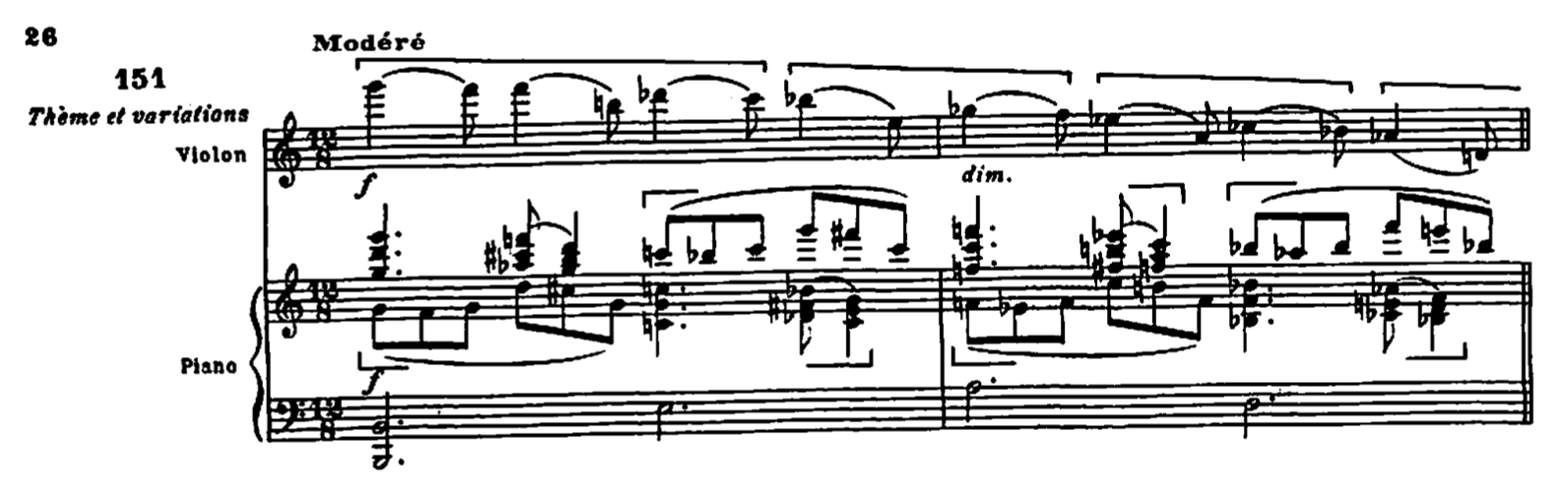
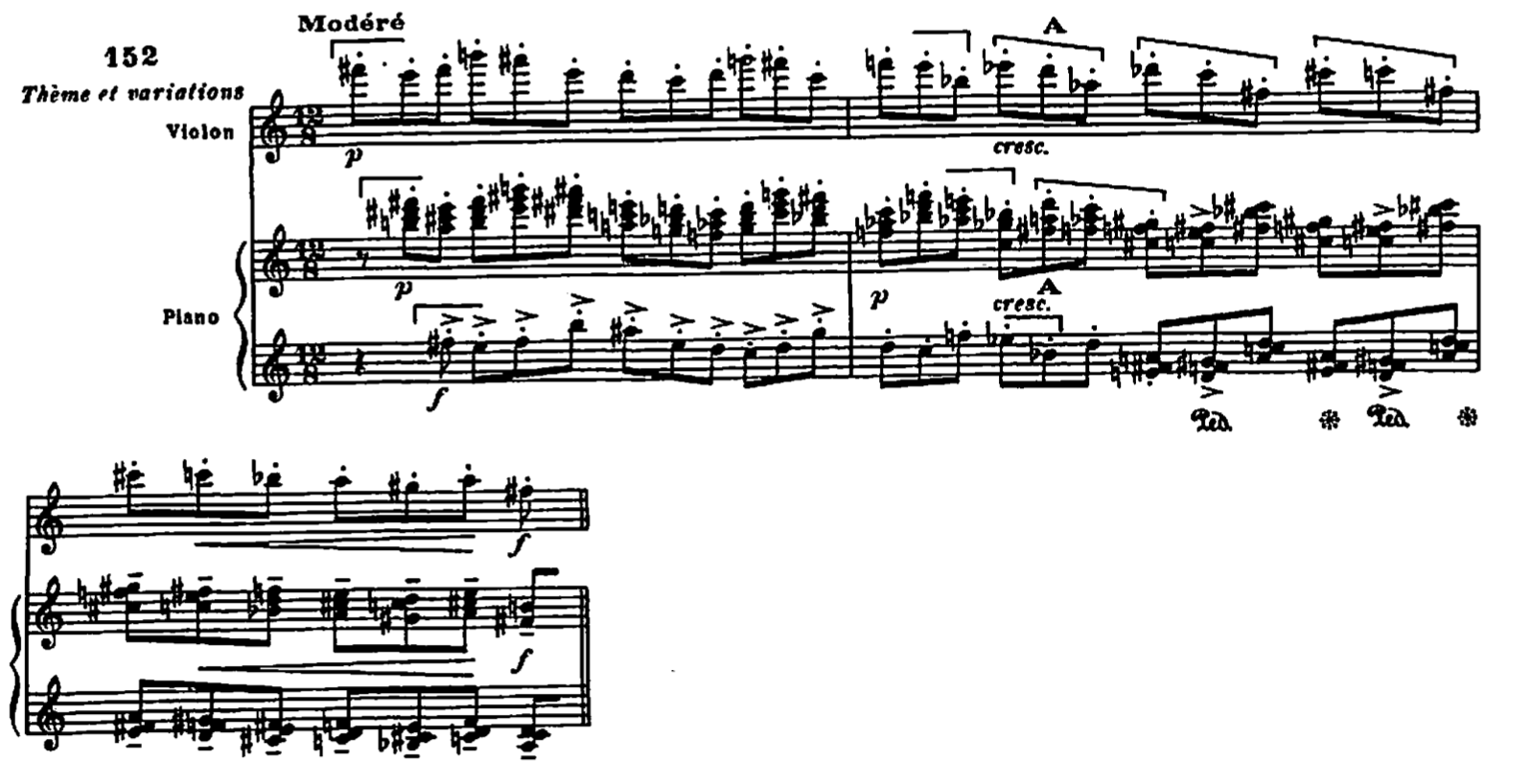



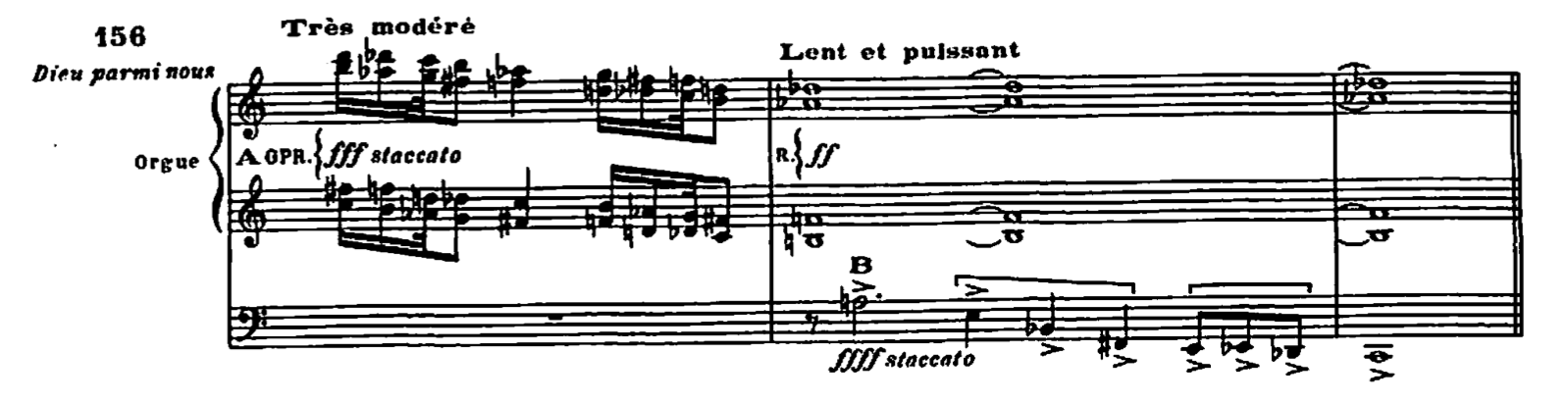
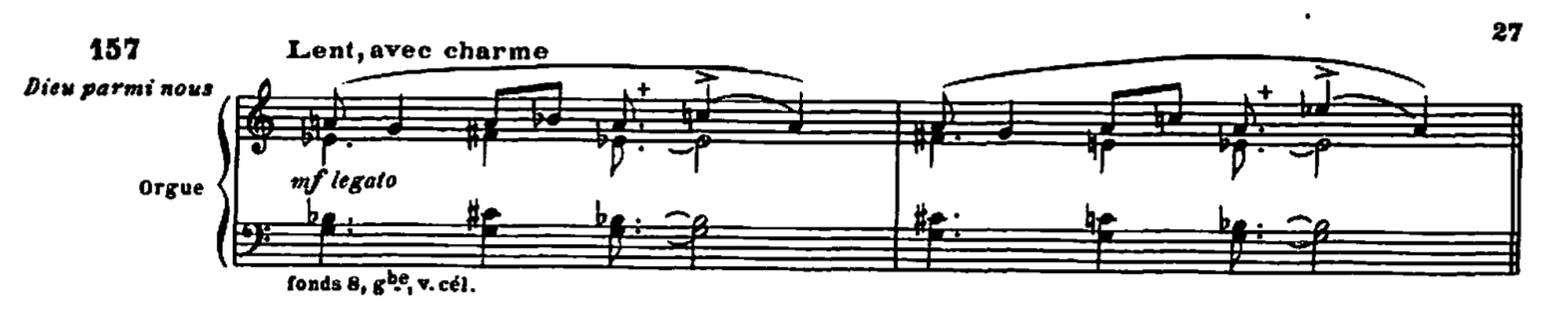






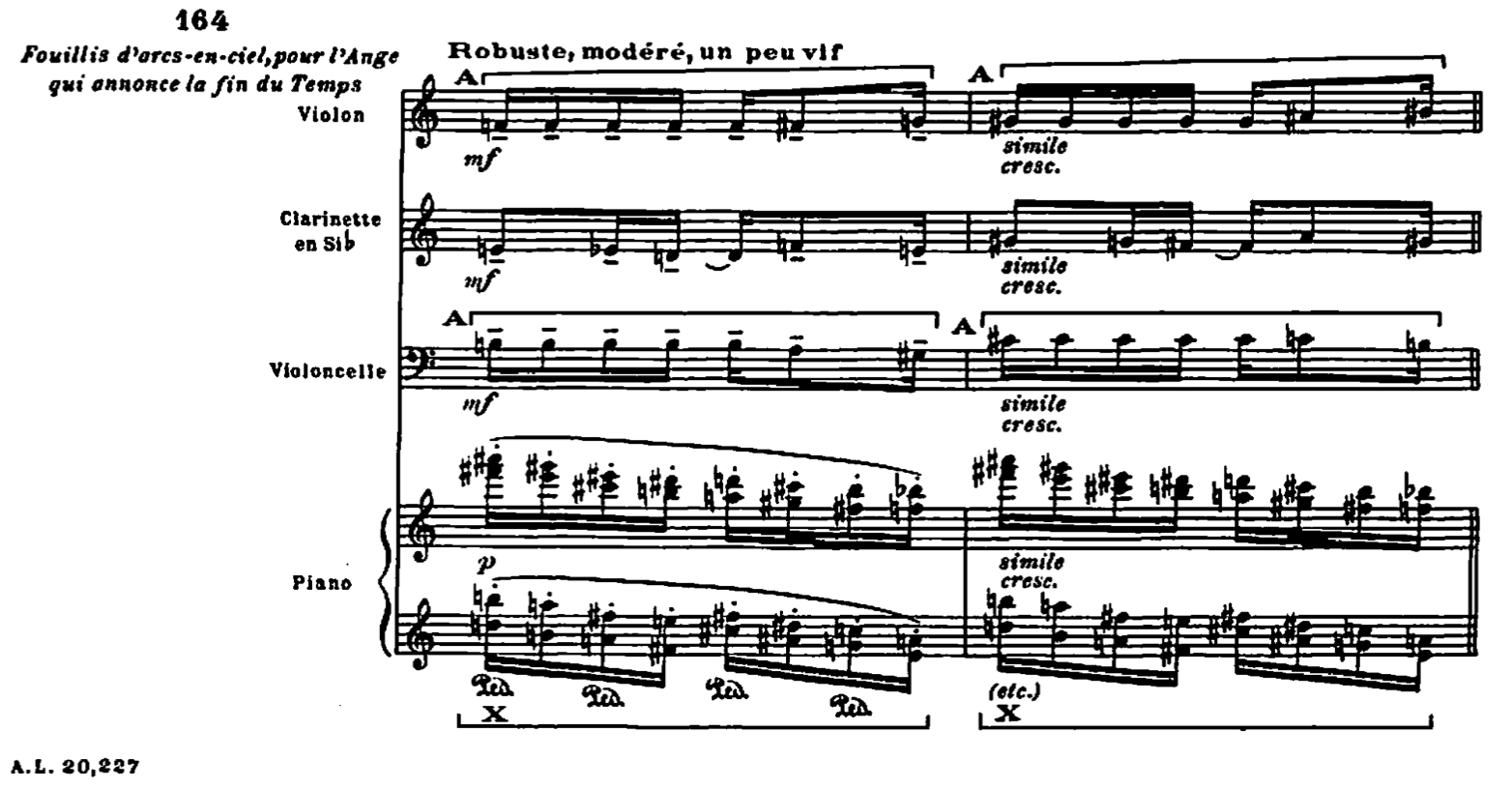
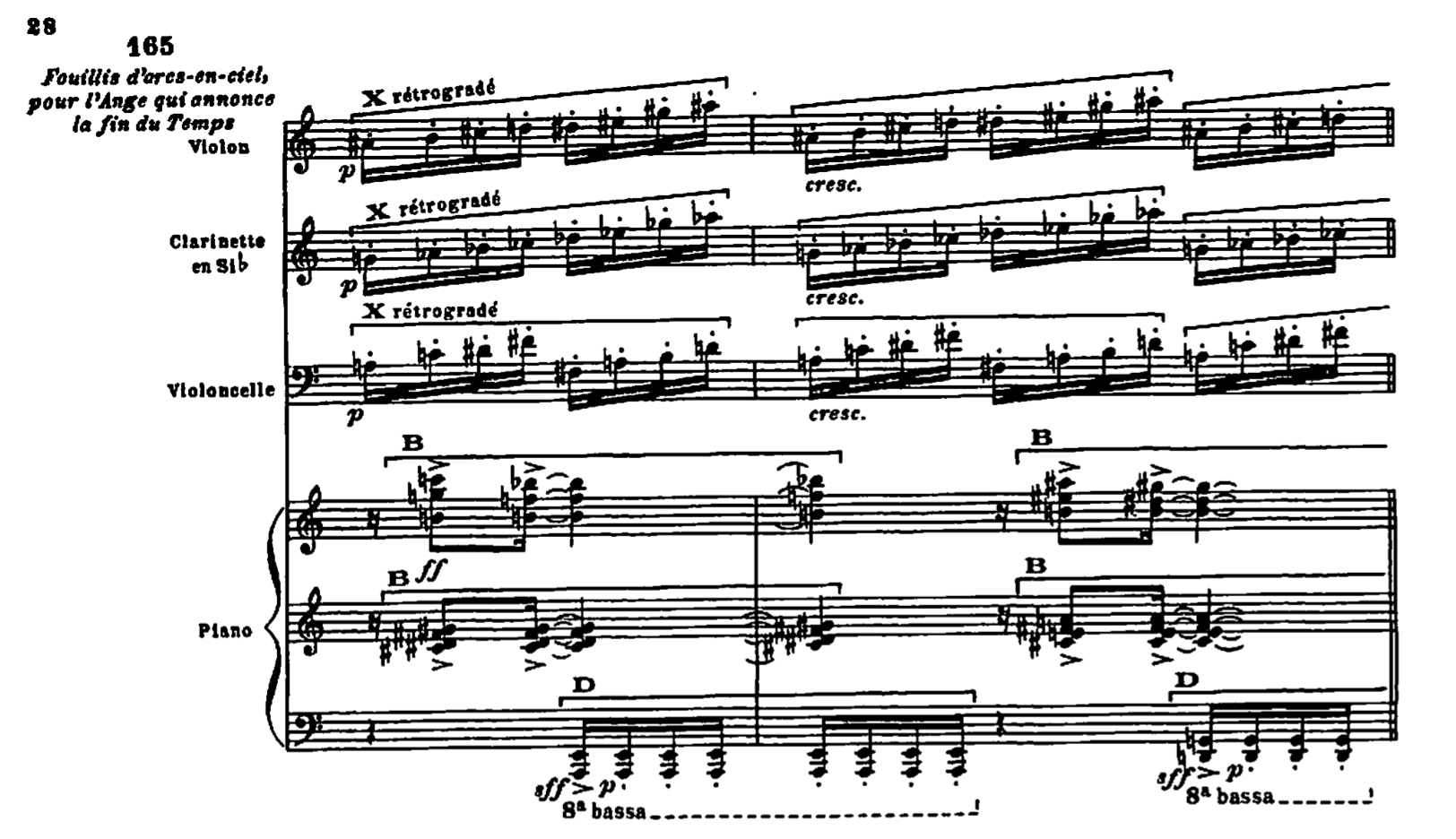
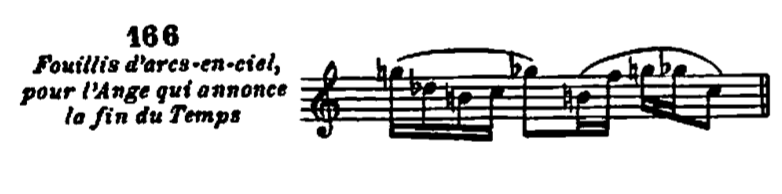
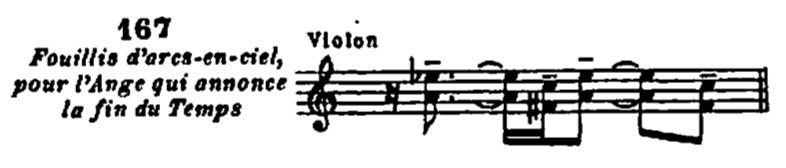
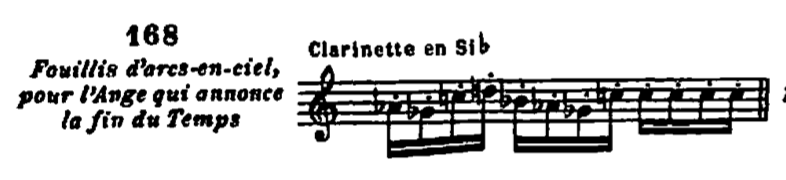
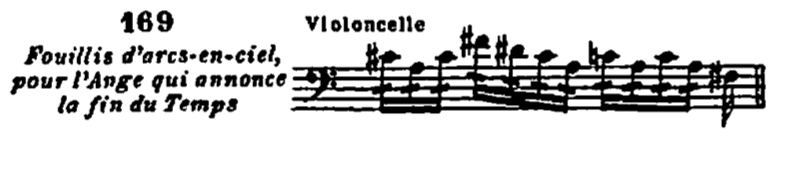

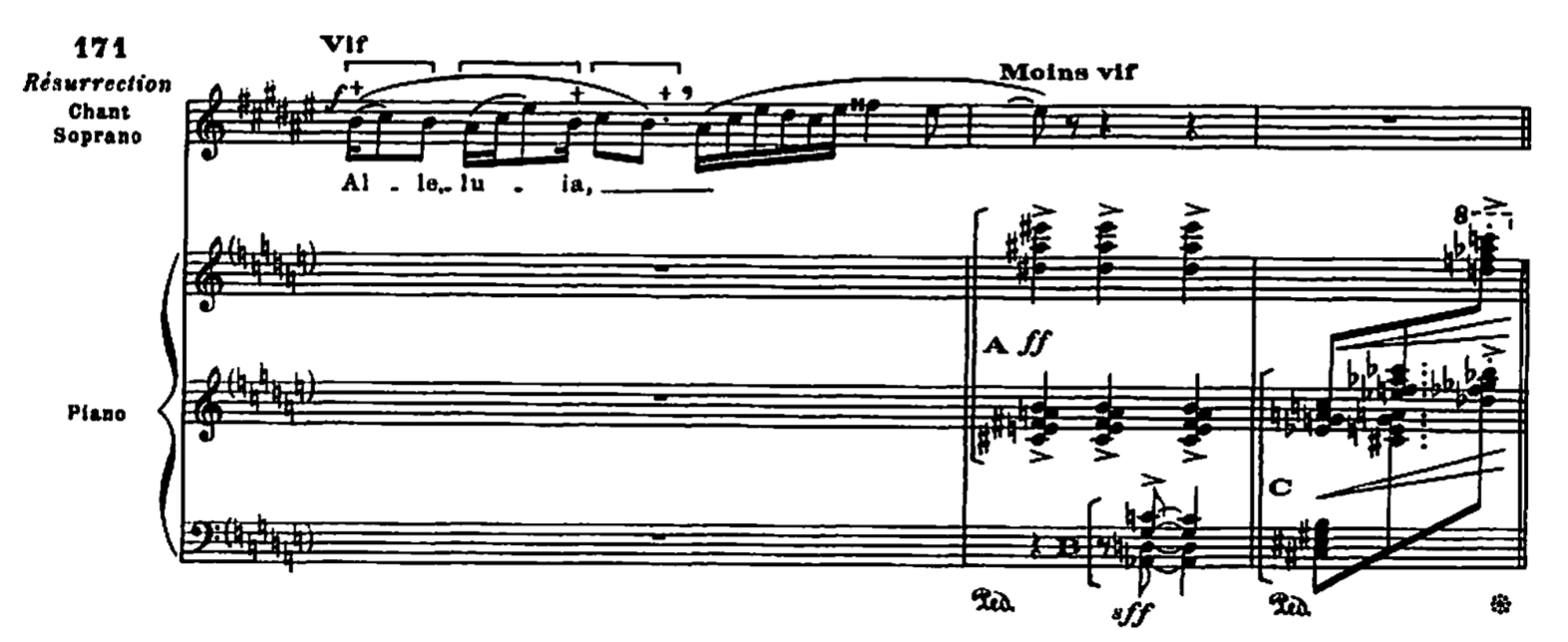

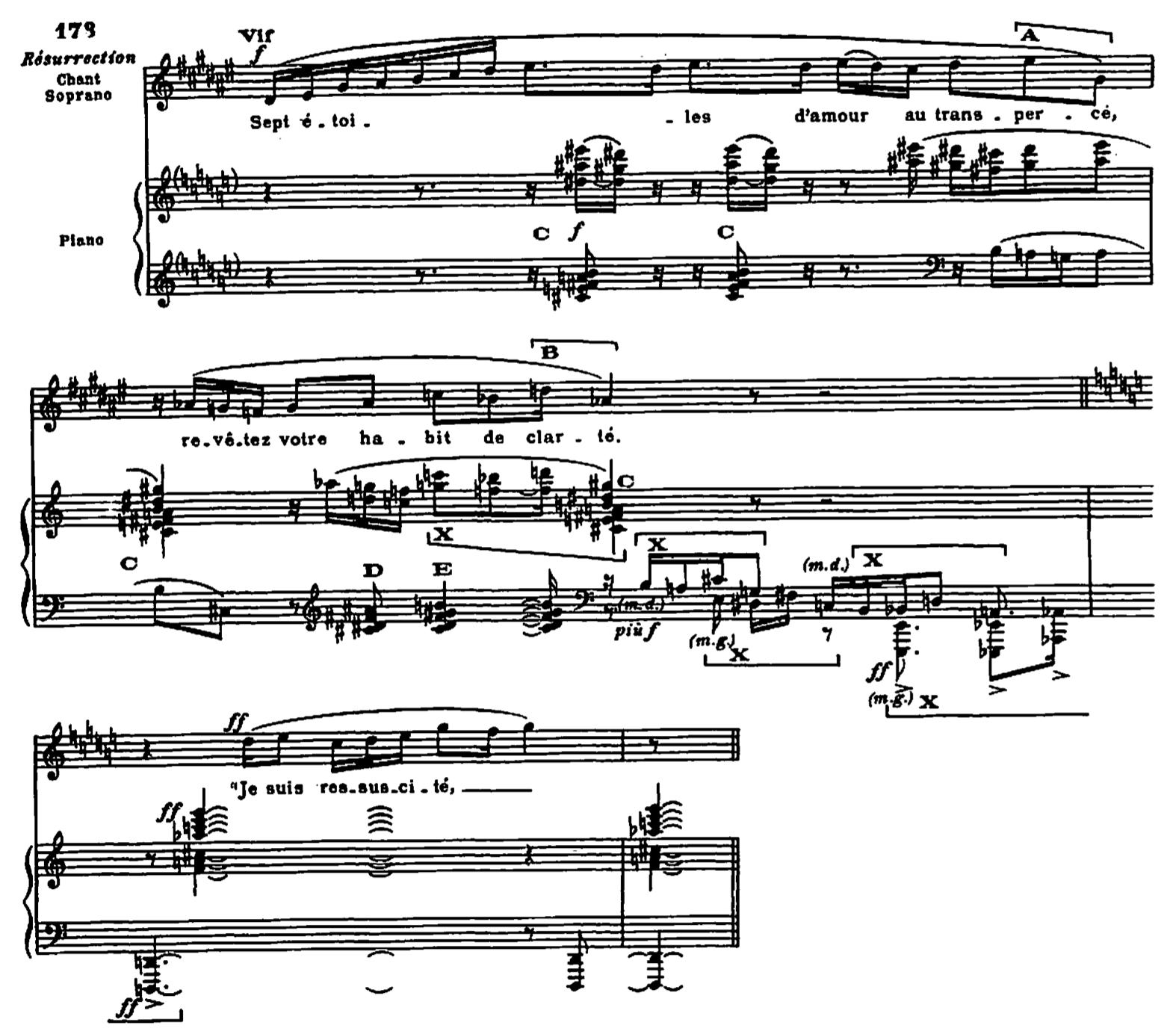
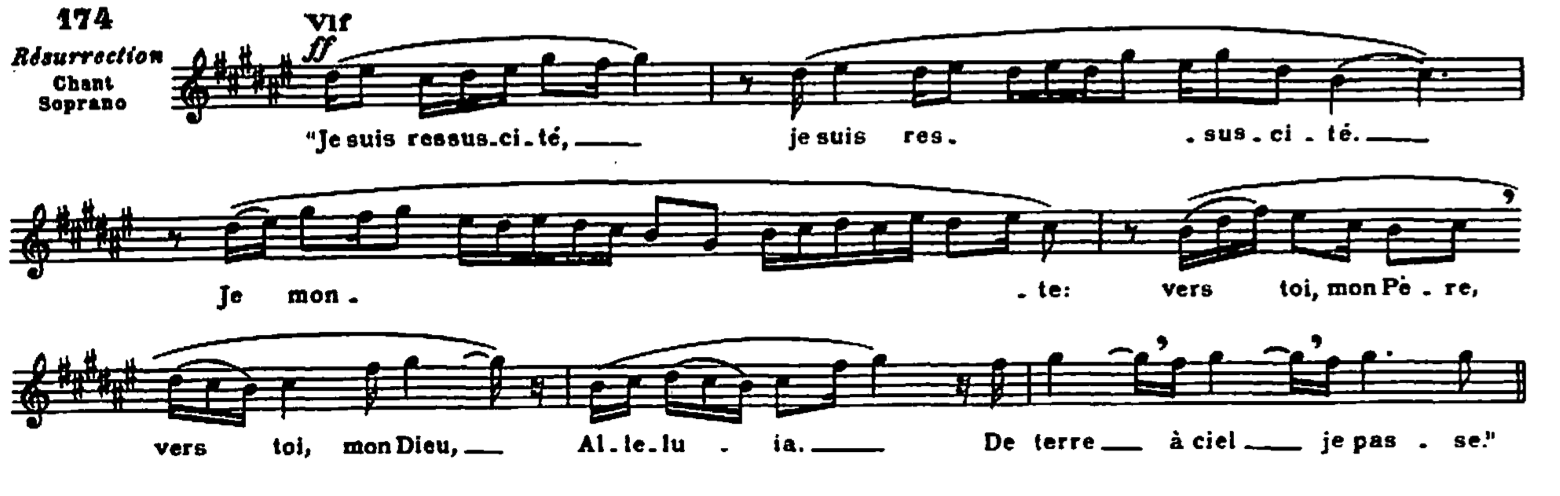
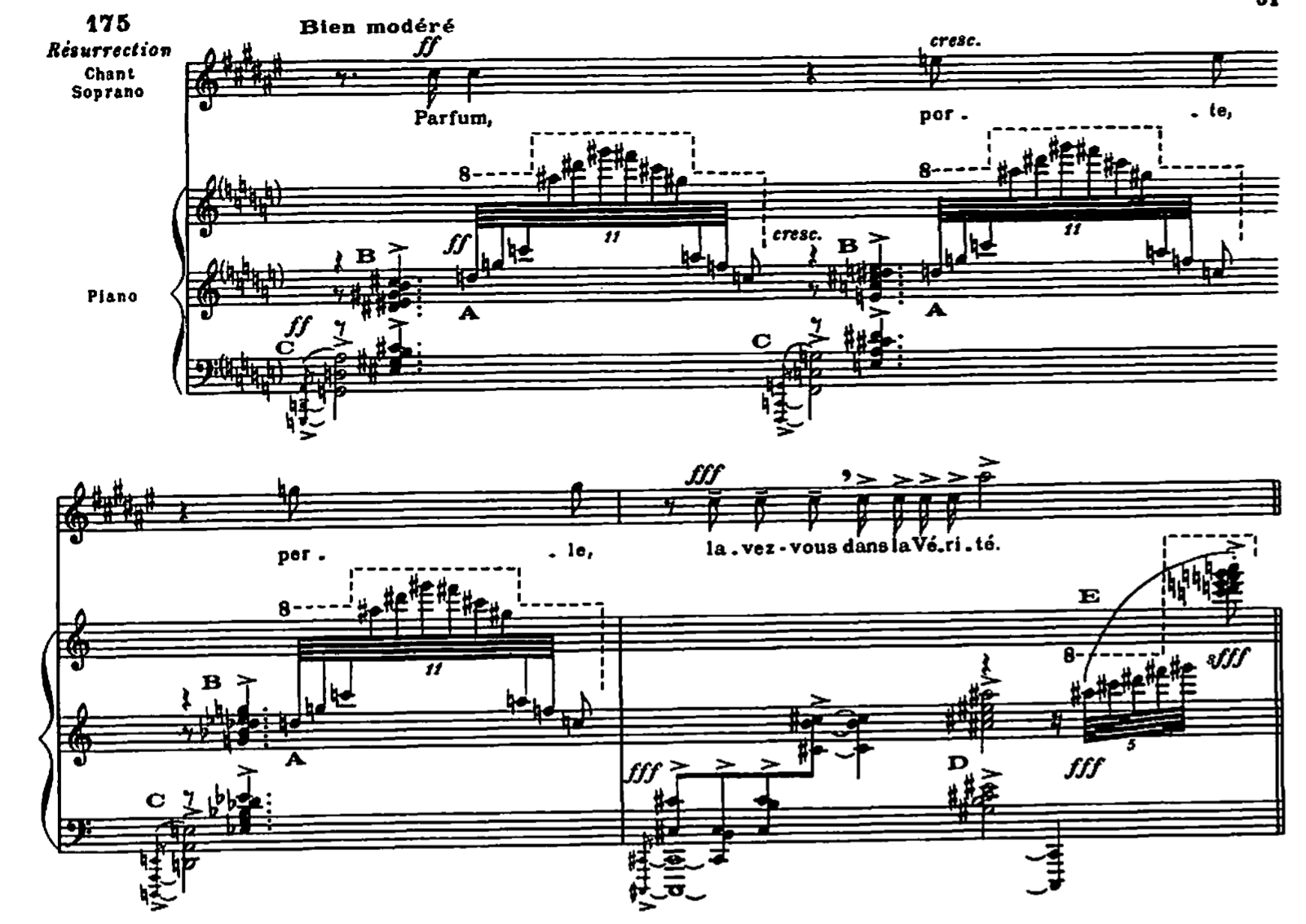
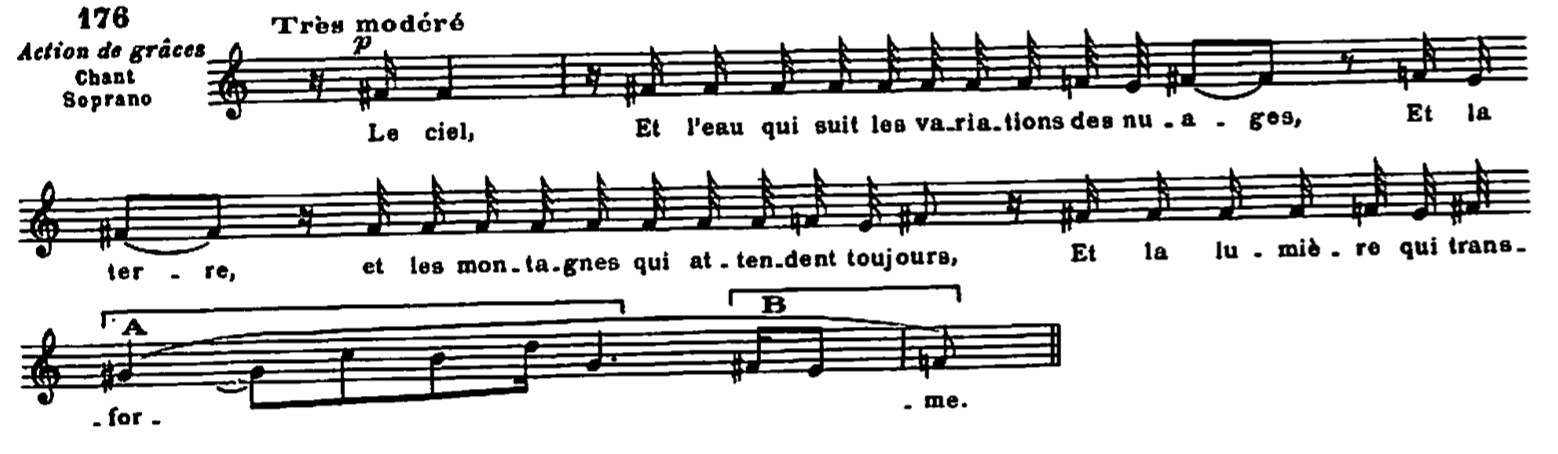
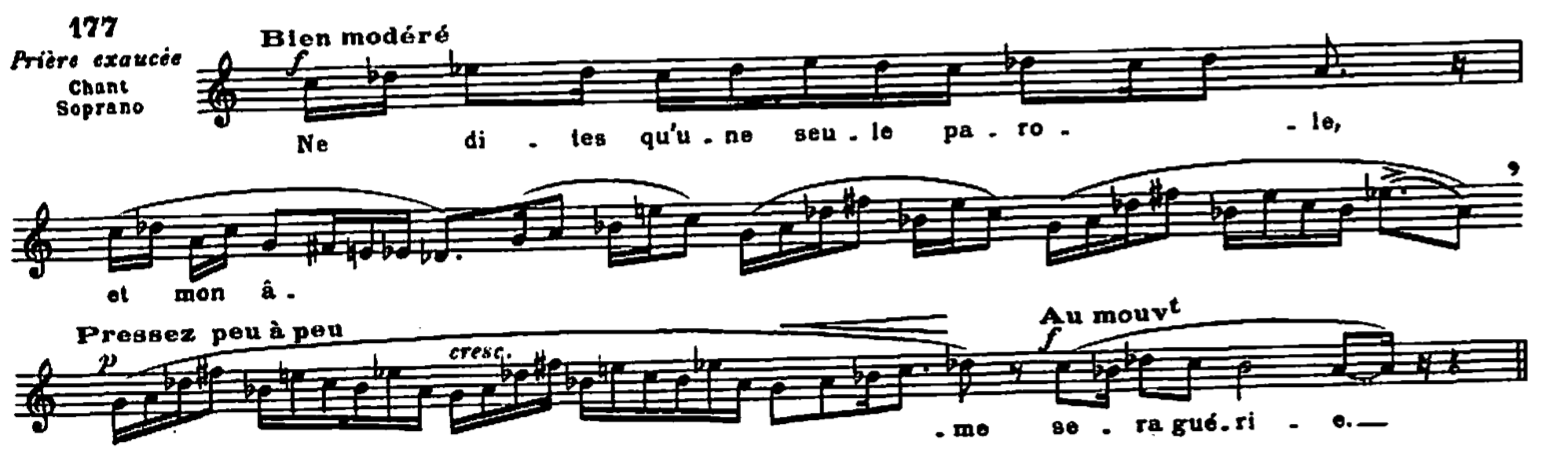

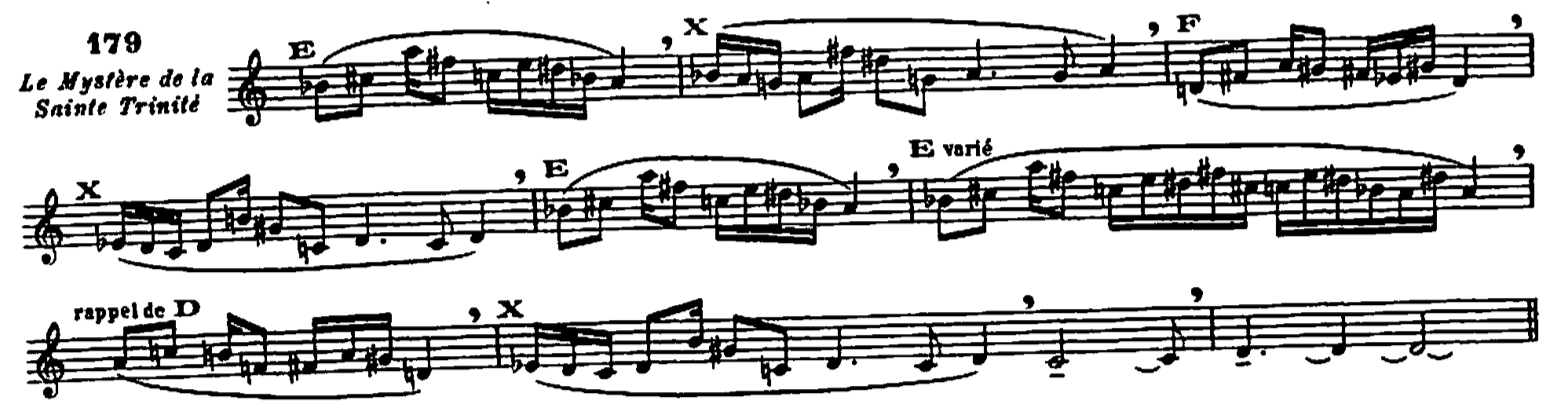

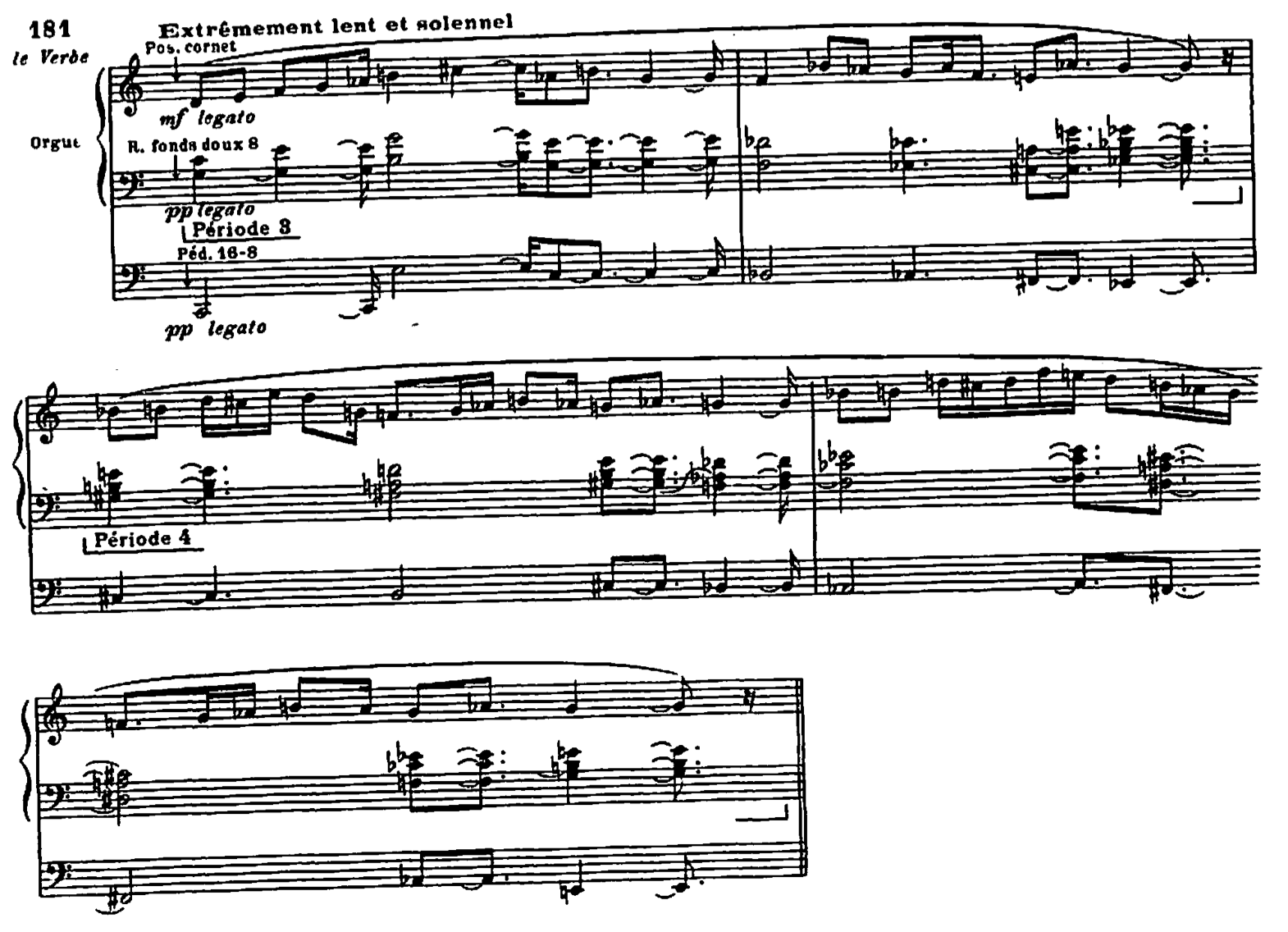
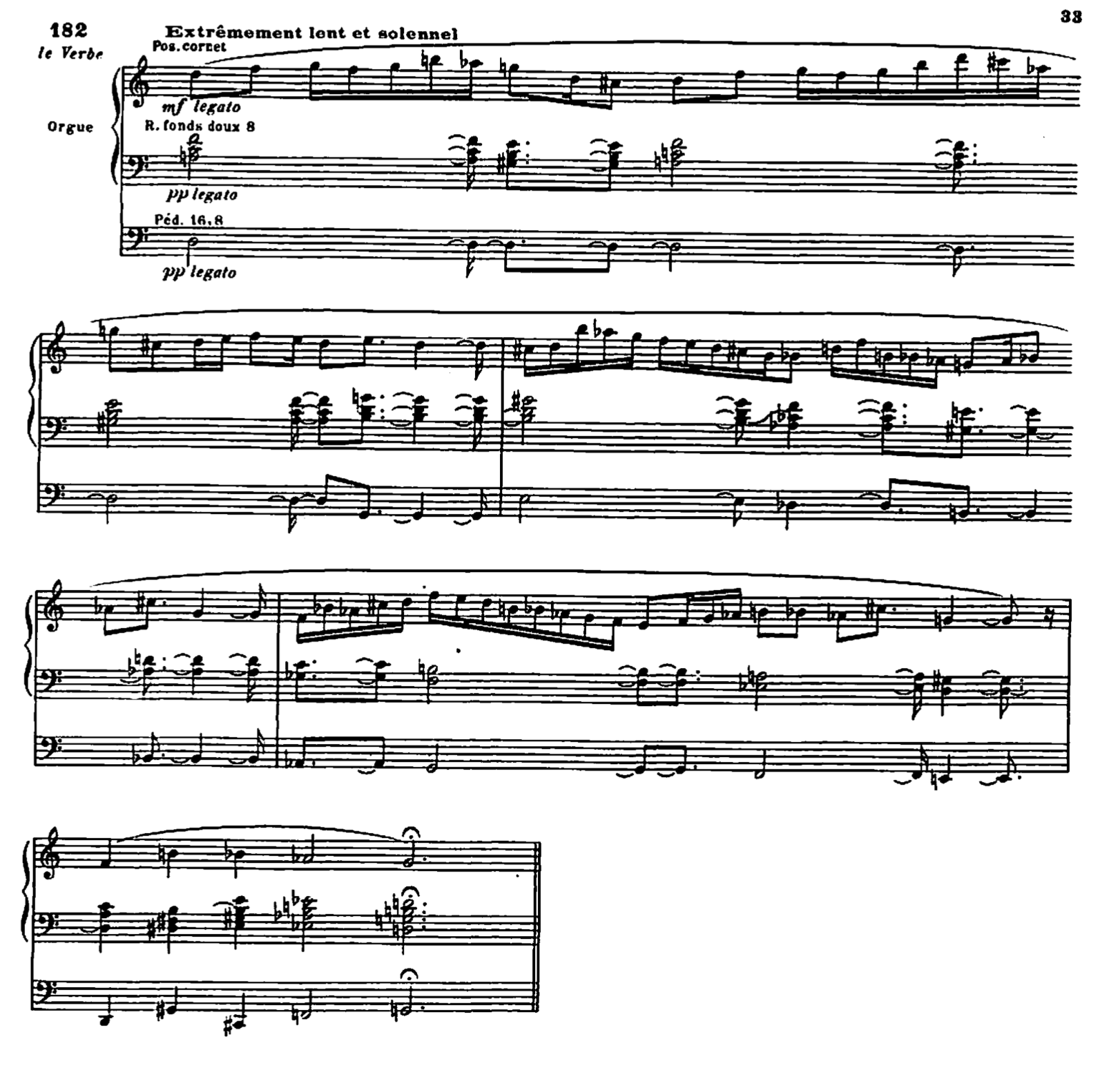
Overview
This expansive chapter concludes the melodic section by addressing large-scale formal organization, demonstrating how Messiaen adapts traditional forms (fugue, sonata-allegro) and plainchant structures (anthems, alleluias, psalmodics, Kyrie, sequence) to his compositional system. By passing rapidly over well-known forms (fugue and sonata) to focus on "less usual forms," Messiaen reveals his interest in plainchant liturgical structures as primary formal models, reflecting his Catholic faith and organist background. The chapter presents five distinct formal approaches: traditional development-based forms derived from sonata (standard sonata-allegro, development of three themes preparing a final, variations of first theme separated by second-theme developments), and plainchant-derived forms (various anthem, alleluia, psalmody, Kyrie, and sequence structures). Through detailed analyses of movements from his own works (La Nativité du Seigneur, Les Corps glorieux, Quatuor pour la fin du Temps), Messiaen demonstrates that his modal-rhythmic innovations function within recognizable formal frameworks while transforming them through characteristic techniques. This chapter bridges from melodic construction (Chapters VIII–XI) to harmonic language (Chapters XIII–XIX), showing that complete movements organize melodic materials (developed through elimination, interversion, registral change) within sentence structures (song-sentence, binary, ternary) to create large-scale forms serving both structural coherence and expressive/spiritual purposes.
Key Concepts
This chapter introduces five key formal approaches adapted to Messiaen's compositional system:
-
Fugue: Episode and Stretto - Traditional contrapuntal form with episode (harmonic progression concealed by canonic imitation) and stretto (overlapping entries) adapted to modal contexts
-
Sonata-Allegro: Terminal Development - Traditional sonata form with recapitulation declared obsolete, emphasizing terminal development as essential formal principle
-
Development of Three Themes, Preparing a Final Issued from the First - Teleological form presenting three themes in condensed exposition, developing them toward climactic final statement derived from the first theme
-
Variations of the First Theme, Separated by Developments of the Second - Rondo-like structure alternating theme variations with developmental episodes, creating sophisticated interaction between variation and development principles
-
Plainchant Forms: Anthems, Alleluias, Psalmodics, Kyrie, Sequence - Large-scale formal structures derived from Catholic liturgical chant genres, providing models embodying centuries of sacred practice
Fugue: Episode and Stretto
Definition: The traditional contrapuntal form built on systematic imitative entries of a subject, with Messiaen identifying episode (progression of harmony concealed by canonic entrances at symmetrical intervals) and stretto (overlapping entries creating intensification) as essential elements adaptable to modal contexts.
Messiaen's Treatment: Messiaen states he will pass over fugue and sonata rapidly, assuming reader familiarity. Without constraining himself to making regular fugues, he will keep the most essential parts: episode and stretto.
The episode is a progression of harmony concealed by entrances in canonic imitation at symmetrical intervals, generally fifth to fifth. He cites Bach's Kyrie from Mass in B minor, the first movement of Sixth Trio Sonata for organ, and Fugue in G minor for organ as support for this definition.
Example 151 demonstrates an episode: in piano, harmonic progression with symmetrical entrances from fifth to fifth upon the head of the subject elongated by a coda; in violin, descent upon the head of the countersubject.
Example 152 shows stretto in triple canon at the octave, at one note's distance, using Mode 3 in its third transposition from point A forward.
Modern Context: Messiaen's approach to fugue reflects modernist selective appropriation of Baroque procedures:
Traditional fugue elements retained:
- Subject: Thematic material for imitative development
- Episode: Developmental sections with sequential treatment
- Stretto: Overlapping entries creating climactic intensification
- Canonic imitation: Systematic voice leading at specific intervals
Elements transformed or omitted:
- Tonal answer: Real vs. tonal answer distinction irrelevant in modal context
- Counter-exposition: Formal rigidity relaxed
- Functional harmony: Episodes no longer modulate through tonal regions but rather shift modal transpositions
Historical context:
- Baroque fugue: Strict formal procedures, tonal hierarchy (Bach, Handel)
- Romantic fugue: Freer treatment, integration with other forms (Brahms, Mendelssohn)
- Modernist fugue: Adaptation to atonal/modal contexts (Hindemith's Ludus Tonalis, Shostakovich's 24 Preludes and Fugues, Berg's use in Wozzeck)
Messiaen's "canonic imitation at symmetrical intervals, generally fifth to fifth" adapts traditional fugal spacing (dominant answer) to modal context. In modes of limited transposition, the fifth may function differently than in tonal music, but the intervallic relationship provides structural consistency.
The triple canon stretto (Example 152) at "one note's distance"—each voice entering immediately after the previous—creates maximum contrapuntal density, characteristic of climactic fugal stretti.
Examples: Examples 151–152 demonstrate episode and stretto adapted to modal contexts.
Sonata-Allegro: Terminal Development
Definition: The traditional sonata form with Messiaen identifying one element as obsolete (recapitulation) and emphasizing terminal development as essential—developmental sections building over understood dominant and tonic pedals, creating climactic conclusions rather than literal recapitulations.
Messiaen's Treatment: Messiaen states that all free instrumental forms derive more or less from the four movements of the sonata, with the sonata-allegro synthesizing the whole sonata. Having written some absolutely regular sonata-allegros, he declares one thing has become obsolete: the recapitulation. He will try to keep what is most essential: the development.
There are two in a sonata-allegro: the middle modulating development; the terminal development, generally built over understood dominant and tonic pedals. He will be able to write pieces made of this terminal development alone, as tried in "les Enfants de Dieu" from La Nativité du Seigneur.
Analysis of this piece (Examples 153–154):
- (a) First element over a dominant pedal in B major, development by amplification of the second measure of the theme
- (b) A great fortissimo cry, upon a sort of schematic augmentation of the theme
- (c) A tender phrase forming the conclusion, established over a tonic pedal in B major
He may also start directly upon the central modulating development and end upon a large sentence forming at once the conclusion, the first complete exposition of the principal theme, and the definite establishment of the principal tonality, as tried in "Combat de la Mort et de la Vie" from Les Corps glorieux.
Analysis of this piece (Example 155): First element of the development, theme in C minor, in one voice, followed by a contest of chords alternated tumultuously. Then sections in E minor (two voices in canon), A-flat major (three voices in canon), D minor (bass with tumult of chords), ultimately leading to F-sharp major for climax and final exposition.
Modern Context: Messiaen's engagement with sonata form reflects broader modernist reassessment of Classical structures:
Traditional sonata-allegro:
- Exposition: Primary and secondary themes, closing material
- Development: Fragmentation, modulation, contrapuntal treatment
- Recapitulation: Return of exposition material in tonic
- Coda: Final affirmation
Messiaen's modifications:
- Recapitulation obsolete: Literal return replaced by terminal development
- Development essential: Transformation and intensification as primary formal process
- Tonal goal displaced: Not tonic return but climactic arrival
- Through-composed trajectory: Continuous development rather than sectional return
This approach parallels other modernist treatments:
- Schoenberg: Developing variation making recapitulation redundant (Chamber Symphony Op. 9)
- Sibelius: Teleological forms building toward final thematic revelation (Symphony No. 5)
- Liszt: Thematic transformation replacing development-recapitulation (Sonata in B minor)
Messiaen's "terminal development" concept resembles Sibelius's practice of withholding complete thematic statement until the end, making the entire piece a preparation for final revelation. In "Combat de la Mort et de la Vie," the full theme's emergence in F-sharp major represents both climax and resolution—formal culmination and theological meaning (resurrection) unified.
The reference to dominant and tonic pedals shows Messiaen maintaining tonal reference points even within modal contexts. These pedals function as anchors rather than functional harmonies—sustained bass notes providing stability without implying tonal progressions.
Examples: Examples 153–155 demonstrate terminal development as primary formal principle.
Development of Three Themes, Preparing a Final Issued from the First
Definition: A formal procedure resembling sonata development but presenting three distinct themes in condensed exposition, then developing them toward a climactic final statement derived from the first theme—creating teleological trajectory toward thematic synthesis.
Messiaen's Treatment: This form resembles the preceding sonata-based model. Used in the ninth part of La Nativité du Seigneur: "Dieu parmi nous."
Analysis (Examples 156–160):
-
(a) Condensed exposition of three themes in eight measures:
-
First theme (rhythmic): Example 156—divided into A and B; A written in Mode 4, B written in Mode 2; B contains three quarter-notes and three eighth-notes (diminution of three quarter-notes), a rhythm recalling rāgavardhana which will be the basis of the final toccata
-
Like Bach's chorale Adam's Fall (for organ), like the descent of Ariane (light to midst of darkness where Bluebeard's wives suffered in Paul Dukas's opera), this element B assimilates rhythmic precipitation and the passage from treble to bass into the idea of fall—but it is a question of the glorious and ineffable fall of the second person of the Holy Trinity into human form (if permissible to employ this term on the subject of the Incarnation of the Word)
-
Second theme (melodic and harmonic): Example 157—expressing love for Jesus Christ of the communicant, of the Virgin, of the entire Church
-
Without added value at crosses (Chapter III), this theme could have been written in 5/8 time
-
Third theme (melodic): Example 158—a Magnificat, alleluiatic praise in bird style
-
-
(b–e) Development sections:
- Development of first and third themes (159)
- Development of third theme in jubilatory counterpoint in two voices
- More impassioned development of second theme
- Element A of first theme over dominant pedal in E major; element B in contrary motion bursts like thunder and engenders a joyous and vigorous toccata
-
(f) Toccata in E major is the piece itself, all the large development which precedes having been only the preparation of it. Except for a passage recalling the third theme and a new melodic element (Example 159), the whole toccata is built upon element B of the first theme (Example 160), whose four quarter-notes are developed at length, repeated, triturated, hesitating in the bass around F-natural before concluding on E (tonic) in a triumphant glee.
Modern Context: This form represents Messiaen's distinctive contribution to developmental procedures:
Key characteristics:
- Multiple thematic exposition: Three contrasting themes presented in compressed form
- Differential development: Each theme receives varied developmental treatment
- Teleological trajectory: All development prepares climactic final section
- Thematic derivation: Final toccata derives from element of first theme, creating unity through transformation
Comparison with traditional forms:
- Sonata development: Works out exposition themes but returns them in recapitulation
- Lisztian transformation: Generates multiple themes from single germ, transforms throughout
- Messiaen's approach: Multiple independent themes converge toward single derived climax
This anticipates later compositional thinking:
- Goal-directed forms: Trajectory toward predetermined arrival (Carter, Ferneyhough)
- Thematic synthesis: Combination or derivation of final material from earlier themes (Lutosławski)
- Accumulation forms: Building intensity through progressive layering (Varèse, Xenakis)
The theological program is explicit: first theme's element B represents the Incarnation (fall from heaven to earth, divinity to humanity), developed throughout until finally erupting in the toccata—musical form embodies theological narrative. The rāgavardhana reference connects this theological meaning to Hindu rhythmic source (Chapter II), demonstrating cross-cultural synthesis serving Christian theology.
The observation that the entire large development is "only the preparation" for the toccata inverts traditional formal hierarchy—what appears to be the main body (development) is actually preparation for what appears to be coda (toccata). This resembles Sibelius's practice of building entire movements toward final thematic revelation.
Examples: Examples 156–160 systematically present themes and trace their development toward final toccata.
Variations of the First Theme, Separated by Developments of the Second
Definition: A formal procedure alternating variations of a primary theme with developmental episodes of a secondary theme, creating rondo-like structure where theme variations function as ritornellos and second-theme developments function as episodes.
Messiaen's Treatment: Form used in the seventh part of Quatuor pour la fin du Temps: "Fouillis d'arcs-en-ciel, pour l'Ange qui annonce la fin du Temps."
Analysis (Examples 161–169):
-
(a) Exposition of first theme (melodic): Example 161—a complete sentence in Mode 2, drifting between tonalities of A major, F-sharp major, E-flat major (see Chapter XVII's Example 339 where it is quoted completely with its harmonics)
-
(b) Exposition of second theme (rhythmic) by four instruments (violin, clarinet in B-flat, violoncello, piano): Example 162—drawn from second movement of the Quatuor
-
(c) First variation of the first theme, accompanied by clarinet's counterpoint, still in Mode 2, drifting between F-sharp, E-flat, and E major tonalities (Chapter XVI's Example 326 quotes first measures)
-
(d) Development of rhythmic elements A, B, C, D, all drawn from second theme (Example 163): First measures of second theme, development of A in strings over cluster of chords X in piano drawn from second movement of Quatuor (Example 164); next measures of second theme, development of B and D in piano under cluster X retrograded in violin and clarinet for the two top voices of the chords (violoncello partially retrogrades the two low voices), with use of dominant chord with appoggiaturas in B and effects of inferior resonance in D (Chapter XIV, articles 1 and 4) (Example 165); then development of C by elimination (Example 164 and 165, clarinet sounds a tone lower than notation)
-
(e) Second variation of first theme—arabesques in violin and piano opposed to clarinet in low register and col legno of violoncello
-
(f) Combination of commentary of second theme (Example 166) with rhythm of the first (Example 167), and clarinet recall in equal values of sixth movement of Quatuor (Example 168)
-
Development of trilled chords ending second theme's commentary. Cluster X in normal and retrograde movement simultaneously. Then new succession of chords drawn from second theme and from second movement of Quatuor. Finally, "jumble"—clusters, cascades of chords. Clarinet repeats arpeggio formula of dominant chord already heard in second and third movements of Quatuor. Violin and violoncello, borrowing diminution from first theme (Example 169), make of it an ascent in development by elimination (Chapter X), leading naturally to the final variation.
-
(g) Last variation of first theme, same mode and same tonal drifting. Sentence trilled throughout. Short recall of second theme to conclude.
Modern Context: This form creates sophisticated interaction between variation and development principles:
Structural elements:
- Theme variations: Progressive transformations of primary melodic material
- Developmental episodes: Working-out of secondary rhythmic material
- Alternation principle: AVAAVA... structure (where A = first theme, V = second theme development)
Historical precedents:
- Rondo form: Theme returns alternating with episodes (ABACA)
- Variation form: Progressive transformation of single theme (Baroque chaconne/passacaglia, Classical variations)
- Development variation: Brahmsian synthesis of variation and development
Messiaen's innovation lies in treating themes parametrically:
- First theme: Melodic, varied primarily through textural/registral changes while maintaining contour
- Second theme: Rhythmic, developed through elimination, combination, retrograde
This creates formal richness through parametric independence—melodic theme varies while rhythmic theme develops, two processes operating simultaneously but independently.
The self-quotation from second and sixth movements of the Quatuor demonstrates cyclic formal thinking—materials recurring across movements, creating large-scale unity. This reflects Franck/d'Indy influence on French formal thinking (cyclical forms with thematic transformation across movements).
The final "jumble" (fouillis)—clusters, cascades of chords—before final variation represents climactic accumulation, analogous to development retransition in sonata form. The apocalyptic program (angel announcing the end of time) finds musical realization in this textural climax before serene final variation.
Examples: Examples 161–169 comprehensively trace the alternation of theme variations and developmental episodes.
Plainchant Forms: Anthems, Alleluias, Psalmodics, Kyrie, Sequence
Definition: Large-scale formal structures derived from Catholic liturgical chant, particularly the various genres of Gregorian and other plainchant traditions, providing Messiaen with formal models embodying centuries of sacred musical practice and reflecting his spiritual commitments.
Messiaen's Treatment: Messiaen states one can hardly use plainchant themes more and better than Charles Tournemire in his Orgue mystique. Leaving these themes and their melodic contours (Chapter VIII) for a little, he will turn toward the plainchant forms, noting that Alleluias and great ornament anthems will allure us from the very first.
General approach: He applies plainchant formal structures while forgetting their original modes and rhythms in favor of his own (modes of limited transposition, added values, etc.).
(i) Anthem Forms ("Subtilitê des Corps glorieux" from Les Corps glorieux):
A large ornamented anthem in one voice without harmonization, each period terminated by a formula of melodic cadence repeated in echo (Example 170).
Formal structure (periods labeled A, B, C, D, E):
- A: Repeated twice
- B: Repeated twice with second time variants of accent, descent, and curves; restatement of A
- C: Modulating to dominant and concluding on tonic
- A: Varied
- D: Modulating to dominant with varied repetitions in crescendo and great vocalise, ending in period A deprived of its head
- E: Starting upon great vocalise and concluding on tonic, with echoes and rhythmic enlargement
In "Antienne du Silence" (Chants de Terre et de Ciel), principal sentence given to voice upon melody in anthem form, surrounded by quasi-atonal double counterpoint.
(ii) Alleluia ("Résurrection"):
Retains essential part of alleluias: alleluiatic vocalise, whose character music will often have. Example 171: Alleluiatic melody with added values (at crosses) divided into little groups of five sixteenth-notes (prime number); vocalise following accentuates rapid, supple, joyous, triumphant pace of passage.
In piano: enormous carillon irradiated, using interpretation of Hindu rhythm rāgavardhana (Chapter II). At A, dominant chord with appoggiaturas (Chapter XIV) provided with effect of inferior resonance at B. At C, chord of resonance with effect of stained-glass window (Chapter XIV). Further on, initial vocalise amplified (at A) (Example 172).
Third jubilatory example (Example 173): Notice intervals of two melodic descents—at A, descending major sixth; at B, descending augmented fourth. In piano, dominant chord with appoggiaturas (Chapter XIV, article 1) used in different inversions at C, D, E. Still in piano: close entrances X, the thematic fragment (first formula of melodic cadence, Chapter VIII) changes rhythm at each entry.
Example 174: Voice turns around melodic dominant (G-sharp) with sunny gaiety more and more delirious. Example 175: Work ends with this last increase of joy.
The volleys in bird style (at A) contrast with powerful solemnity of chords B (preceded at C by their effect of inferior resonance). At D, chord of dominant seventh with added sixth (Chapter XIII). At E, last volley like blow of instantaneous light!
Messiaen notes: Let us see now how one can blend alleluiatic vocalise with psalmody. Afterwards we shall study two plainchant forms: the Kyrie and the sequence.
(iii) Psalmody and Vocalise ("Psalmody and Vocalise" section):
Without forgetting that voice should first sing and afterwards turn to exigences of text and imitate inflections of speech, we may occasionally adopt certain system of declamation more easily applicable if we ourselves write poems of our vocal works.
Two domains of recitative:
- Psalmody: Words uttered at very rapid pace on repeated note, punctuation underlined by formulas of vocalized melodic cadences
- Important words: Especially important, moving, rich in meaning, adorned with long or even very long vocalise
Example 176 (psalmody): Melodic cadence contains returning chromaticism B and melodic contour A often quoted in this work (Chapter VIII). Example 177: Important word âme (soul that suffers and prays) vocalized at length.
(iv) Kyrie ("Mystère de la Sainte Trinité"):
In plainchant masses, some Kyries divided thus: first, Kyrie eleison (Father) three times A, B, A; second, Christe eleison (Son) three times C, D, C; third, Kyrie eleison (Holy Ghost) three times E, F; last Kyrie (longer) takes up period E again, repeating it twice, followed by melodic conclusion. Music assumed at word eleison ("have pity upon us!") remains the same for nine invocations.
Messiaen's "Mystère de la Sainte Trinité" (organ piece written in three voices, supplementary homage to Trinity): Form itself tripartite—three times three. Top voice sings distant counterpoint, quasi-atonal, made of upbeats and terminations; bass unfolds long rhythmic pedal (Chapter XV, example 310, drawn exactly from "Mystère de la Sainte Trinité"). He quotes here only middle voice with principal song (Example 178).
Analysis of first tercet (A, B, A) in D; second tercet (C, D, C) touches upon key of A; third tercet (E, F, E) (Example 179) also begins in A, X being transposed, F is only restatement of A. Then E repeated twice, second time being enlarged by ornamental melodic variant. Conclusion in D recalling period D; X (eleison) in D with rhythmic expansion, to finish.
(v) Sequence ("le Verbe" section):
Sequence is canticle of popular style. Each period heard twice, either consecutively or alternately; all end on same note. In "le Verbe" (fourth part of Nativité du Seigneur), very special form simultaneously holds to sequence through its divisions, to Hindu ragas through character, to ornamented chorales of J.S. Bach through expressive and austere arabesques which overload the solemn, long, slow melody.
In it each repetition of period varied, provided with new ornamentation; G (final of each period) in course of sentence harmonized in nine different ways. Mode 2 (melody) mixed with major tonality and seventh mode of plainchant or mode on G (harmonies)—these mixtures will be examined more closely in Chapters XVII and XVIII.
Distribution of periods (Examples 180–182):
- Period 1: Example 180
- Period 2 repeated twice; Periods 3 and 4: Example 181
- Periods 3 and 4 varied: Then restatement of period 2, very much elongated and followed by sort of amen to conclude (Example 182)
Modern Context: Messiaen's engagement with plainchant forms represents distinctive twentieth-century practice:
Historical context:
- 19th-century plainchant revival: Solesmes restoration, scholarly editions
- Cecilian movement: Reform of Catholic church music
- French organ school: Tradition of plainchant-based improvisation and composition (Widor, Vierne, Tournemire)
Messiaen's approach:
- Formal structures retained: Periodic organization, repeat schemes, vocalise patterns
- Melodic/harmonic language transformed: Modes of limited transposition replace church modes
- Rhythmic treatment transformed: Added values and Hindu rhythms replace plainchant rhythm
- Spiritual purpose maintained: Liturgical/theological meanings preserved through formal associations
This differs from other twentieth-century plainchant uses:
- Stravinsky (Symphony of Psalms, Mass): Austere, archaic textures evoking medieval sound
- Poulenc (Figure humaine, sacred choruses): Direct quotation or close stylistic imitation
- Pärt (tintinnabuli style): Radical simplification inspired by early music aesthetics
Messiaen maintains plainchant formal complexity while completely transforming harmonic/rhythmic language—the structure conveys liturgical meaning even when the sound is thoroughly modern.
The extensive treatment of alleluia (Examples 171–175) reflects this form's significance—the alleluia is the most jubilatory, ornamental plainchant genre, embodying spiritual joy through extended melismatic vocalise. Messiaen's alleluiatic vocalises combine bird style (volleys, trills) with liturgical jubilation—natural and sacred joy unified.
The Kyrie analysis demonstrates structural thinking—nine invocations (3×3), tripartite form, Trinity symbolism all embodied in formal organization. Music serves theological meaning through numerology and structural symbolism.
The sequence discussion reveals Messiaen's synthetic method at its most complex: sequence form (medieval) + Hindu raga character + Bach chorale ornamentation + Mode 2 + major tonality + seventh plainchant mode = maximalist fusion serving spiritual expression.
Examples: Examples 170–182 comprehensively demonstrate adapted plainchant forms across multiple genres.
Relationship to Other Chapters
Chapter XII integrates all previous melodic/rhythmic techniques within large-scale forms:
-
Chapter II (Rāgavardhana): Rāgavardhana appears in "Dieu parmi nous" (Example 156) and "Résurrection" alleluia, connecting Hindu rhythm to theological themes.
-
Chapter III (Added Values): Multiple examples incorporate added values (crosses marking additions throughout Examples 171–173).
-
Chapter VIII (Melody and Melodic Contours): First formula of melodic cadence (Chapter VIII) appears in Example 173, showing contour formulas operating within large-scale forms.
-
Chapter X (Melodic Development): Elimination technique structures developmental sections (Examples 163–165, Example 169).
-
Chapter XI (Song-Sentence, Binary and Ternary Sentences): Sentence structures organize individual periods within larger forms.
-
Chapter XIV (Special Chords, Clusters, Connections): Dominant chord with appoggiaturas, chord of resonance, stained-glass window effect, inferior resonance—all characteristic chords appear throughout (Examples 171–175).
-
Chapter XV (Enlargement of Foreign Notes, Upbeats, Terminations): Kyrie example (178) references upbeats and terminations; rhythmic pedal (310) cited.
-
Chapter XVI (Modes of Limited Transpositions): Multiple modes referenced (Mode 2, Mode 3, Mode 4) providing harmonic context.
-
Chapter XVII (Modulations of These Modes): Modal mixture and modulation discussed in sequence and Kyrie examples.
The chapter demonstrates that Messiaen's innovations (modes, rhythms, techniques) function within recognizable formal frameworks—traditional Western forms (fugue, sonata) and liturgical structures (plainchant genres)—creating music simultaneously modern (harmonically/rhythmically) and historically grounded (formally).
Summary
Chapter XII concludes the melodic section by demonstrating how Messiaen's innovations operate within large-scale formal structures, addressing both traditional instrumental forms (fugue, sonata-allegro) and plainchant liturgical genres (anthem, alleluia, psalmody, Kyrie, sequence). By identifying recapitulation as obsolete and emphasizing terminal development as essential, Messiaen reveals his preference for teleological forms building toward climactic arrivals rather than symmetrical returns. The extensive treatment of plainchant forms reflects his Catholic faith and organist background—these liturgical structures provide formal models embodying centuries of sacred practice while accommodating his modal-rhythmic innovations. Through detailed analyses of movements from his major works, Messiaen demonstrates that complete pieces organize melodic materials (derived from diverse sources, developed through systematic transformations) within sentence structures (from Chapter XI) to create large-scale forms serving both structural coherence and spiritual expression. The chapter reveals Messiaen's synthetic method at maximum complexity: developmental procedures from Beethoven + canonic techniques from Bach + formal archetypes from plainchant + modes of limited transposition + Hindu rhythms + bird style + characteristic chords = personal language simultaneously historical and innovative, systematic and expressive, technical and theological.
For contemporary readers, this chapter illustrates how modernist innovations can function within traditional formal frameworks rather than requiring revolutionary formal approaches, and how composers can draw formal models from liturgical as well as instrumental traditions. Messiaen's forms are neither abstract structures nor programmatic narratives but rather embodiments of theological meanings—the Incarnation (descent of element B in "Dieu parmi nous"), Resurrection (jubilatory alleluia), Trinity (nine invocations, tripartite Kyrie), Word made flesh (sequence combining major tonality, plainchant mode, and Mode 2). This integration of technical innovation, formal tradition, and spiritual purpose completes the melodic section, preparing for the harmonic chapters (XIII–XIX) that will develop the modal and chordal language supporting these melodic-formal structures.
Part III: Harmony—The Rainbow of Transcendence
The seven chapters on harmony reveal something extraordinary: a complete reimagining of how pitch relationships can generate both structure and color, grounded not in historical convention but in acoustic resonance, mathematical symmetry, and spiritual vision. Where rhythm gave us the "charm of impossibilities" through temporal symmetry, and melody showed us how contour and birdsong transcend conventional phrase structure, harmony completes the theological rainbow—modes that exist simultaneously in multiple tonal atmospheres while committing to none, chords that emerge from natural resonance rather than theoretical construction, and progressions that move through kaleidoscopic transformations while maintaining crystalline clarity.
Beyond Functional Harmony: The Liberation of Dissonance
Messiaen begins with a radical proposition: what if dissonances didn't need to resolve? The concept of added notes (Chapter XIII) transforms our entire relationship with harmonic tension. Those pitches that traditional harmony treats as temporary—passing tones, appoggiatura, suspensions—become permanent residents within the chord. They don't resolve; they simply are. The added sixth and augmented fourth aren't ornaments awaiting resolution—they're structural members possessing "full citizenship in the chord."
Consider what this means for your music: every chord can be a destination, not just a waypoint. That suspended fourth you've been dutifully resolving? Let it ring. That added ninth creating delicious friction? It's not friction—it's the chord's natural resonance. Messiaen shows us that harmonic richness doesn't require constant motion; it can achieve stasis without stagnation, creating what he calls "stained-glass window effects" where multiple inversions and colorings of the same harmonic essence shimmer with internal life.
The parallel he draws between added notes and added values isn't mere theoretical elegance—it's compositional methodology. Both techniques share "the same charm, somewhat perverse": they make music "limp deliciously," introducing asymmetry and supplementation that transforms without destroying. If your rhythms use added values to create temporal complexity, why shouldn't your harmonies use added notes to create vertical richness? The principle of enrichment through "foreign" elements operates across all parameters.
Three Chords That Change Everything
Chapter XIV presents three harmonic building blocks that open radical compositional possibilities. First, the chord on the dominant saturates diatonic space—all seven notes of the major scale sounding simultaneously. But rather than creating chaos, this maximal density hovers between tension and stasis, especially when treated with Messiaen's "multicolor work," arranging inversions over a common bass to create harmonic halos.
Second, the chord of resonance grounds harmony in acoustic reality. Built from the overtone series, this sonority claims legitimacy from nature itself—it's not constructed; it's discovered. When Messiaen writes of "natural harmony" as "pre-existent, having always been enclosed in the melody, awaiting manifestation," he's describing harmonic choices as acts of revelation rather than invention. Your task isn't to create harmony from nothing but to filter and refine what acoustic resonance already offers.
Third, the chord in fourths abandons tertian stacking entirely. Perfect and augmented fourths create ambiguous, hovering sonorities neither major nor minor, suggesting harmonic space beyond traditional categories. Jazz composers rediscovered these voicings decades later; Messiaen systematizes them through connection to his fifth mode of limited transpositions.
But the chapter's most profound moment comes not in these specific chords but in Messiaen's aesthetic manifesto on "natural harmony." His description of "swords of fire, those sudden stars, those flows of blue-orange lavas, those planets of turquoise" isn't hyperbole—it's a composer articulating the synaesthetic experience of harmonic color. He's giving you permission to hear harmonies as colors, textures, even temperatures. The 71 examples of chord connections that follow aren't prescriptive formulas but demonstrations of possibility—here's how these materials behave in practice, now discover what they might do in your music.
The Enlargement Principle: Making Small Things Large
Chapter XV transforms our understanding of harmonic gesture through a simple but powerful idea: what if ornamental details became structural gestures? The pedal group, passing group, and embellishment group take single-note phenomena and inflate them into complete musical structures possessing their own internal organization.
This isn't just theoretical elegance—it's compositionally liberating. That pedal point anchoring your bass? Make it a complete repeating pattern, a miniature ostinato with its own rhythm, melody, and harmony. Those passing tones connecting chord tones? Turn them into entire sequences of harmonic progressions moving through pitch space. That ornamental flourish? Expand it into a cadenza-like scroll that takes its time, reveling in surface detail while ultimately serving ornamental function.
The upbeat-accent-termination complex represents Messiaen's most practical contribution to phrase structure. Every musical gesture contains anacrusis (preparation), accent (arrival), and termination (dissolution). But Messiaen liberates these from their traditional durations—upbeats and terminations become "immense," separated by rests, or even appearing independently. Example 310 shows how cutting gesture into fragments creates "impression of effort, of exhaustion"—the discontinuity itself becomes expressive content.
Think about your own music: how are your phrases articulated? Do they follow predictable anacrusis-downbeat-continuation patterns, or might some benefit from extended preparation building to sudden, devastating accents? Could terminations linger, dissolving slowly in quasi-atonal chromatic descents? The examples demonstrate "anguish," "desire," "horror," "effort"—these structural articulations serve emotional ends.
The Modes: Seven Windows Into Infinite Possibility
Chapter XVI is the theoretical keystone, presenting the modes of limited transpositions—symmetrical pitch collections that can only be transposed a certain number of times before reproducing their original content. But grasping this technically isn't enough; you need to hear what they offer compositionally.
These modes exist "in the atmosphere of several tonalities at once, without polytonality." This isn't vague mysticism—it's precise description of perceptual reality. An octatonic collection (Mode 2) suggests C, E♭, F♯, and A major/minor simultaneously. You can emphasize one (through bass notes, dominant sevenths, thematic design) or leave the tonal impression unsettled. Either way, you're working with harmonic ambiguity as an aesthetic resource, not a problem to solve.
The connection to nonretrogradable rhythms reveals deep unity: both embody symmetry, both create the "charm of impossibilities," both operate without polytonality/polyrhythm despite containing multiple implications. The modes aren't just pitch collections—they're manifestations of the same organizational principle governing temporal structure. If you're working with symmetrical rhythms, why wouldn't you use symmetrical pitch collections?
Messiaen's treatment of individual modes is revealing. Mode 1 (whole-tone) he avoids as "exhausted" by Debussy—useful lesson in compositional economy. Some materials, however elegant, become cliché through overuse. Mode 2 (octatonic) receives extensive treatment because its three transpositions offer both constraint and variety. Mode 3 approaches chromatic saturation (nine of twelve pitches) while maintaining modal identity through its gaps and symmetries.
Modes 4–7, each transposable six times, offer "less interest" precisely because greater transposability means less constraint, less recognizable identity. Yet Messiaen uses them where their particular colors fit—Mode 5 connects to the chord in fourths and its associated melodic formula; Mode 6 appears in rhythmic contexts requiring its specific sonority. The lesson: not all materials need equal emphasis. Some modes might dominate your vocabulary; others serve specialized roles.
Flexibility in Practice: Modulation and Mixture
Chapters XVII-XVIII demonstrate that modal purity isn't dogma. You can mix modes with major tonality (Chapter XVII), emphasizing particular pitches or using dominant sevenths to create tonal orientation. You can modulate a mode to itself by changing transposition levels—Mode 2 at transposition 1 to Mode 2 at transposition 3, maintaining character while creating harmonic motion. You can modulate between different modes—Mode 3 to Mode 2, Mode 2 to Mode 6—accessing diverse harmonic palettes while remaining within symmetrical structures.
Chapter XVIII clarifies what modes aren't: they're not traditional modal scales (those transpose twelve times), they're not systematic atonality (modes can suggest tonal centers), and they're not polytonality (the "modal force always absorbs" potential polytonal implications). This last distinction matters profoundly: polytonality creates clash through juxtaposition of incompatible centers; polymodality (Chapter XIX) creates unified fields containing multiple implications.
Think practically: you might start a piece in Mode 2, mix it with G major passages using dominant sevenths to establish tonal orientation, modulate to Mode 3 at a contrasting section, return to Mode 2 at a different transposition level, and conclude in pure G major. The modes aren't exclusive systems; they're colors on your palette, resources to deploy according to expressive need.
Polymodality: The Summit of Harmonic Complexity
Chapter XIX presents polymodality—simultaneous superposition of different modes in different textural layers—as the culmination of harmonic practice. This isn't about complexity for its own sake; it's about creating stratified textures where each layer maintains internal consistency while combining to produce emergent harmonic properties.
The principle is simple: upper staff uses Mode 3, lower staff uses Mode 2, each operating melodically and harmonically within its assigned mode. But the resultant vertical combinations create sonorities neither mode produces alone. Example 371 shows two pedal groups of unequal length (five chords vs. four chords) repeating until they meet again at departure—minimalist phasing applied to polymodal harmony.
Polymodal modulation operates at even higher structural levels. You can change transpositions of superposed modes (Example 376), invert which mode appears in which layer (Example 380), or substitute entirely different modes (Examples 381-382). Example 381's detailed performance instructions—pedal sounds octave higher, true bass in sixteenth-notes, specific organ registration—reveal how timbral differentiation supports polymodal clarity. Different modes receive different timbres, helping listeners perceive stratification.
The observation that Fragment B uses all chromatic pitches except E, with E's arrival augmenting the effect of subsequent modulation, demonstrates sophisticated pitch-class planning. You're not just layering modes; you're managing aggregate completion, strategic omission, and dramatic arrival as compositional parameters.
Composing with These Materials: Practical Pathways
How might you actually use this harmonic system? Several approaches suggest themselves:
Modal Purity: Write entirely within single modes, changing transposition levels for formal contrast. Explore how long you can sustain Mode 2 or Mode 3 before needing change. Investigate the characteristic melodic and harmonic gestures each mode generates naturally.
Strategic Mixture: Combine modal passages with tonal sections. Use modes for mystical, suspended, or ambiguous passages; use traditional tonality for grounded, directional music. The contrast itself becomes compositional material.
Polymodal Stratification: Create textures with independent modal layers. Pedal group in Mode 3 beneath passagework in Mode 2. Melody in Mode 6 over accompaniment in Mode 7. Experiment with which combinations create richest emergent sonorities.
Parametric Integration: Coordinate modal choices with rhythmic procedures. If you're using nonretrogradable rhythms, use modes of limited transpositions. If you're using added values, use added notes. Let the same organizational principles govern all parameters.
Coloristic Focus: Treat specific chords as color fields—linger on the chord of resonance, the chord in fourths, saturated dominant structures. Use resonance effects (chord clusters above or below structural harmonies) to create harmonic halos. Think vertically about timbre and texture as much as progression.
Gestural Articulation: Shape phrases using upbeat-accent-termination complexes. Experiment with "immense" preparations and dissolutions. Try separating elements with rests, or presenting terminations without preceding accents. Use structural gesture as expressive content.
Practice: Exercises for Harmonic Exploration
These exercises move from simple to complex. Don't rush—each level builds skills for the next.
Level 1: Added Notes
Exercise 1.1: The Added Sixth Take a simple four-bar progression in C major (C–F–G–C). Now add the sixth to every chord (A to C major, D to F major, E to G major). Play both versions. Notice how the added sixths create warmth without changing harmonic function.
Exercise 1.2: The Added Augmented Fourth Return to your C–F–G–C progression. Add F♯ to the C major chord (the augmented fourth). Let it ring—don't resolve it. This is the characteristic Messiaen sonority. Try adding the augmented fourth to other chords in the progression.
Exercise 1.3: Combining Added Notes Build a C major chord with both added sixth (A) and added augmented fourth (F♯): C–E–F♯–G–A. This is the Mode 2 chord. Transpose it through the three Mode 2 transposition levels and listen to how the color remains consistent while pitch content changes.
Level 2: Single Mode Composition
Exercise 2.1: Mode 2 Melody Write an 8-bar melody using only the pitches of Mode 2, first transposition: C–C♯–D♯–E–F♯–G–A–B♭. Notice which intervals occur naturally (minor seconds, minor thirds, tritones). Let the mode's internal structure guide your contour choices.
Exercise 2.2: Mode 2 Harmonization Harmonize your melody using only chords built from Mode 2 pitches. Every note in every chord must belong to the mode. Discover which triads, seventh chords, and added-note structures are available.
Exercise 2.3: Mode 3 Exploration Repeat exercises 2.1 and 2.2 using Mode 3, first transposition: C–D–E♭–E–F♯–G–A♭–B♭–B. With nine pitches available, you have more harmonic options but the mode still excludes three chromatic pitches (D♭, F, A). Notice how these "gaps" create the mode's distinctive character.
Level 3: Modal Modulation
Exercise 3.1: Transposition Change Write a passage in Mode 2, first transposition. At the midpoint, shift to Mode 2, second transposition (C♯–D–E–F–G–A♭–B♭–B). Find smooth voice-leading between the two transpositions—which pitches are common to both?
Exercise 3.2: Mode-to-Mode Modulation Write a passage that begins in Mode 2 and modulates to Mode 3. Plan the transition: which pitches do these modes share in your chosen transpositions? Can you find a chord that belongs to both modes as a pivot?
Exercise 3.3: Modal-Tonal Mixture Write a passage in Mode 2 that clearly establishes F♯ major as tonal center. Use the dominant seventh of F♯ (C♯7) and frequent returns to F♯ in the bass. Notice how tonal orientation and modal color coexist.
Level 4: Special Chords and Resonance
Exercise 4.1: Chord of Resonance Build the chord of resonance from a low C: add the pitches suggested by the overtone series (E, G, B♭, D, F♯, and higher partials as desired). Voice it in different registrations—spread across the keyboard, clustered in middle register, with wide bass and close upper voices.
Exercise 4.2: Stained-Glass Window Take one chord (try the chord of resonance or the added-sixth-plus-augmented-fourth chord). Create a passage where this single harmony appears in multiple inversions over a pedal bass, with different voicings and registrations. The harmony doesn't change; only its coloring shifts.
Exercise 4.3: Superior and Inferior Resonance Write a simple chord progression. Add "superior resonance" (small chord clusters above each main chord) and "inferior resonance" (clusters below). Experiment with how close or distant these resonance clusters are from the principal harmony.
Level 5: Enlargement and Gesture
Exercise 5.1: Pedal Group Create a four-chord pattern (not a single pedal note, but a complete repeating progression). Loop this as an ostinato in one hand while the other hand plays freely above or below it. The looping pattern functions as a single "enlarged pedal."
Exercise 5.2: Upbeat-Accent-Termination Write a phrase with exaggerated gesture: an "immense" upbeat (four or more bars of preparation building in register and dynamics), a sudden accent (fortissimo arrival), and an extended termination (gradual dissolution over several bars). Then try separating these elements with rests.
Exercise 5.3: Embellishment Group Write a held chord. Before resolving it, insert an "immense scroll"—an elaborate flourish that ornaments the chord's top note before finally moving to the next harmony. The flourish should feel like a single ornament despite lasting several beats.
Level 6: Polymodality
Exercise 6.1: Two-Mode Superposition Right hand: write a passage using Mode 3, first transposition. Left hand: write an accompaniment using Mode 2, second transposition. Each hand must stay strictly within its assigned mode. Listen to the vertical combinations that result—neither mode alone produces these sonorities.
Exercise 6.2: Unequal Pedal Groups Create two polymodal pedal groups of different lengths (e.g., 5 chords in Mode 3 above, 4 chords in Mode 2 below). Loop both simultaneously. They'll realign after 20 iterations—but notice the shifting vertical relationships along the way.
Exercise 6.3: Polymodal Modulation Write a passage that begins with Mode 3 over Mode 2, then modulates to Mode 2 over Mode 3 (exchange which mode is in which layer). Finally, modulate to a completely different combination (Mode 6 over Mode 4, for instance). Plan voice-leading for smooth transitions.
Level 7: Integration
Exercise 7.1: Complete Miniature Write a 16-bar piece that uses:
- Added notes (at least added sixth and augmented fourth)
- One mode of limited transpositions as primary harmonic material
- At least one modal modulation (transposition change or mode change)
- One instance of upbeat-accent-termination articulation
Exercise 7.2: Parametric Coordination Write a passage combining:
- Nonretrogradable rhythm in one voice
- Mode of limited transpositions in harmony
- Added values in melodic rhythm
- Added notes in chord voicings
The symmetry principles should operate in parallel across parameters.
Exercise 7.3: Your Harmonic Signature After working through these exercises, identify:
- Which mode(s) appeal most to your ear?
- Which added-note combinations feel most characteristic?
- What voicing preferences have emerged?
- How do you tend to handle modal modulation?
Document these discoveries in Part IV (the composer's workbook). This is the beginning of understanding your own harmonic language through Messiaen's method of systematic self-observation.
The Transcendental Rainbow
Messiaen concludes his modes chapter by asking whether we need reminding of their deeper purpose: creating "that sort of theological rainbow which the musical language, of which we seek edification and theory, attempts to be." This isn't decorative rhetoric—it's statement of purpose.
The modes exist "in the atmosphere of several tonalities" because they embody transcendence, hovering between earthly key areas without settling into any. They possess "impossibility of transposition" because this creates "strange charm," the fascination with structural impossibility that pervades the entire treatise. They connect to nonretrogradable rhythms because symmetry—whether temporal or transpositional—manifests divine order, eternal structures existing outside human temporality.
You don't need to share Messiaen's theology to recognize what he's offering: harmonic materials that escape traditional functional progressions while avoiding arbitrary chromaticism, colors that shimmer with internal complexity while maintaining perceptual clarity, structures that feel inevitable through their symmetrical logic yet utterly distinctive from conventional harmony. Whether you hear them as manifestations of divine order or simply as powerful compositional resources, the modes work.
Your Harmonic Journey
The seven harmony chapters present not a rigid system but an invitation. Start where connection feels strongest—perhaps the added-note principle resonates with how you already enrich chords, or the upbeat-accent-termination complex clarifies phrase structures you've been using intuitively, or a specific mode's color captivates your ear.
Messiaen provides 200+ musical examples not as prescriptions but as demonstrations: here's what these materials might do, now discover what they do in your hands. The extensive catalog of chord connections in Chapter XIV isn't exhaustive formula-book but creative springboard. The polymodal combinations in Chapter XIX aren't the only possibilities but examples of what superposition offers.
Most importantly: these techniques exist to serve expression, not to display technique. Every harmonic choice Messiaen describes connects to affective goals—"anguish," "tenderness," "divine love," "infinite gorgeousness." The question isn't "how do I use Mode 2?" but "what does Mode 2 help me express?" The theological rainbow isn't about complexity for its own sake; it's about discovering harmonic materials adequate to spiritual and emotional experience that traditional harmony can't quite capture.
Your task now isn't to master every mode, memorize every cadence formula, or systematically work through every polymodal combination. It's to find which materials speak to your musical imagination, experiment with them in your own contexts, discover what they enable that your previous harmonic vocabulary didn't. Some composers might use these modes as primary language; others might deploy them sparingly for special moments. Both approaches are valid.
The harmony section culminates not in prescriptive rules but in generous offering: here are resources for creating harmonic language both systematic and sensuous, both structurally rigorous and coloristically luxuriant. The modes await your filtering, refining, transforming presence. The theological rainbow isn't something Messiaen created—it's something he discovered and now invites you to explore for yourself.
What colors will you find there?
Chapter XIII: Harmony, Debussy, Added Notes
Original: Pages 47–49 in Satterfield translation
Musical Examples:
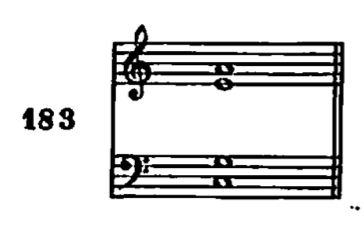
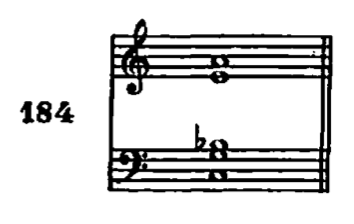
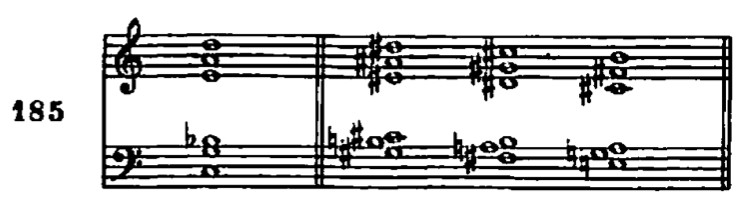
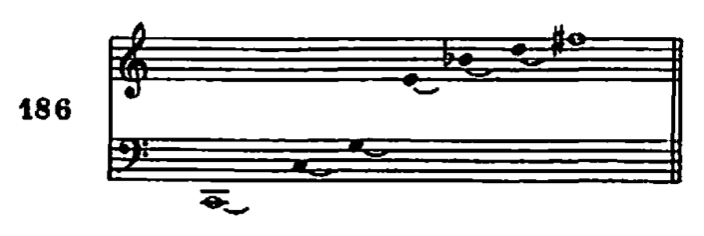
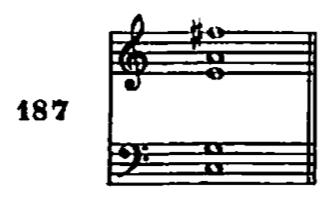
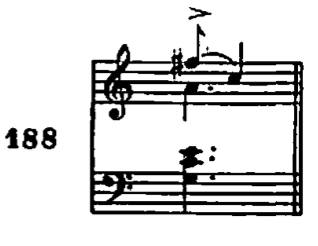
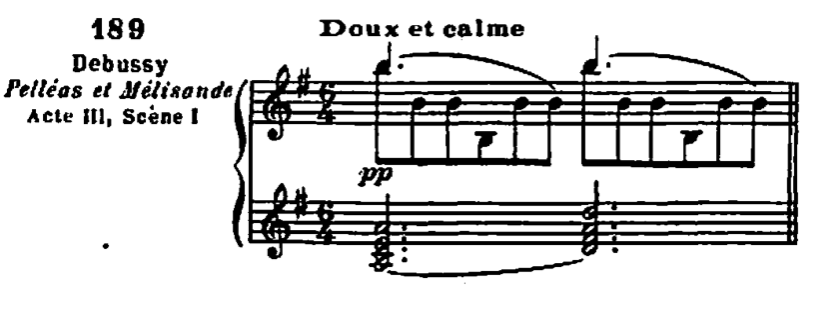
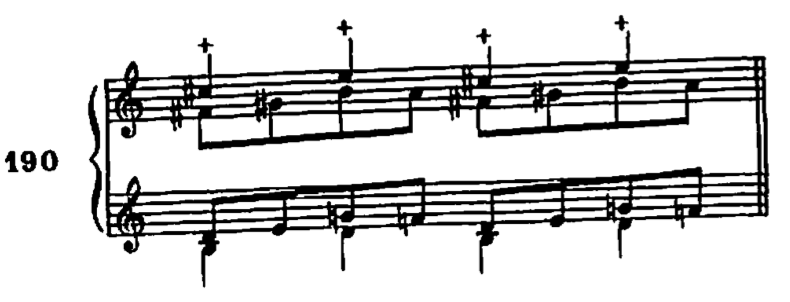
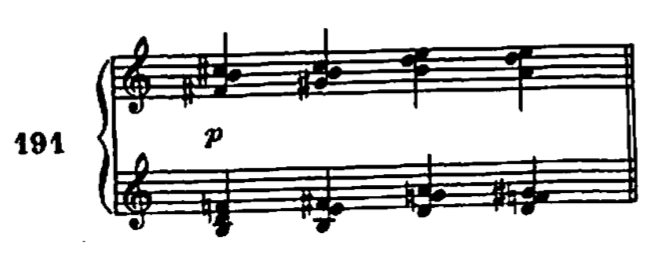
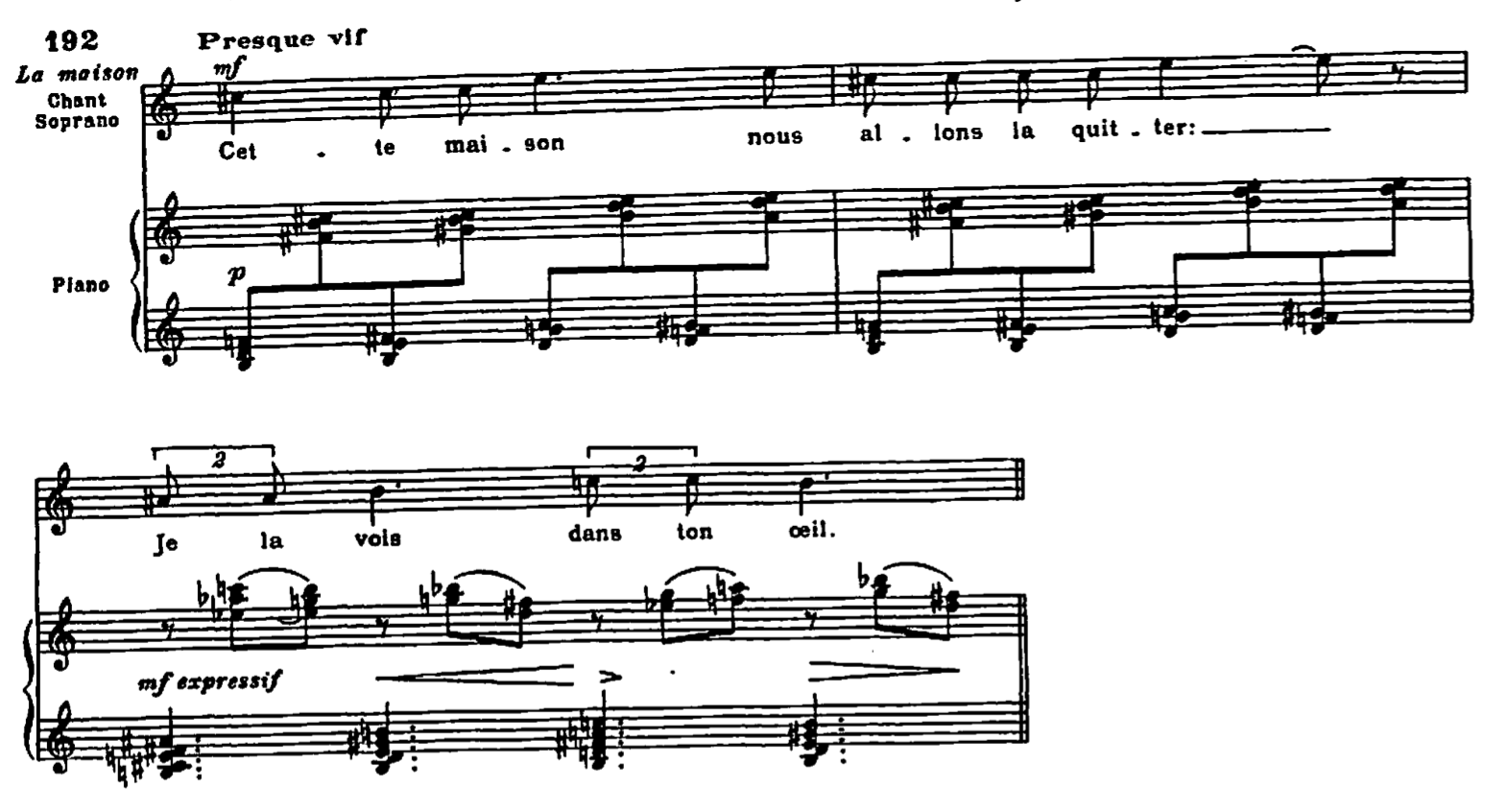
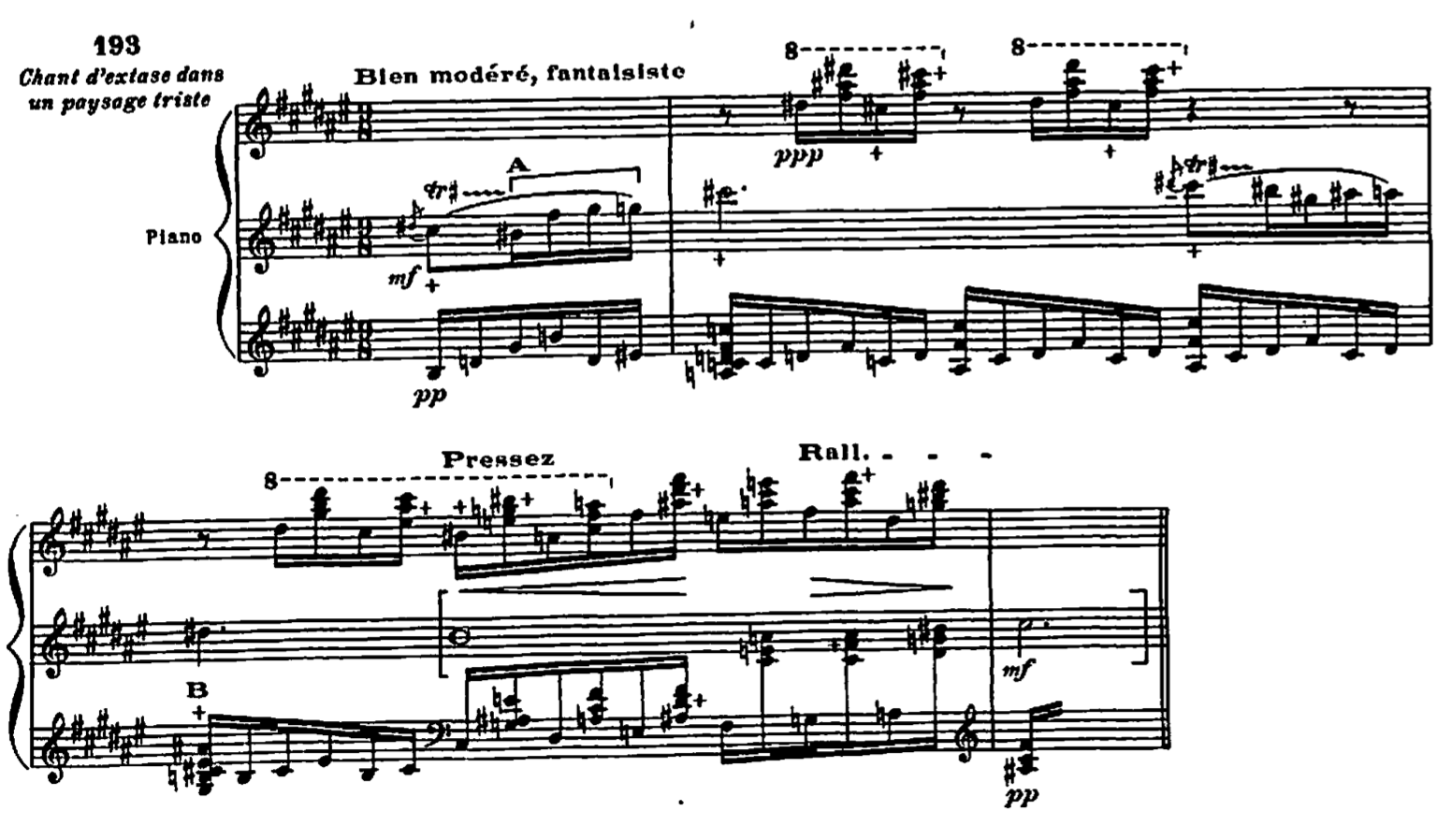
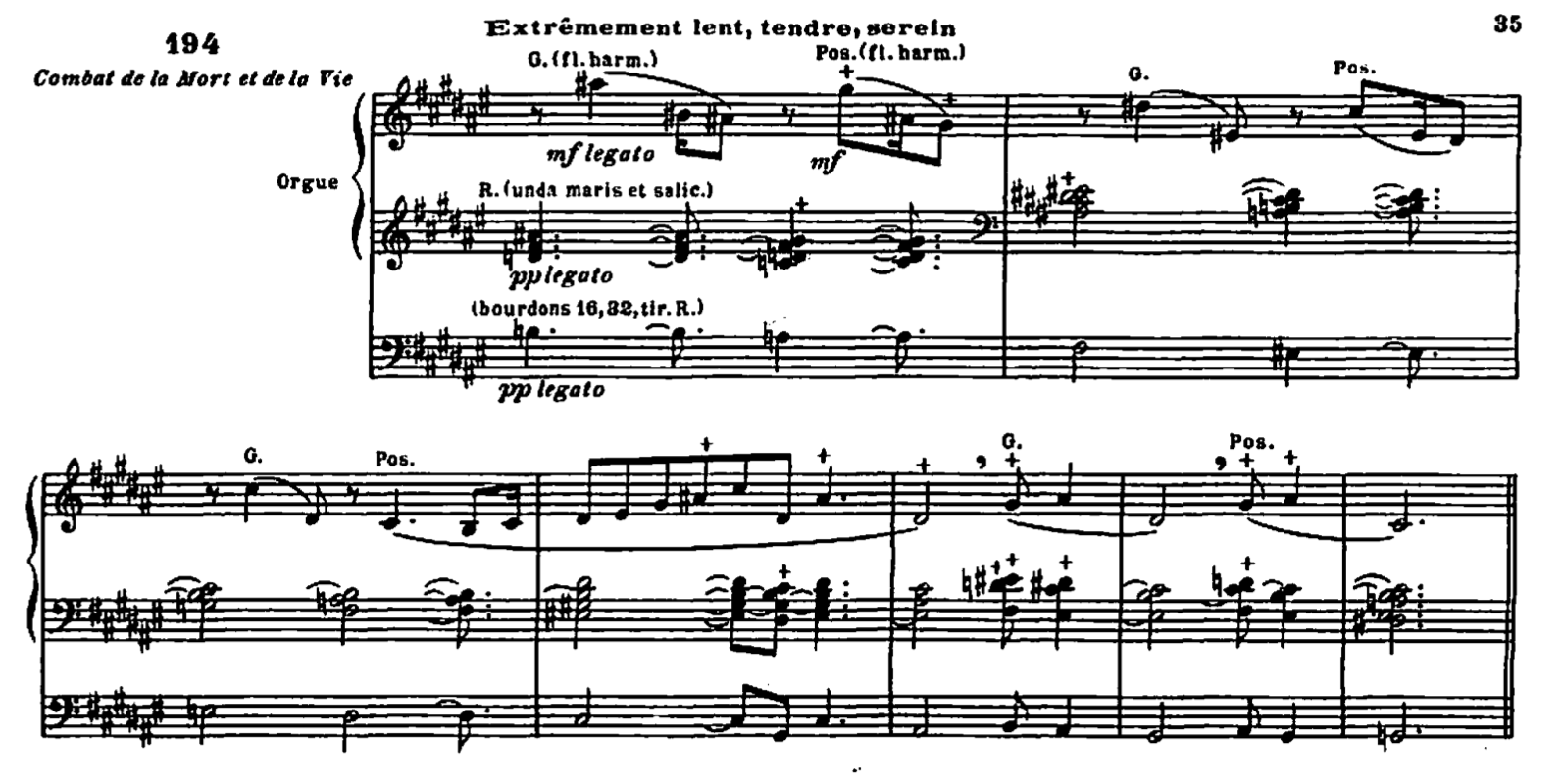
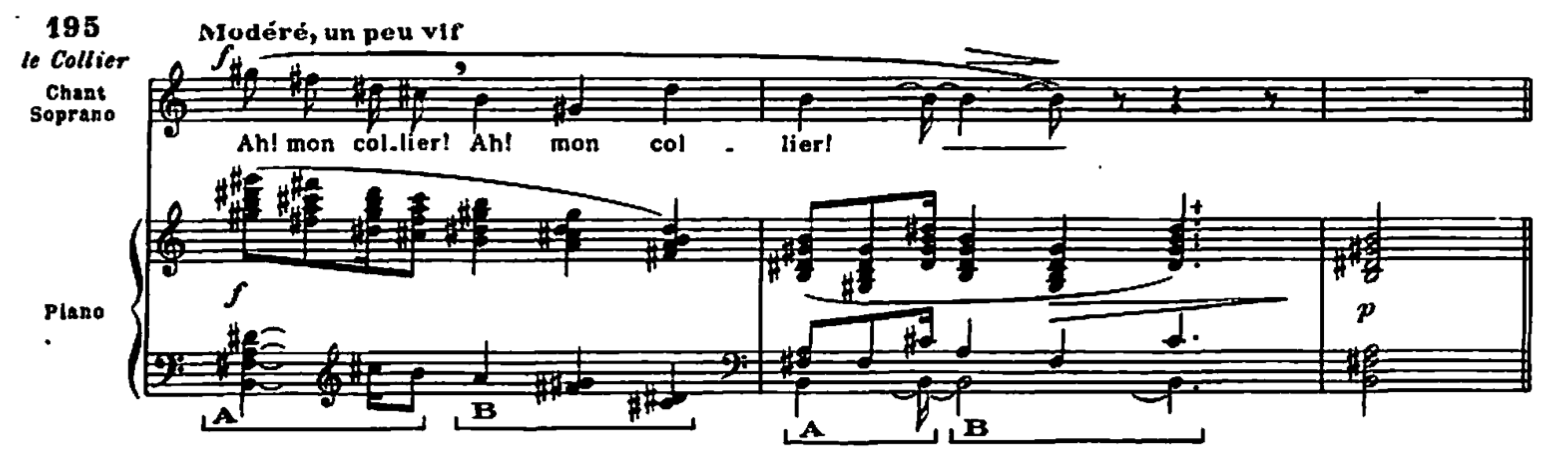
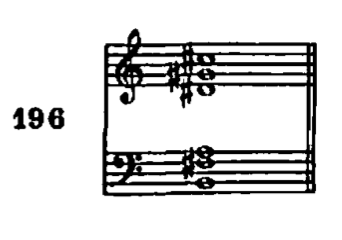
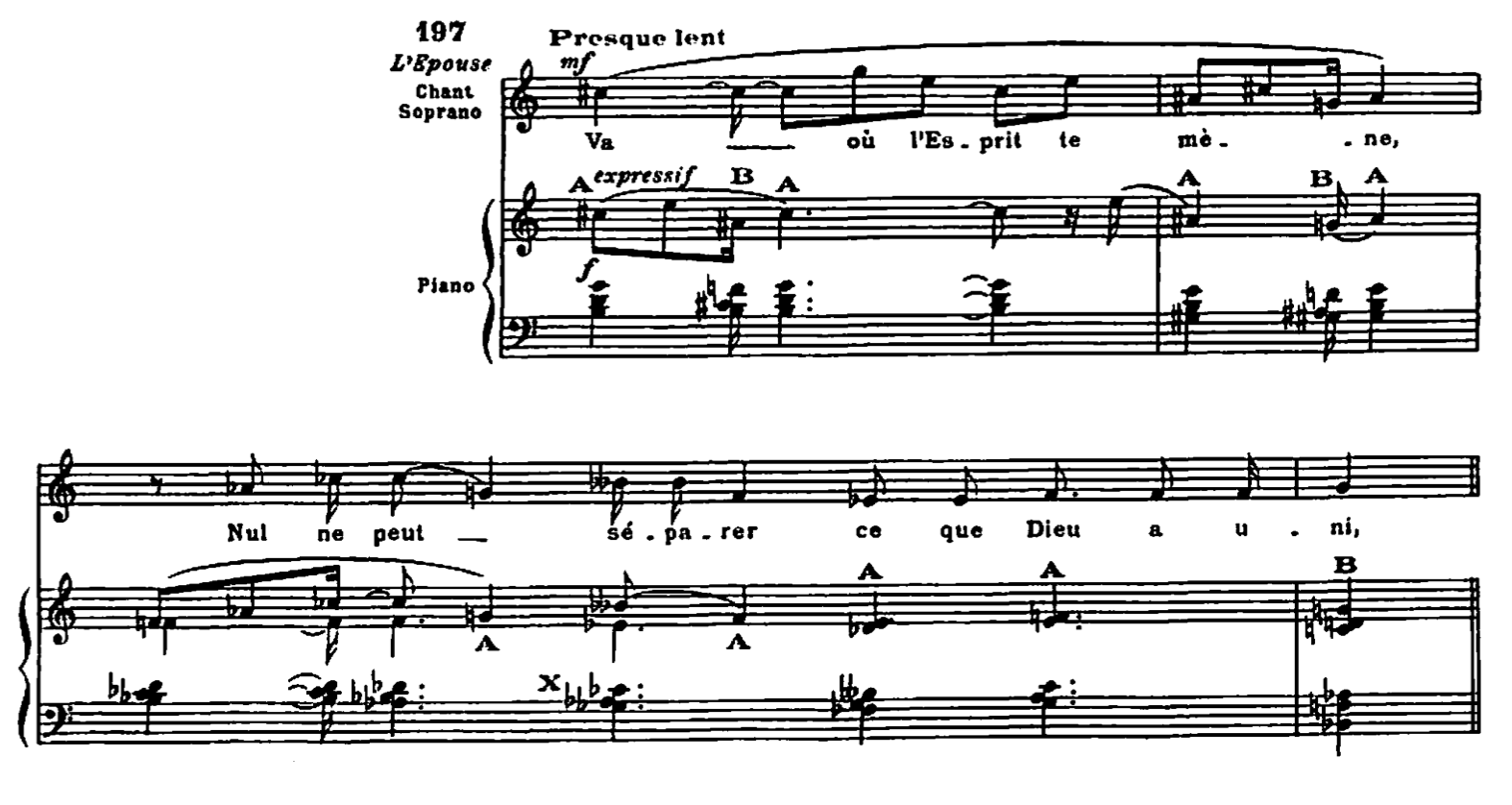
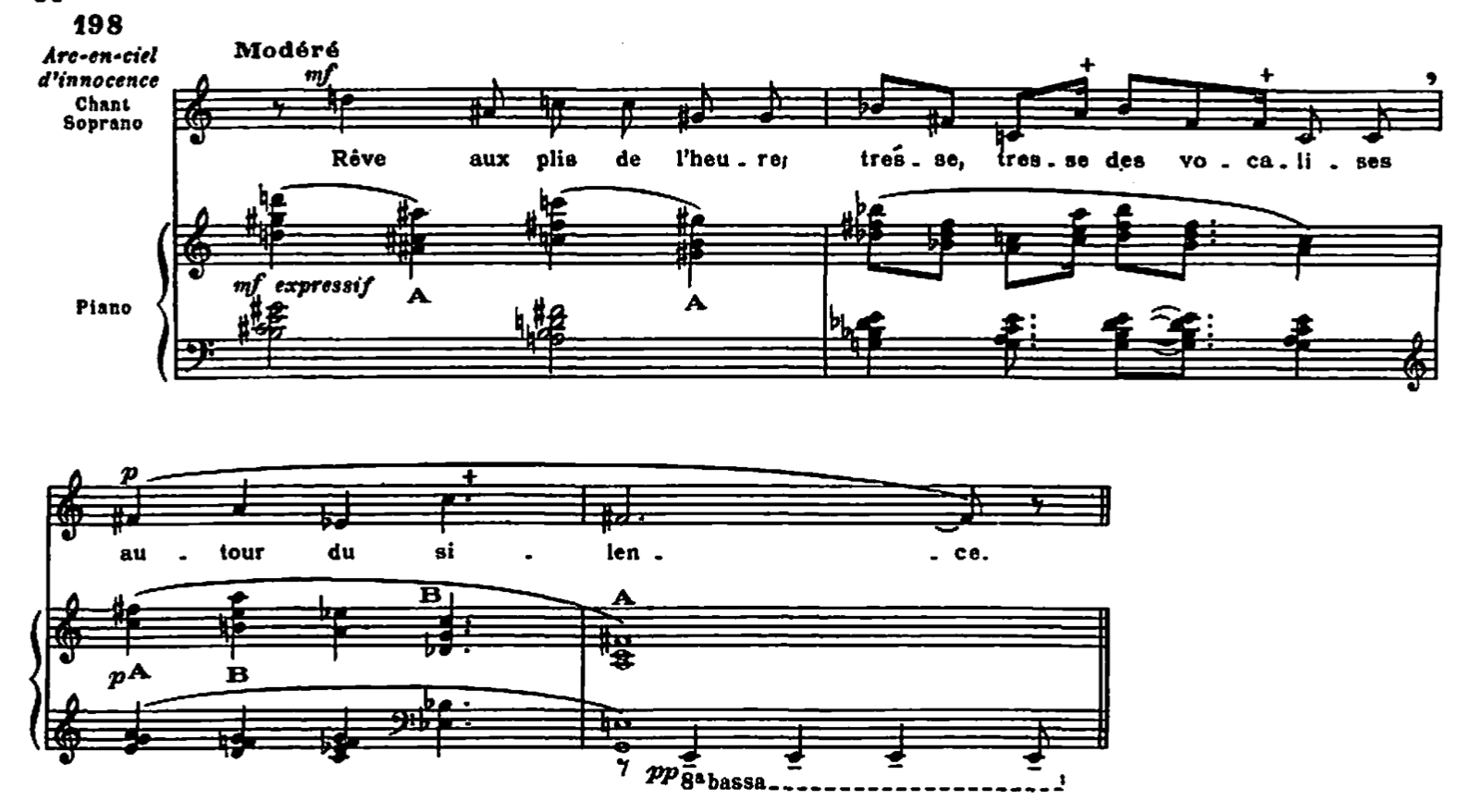
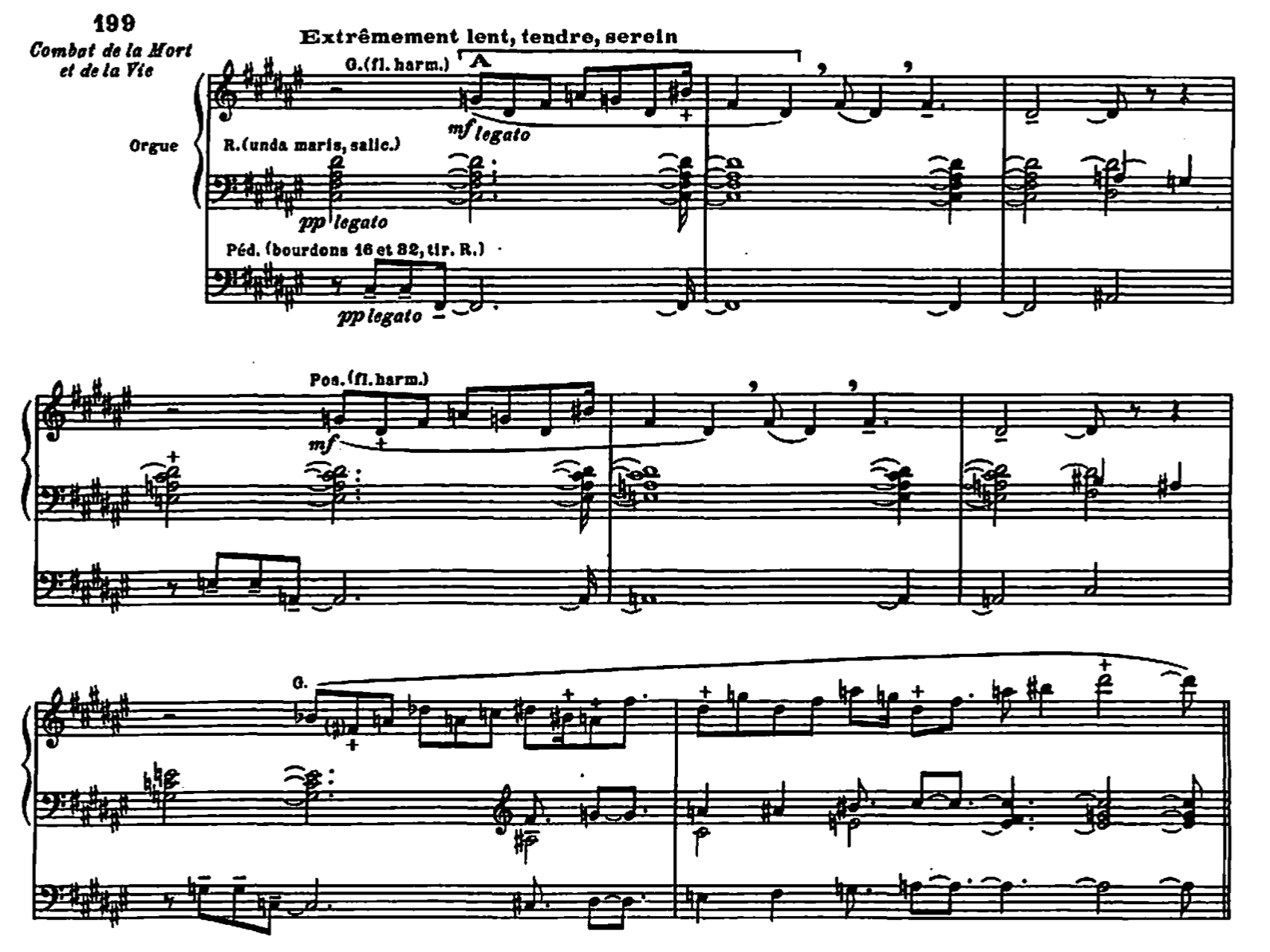

Overview
Chapter XIII inaugurates Messiaen's discussion of harmony by establishing the concept of "added notes"—pitches that enrich chords without requiring traditional preparation or resolution. Messiaen positions Claude Debussy as the decisive figure who liberated these sonorities, transforming what earlier composers treated as ornamental appoggiature into structural chord members. This chapter establishes a foundational harmonic principle that will inform all subsequent discussions of modal and polymodal harmony.
Key Concepts
This chapter introduces four key concepts establishing added-note harmony as a central principle:
-
Added Notes (Notes Ajoutées) - Pitches added to conventional chord structures that function as integral chord members rather than nonharmonic tones requiring resolution
-
The Added Sixth and Added Augmented Fourth - The two most characteristic added-note sonorities in Messiaen's harmonic vocabulary
-
Relation Between Added Notes and Added Values - A conceptual and aesthetic parallel between harmonic and rhythmic enrichment
-
Use of Added Notes in Messiaen's Own Music - The compositional application of added-note harmony in Messiaen's works, particularly Pelleas and melodic movements
Added Notes (Notes Ajoutées)
Definition: Pitches added to a conventional chord structure that function as integral chord members rather than as nonharmonic tones requiring resolution. These pitches maintain their "foreign" quality (they add color and "spice" to the sonority) while simultaneously possessing full citizenship within the chord.
Messiaen's Treatment: Messiaen traces the historical emergence of added notes through Debussy's piano works, particularly Pelleas et Melisande, les Estampes, les Preludes, and les Images. In these works, what traditional harmony would classify as appoggiature, passing tones, or other nonharmonic embellishments appear without preparation or resolution, yet achieve harmonic stability through their sonic resonance with the fundamental chord tones. Messiaen describes these notes as possessing "a certain citizenship in the chord, either because they have the same sonority as some classified appoggiatura, or because they issue from the resonance of the fundamental." The result is a transformation of the chord's timbre—changing its color, providing new aromatic quality—without destroying its identity.
Modern Context: Contemporary pitch-class set theory would describe many of Messiaen's added-note chords as specific set classes that include both tertian and non-tertian elements. For example, a major triad with added sixth and augmented fourth forms a five-note collection. However, Messiaen's conception differs from set-theoretical approaches in its preservation of chord function and identity: the added notes enrich rather than replace the underlying harmonic structure. This approach anticipates later jazz harmony, where added sixths, ninths, elevenths, and thirteenths function similarly as chord members rather than extensions requiring resolution.
Examples: Examples 183–188, 196
The Added Sixth and Added Augmented Fourth
Definition: The two most characteristic added-note sonorities in Messiaen's harmonic vocabulary. The added sixth appears above the root of triads and other structures; the added augmented fourth (tritone above the root) appears in combination with the added sixth to create particularly rich sonorities.
Messiaen's Treatment: Messiaen identifies the added sixth as "the most used of these notes," citing its appearance in works by Rameau, Chopin, Wagner, Massenet, and Chabrier before its definitive installation in the musical language by Debussy and Ravel. The added sixth may appear on the perfect chord (Example 183), on the dominant seventh chord (Example 184), and on the ninth chord (Example 185). When combined with the added augmented fourth, particularly on the perfect chord, the resulting sonority becomes especially significant: it forms the characteristic chord of the second mode of limited transpositions (discussed in Chapter XVI). Messiaen provides examples of this combined sonority on various chord types, demonstrating how the added augmented fourth can function both as a structural member and as an attractive force—for instance, F-sharp in the resonance of C functions simultaneously as an added note in the perfect C chord (already containing an added sixth) and as a pitch that "tends to resolve itself upon the latter" (Example 187–188).
Modern Context: The added-sixth chord anticipates the common jazz and popular music "sixth chord," while the combination of added sixth and augmented fourth produces what jazz theory might call a "major seventh sharp eleven" sonority. The interval content of this combined chord—the tritone, major third, perfect fifth, and major sixth above the root—creates a symmetrical structure that explains Messiaen's association of this sonority with his second mode of limited transpositions. The pitch-class collection {0, 2, 4, 6, 9} (in integer notation with C as 0) exhibits limited transposability precisely because of its interval-class content.
Examples: Examples 183–188
Relation Between Added Notes and Added Values
Definition: A conceptual and aesthetic parallel between harmonic and rhythmic enrichment. Just as added values supplement rhythmic durations (Chapter III), added notes supplement harmonic structures.
Messiaen's Treatment: Messiaen explicitly draws this connection, stating that "the relation of notes added to chords and values added to rhythms strikes us." He identifies "the same charm, somewhat perverse" in both domains: both involve elements that make structures "limp deliciously," whether through rhythmic irregularity or harmonic enrichment. This connection reveals a deeper aesthetic unity in Messiaen's system—the principle of supplementation and asymmetry operates across all musical parameters. The added elements in both cases function as foreign intrusions that transform rather than destroy the identity of their host structures.
Modern Context: This cross-domain analogy exemplifies Messiaen's systematic thinking. Contemporary theory might interpret this parallel through concepts of perturbation or destabilization: just as added values disrupt metric regularity while maintaining temporal coherence, added notes disrupt harmonic simplicity while maintaining tonal identity. Both techniques embody what Messiaen calls in Chapter I the "charm of impossibilities"—the aesthetic pleasure derived from elements that seem contradictory yet function coherently. The parallel also suggests that Messiaen conceives musical parameters not as independent domains but as manifestations of underlying structural principles.
Examples: Discussed throughout; specific rhythmic examples in Chapter III
Use of Added Notes in Messiaen's Own Music
Definition: The compositional application of added-note harmony in Messiaen's works, particularly Pelleas and melodic movements.
Messiaen's Treatment: Messiaen provides extensive examples from his own compositions, demonstrating various applications of added-note technique. In passages from Pelleas (Examples 189–191), he shows the genesis and development of added-note harmonies, with the added notes indicated by crosses in the score. Example 192 demonstrates the use of added notes in one of his melodies, "La Maison," where rhythmic values interact with harmonic color: four quarter-notes appear in the first two measures, followed by four dotted quarter-notes in the third measure, with the eighth-note maintaining consistent value throughout—this rhythmic treatment combines with added-note harmony to create the characteristic "nonchalant" quality Messiaen prizes. Example 193 shows a fragment previously quoted in Chapter VIII, where at point A a "passing group" appears (referencing Chapter XV), at point B an added sixth colors a ninth chord, and at point C the second mode of limited transpositions is employed. Throughout these examples (continuing through Examples 194–200), Messiaen demonstrates various applications: added sixths in ninth chords, augmented fourths added to perfect chords, combinations of added notes with dominant seventh chords, and the integration of added-note technique with other modal and rhythmic procedures, including Hindu rhythms (râgavardhana) and the second mode of limited transpositions.
Modern Context: These examples reveal Messiaen's synthetic approach to composition, where added-note harmony does not function in isolation but integrates with rhythmic procedures (added values), melodic technique (passing groups), and modal structures (limited transposition modes). The systematic marking of added notes with crosses in the examples demonstrates Messiaen's pedagogical concern with making harmonic structure explicit—a practice that anticipates the analytical notation used in later twentieth-century theoretical work. The combination of techniques across multiple parameters exemplifies what later theorists might call "parametric integration," where distinct musical dimensions reinforce unified compositional goals.
Examples: Examples 189–200
Relationship to Other Chapters
This chapter connects fundamentally to Chapter III (Added Values), establishing the rhythmic-harmonic parallel that will recur throughout the treatise. It anticipates Chapter XVI (Modes of Limited Transpositions), where the perfect chord with added sixth and augmented fourth will be revealed as the characteristic sonority of the second mode. The chapter also references Chapter VIII (melodic contours) and previews Chapter XV (foreign notes and passing groups), demonstrating how added-note harmony integrates with melodic procedures. The aesthetic principle introduced here—enrichment through "foreign" elements that transform without destroying underlying identity—connects to the overarching theme of Chapter I, the "charm of impossibilities."
Summary
Chapter XIII establishes added notes as a central harmonic principle in Messiaen's compositional language, positioning Debussy as the historical figure who legitimized these sonorities as structural chord members. By drawing explicit parallels to added rhythmic values and providing extensive examples from his own works, Messiaen demonstrates how this harmonic technique functions not as an isolated phenomenon but as one manifestation of broader aesthetic principles governing his entire musical system. The added sixth and augmented fourth emerge as particularly significant sonorities that will connect to the modal structures discussed in subsequent chapters.
Chapter XIV: Special Chords, Clusters of Chords, and a List of Connections of Chords
Original: Pages 50–54 in Satterfield translation
Musical Examples: Examples 201–301 (101 examples)
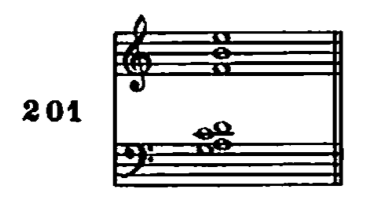

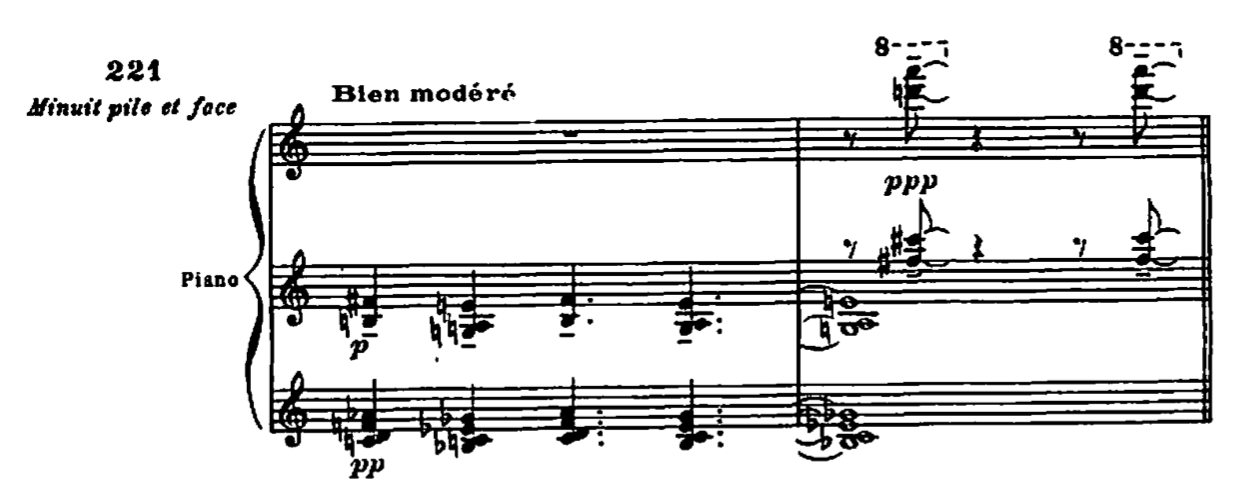
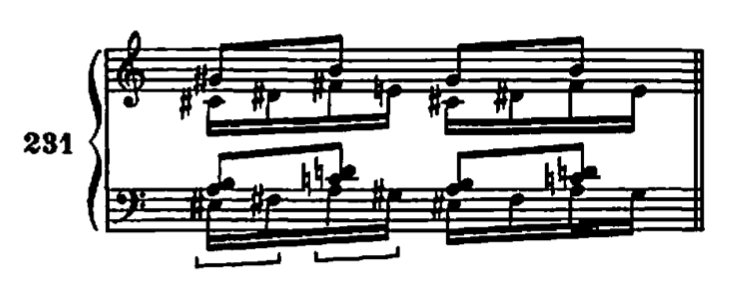
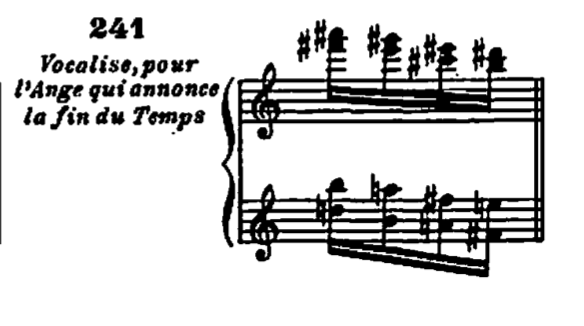
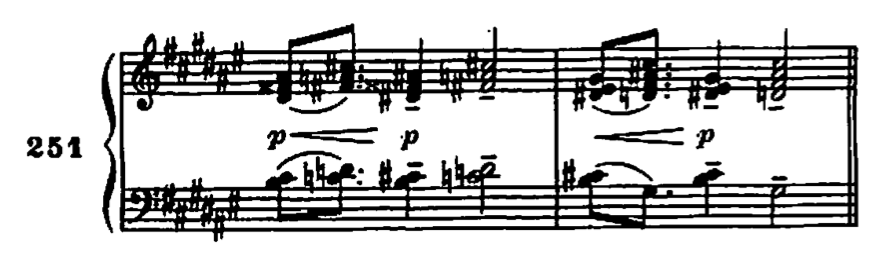
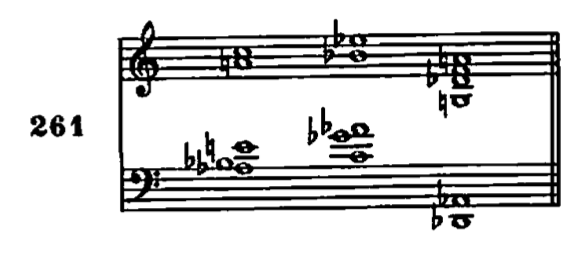
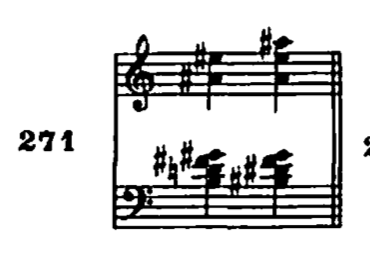
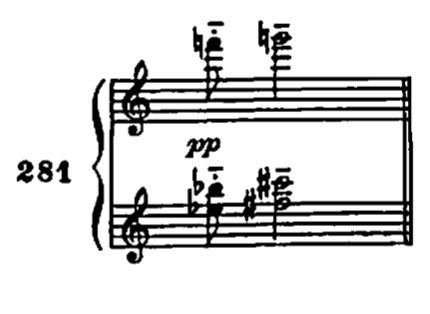
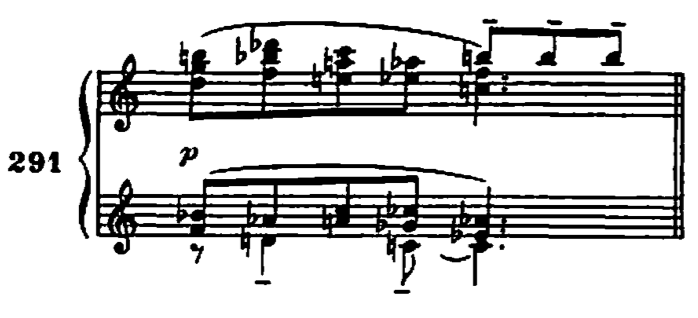
Overview
Chapter XIV expands Messiaen's harmonic vocabulary by presenting three distinctive chord types—the chord on the dominant, the chord of resonance, and the chord in fourths—followed by extended discussions of resonance effects, chord clusters, analytical comparisons with other composers' styles, and a comprehensive catalog of chord connections. The chapter culminates in Messiaen's aesthetic manifesto on "natural harmony," positioning his harmonic language as an organic outgrowth of acoustic phenomena and spiritual aspiration rather than systematic theoretical construction.
Key Concepts
This chapter introduces eight key concepts expanding Messiaen's harmonic vocabulary:
-
The Chord on the Dominant - A saturated harmonic structure containing all seven pitch-classes of the major scale, functioning as an enriched dominant sonority
-
The Chord of Resonance - A harmonic structure derived from the acoustically perceptible overtones of a low fundamental pitch, forming the basis of "natural harmony"
-
The Chord in Fourths - A harmonic structure built from stacked perfect and augmented fourths, abandoning tertian construction
-
Effects of Resonance - Compositional techniques employing chord clusters to simulate or evoke acoustic resonance phenomena
-
Clusters of Chords - Multiple chords sounding simultaneously, creating dense harmonic textures and coloristic stratifications
-
A Look at Other Styles - Analytical examination of how other composers' harmonic languages can be understood through Messiaen's theoretical framework
-
Natural Harmony - A conception of harmony as emerging from acoustic phenomena and spiritual aspiration rather than theoretical systems
-
A List of Connections of Chords - A systematic catalog of harmonic progressions demonstrating practical applications (Examples 230–301)
The Chord on the Dominant
Definition: A saturated harmonic structure containing all seven pitch-classes of the major scale, functioning as an enriched dominant sonority.
Messiaen's Treatment: Messiaen presents this chord as containing all notes of the major scale (Example 201), with its supposed resolution shown in Example 202. However, rather than treating these pitches as appoggiature requiring resolution, Messiaen transforms them into added notes (Example 203), thereby creating a stable, self-sufficient sonority. The chapter demonstrates various coloristic treatments of this chord, particularly through what Messiaen calls "multicolor work"—arranging different inversions of the chord with appoggiature over a common bass note (C-sharp or D-flat) to create a stained-glass window effect (Example 204). Additional dispositions and transformations appear in Examples 205–207, showing how the chord functions both as a functional dominant and as a coloristic entity in its own right.
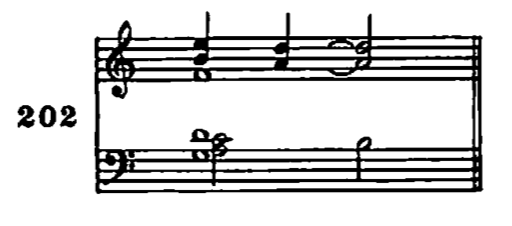
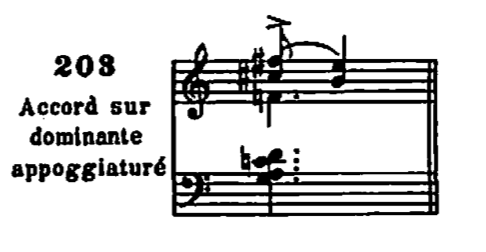

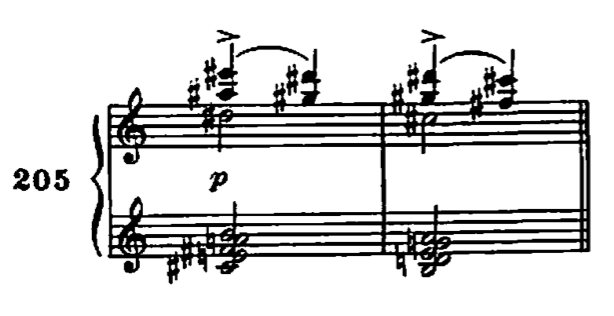
Modern Context: This chord anticipates what jazz theory would later systematize as the dominant thirteenth chord with various alterations. The seven-note collection represents maximal saturation within diatonic space—every scale degree appears simultaneously, creating a sonority that hovers between extreme tension and stasis. Contemporary set theory would identify this as set class 7-35 (the diatonic collection), though Messiaen's emphasis on bass pedal and inversion places the structure within a quasi-functional rather than purely set-theoretical context. The "stained-glass window" metaphor reveals Messiaen's visual-sonic synesthesia and his concern with harmony as color rather than merely as functional progression.
Examples: Examples 201–207
The Chord of Resonance
Definition: A harmonic structure derived from the acoustically perceptible overtones of a low fundamental pitch, forming the basis of Messiaen's conception of "natural harmony."
Messiaen's Treatment: Messiaen describes this chord as containing nearly all the notes perceptible to an extremely fine ear in the resonance of a low C (Example 208). Like the chord on the dominant, this sonority receives the stained-glass window treatment—inversions arranged over a common bass note (C-sharp or D-flat) to create coloristic effects (Example 209). When connected to its second inversion (Example 210), the chord of resonance yields all notes of the third mode of limited transpositions (Example 211). A progression alternating the chord and its first inversion appears in Example 212. This chord becomes a fundamental building block in Messiaen's harmonic language, representing the acoustic foundation from which "natural" harmony emerges.
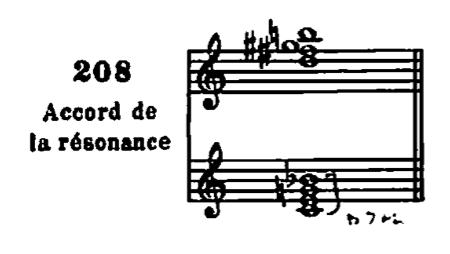
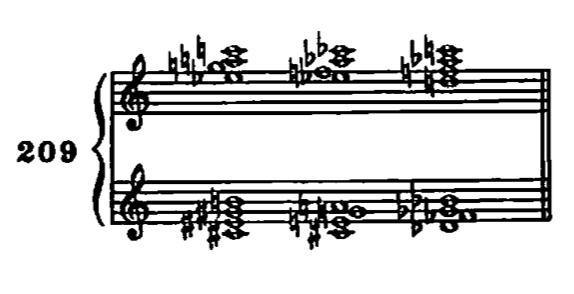
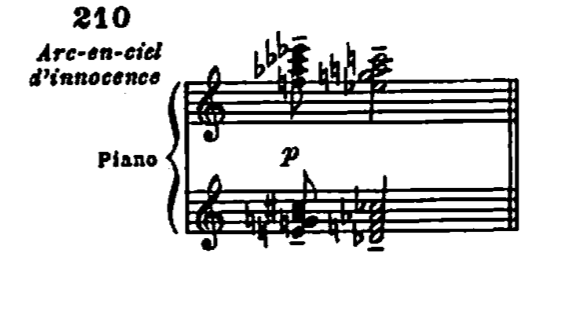
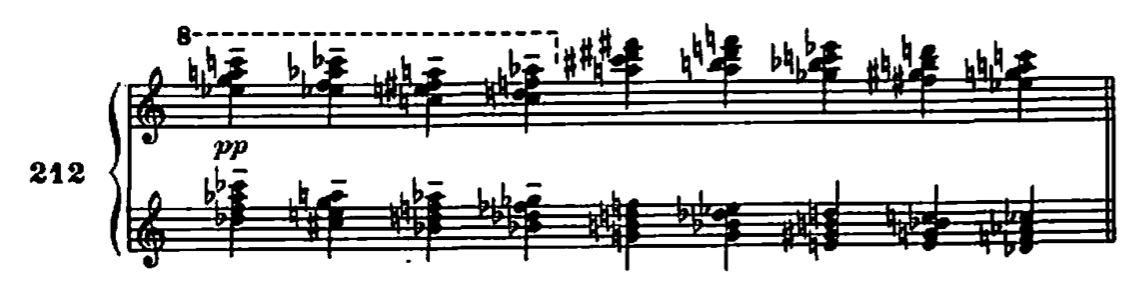
Modern Context: The chord of resonance reflects early twentieth-century interest in acoustical foundations for harmony, paralleling work by theorists such as Hindemith and Schoenberg. The overtone series provides pitches approximating a major triad with added sixth, ninth, and sharp eleventh—essentially creating what contemporary jazz theory calls a "Lydian" chord quality. Messiaen's claim that this chord "gives all the notes of the third mode of limited transpositions" reveals the systematic relationship between acoustic phenomena and the symmetrical modes discussed in Chapter XVI. Contemporary spectral music composers would later pursue similar acoustic derivations, though with more precise frequency relationships. The concept of "natural harmony" here functions both as acoustic justification and aesthetic principle—harmony as pre-existing in nature rather than constructed by compositional artifice.
Examples: Examples 208–212
The Chord in Fourths
Definition: A harmonic structure built from stacked perfect and augmented fourths, abandoning tertian construction in favor of quartal sonorities.
Messiaen's Treatment: Messiaen advocates forgetting "classic chords of superposed thirds to use a chord of augmented and perfect fourths" (Example 213). This chord contains all notes of the fifth mode of limited transpositions (Example 214). Associated with this chord and mode is a specific melodic formula (Example 215), previously cited in Chapter X regarding the interversion of notes. Example 216 demonstrates a succession offering use of both the chord in fourths and the chord of resonance at different structural points.
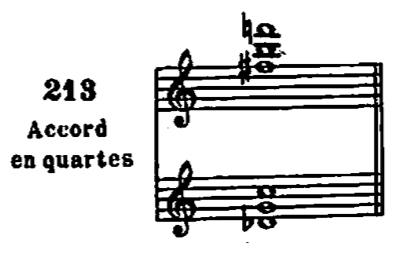
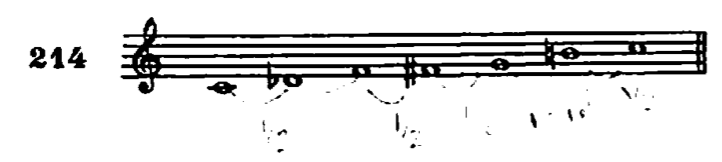
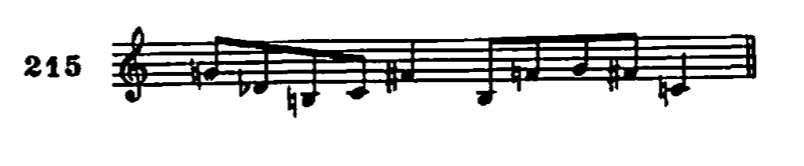
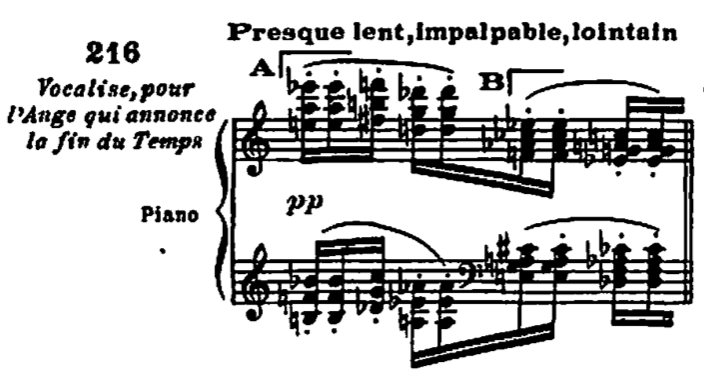
Modern Context: Quartal harmony emerged prominently in early twentieth-century music, particularly in works by Scriabin, Schoenberg, and American composers like Copland and Ives. Messiaen's systematic association of the quartal chord with the fifth mode of limited transpositions reveals the underlying symmetrical structures that generate both vertical and horizontal musical materials. Contemporary theory recognizes quartal chords as producing sonorities ambiguous between major and minor, creating harmonic color distinct from tertian formations. The intervallic content of stacked fourths creates set classes with particular invariance properties under transposition and inversion, explaining the connection to limited transposition modes. Jazz composers from the 1960s onward (particularly McCoy Tyner and post-bop pianists) would extensively exploit similar quartal voicings, often without awareness of Messiaen's theoretical systematization.
Examples: Examples 213–216
Effects of Resonance
Definition: Compositional techniques employing chord clusters to simulate or evoke acoustic resonance phenomena, creating harmonic halos and coloristic washes.
Messiaen's Treatment: Messiaen invokes Paul Dukas's discussion of "effects of resonance," describing them as pure fantasy similar to but distant from natural acoustic resonance. These effects involve learned rhythmic variations found in the Danses rituelles and especially in André Jolivet's Mana. Messiaen demonstrates both superior and inferior resonance: Example 217 shows superior resonance where cluster B (written in the sixth mode of limited transpositions) and cluster C (in the second mode) form resonance above chord A. Example 218 presents inferior resonance (marked with a cross), followed by analogous effects (Example 219) and a third example of inferior resonance (Example 220). Example 221 integrates multiple techniques: at point A, an arpeggio combining clarinet and piano chords creates the chord on the dominant; at point B, inferior resonance appears; at point C, bird-style melodic contours emerge (referencing Chapter IX).
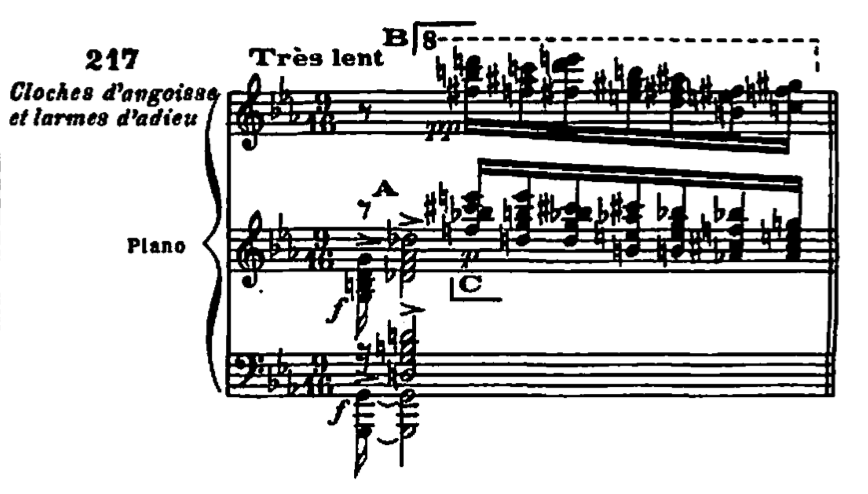
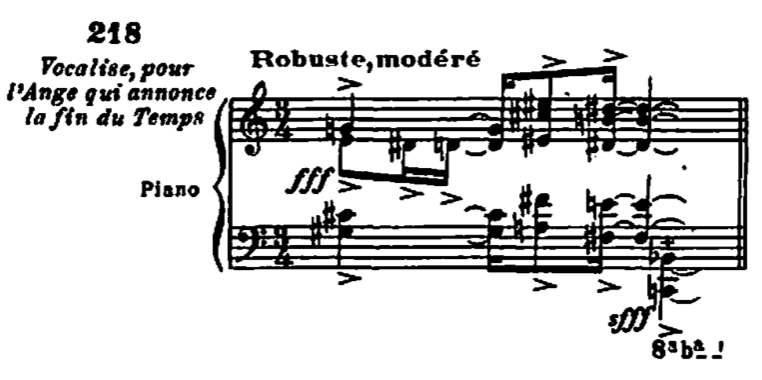
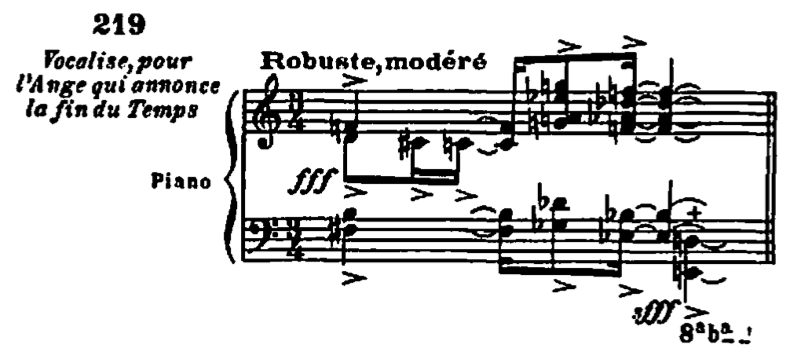
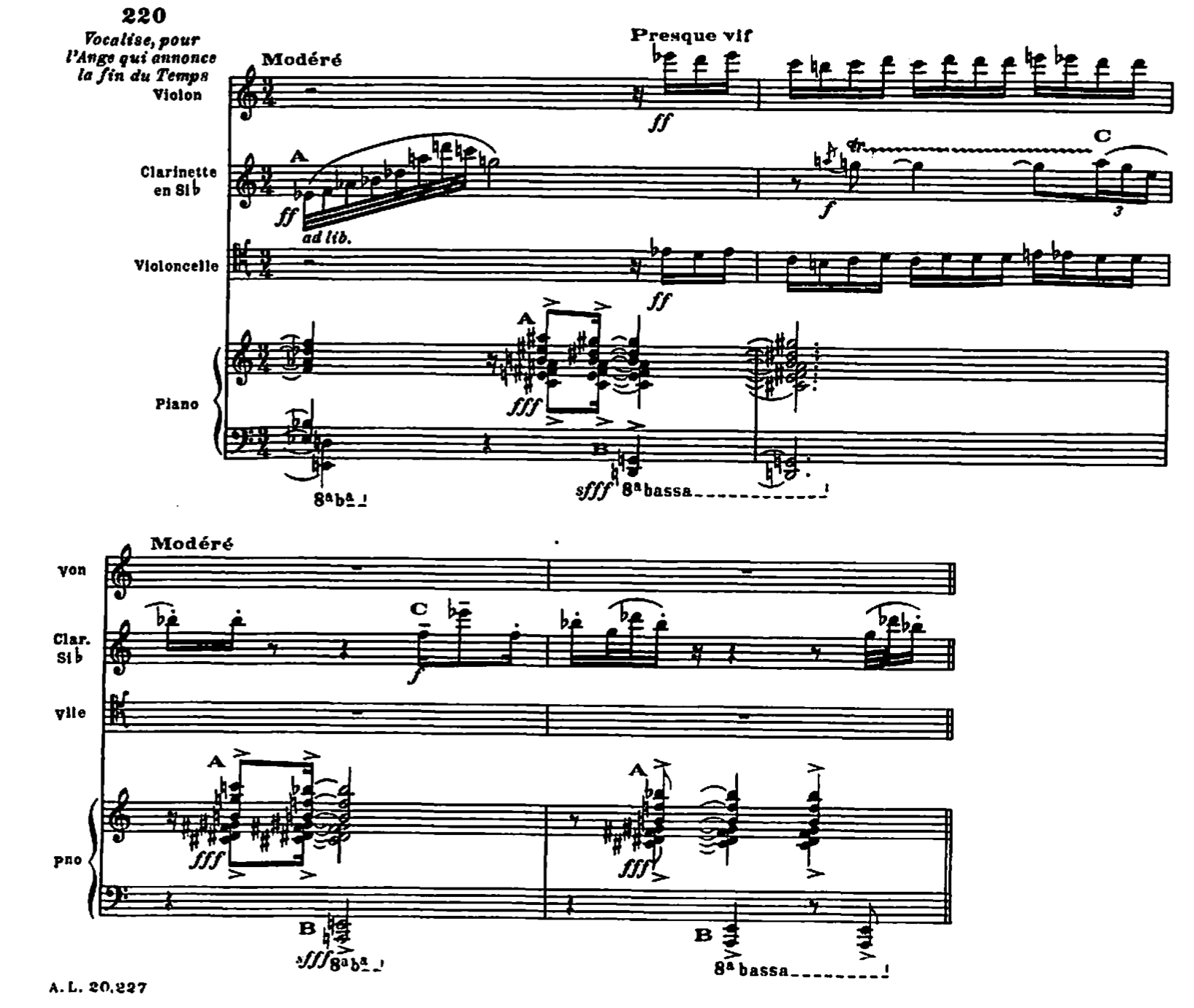
Modern Context: The concept of resonance effects anticipates techniques later codified in spectral music, where composers systematically derive harmonic structures from acoustic spectra. Messiaen's approach differs from later spectral practice in remaining more intuitive and coloristic rather than mathematically rigorous. The use of modal clusters (from the second and sixth modes) to create resonance reveals the systematic integration of symmetrical pitch collections with coloristic goals. Contemporary orchestration treatises might describe similar effects as "harmonic pedals" or "sustained resonances," but Messiaen's emphasis on the acoustic metaphor—treating added clusters as if they were naturally occurring overtones—distinguishes his conception. The technique relates to what Varèse would call "sound masses" and what Ligeti would later develop in his micropolyphonic textures, though Messiaen maintains clearer distinctions between resonating and resonated structures.
Examples: Examples 217–221
Clusters of Chords
Definition: Multiple chords sounding simultaneously, creating dense harmonic textures and coloristic stratifications.
Messiaen's Treatment: Messiaen presents Example 222 as an illustration of chord clusters, describing it as "a gentle cascade of blue-orange chords surrounding with its distant carillon the melody, quasi-plainchant, of the strings." The passage contains superposed fourths at point A, a progression upon the chord of resonance at point B (referencing Example 212), and the second mode of limited transpositions at point C. This technique creates stratified textures where multiple harmonic layers function simultaneously, each potentially drawn from different modal sources.
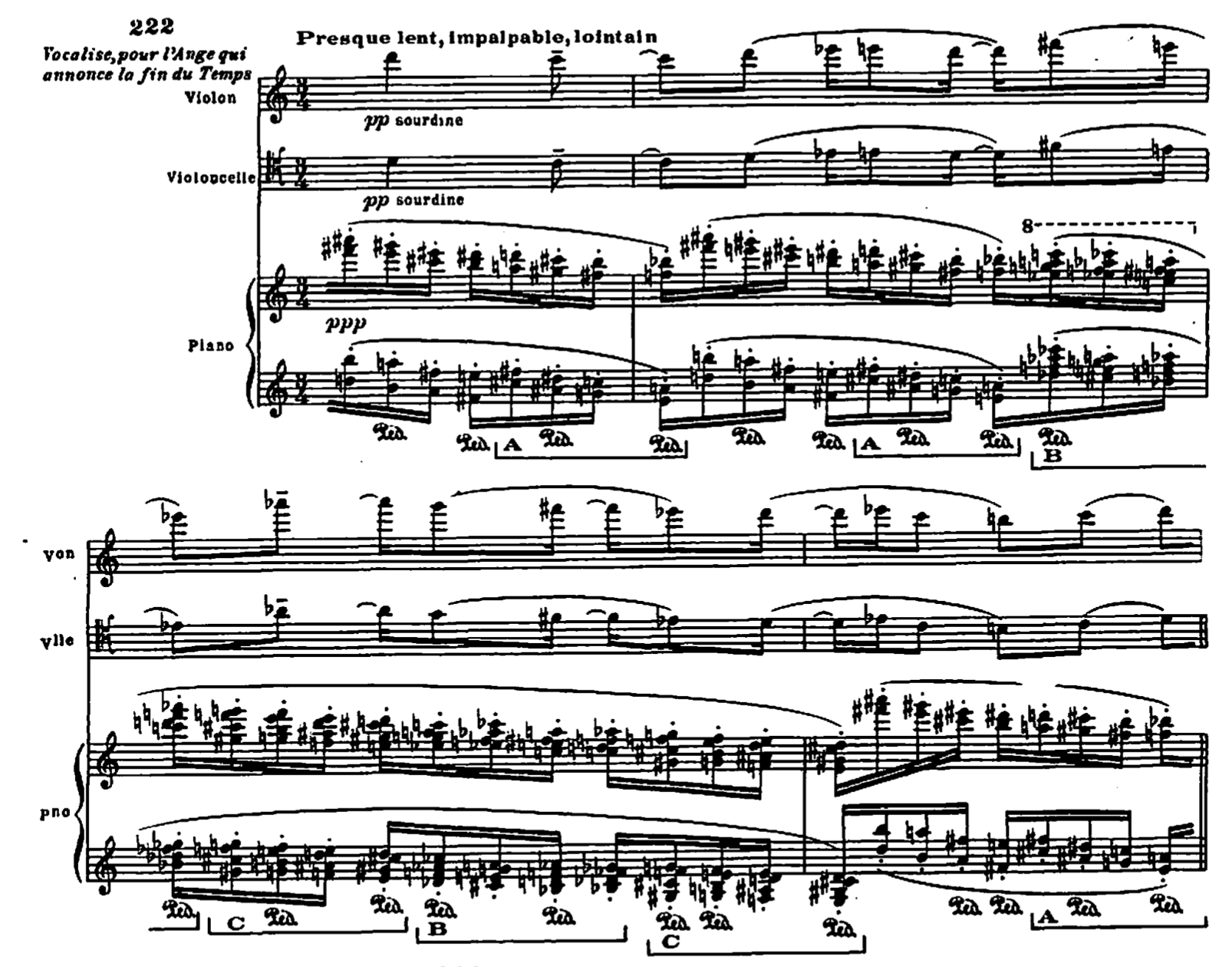
Modern Context: The term "chord clusters" in contemporary usage typically refers to chromatic or diatonic clusters (adjacent pitches played simultaneously), as in the music of Henry Cowell or Iannis Xenakis. Messiaen's usage appears more specific: multiple distinct chords (each potentially complex) sounding together rather than undifferentiated chromatic aggregates. This technique anticipates later practices in composers like Stockhausen (who studied with Messiaen) and Lutosławski, where multiple harmonic strata operate independently. The "blue-orange" color association reveals Messiaen's synesthesia, where harmonic combinations evoke specific color perceptions. The integration of multiple modes and chord types within single textures demonstrates the synthetic potential of Messiaen's harmonic vocabulary—the modes of limited transpositions, resonance chords, and quartal structures can coexist in polystylistic or polymodal combinations.
Examples: Examples 217, 222
A Look at Other Styles
Definition: Analytical examination of how other composers' harmonic languages can be understood through Messiaen's theoretical framework.
Messiaen's Treatment: Messiaen analyzes passages from his own earlier work Pelleas (Example 223) as engendering Ravel's Danse générale from Daphnis and the polytonality particularly associated with Milhaud. He traces harmonic evolution from composer to composer, acknowledging the curious progression from Orfeo and Monteverdi's madrigals through contemporary practice. Messiaen then provides analytical transformations of passages by Debussy and Ravel: a measure from Debussy (Example 224) and its progression (Example 225), followed by another transformation (Example 226); a measure from Ravel (Example 227) and its reversal (Example 228), followed by another transformation (Example 229). These analyses demonstrate how passages by other composers can be reinterpreted through Messiaen's vocabulary of added notes, modal structures, and resonance effects.
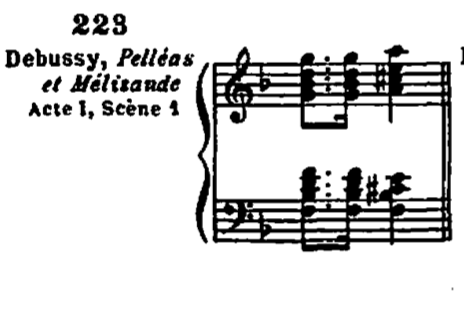
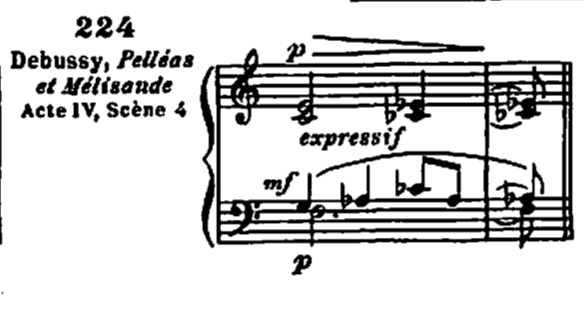
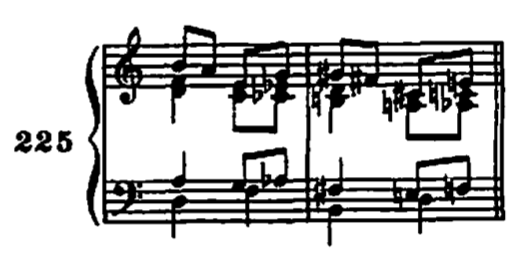
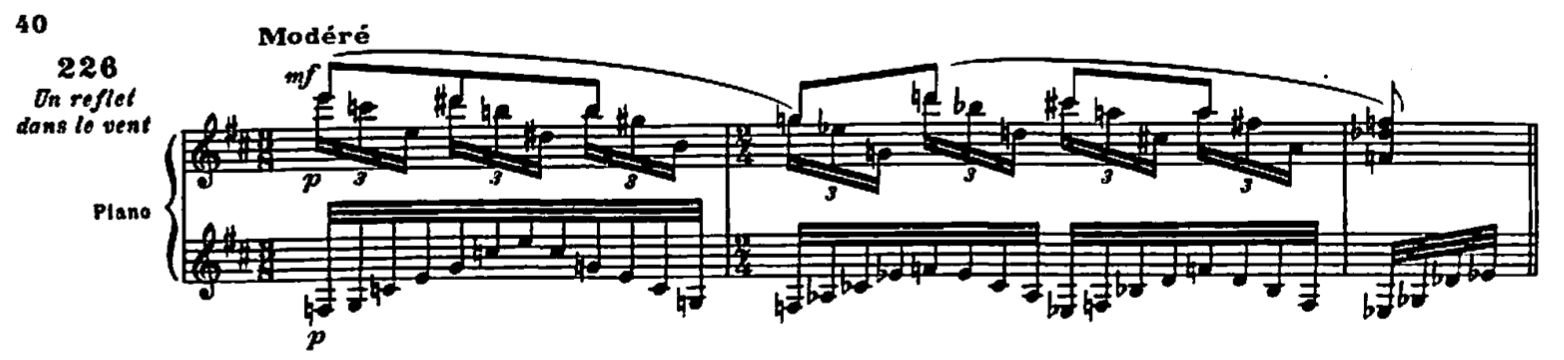
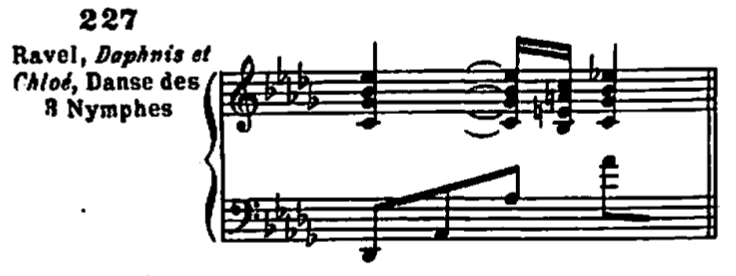
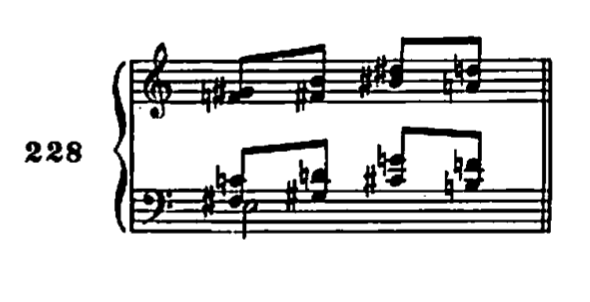
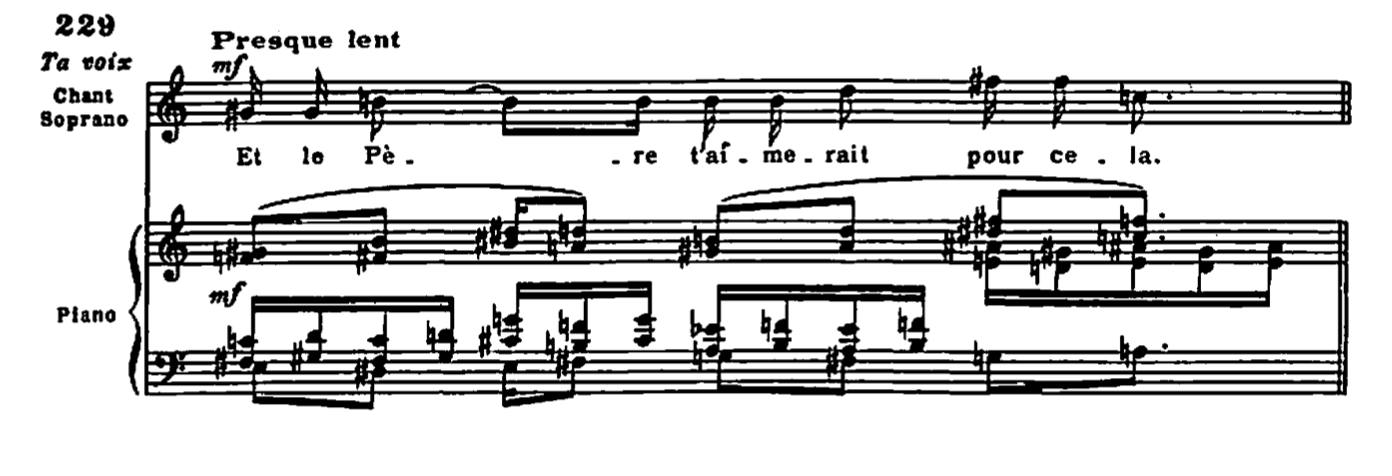
Modern Context: This analytical approach reveals Messiaen's pedagogical method—showing how his techniques connect to and derive from the harmonic practices of his immediate predecessors. The transformations demonstrate that Messiaen views Debussy and Ravel not merely as historical influences but as composers whose harmonic innovations can be systematically understood through the theoretical apparatus he is constructing. Contemporary analysts might describe this as "transformational analysis," showing how specific harmonic configurations can generate related structures through systematic operations. The acknowledgment of evolution from Monteverdi through the madrigalists to modern practice situates Messiaen within historical continuity rather than revolutionary rupture—his harmonic innovations emerge organically from earlier developments. The polytonality reference to Milhaud signals Messiaen's awareness of alternative contemporary approaches, even as he pursues his own modal-resonance-based path.
Examples: Examples 223–229
Natural Harmony
Definition: A conception of harmony as emerging from acoustic phenomena, pre-existing in nature rather than constructed by theoretical systems, motivated by spiritual and aesthetic rather than purely formal concerns.
Messiaen's Treatment: The chapter culminates in an aesthetic manifesto where Messiaen acknowledges that his upcoming investigations into modes of limited transpositions and various technical combinations "ought not make us forget the natural harmony: the true, unique, voluptuously pretty by essence, willed by the melody, issued from it, pre-existent in it, having always been enclosed in it, awaiting manifestation." He describes his desire for "enchanted gorgeousness in harmony" as pushing him toward coloristic imagery—"swords of fire, those sudden stars, those flows of blue-orange lavas, those planets of turquoise, those violet shades, those garnets of long-haired arborescence, those wheelings of sounds and colors in a jumble of rainbows." He references the preface to his Quatuor pour la fin du Temps, stating that "such a gushing out of chords should necessarily be filtered; it is the sacred instinct of the natural and true harmony which, alone, can so charge itself."
Modern Context: This passage reveals the aesthetic and spiritual foundations underlying Messiaen's technical apparatus. The concept of "natural harmony" functions as both acoustic principle (harmony derived from resonance phenomena) and theological claim (harmony as pre-existing in divine creation rather than human construction). The vivid coloristic language—unprecedented in theoretical treatises—demonstrates Messiaen's synesthesia and his conviction that harmony exists primarily for sensory and spiritual experience rather than structural logic. This aesthetic position distances Messiaen from both the systematic serialism emerging in the 1940s (which he would later engage with) and from neoclassical restraint. The filtering metaphor suggests that while natural harmony provides infinite possibilities, compositional discipline requires selection and refinement—technical mastery serves to channel rather than generate harmonic inspiration. Contemporary readers might interpret this as a phenomenological approach to harmony, where perceptual and affective experience takes priority over abstract structural relations. The passage also reveals Messiaen's literary ambitions and his comfort with poetic rather than purely technical discourse.
Examples: Discussed conceptually throughout Chapter XIV
A List of Connections of Chords
Definition: A systematic catalog of harmonic progressions, demonstrating practical applications of Messiaen's chord types and techniques across diverse compositional contexts.
Messiaen's Treatment: Messiaen provides an extensive series of examples (230–301) organized into several categories:
Progressions of harmony (Examples 230–245): These include retrograde relationships (Examples 230–231 retrograde the second term of progressions), expressive treatments (Example 236), and passages where contrary motion in upper voices changes the progression's character (Example 237). Examples involve rhythmic variation (238, 244, 245), quotations from Vocalise, pour l'Ange qui annonce la fin du Temps (Example 244 superposes modes three and two; Example 245 uses Ta voix). The examples draw from various works and demonstrate both traditional and modal progressions.
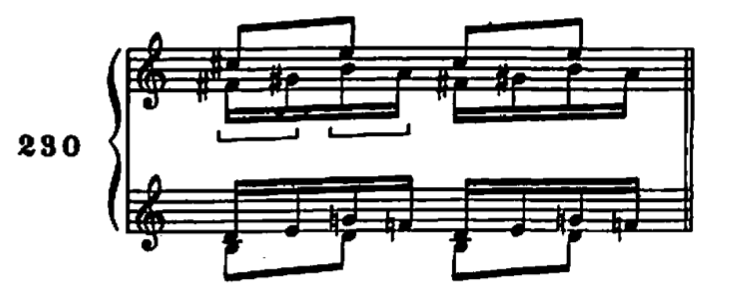
Harmonic litanies (Examples 246–251): The harmonic litany—defined as a melodic fragment repeated with different harmonizations—appears in examples drawn from Bail avec Mi, Un reflet dans le vent, Louange à l'Immortalité de Jésus, and Fouillis d'arcs-en-ciel, pour l'Ange qui annonce la fin du Temps.
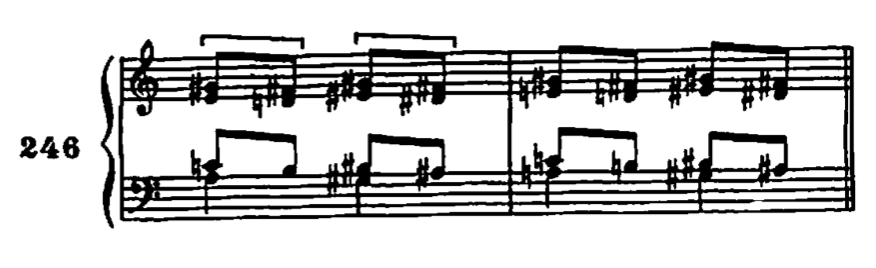
Various connections (Examples 252–276): This diverse category includes passages written in various modes of limited transpositions (Example 253 in the seventh mode, Example 256 in the second mode), polytonal passages (Example 258 in le Collier appears polytonal despite being in A major, Example 262 being in A major despite polytonal appearance, Example 269 made from 268, Example 274 being polytonal). Example 272 superposes two modes of limited transpositions (mode three in upper staff over mode two in lower staff), appearing again transposed with different rhythm in Arc-en-ciel d'innocence. Example 276 contracts the theme from Debussy's Mélisande.
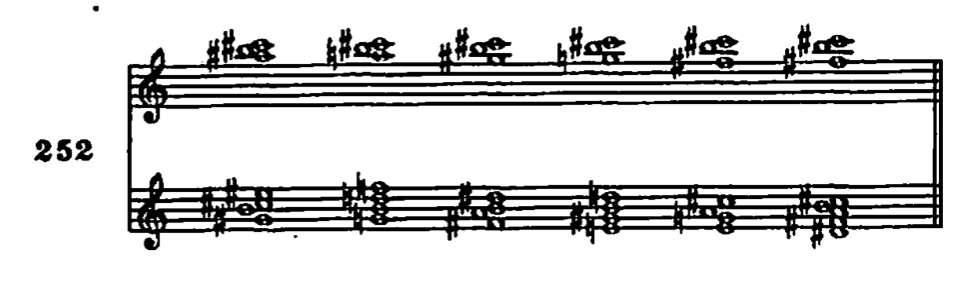
Superpositions of perfect and augmented fourths, of perfect and diminished fifths (Examples 277–287): Example 277 from Vocalise, pour l'Ange qui annonce la fin du Temps superposes perfect fourths; at the cross (reading from bottom upward): perfect fourth, augmented fourth, perfect fourth. Examples 282–283 show spaced positions creating the same superpositions. Examples 284–287 give glimpses of the "gushing out of chords" described in paragraph 7.
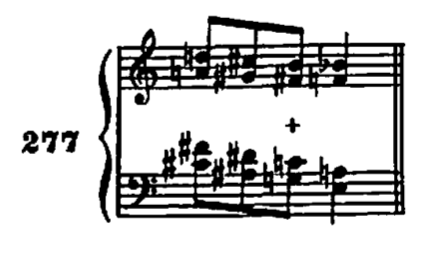
Examples of longer duration (Examples 288–293): Example 287 mixes three harmonic styles (A evokes Ravel, B evokes Stravinsky, C evokes Honegger).
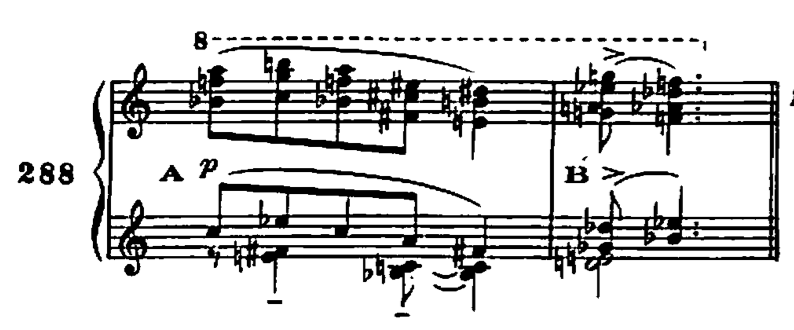
More refined examples (Examples 294–301): Example 288 measure A derives from Fouillis d'arcs-en-ciel, pour l'Ange qui annonce la fin du Temps; measure B contracts the resonance of Example 290. Example 291 transforms three Ravel-like chords (Example 292, Ravel, Ma Mère l'Oye). Example 293 uses at A the connections of 288, at C those of 291, and at B the dominant chord with appoggiature (referencing Example 204, article 1 of this chapter).
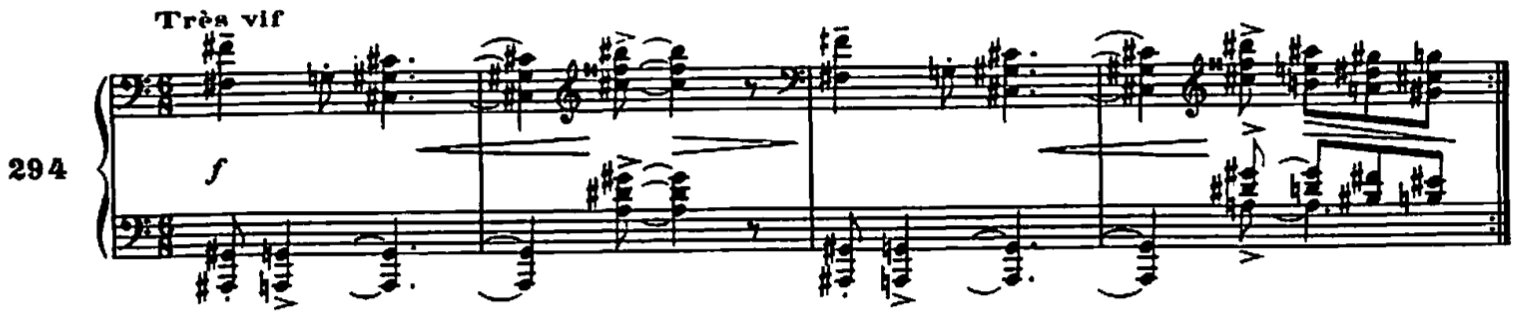
Formulas of accompaniment (Examples 294–301): Example 294 (Le nombre léger) places a theme in middle voice. Example 295 calls for a voice above and below the accompaniment. Example 296 (Paysage) employs the second mode of limited transpositions with the theme placed above in the same mode. Example 297 superposes a melodic formula in the fifth mode of limited transpositions upon arpeggios using the sixth of these modes, calling for voices above and below. Example 298 presents bird style with supposed voice below, as do Examples 299 and 300. Example 301 combines voice and accompaniment.
Modern Context: This extensive catalog serves multiple pedagogical functions. First, it demonstrates the practical versatility of Messiaen's harmonic vocabulary—the techniques are not merely theoretical constructs but compositionally functional across diverse contexts. Second, the organization by progression type, litany, superposition, and accompaniment formula reveals how Messiaen categorizes harmonic thinking according to compositional function rather than purely theoretical criteria. Third, the frequent citations of his own works (Quatuor pour la fin du Temps, Vocalise, etc.) show how the treatise functions partly as analytical guide to his existing compositions. The mixture of original demonstrations and arrangements of passages by Debussy, Ravel, and Stravinsky positions Messiaen's practice within a continuous tradition while asserting distinctive innovations. Contemporary composition pedagogy rarely provides such extensive catalogs of specific progressions, preferring instead to teach generative principles—Messiaen's approach combines systematic theory with practical model-building, assuming students learn both from abstract principles and concrete exemplars.
Examples: Examples 230–301
Relationship to Other Chapters
Chapter XIV integrates concepts from multiple previous chapters: the chord on the dominant employs added notes (Chapter XIII), resonance effects connect to acoustic foundations anticipated in earlier discussions, and all three special chords tie directly to the modes of limited transpositions (Chapter XVI). The chord in fourths relates to melodic formulas discussed in Chapter X. The harmonic litanies connect to the repetition structures examined in rhythmic chapters. The aesthetic manifesto on natural harmony returns to the "charm of impossibilities" from Chapter I, now applied specifically to harmonic gorgeousness. The extensive catalog of chord connections anticipates the systematic modal discussions of Chapters XVI–XIX while grounding abstract theory in compositional practice.
Summary
Chapter XIV expands Messiaen's harmonic vocabulary by presenting three foundational chord types—the chord on the dominant, the chord of resonance, and the chord in fourths—each connected to specific modes of limited transpositions. The chapter demonstrates advanced coloristic techniques including resonance effects and chord clusters, analyzes how other composers' practices relate to Messiaen's framework, and provides an aesthetic manifesto positioning harmony as emerging from natural acoustic phenomena and spiritual aspiration. The extensive catalog of chord connections (Examples 230–301) grounds these theoretical concepts in practical compositional applications, demonstrating the versatility and expressive range of Messiaen's harmonic language across diverse musical contexts.
Chapter XV: Enlargement of Foreign Notes, Upbeats and Terminations
Original: Pages 55–57 in Satterfield translation
Musical Examples:
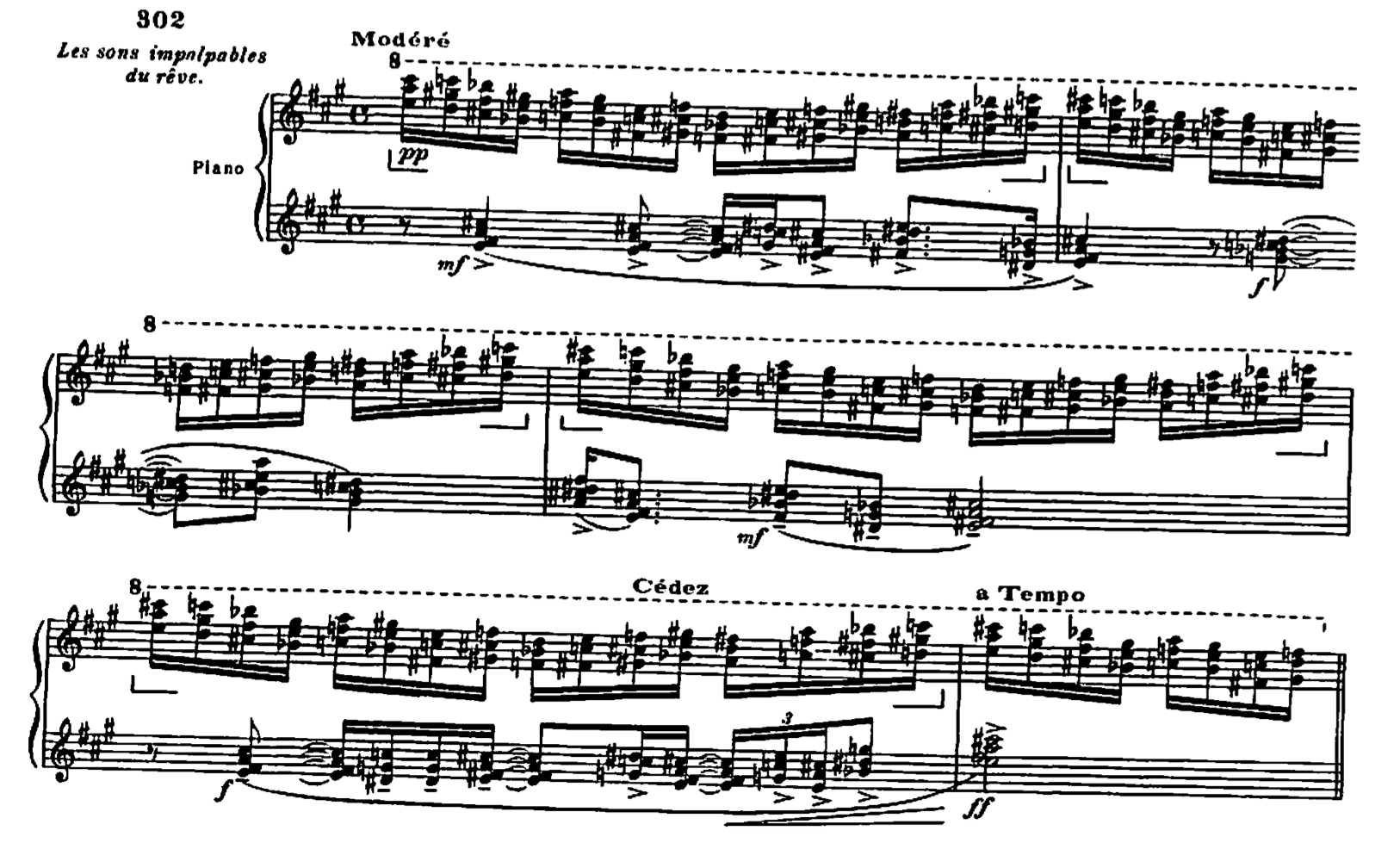


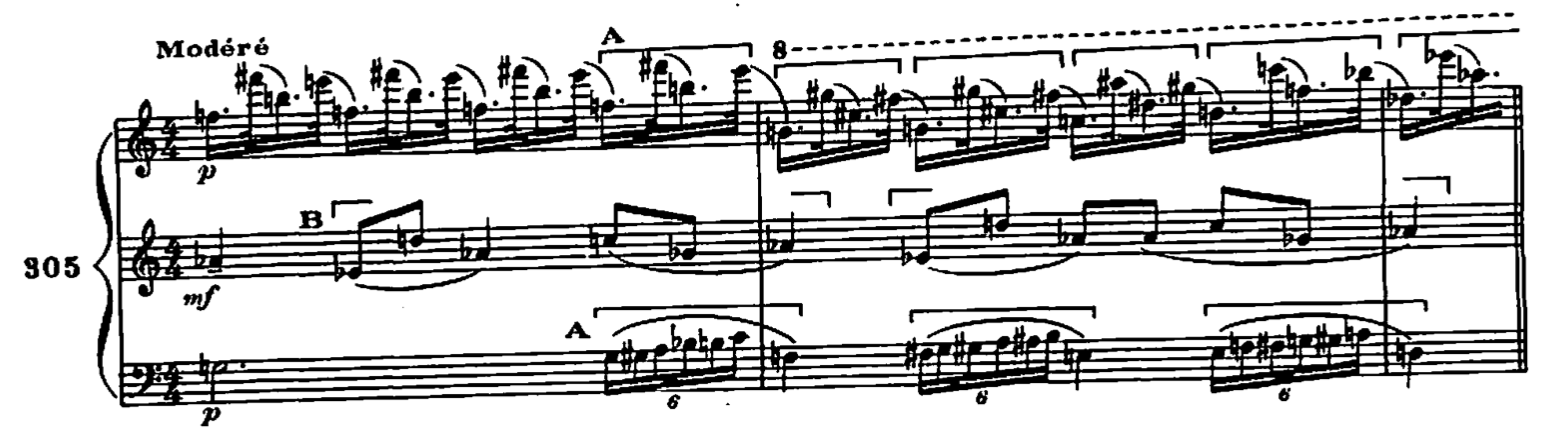
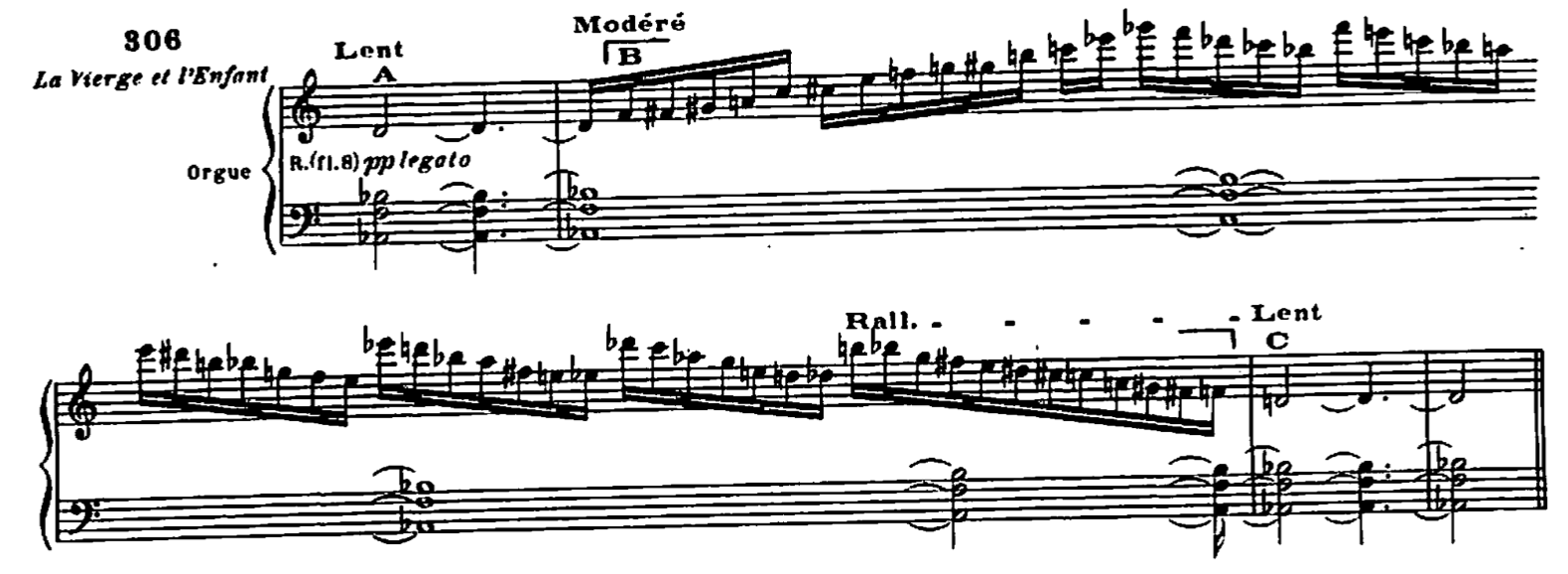
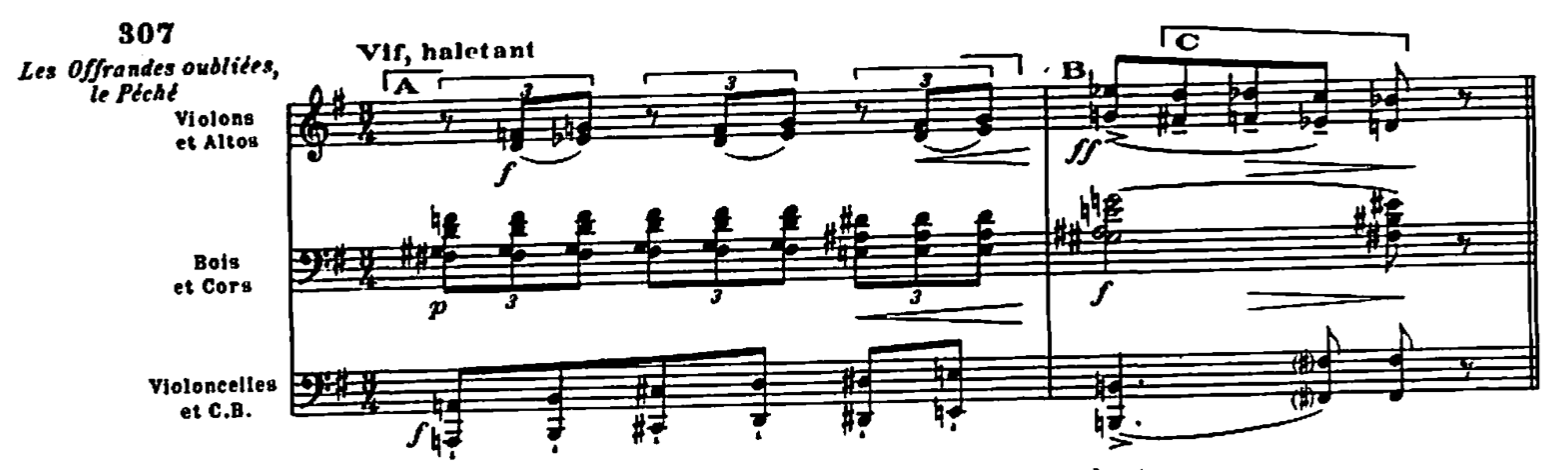
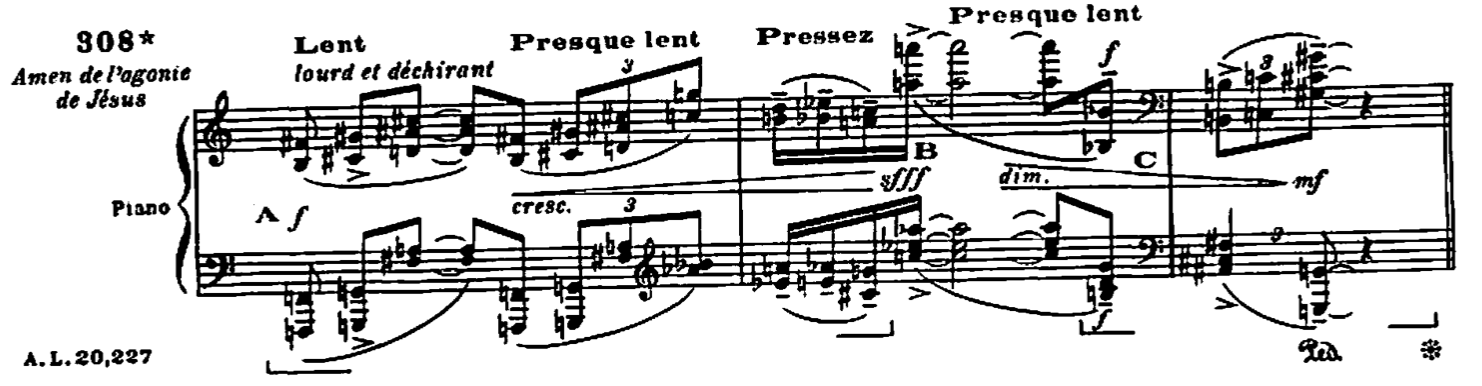
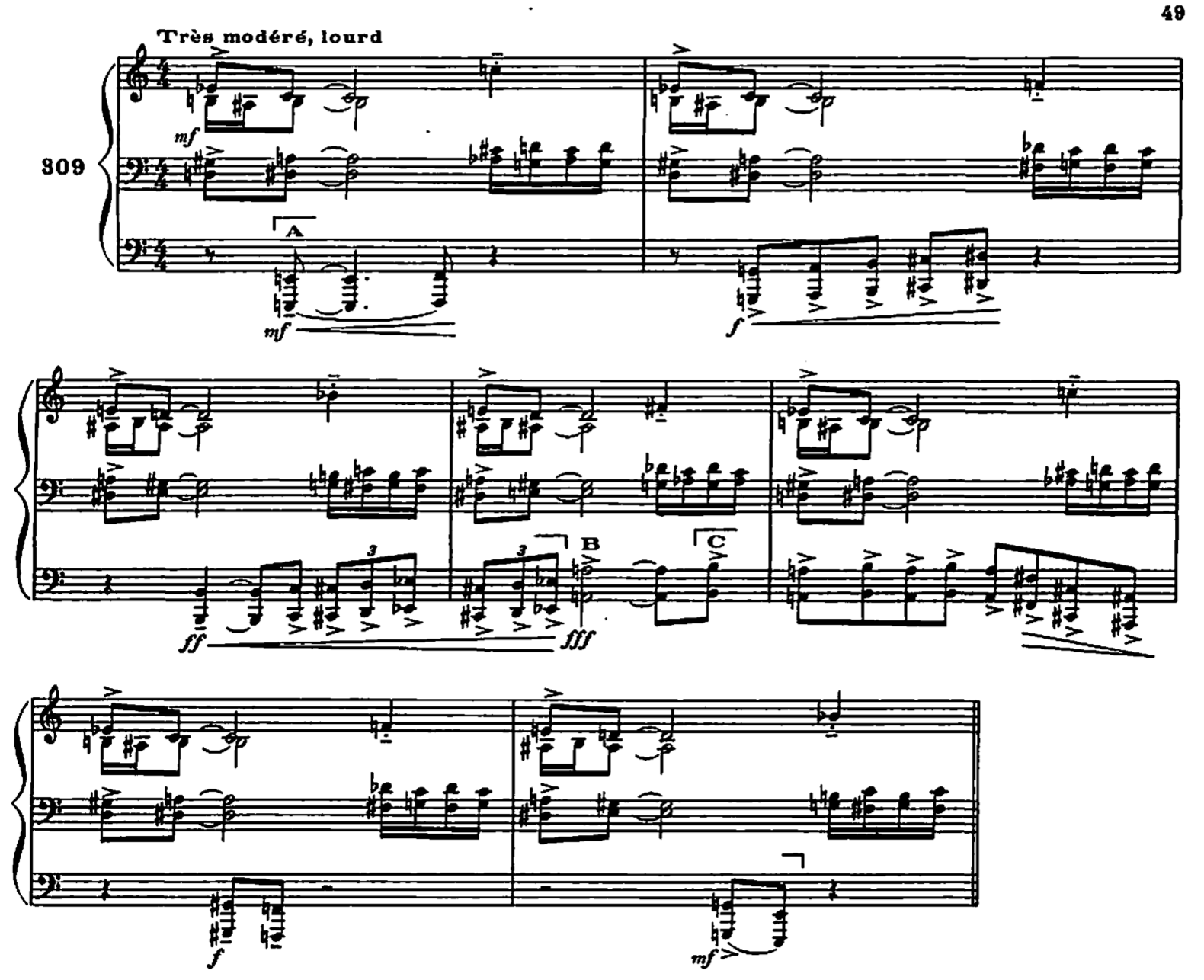
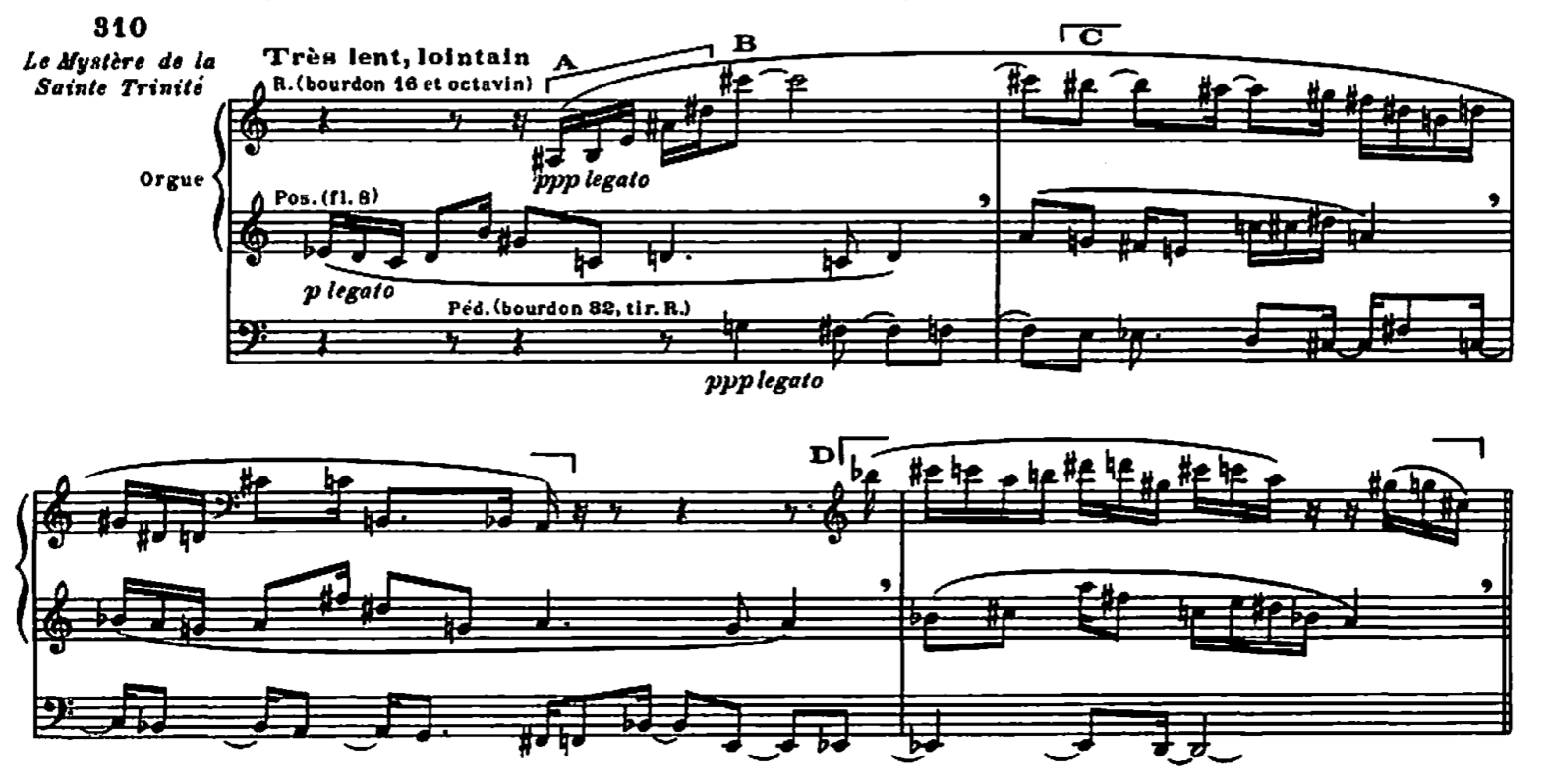

Overview
Chapter XV reframes traditional nonharmonic tone categories—pedals, passing notes, appoggiature, and embellishments—by "enlarging" them from individual pitches into complete musical structures (groups) that possess their own internal rhythmic, melodic, and harmonic organization. Rather than treating dissonances as momentary decorations requiring resolution, Messiaen reconceives them as self-sufficient musical entities. The chapter culminates in an extended discussion of the upbeat-accent-termination complex, which Messiaen identifies as the most important and expressive combination of foreign notes in the classical style. This approach transforms surface-level harmonic detail into a principle of large-scale formal articulation.
Key Concepts
This chapter introduces five key concepts reframing traditional nonharmonic tone categories:
-
Enlargement of Foreign Notes into Groups - The transformation of traditional single-note dissonances into multi-note structures that function as complete, self-contained musical units
-
The Pedal Group - A sustained or repeated musical structure, foreign to the surrounding harmonic context, possessing its own internal musical organization
-
The Passing Group - A musical structure that reproduces the terms of a harmonic progression symmetrically while functioning analogically to traditional passing motion
-
The Embellishment Group - A complex ornamental gesture that elaborates a single structural pitch while functioning as a complete musical unit
-
Upbeats and Terminations - The structural articulation points that frame and define musical gestures, forming the upbeat-accent-termination complex
Enlargement of Foreign Notes into Groups
Definition: The transformation of traditional single-note dissonances (pedal tones, passing notes, embellishments, appoggiature) into multi-note structures that function as complete, self-contained musical units, each with its own internal organization of rhythm, harmony, and melody.
Messiaen's Treatment: Messiaen opens the chapter by questioning whether dissonance remains possible given the complexity of modern chords saturated with added notes. Rather than abandoning the expressive function of foreign notes, he proposes preserving them through enlargement: the pedal becomes the pedal group, the passing note becomes the passing group, and the embellishment becomes the embellishment group. Each group contains several foreign notes and constitutes complete "whole music" (rhythm, harmony, melody) while simultaneously functioning analytically as a single unit—"a single pedal, a single passing note, a single embellishment." Messiaen explicitly states that traditional anticipation and escape tones (which had served prophetic functions in the context of added notes) have been erased by the suspension, which itself has diminished before the appoggiatura. The most important and expressive foreign note configuration in the classical style—the combination of upbeat, accent, and termination—will receive special attention.
Modern Context: This concept represents a significant theoretical innovation that anticipates later developments in prolongational analysis and form-functional theory. What Heinrich Schenker conceived as voice-leading diminutions operating at multiple structural levels, Messiaen reformulates as the inflation of ornamental gestures into autonomous musical passages. Contemporary theory might describe this as recursive application of dissonance categories across different temporal scales—what functions ornamentally at the surface can function structurally at deeper levels. The approach also parallels concepts in phrase rhythm theory, where anacrusis-downbeat-continuation patterns operate at multiple hierarchical levels. Messiaen's insistence that these groups possess complete musical identity (rhythm, harmony, melody) while simultaneously functioning as single analytical units reveals sophisticated understanding of how musical categories operate simultaneously at multiple levels of structure. This thinking prefigures the "grouping structures" later formalized by Fred Lerdahl and Ray Jackendoff in A Generative Theory of Tonal Music.
Examples: Discussed conceptually throughout the chapter; specific realizations in Examples 302–311
The Pedal Group
Definition: A sustained or repeated musical structure, foreign to the surrounding harmonic context, possessing its own internal musical organization while functioning analogically to a traditional pedal point.
Messiaen's Treatment: Instead of a single sustained note foreign to surrounding chords, Messiaen employs repeated music (he notes that "repetition and sustaining are equivalent") that remains foreign to other music situated above or below it. Each musical layer maintains its own rhythm, melody, and harmonies. Example 302 demonstrates this principle: the upper staff music repeats from measure to measure, independent of the lower staff; it constitutes a pedal group. The entire passage operates in A major while being polymodal and superposing two modes of limited transpositions—the third mode for the upper staff (Example 303) and the second mode for the lower staff (Example 304). Messiaen notes that this polymodality will be discussed further in Chapter XIX.
Modern Context: The pedal group concept extends the traditional pedal point—typically a single pitch (usually tonic or dominant) sustained beneath changing harmonies—into a more complex polystylistic or polymodal structure. What distinguishes this from mere textural layering is the analytical claim that the entire repeating layer functions as a single "pedal" despite containing complete musical material. This approach anticipates techniques in minimalist music (particularly Steve Reich and Philip Glass) where repeating patterns function as stable structural layers against which other materials move. It also relates to concepts of "stratification" in the music of Charles Ives and Elliott Carter, where independent musical streams coexist without syntactic integration. The modal differentiation between layers (third mode versus second mode) demonstrates how Messiaen's modes of limited transpositions enable clear structural differentiation while maintaining harmonic consistency—each layer remains internally coherent within its own modal framework. The polymodal technique here serves both coloristic and formal functions, creating timbral differentiation between structural layers.
Examples: Examples 302–304
The Passing Group
Definition: A musical structure that reproduces the terms of a harmonic progression symmetrically (ascending or descending by degree) while functioning analogically to traditional passing motion between two structural harmonies.
Messiaen's Treatment: Messiaen states that just as on-the-spot repetition equates to sustaining (making it appropriate for pedal groups), the reproduction of progression terms constitutes the equivalent of symmetrical movement—ascending or descending degree by degree—characteristic of passing notes. Example 305 demonstrates this: the middle voice (B) contains a pedal group, while the two outer voices (at A) present groups of foreign notes reproduced symmetrically, in ascending progression for the upper part and descending for the bass. These constitute passing groups connecting structural points.
Modern Context: The passing group concept parallels Schenkerian concepts of "passing motion" operating at deeper structural levels, though Messiaen's approach remains more surface-oriented and less concerned with background voice leading. Contemporary harmony textbooks typically treat passing motion as stepwise connection between chord tones, operating primarily at the foreground level. Messiaen's enlargement allows passing function to operate across entire phrases or sections, where sequences or transposed repetitions of harmonic progressions create directed motion between structural pillars. This thinking anticipates William Caplin's form-functional categories, particularly "sequential progression" as a distinct formal function. The symmetrical aspect (simultaneous contrary motion in outer voices) creates what traditional counterpoint would call "wedge motion" or "expanding/contracting intervals," now applied to complete harmonic progressions rather than individual melodic lines. The integration of pedal group (middle voice) with passing groups (outer voices) demonstrates Messiaen's synthetic approach where multiple types of prolongation operate simultaneously across different textural layers.
Examples: Example 305
The Embellishment Group
Definition: A complex ornamental gesture, often realized as an extended scalar figure or flourish, that elaborates a single structural pitch while functioning as a complete musical unit rather than a simple melodic decoration.
Messiaen's Treatment: Example 306 demonstrates this concept: at points A and C, the real structural note is D, while at point B, an immense scroll forms a single embellishment of that D—it constitutes an embellishment group. The "immense scroll" functions analogically to how a single trill or turn would ornament a note in classical style, but now the embellishment itself contains substantial musical content.
Modern Context: The embellishment group extends traditional diminution concepts where simple ornaments (trills, mordents, turns) elaborate structural tones. What Messiaen proposes is the inflation of these gestures into cadenza-like passages or extensive scalar runs that maintain ornamental function despite their temporal extent. This concept relates to improvised embellishment traditions in Baroque music (where performers would ornament written melodic lines with elaborate divisions) and to the cadenza in Classical concerto form (where an extended improvisation ultimately elaborates dominant harmony before final resolution). Contemporary theory might analyze such passages using Schenkerian neighbor-note or incomplete-neighbor prolongations operating across multiple measures. The embellishment group also anticipates extended techniques in later twentieth-century music where what appears to be substantial musical material functions structurally as decoration—for instance, the elaborate flourishes in the music of Boulez or the virtuosic instrumental writing in Berio, which often serves ornamental rather than thematic functions. Messiaen's characterization of the embellishment as an "immense scroll" reveals his visual-musical synesthesia and suggests connections to visual ornamental traditions (Gothic tracery, Arabic calligraphy, Art Nouveau decorative excess) where elaborate surface detail coexists with simple underlying structure.
Examples: Example 306
Upbeats and Terminations
Definition: The structural articulation points that frame and define musical gestures, consisting of anacrustic preparation (upbeat), moment of arrival or emphasis (accent), and consequent resolution (termination). When combined into the upbeat-accent-termination complex, these elements constitute the most expressive configuration in Messiaen's harmonic vocabulary.
Messiaen's Treatment: Messiaen identifies Mozart as the distant herald of this technique, notes that Schönberg and Alban Berg employed it with rare emotional intensity, but credits Arthur Honegger as the composer who carried it to maximum effect (citing Judith, Horace victorious, Antigone, and Danse des morts). The essential element in the appoggiatura is the expressive accent, which Messiaen proposes to prepare through an immense upbeat and resolve through an equally immense termination. The result—upbeat-accent-termination—gains augmented expressive power through proportional expansion. Importantly, the upbeat and termination may be separated from the accent by rests or may exist independently without any accent. In the embellishment group (unlike the pedal and passing groups, which could possess their own harmonies), all notes are foreign, and the combination upbeat-accent-termination operates exclusively with melody. The distinguishing principle: the combination centers on the expressive accent, which provides its reason for being, whereas the embellishment group lacks an accent.
Messiaen provides multiple demonstrations: Example 307 shows the fundamental principle, with the combination revolving around the expressive accent. Example 308 presents a "course of anguish, of desire, and of horror" with panting upbeat at A, accent at B, and termination at C. Example 309 demonstrates how direct movement and chord cruelty provide great expressive strength, with lacerating accent at B, upbeat and rhythmic precipitation at A, and termination at C. Example 310 shows upbeat A and termination C cut by rests, creating impression of effort and exhaustion despite—or precisely because of—this interruption; the combination exceptionally begins and ends on the same note (E). Example 311 presents accent B as distant, upbeat A as more calm, with a very long termination in quasi-atonal style at C and a termination at D not preceded by accent. The bass reveals a rhythmic succession previously quoted in Chapter VI concerning rhythmic pedals, demonstrating how this harmonic technique integrates with rhythmic procedures.
Modern Context: The upbeat-accent-termination complex represents Messiaen's most significant contribution to understanding phrase articulation and gesture in twentieth-century music. This formulation anticipates later theoretical work on musical grouping, particularly the "beginning-middle-end" paradigm in form-functional theory and the "anacrusis-strong beat-aftermath" categories in metric theory. What distinguishes Messiaen's approach is the emphasis on proportional expansion—the upbeat and termination must be "immense" to properly frame the accent—and the allowance for discontinuity (rests separating elements or elements appearing without their expected complements). This thinking parallels developments in twentieth-century phrase rhythm, where traditional period structures fragment into more discontinuous gestures. The emotional characterizations ("anguish," "desire," "horror," "effort," "exhaustion") reveal Messiaen's consistent attention to expressive content—these structures serve psychological and dramatic functions, not merely formal ones. The integration with rhythmic pedals (Example 311) demonstrates the synthetic nature of Messiaen's technique, where harmonic, melodic, and rhythmic procedures reinforce unified expressive goals. Contemporary composers working with gestural music (Berio, Ligeti, Saariaho) employ similar principles of expanded anacrusis and extended resolution, often without explicit theoretical formulation—Messiaen provides the conceptual framework for understanding such practices. The technique also relates to concepts of "statistical climax" or "textural intensification" in electroacoustic and spectral music, where density and activity increase toward arrival points before dissipating.
Examples: Examples 307–311
Relationship to Other Chapters
Chapter XV connects directly to Chapter XIII's discussion of added notes—the proliferation of added notes in modern harmony necessitates reconceptualizing traditional dissonance categories. The pedal group references rhythmic concepts from earlier chapters, particularly the equivalence of repetition and sustaining established in discussions of rhythmic ostinato. The passing group relates to melodic contour discussions in Chapter VIII and anticipates the sequential procedures in modal progressions. The embellishment group connects to bird song (Chapter IX) where elaborate melodic flourishes ornament simple structural frameworks. The upbeat-accent-termination complex integrates with rhythmic pedals from Chapter VI (as demonstrated in Example 311) and anticipates the modal harmonic progressions of Chapters XVI–XIX, where these articulatory gestures will operate within specific modal contexts. The polymodality of Example 302 previews the systematic treatment of polymodal techniques in Chapter XIX. Throughout, the chapter demonstrates Messiaen's principle that musical parameters operate synthetically—rhythm, harmony, and melody combine to create unified expressive gestures.
Summary
Chapter XV reconceives traditional nonharmonic tone categories by enlarging them from individual pitches into complete musical structures—pedal groups, passing groups, and embellishment groups—each possessing internal rhythmic, harmonic, and melodic organization. The chapter's central contribution is the upbeat-accent-termination complex, which Messiaen identifies as the most expressive combination of foreign notes in both classical and modern styles. By allowing these elements to expand to "immense" proportions and to function discontinuously (separated by rests or appearing without expected complements), Messiaen provides a theoretical framework for understanding gestural articulation and phrase structure in twentieth-century music. The integration of these harmonic concepts with rhythmic procedures and modal techniques demonstrates the synthetic nature of Messiaen's compositional thinking, where all musical parameters collaborate toward unified expressive goals.
Chapter XVI: Modes of Limited Transpositions
Original: Pages 58–63 in Satterfield translation
Musical Examples: Examples 312–357 (46 examples)

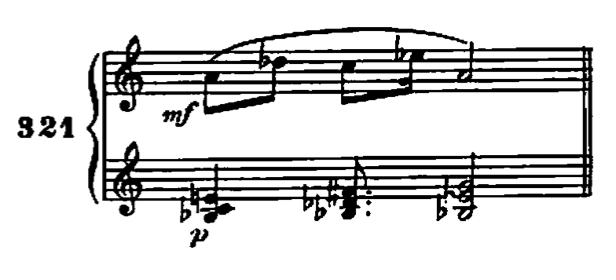


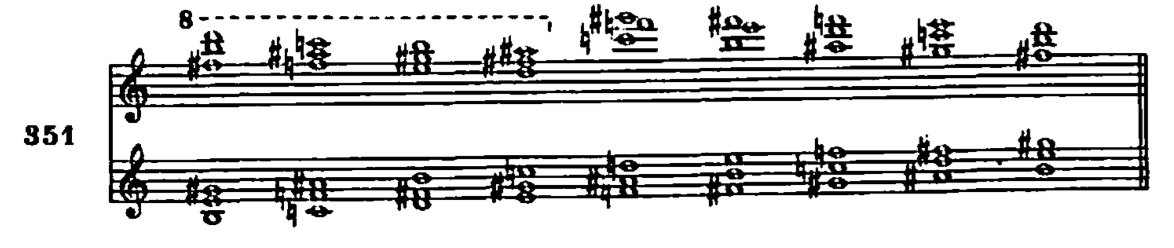
Overview
Chapter XVI presents the theoretical foundation and practical application of Messiaen's most distinctive contribution to twentieth-century harmonic practice: the modes of limited transpositions. These symmetrical pitch collections, formed from repeating intervallic groups, exhibit the remarkable property that they cannot be transposed beyond a certain number of times without duplicating their original pitch content. Messiaen identifies seven such modes within the twelve-tone equal-tempered system and demonstrates their comprehensive use for both melodic and harmonic purposes. The chapter establishes fundamental connections between these modal structures and the nonretrogradable rhythms discussed earlier, revealing deep symmetries operating across both pitch and temporal domains. This system provides Messiaen with a harmonic language that exists outside traditional tonality while avoiding what he perceives as the excessive transposability and lack of character in other contemporary approaches.
Key Concepts
This chapter introduces six key concepts establishing the modes of limited transpositions:
-
Theory of the Modes of Limited Transpositions - Pitch collections formed from symmetrical intervallic groups that can only be transposed a limited number of times before reproducing the same pitch-class content
-
First Mode of Limited Transpositions (Whole-Tone Scale) - A six-note collection transposable only twice, equivalent to the whole-tone scale
-
Second Mode of Limited Transpositions (Octatonic Scale) - An eight-note collection consisting of four symmetrical groups, transposable three times, corresponding to the octatonic or diminished scale
-
Third Mode of Limited Transpositions - A nine-note collection transposable four times, consisting of three symmetrical groups of four notes each
-
Modes 4, 5, 6, and 7 - Four additional modes transposable six times, each divided into two symmetrical groups, offering distinctive harmonic colors
-
Relation of Modes of Limited Transpositions and Nonretrogradable Rhythms - A fundamental structural parallel between symmetrical properties of modes and nonretrogradable rhythms, creating a "theological rainbow"
Theory of the Modes of Limited Transpositions
Definition: Pitch collections formed from symmetrical intervallic groups that, due to their internal structure, can only be transposed a limited number of times before reproducing the same pitch-class content. These modes exist within the twelve-tone equal-tempered system and are mathematically closed—no additional modes of this type can be discovered within the system.
Messiaen's Treatment: Messiaen explains that these modes consist of several symmetrical groups, with the last note of each group always held in common with the first note of the following group. After a certain number of chromatic transpositions (which varies with each mode), they cease to be transposable—the fourth transposition yields exactly the same notes as the first, the fifth the same as the second, and so forth. Messiaen emphasizes enharmonic equivalence: when he says "the same notes," he means enharmonically, within the tempered system where C-sharp equals D-flat. Three modes exhibit this property most strongly (modes 1, 2, and 3), while four other modes (4, 5, 6, 7) are transposable six times but present less interest due to their greater number of transpositions. All seven modes can be used melodically and especially harmonically, with melody and harmonies never leaving the notes of the mode.
The theoretical foundation connects to the "charm of impossibilities" discussed in Chapter I: their impossibility of transposition creates their distinctive character. They exist in the atmosphere of several tonalities simultaneously, without polytonality, allowing the composer to give predominance to one tonality or leave the tonal impression unsettled. Their series is closed—it is mathematically impossible to find others within the tempered system of twelve semitones. Messiaen notes that in quarter-tone systems (explored by composers like Haba and Wischnegradsky), corresponding series exist, though he cannot elaborate on this topic as it lies outside his work's scope.
Messiaen adds that the modes of limited transpositions have nothing in common with the three great modal systems of India, China, and ancient Greece, nor with plainchant modes (relatives of the Greek modes)—all these scales being transposable twelve times.
Modern Context: Contemporary pitch-class set theory recognizes these structures through the concept of transpositional symmetry. A pitch-class set exhibits limited transposability when it maps onto itself under transposition by some interval other than the octave. The degree of symmetry determines the number of distinct transpositions: the whole-tone scale (Mode 1) has maximal symmetry (transpositionally equivalent at six levels), the octatonic collection (Mode 2) has three distinct transpositions, and the augmented or hexatonic collection (Mode 3) has four distinct transpositions. Modes 4–7 have two distinct transpositions each. Allen Forte's set-class theory systematizes these relationships, assigning each symmetrical collection a Tn/TnI-type designation indicating its transpositional and inversional symmetry.
What distinguishes Messiaen's approach from abstract set theory is his insistence on practical compositional application—these are not merely mathematical curiosities but living harmonic resources with distinctive coloristic properties. His claim that the series is closed anticipates later theoretical work demonstrating that only certain interval-class vectors permit transpositional symmetry within twelve-tone equal temperament. The connection to non-Western modal systems reveals Messiaen's awareness of ethnomusicological research while maintaining that his modes represent a fundamentally different organizational principle based on symmetry rather than scalar tradition. The theological dimension—modes existing in "the atmosphere of several tonalities" without committing to any—suggests Messiaen heard these structures as embodying a kind of harmonic transcendence or suspension of earthly tonal gravity.
Examples: Theoretical exposition throughout; practical demonstrations in Examples 312–357
First Mode of Limited Transpositions (Whole-Tone Scale)
Definition: A six-note collection consisting of six groups of two notes each (a tone and a semitone within each group), transposable only twice. This mode is equivalent to the whole-tone scale.
Messiaen's Treatment: Messiaen notes that Debussy employed this mode extensively in works like Pelléas et Mélisande, and Paul Dukas made remarkable use of it in Ariane et Barbe-Bleue. Given this thorough exploitation by his predecessors, Messiaen states that there is nothing more to add and that he carefully avoids using it unless concealed within a superposition of modes that renders it unrecognizable, as in Example 43 of Chapter VI, paragraph 3.
Modern Context: The whole-tone scale represents the most symmetrical division of the octave into equal intervals, creating a collection with maximal transpositional symmetry. Its interval-class vector (060603) reveals that it contains only whole steps and tritones, producing characteristically ambiguous harmonies lacking perfect fifths and thus resisting traditional tonal function. The scale's extensive use by Debussy and other Impressionist composers became so strongly associated with that aesthetic that later composers (including Messiaen) often avoided it to prevent stylistic connotations. Contemporary jazz theory recognizes whole-tone scales as useful for improvisation over augmented triads or altered dominant chords. The mode's avoidance by Messiaen demonstrates his concern with originality—having been "exhausted" by previous composers, it no longer offered fresh expressive possibilities. This position contrasts with serialist composers who might employ all available pitch resources systematically regardless of historical associations.
Examples: Referenced but intentionally not demonstrated in isolation; appears concealed in Example 43 (Chapter VI)
Second Mode of Limited Transpositions (Octatonic Scale)
Definition: An eight-note collection consisting of four symmetrical groups of three notes each, with each "trichord" taken in ascending movement divided into two intervals—a semitone and a tone. The mode is transposable three times and corresponds to what later theorists call the octatonic or diminished scale.
Messiaen's Treatment: Messiaen traces historical precedents: traces appear in Rimsky-Korsakov's Sadko, Scriabin uses it more consciously, and Ravel and Stravinsky employ it transiently, though the modal effect remains absorbed by classified sonorities rather than emerging distinctly. Mode 2 connects directly to the diminished seventh chord. Messiaen provides the first transposition (Example 312), the second and third transpositions (Examples 313 and 314), and notes that the fourth transposition reproduces the first enharmonically (Example 315). The fifth and sixth transpositions duplicate the second and third respectively.

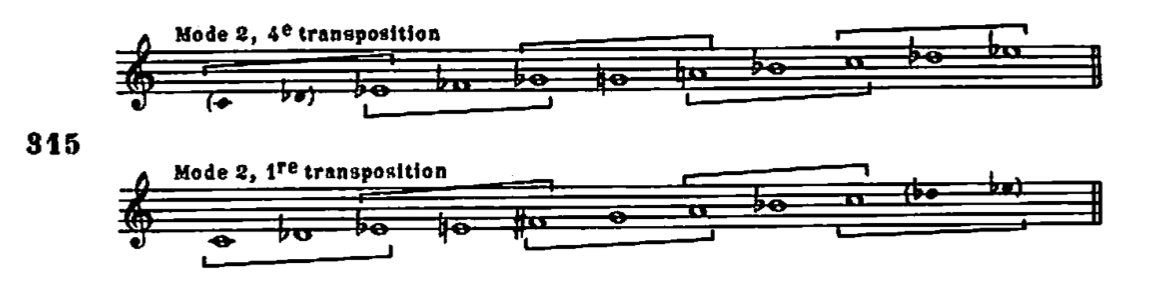
One can begin the scale on the second degree, producing intervals of a tone, then a semitone (instead of semitone, then tone), but this changes nothing in the chords created by the mode—one falls again enharmonically into the notes of the first transposition (Example 316). Messiaen demonstrates Mode 2 in parallel chord succession with each voice realizing the entire mode starting on different degrees (Example 317), showing how this succession alternates the six-four chord with added augmented fourth and the dominant seventh chord with added sixth (referencing Chapter XIII). Example 318 presents contrary motion in the same transposition, while Example 319 shows the typical chord of the mode. Example 320 demonstrates a chord containing all notes of the mode in its second transposition.
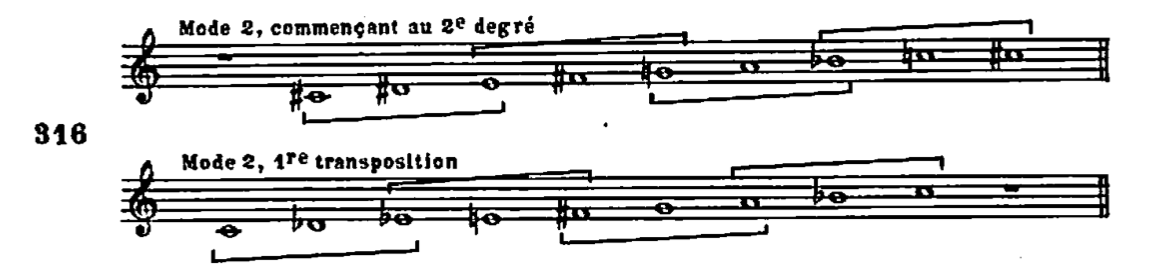

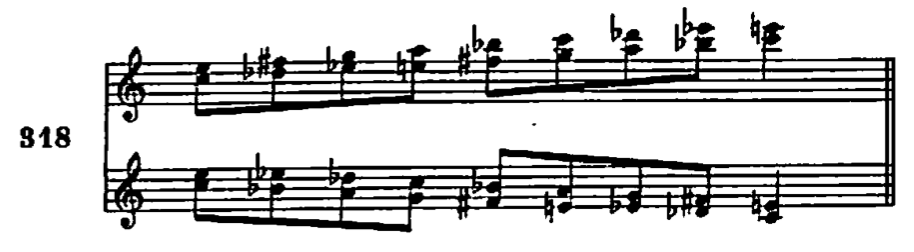
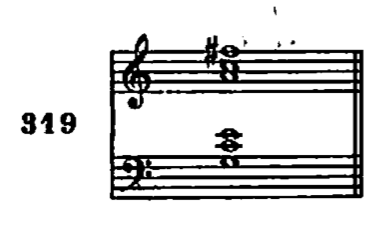
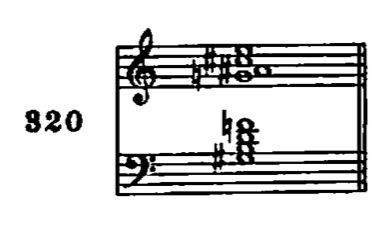
Various cadence formulas belonging to the second mode appear in Examples 321–324. The first formula constitutes the typical cadence of the mode in first transposition, already seen in Chapter VIII (Example 77, "la Vierge et l'Enfant"). The second formula uses the mode in second transposition. The third formula presents a progression of harmony: at A, first term in third transposition; at the cross, added value giving more force to accent preparation; at B, second term in first transposition with rhythmic variation; at the cross, value elongated by dot addition, slackening the descent. The fourth formula uses the second transposition.
Messiaen notes frequent borrowings from the second mode in preceding chapter examples, providing new demonstrations (Examples 325–327) that do not leave the mode's notes in first transposition. The third example contains an interesting accompaniment formula in the piano (referencing Chapter XIV, paragraph 8), with melodic movement comparable to Chapter VIII Example 113 ("l'Ange aux parfums"). Example 328 uses Mode 2 at A in third transposition and at B in first transposition.
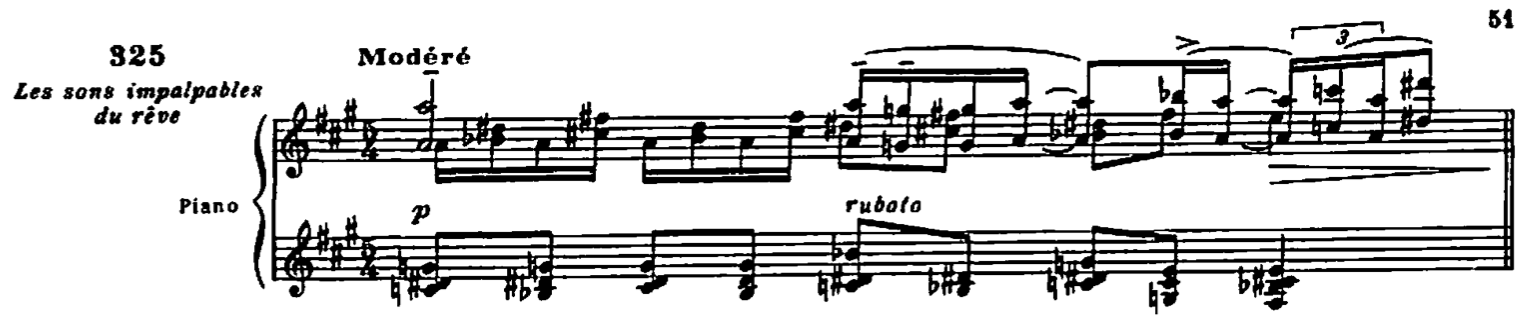
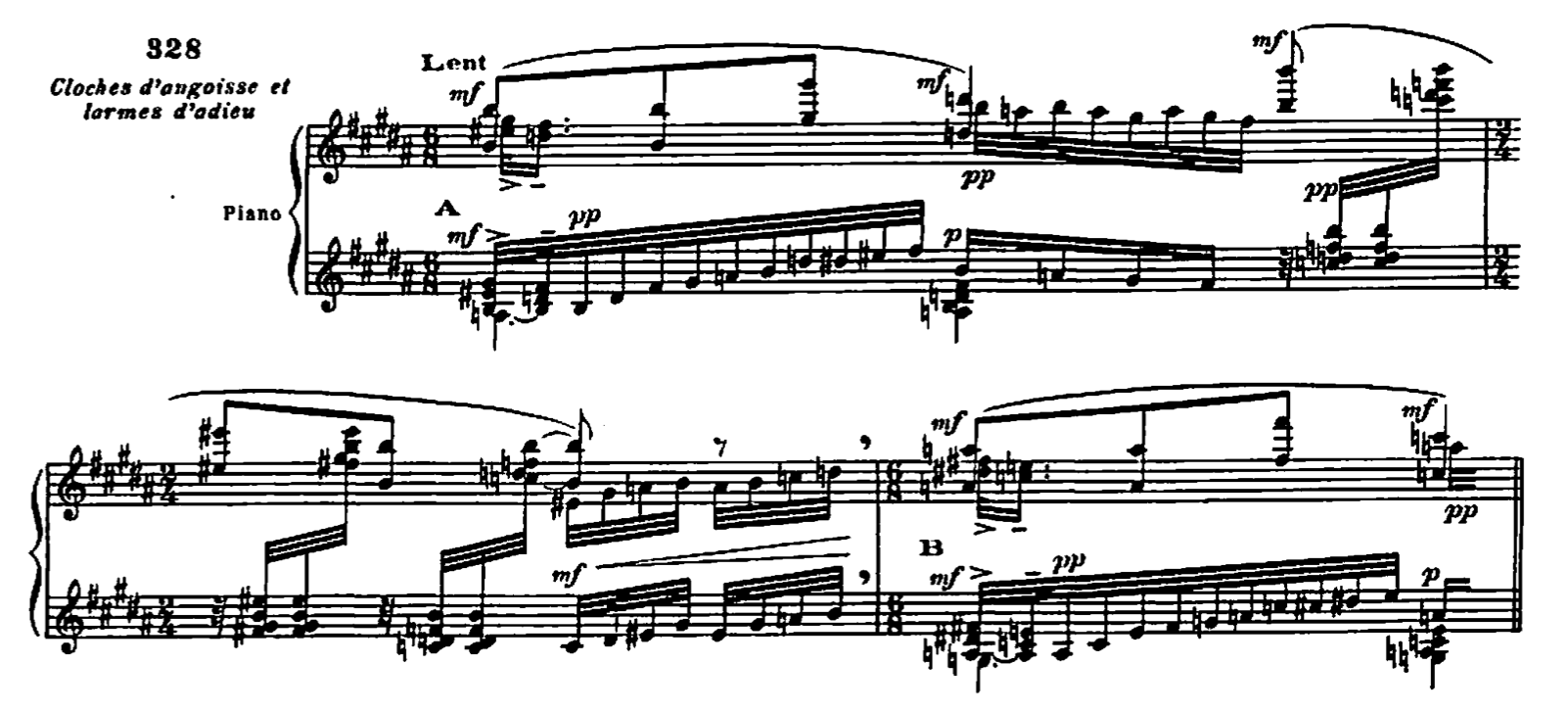
Modern Context: The octatonic collection represents one of the most important pitch structures in twentieth-century music, appearing prominently in works by Stravinsky, Bartók, and numerous later composers. Its interval-class vector (448444) reveals balanced distribution of interval classes, containing abundant semitones, minor thirds, tritones, and perfect fourths/fifths while excluding major thirds and major seconds. This intervallic content allows construction of various symmetrical harmonies: diminished seventh chords, French augmented sixth chords, half-diminished seventh chords, and dominant seventh chords with various alterations—all derivable from a single octatonic collection. Contemporary theory recognizes three distinct octatonic collections (corresponding to Messiaen's three transpositions), often designated OCT(0,1), OCT(1,2), and OCT(2,3) in pitch-class set notation.
The scale's alternating semitone-tone structure creates what Messiaen identifies as its characteristic sound, and its symmetrical properties make it particularly suitable for the kinds of parallel voice leading and symmetrical chord progressions he demonstrates. The connection to the diminished seventh chord—a structure long recognized for its symmetrical properties and enharmonic flexibility—provides historical continuity with nineteenth-century chromaticism while offering expanded harmonic possibilities. Jazz musicians independently rediscovered similar properties, naming this collection the "diminished scale" or "octatonic scale" and using it extensively for improvisation over diminished chords and altered dominants. The mode's capacity to simultaneously suggest multiple tonal centers while committing to none makes it ideal for Messiaen's aesthetic goal of existing "in the atmosphere of several tonalities."
Examples: Examples 312–328
Third Mode of Limited Transpositions
Definition: A nine-note collection, transposable four times, consisting of three symmetrical groups of four notes each. These "tetrachords," taken in ascending movement, are divided into three intervals—a tone and two semitones.
Messiaen's Treatment: Messiaen demonstrates Mode 3 with the first transposition (Example 329), the second, third, and fourth transpositions (Examples 330–332), noting again that the fifth transposition duplicates the first, the sixth the second, and so on, according to the phenomenon observed in Mode 2. One can begin the scale on the second or third degree, but as with Mode 2, this produces only a new order of tones and semitones for each group without changing the notes constituting the mode or the chords it generates.


Mode 3 appears in parallel succession of chords with each voice realizing the entire mode starting on different degrees (Example 333). Example 334 shows contrary motion in second transposition, Example 335 presents the typical chord in first transposition, and Example 336 demonstrates a chord containing all notes of the mode in the same transposition. Two cadence formulas appear: the first in fourth transposition (Example 337), the second in contrary motion in first transposition (Example 338).
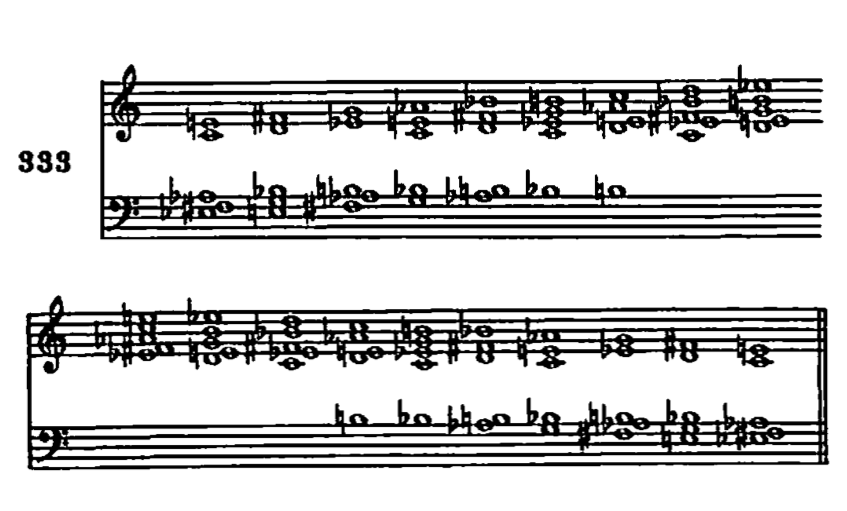
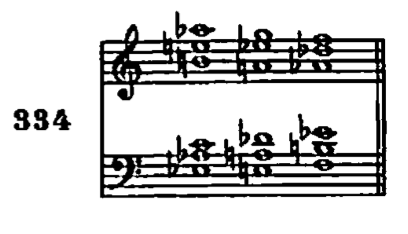
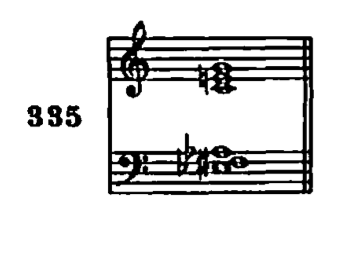
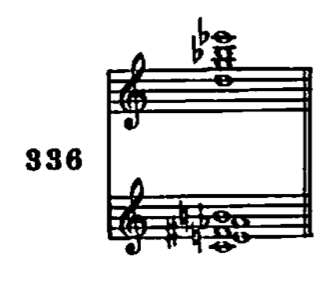
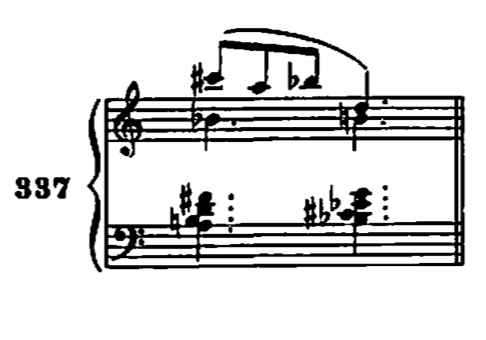
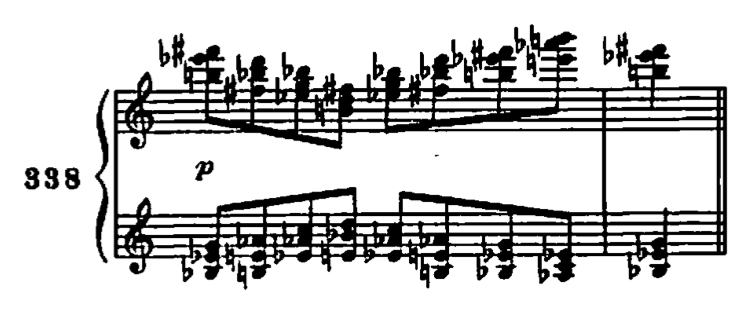
Example 339 demonstrates use of the third mode in a fragment that does not leave the mode's notes in first transposition. The cluster of chords repeated measure to measure in the upper staff of the piano constitutes a pedal group (referencing Chapter XV). Example 340 shows another use of the third mode employing cadence formulas from Examples 337 and 338 with contrary motion from Example 334: at A, fourth transposition; at B, first transposition; at C, second transposition. The three instances of the letter D indicate notes foreign to the mode, forming effects of superior and inferior resonances (referencing Chapter XIV, article 4).
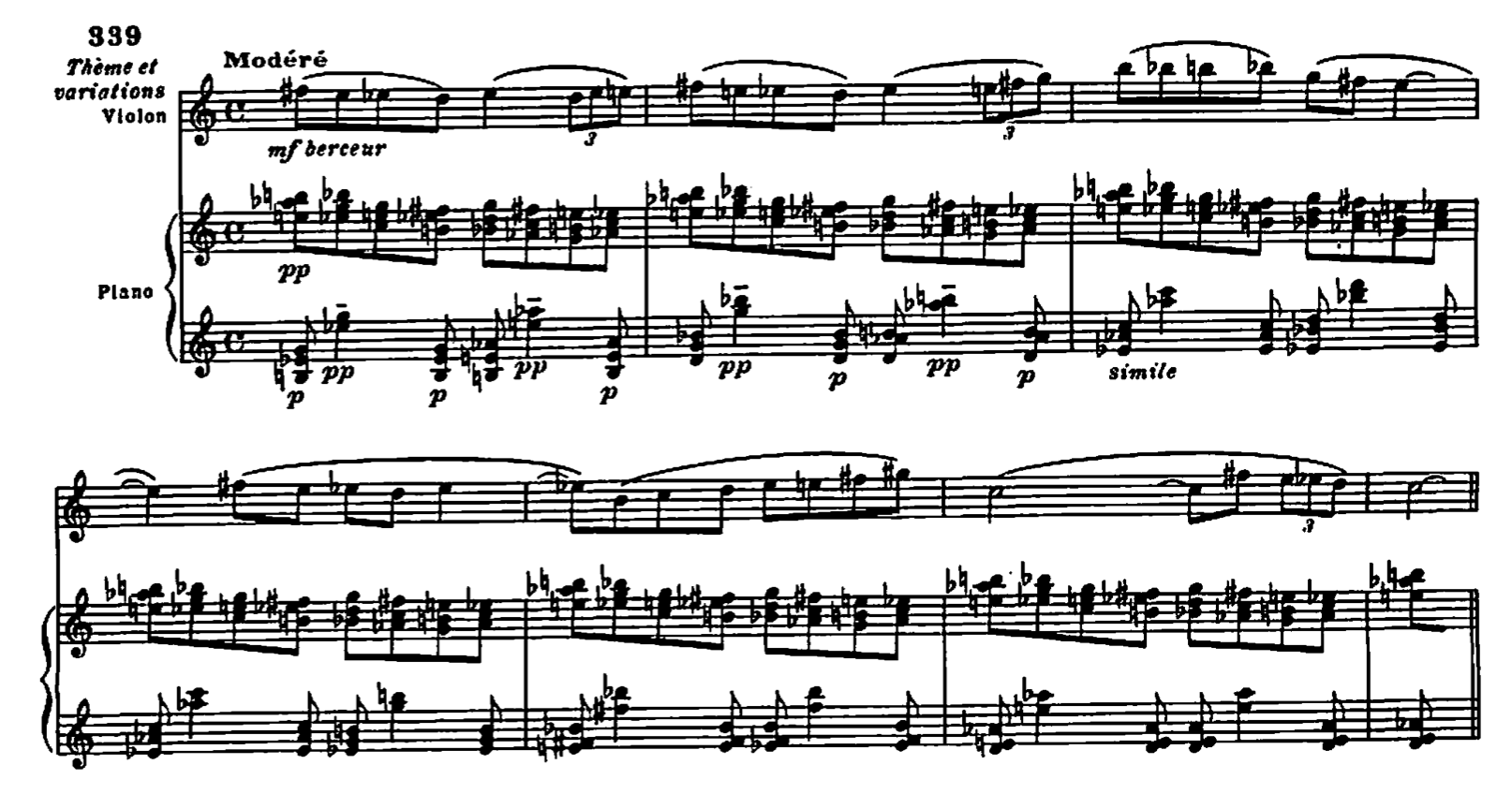
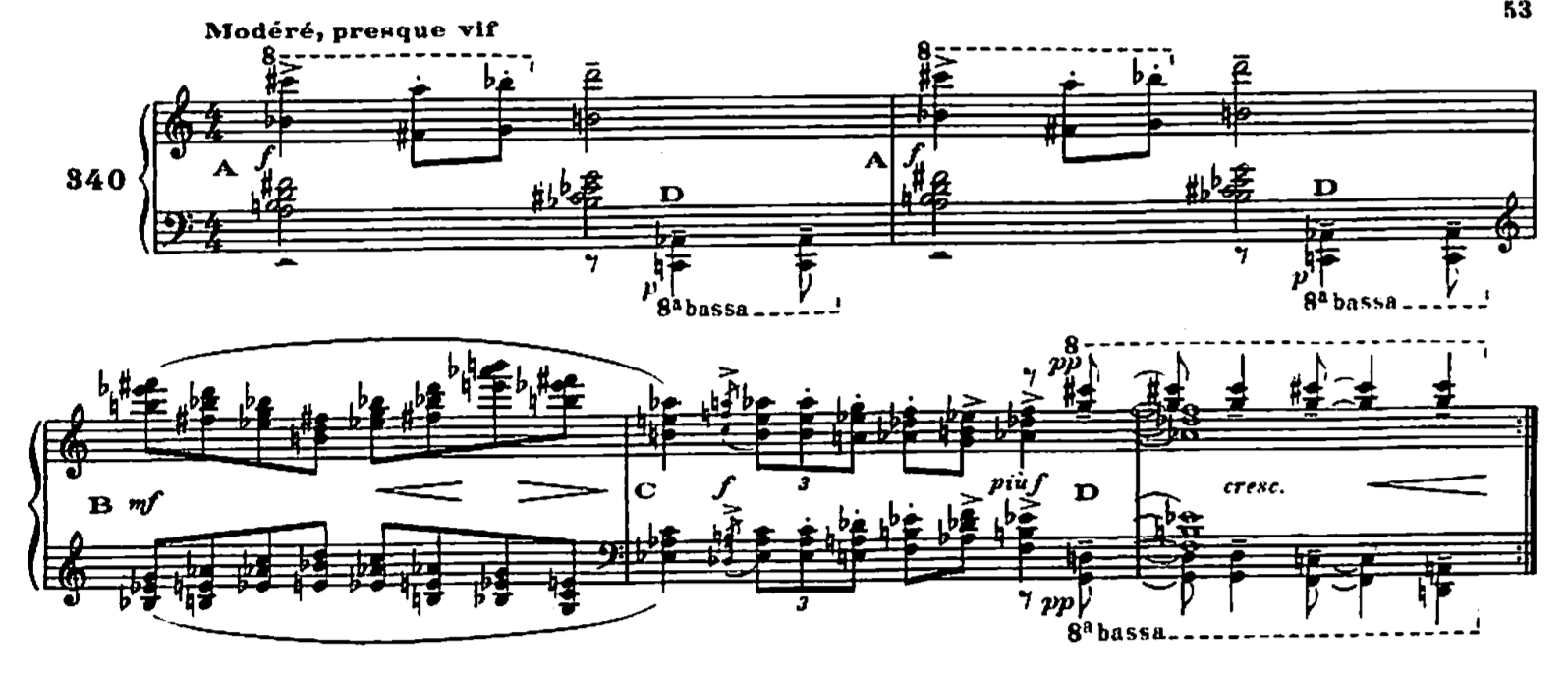
Modern Context: The third mode of limited transpositions, while less frequently discussed in contemporary theory than the octatonic collection, appears in various twentieth-century works, particularly in passages employing augmented triads or hexatonic (augmented) relationships. Its interval-class vector reveals particular intervallic properties that distinguish it from other symmetrical collections. The mode's structure—alternating larger and smaller intervals—creates harmonic ambiguity similar to Mode 2 but with different coloristic properties. The nine-note collection approaches chromatic saturation (containing three-quarters of the chromatic total), yet maintains sufficient gaps to preserve modal identity.
Contemporary theorists recognize relationships between Mode 3 and hexatonic systems (collections built around augmented triads), as the mode contains multiple augmented triads and can be understood as a partial union of hexatonic collections. The mode's four distinct transpositions reflect its tetrachordal symmetry—each transposition represents a rotation of the underlying three-fold division of the octave. Messiaen's demonstration of how beginning on different scale degrees changes interval ordering but not pitch-class content parallels later theoretical concepts of rotational equivalence. The extensive use of Mode 3 in Messiaen's examples, combined with its integration with pedal groups and resonance effects, demonstrates how modal structures function not as abstract pitch collections but as practical harmonic resources that can be combined with other compositional techniques to create specific coloristic and formal effects.
Examples: Examples 329–340
Modes 4, 5, 6, and 7
Definition: Four additional modes of limited transpositions, each transposable six times and divided into two symmetrical groups. These modes present less compositional interest than Modes 1–3 due to their greater number of transpositions, but offer distinctive harmonic colors and connect importantly to Messiaen's melodic formulas and quartal harmonies.
Messiaen's Treatment: Messiaen notes that these modes are transposable six times, like the interval of the augmented fourth, and divide into two symmetrical groups. Four of these modes exist, bringing the total number of modes of limited transpositions to seven. One cannot find others transposable six times because all other combinations dividing the octave into two symmetrical groups either commence the scales of modes 4, 5, 6, and 7 upon other degrees than the first (which changes interval order but not the notes or chords of the modes, as previously established), or form arpeggios of classified chords, or form truncated versions of modes 2 and 5, or form truncated mode 5 specifically.
Messiaen provides examples demonstrating these modes: Mode 4 appears in Example 345, the same in parallel succession of chords (Example 346). He used this mode in "Prière exaucée" from his Poèmes pour Mi. Example 347 shows Mode 5 (the same scale less two notes); this truncated Mode 4 has quotation rights only because it engenders the melodic formula already seen in Chapter X (Example 348) and the chord in fourths analyzed in Chapter XIV, paragraph 3 (Example 349). Both the chord in fourths and the melodic formula contain all notes of Mode 5.


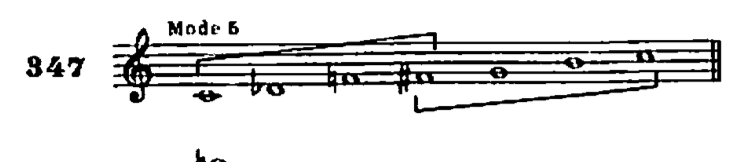

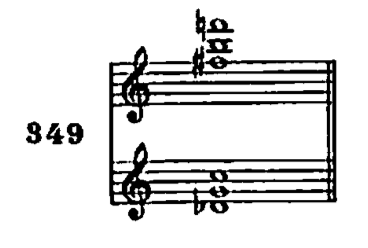
Mode 6 appears in Example 350, with contrary movement (Example 351), another contrary movement (Example 352), and the same mode in parallel succession of chords over a sustained augmented fourth (Example 353). For use of Mode 6, Messiaen references Chapter III, paragraph 2, Example 12 ("les Bergers"), which uses the mode in its fifth transposition, and Chapter VIII, paragraph 4, Example 109 ("la Vierge et l'Enfant"), which uses the mode in first transposition.

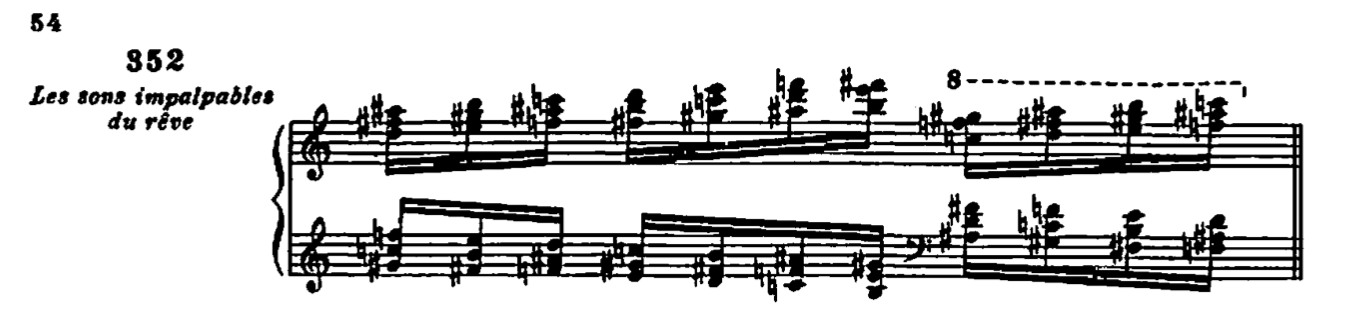
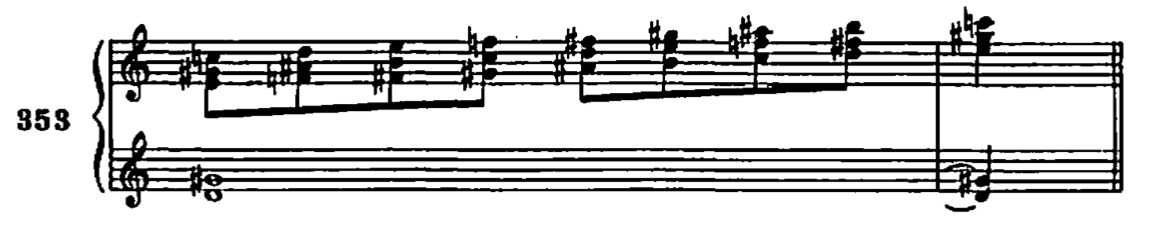
Finally, Mode 7 appears in Example 354, the same in parallel succession of chords (Example 355). Messiaen used this mode in the fourth part of l'Ascension: "Prière du Christ montant vers son Père," and recalls Example 253 of the list of chord connections (Chapter XIV, paragraph 8; Example 356), which uses all notes of Mode 7 in its fifth transposition (Example 357).


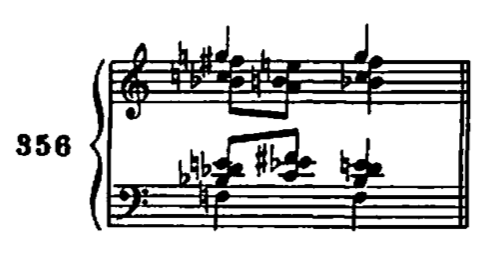

Modern Context: These modes represent what contemporary set theory would classify as additional symmetrical hexachords (six-note collections with two distinct transpositions each). Their lesser prominence in Messiaen's practice—and in subsequent theoretical discourse—reflects the observation that greater transposability correlates with reduced harmonic distinctiveness. Collections transposable six times approach the flexibility of fully chromatic materials while losing some of the characteristic "modal" flavor that modes with fewer transpositions possess. However, their connection to specific melodic formulas and chord types (particularly quartal harmonies) demonstrates how even these "less interesting" modes fulfill specific compositional functions.
The truncation relationships Messiaen identifies (Mode 5 as truncated Mode 4) reveal how these modes exist within a network of subset and superset relationships. Contemporary theorists might analyze these relationships using inclusion lattices or Z-relation concepts, though Messiaen's practical compositional perspective focuses on functional rather than abstract mathematical relationships. The integration of Mode 5 with both the melodic formula (Chapter X) and the chord in fourths (Chapter XIV) exemplifies Messiaen's synthetic approach where pitch collections serve multiple parametric functions—the same mode generates both horizontal (melodic) and vertical (harmonic) materials, ensuring consistency across compositional dimensions.
The reference to actual compositional usage (Poèmes pour Mi, l'Ascension) demonstrates that despite their theoretical "lesser interest," these modes proved sufficiently distinctive for practical application. This suggests that Messiaen's evaluation of "interest" relates not to absolute quality but to the degree of constraint and therefore distinctiveness that limited transposability provides—modes with fewer transpositions offer more constraints and thus more recognizable identity.
Examples: Examples 341–357
Relation of Modes of Limited Transpositions and Nonretrogradable Rhythms
Definition: A fundamental structural parallel between the symmetrical properties of the modes (operating in the vertical/transpositional dimension) and nonretrogradable rhythms (operating in the horizontal/temporal dimension). Both embody the principle of symmetry as a compositional foundation, creating what Messiaen describes as a "theological rainbow" of unified musical language.
Messiaen's Treatment: Messiaen returns to reflections from Chapter V, article 3, establishing the parallel explicitly: modes of limited transpositions realize in the vertical direction (transposition) what nonretrogradable rhythms realize in the horizontal direction (retrogradation). These modes cannot be transposed beyond a certain number without falling again into the same notes, enharmonically speaking; likewise, these rhythms cannot be read in retrograde without one finding again exactly the same order of values as in the right sense. These modes cannot be transposed because they are without polytonality; these rhythms frame a central value common to each group.
The analogy extends further: modes exist in the modal atmosphere of several keys simultaneously and contain in themselves small transpositions; rhythms contain in themselves small retrogradations. These modes are divisible into symmetrical groups; these rhythms also exhibit this difference—the symmetry of rhythmic groups is a retrograde symmetry. Finally, the last note of each group of these modes is always common with the first of the following group, and the groups of these rhythms frame a central value common to each group. The analogy is now complete.
Messiaen quotes from Chapter V, article 3: "Let us think of the hearer of our modal and rhythmic music; he will not have time at the concert to inspect the nontranspositions and the nonretrogradations, and, at that moment, these questions will not interest him further; to be charmed will be his only desire. And that is precisely what will happen; in spite of himself he will submit to the strange charm of impossibilities: a certain effect of tonal ubiquity in the nontranspositions, a certain unity of movement (where beginning and end are confused because identical) in the nonretrogradation, all things which will lead him progressively to that sort of theological rainbow which the musical language, of which we seek edification and theory, attempts to be."
Messiaen concludes by asking rhetorically whether, having arrived at this place in the treatise, it is not useful to repeat these lines.
Modern Context: This theoretical connection represents one of Messiaen's most profound insights—the recognition that symmetry can operate as a unifying principle across different musical parameters. Contemporary theory has explored similar cross-domain symmetries, particularly in the work of composers like Bartók, Webern, and later serialists who sought to systematize relationships between pitch and rhythm. However, Messiaen's formulation remains distinctive in its theological interpretation: symmetry becomes not merely a compositional technique but a manifestation of divine order, a "theological rainbow" bridging temporal and transpositional dimensions.
The parallel between limited transposability and nonretrogradability can be understood through group-theoretic concepts: both represent structures exhibiting non-trivial automorphisms—the modes map onto themselves under certain transpositions, while the rhythms map onto themselves under retrograde inversion. This mathematical elegance appealed to later composers working with serial and algorithmic techniques, though Messiaen characteristically emphasizes perceptual and spiritual rather than purely formal dimensions.
The "charm of impossibilities" concept—that listeners will be unconsciously affected by structural properties they cannot analytically perceive—anticipates later theoretical work on subliminal structural perception and embodied musical cognition. Whether audiences genuinely perceive symmetry at unconscious levels remains an empirical question, but Messiaen's confidence in this principle shaped his compositional aesthetic profoundly. The theological dimension—symmetry as manifestation of eternal, unchanging divine truth—connects to long traditions in sacred architecture, visual art, and mystical mathematics where symmetry signifies perfection and transcendence.
The explicit linkage of these two chapters reveals the systematic unity of Messiaen's treatise—what might appear as separate rhythmic and harmonic techniques are revealed as manifestations of a single underlying structural principle. This holistic thinking distinguishes Messiaen from composers who treated rhythm and pitch as independent parameters, suggesting instead that both dimensions should be governed by parallel organizational principles to achieve aesthetic and theological unity.
Examples: Conceptual discussion drawing on examples from both Chapter V (rhythms) and Chapter XVI (modes)
Relationship to Other Chapters
Chapter XVI represents the theoretical keystone of the treatise's harmonic section, with connections radiating throughout the entire work. The modes were anticipated in Chapter I's "charm of impossibilities," where Messiaen first articulated the aesthetic principle underlying symmetrical structures. Specific chords discussed in Chapter XIII (added notes) and Chapter XIV (chord on the dominant, chord of resonance, chord in fourths) are revealed as derivable from particular modes—the added sixth and augmented fourth chord belongs to Mode 2, the chord of resonance connects to Mode 3, and the chord in fourths derives from Mode 5. Chapter XV's pedal groups, passing groups, and embellishment groups can all operate within modal contexts, as demonstrated in several examples.
The fundamental parallel between modes and nonretrogradable rhythms (Chapter V) establishes the systematic unity of Messiaen's entire compositional approach, demonstrating how a single structural principle—symmetry—generates both rhythmic and harmonic materials. Melodic formulas discussed in Chapter X are revealed as mode-specific, with particular contours associated with particular modes (Mode 5 with its characteristic melodic formula, Mode 6 appearing in "les Bergers" and "la Vierge et l'Enfant"). The chapter anticipates Chapter XVII (modulations of the modes), Chapter XVIII (relation to modal, atonal, polytonal, and quarter-tone music), and especially Chapter XIX (polymodality), where combinations of different modes will create complex coloristic effects. Throughout the remaining chapters, the modes function as the primary harmonic vocabulary, demonstrating their centrality to Messiaen's compositional language.
Summary
Chapter XVI presents Messiaen's modes of limited transpositions as mathematically closed systems of symmetrical pitch collections that can only be transposed a limited number of times before reproducing their original content. Seven such modes exist within twelve-tone equal temperament: the whole-tone scale (Mode 1, transposable twice), the octatonic collection (Mode 2, transposable three times), a nine-note collection (Mode 3, transposable four times), and four hexachordal modes (Modes 4–7, each transposable six times). Messiaen demonstrates comprehensive melodic and harmonic applications of these modes, showing how they generate characteristic sonorities while existing "in the atmosphere of several tonalities" without committing to any single tonal center. The profound connection established between these modes and the nonretrogradable rhythms of Chapter V reveals symmetry as the fundamental organizational principle unifying all dimensions of Messiaen's musical language, creating what he describes as a "theological rainbow"—a compositional system reflecting divine order and eternal truth. The modes provide Messiaen with a distinctive harmonic vocabulary that avoids both traditional tonality and what he perceives as the excessive transposability of other contemporary approaches, establishing the foundation for all subsequent harmonic discussions in the treatise.
Chapter XVII: Modulations of These Modes and Their Relation to the Major Tonality
Original: Pages 64–66 in Satterfield translation
Musical Examples:

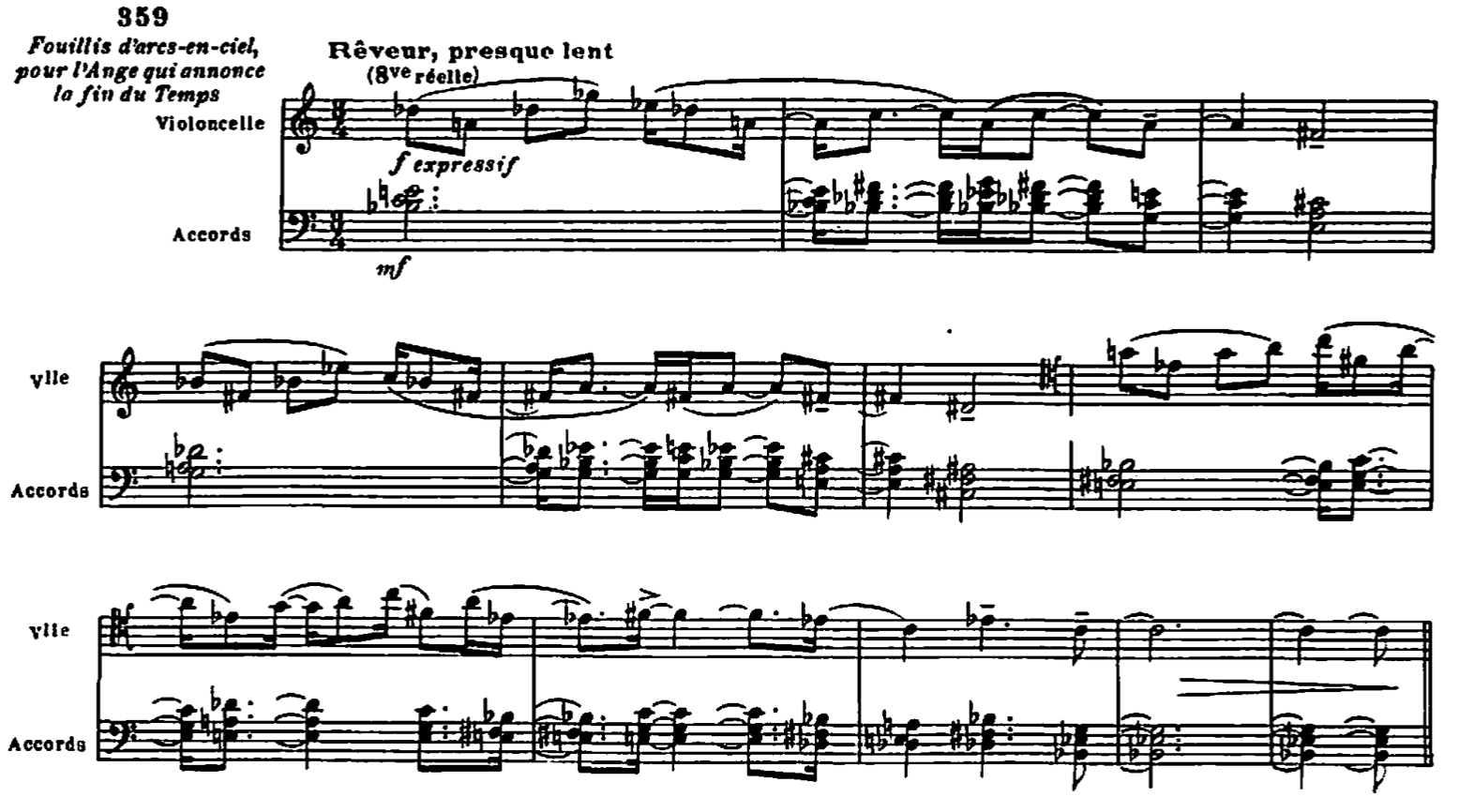
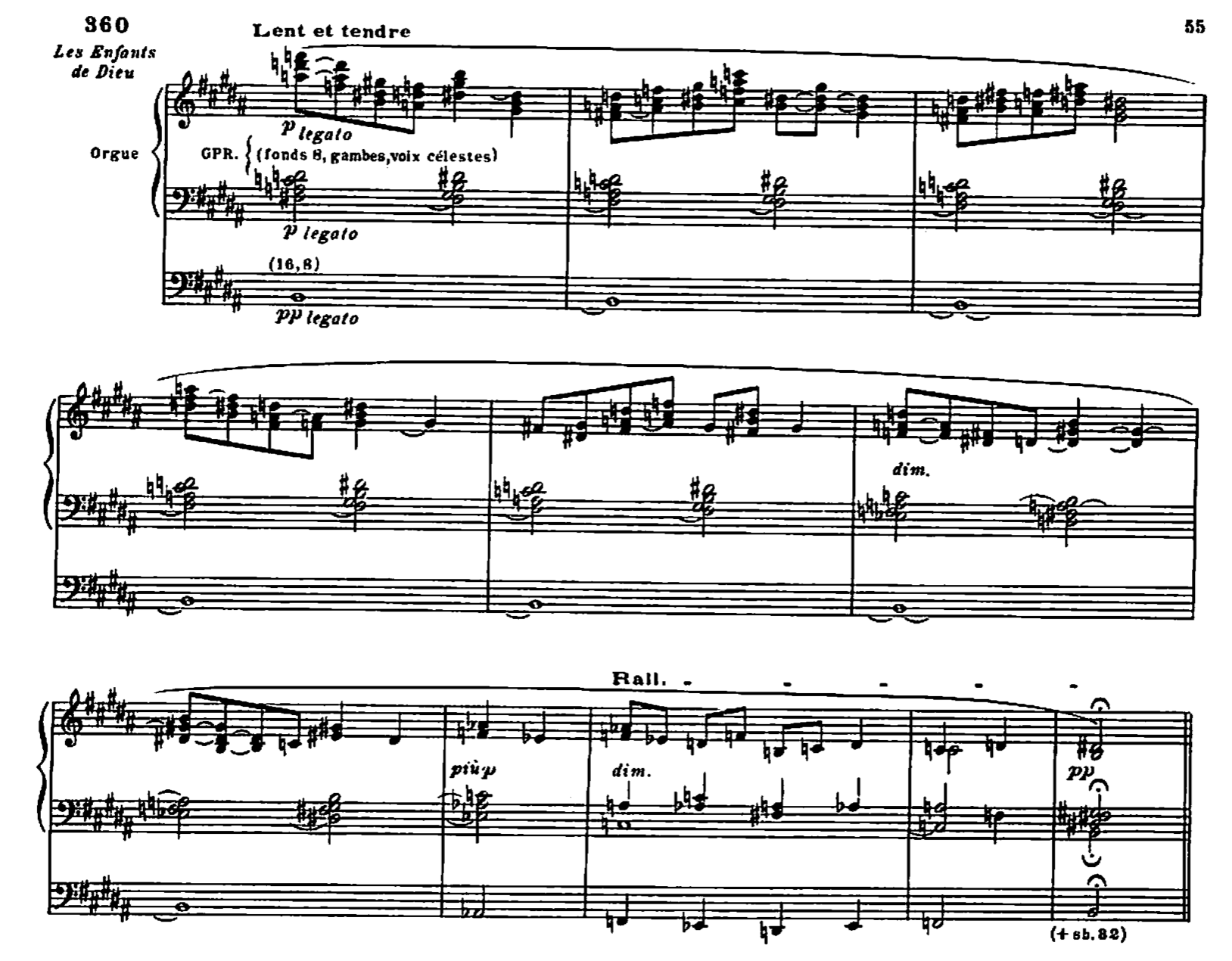
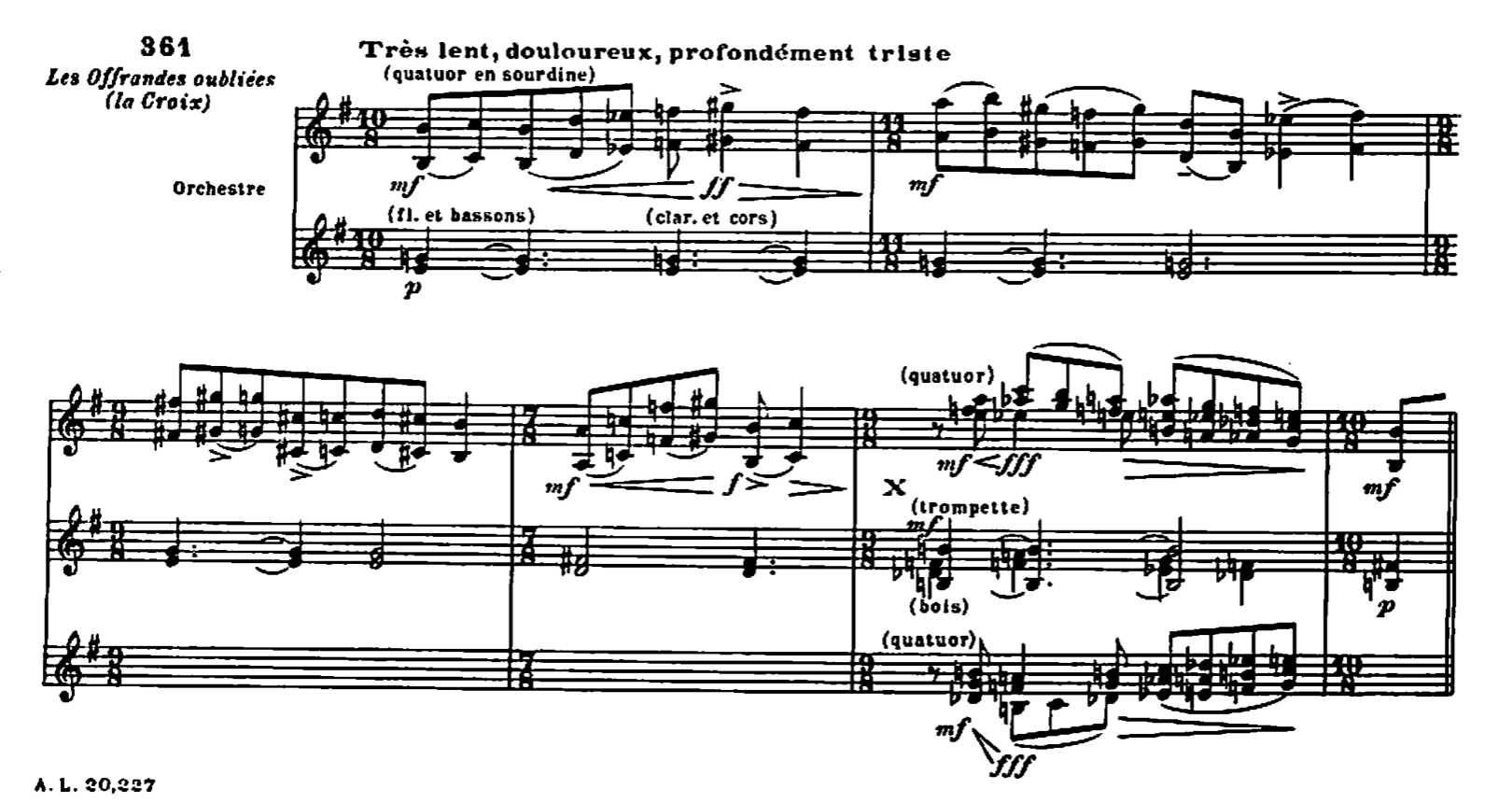
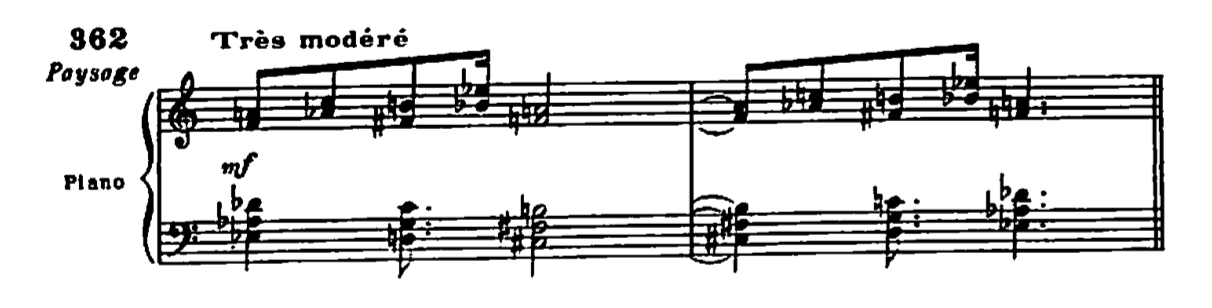
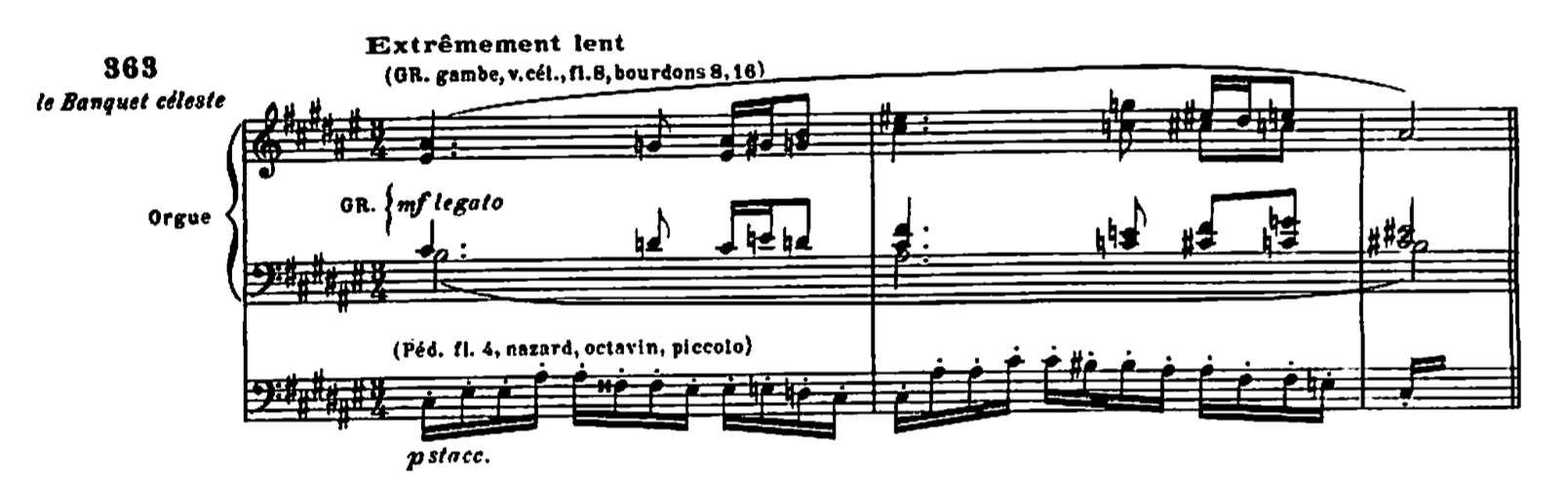



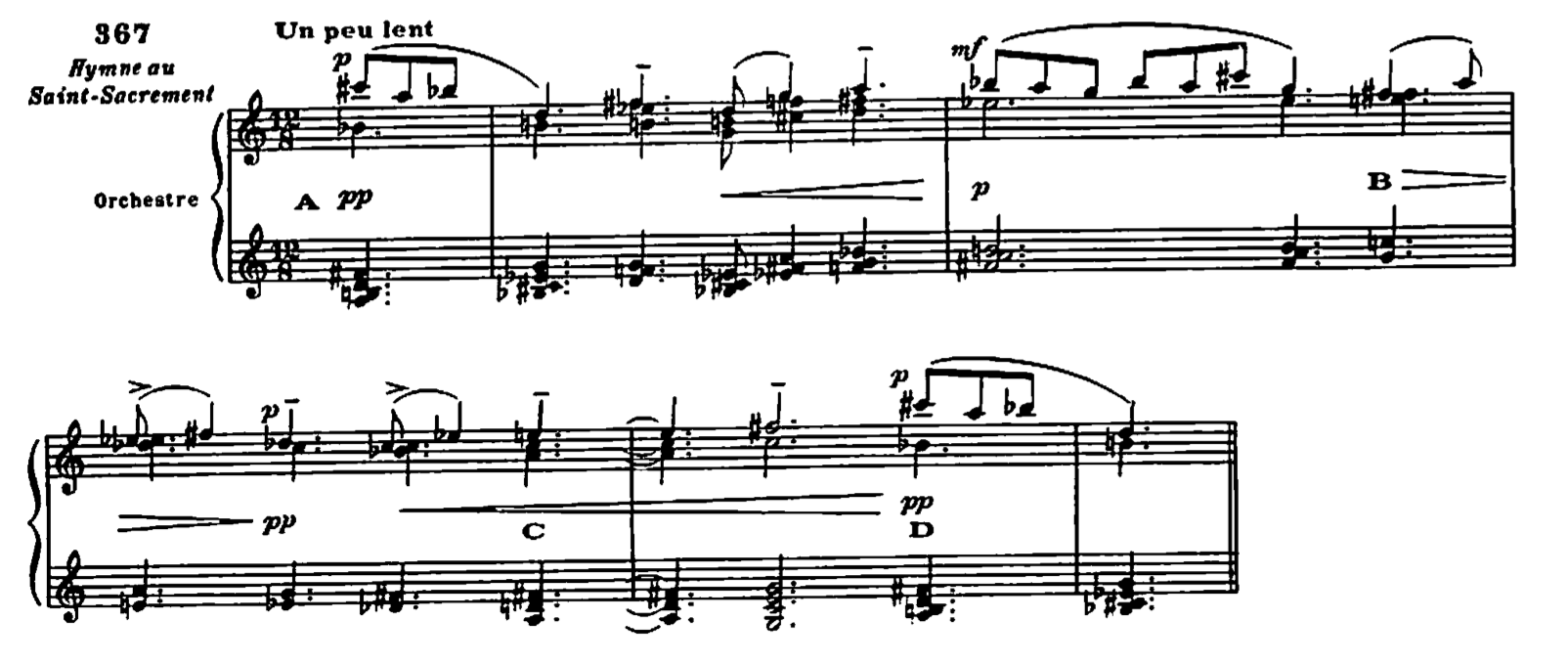
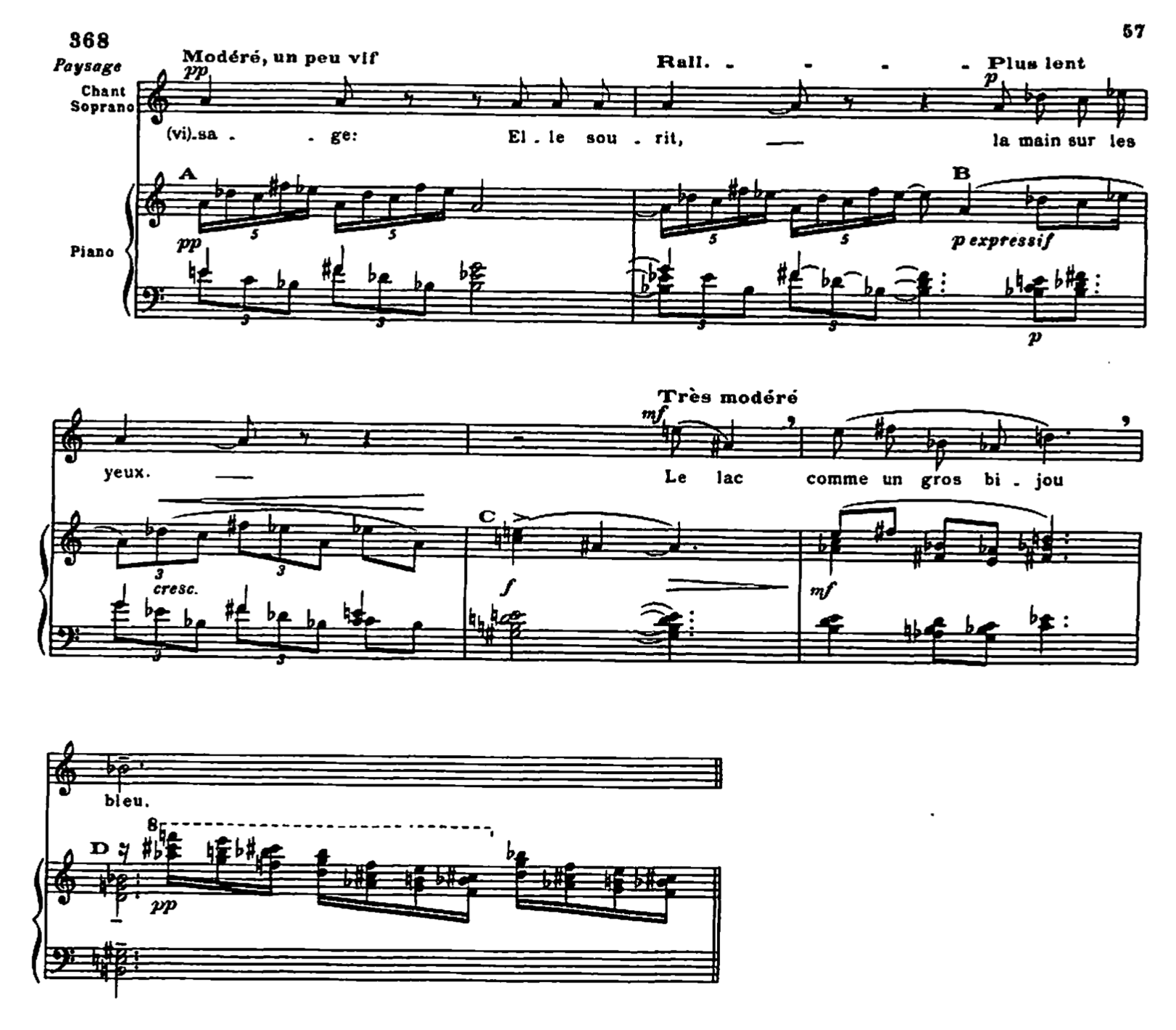
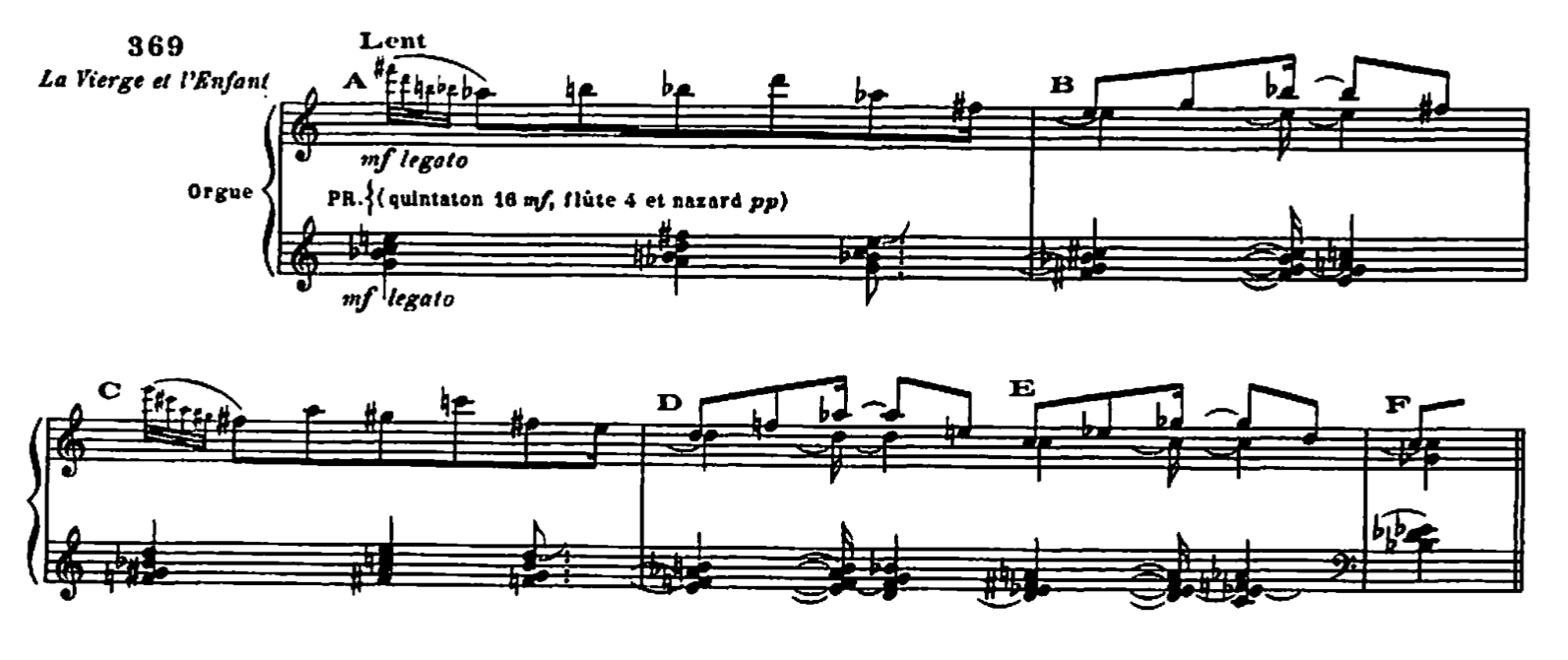
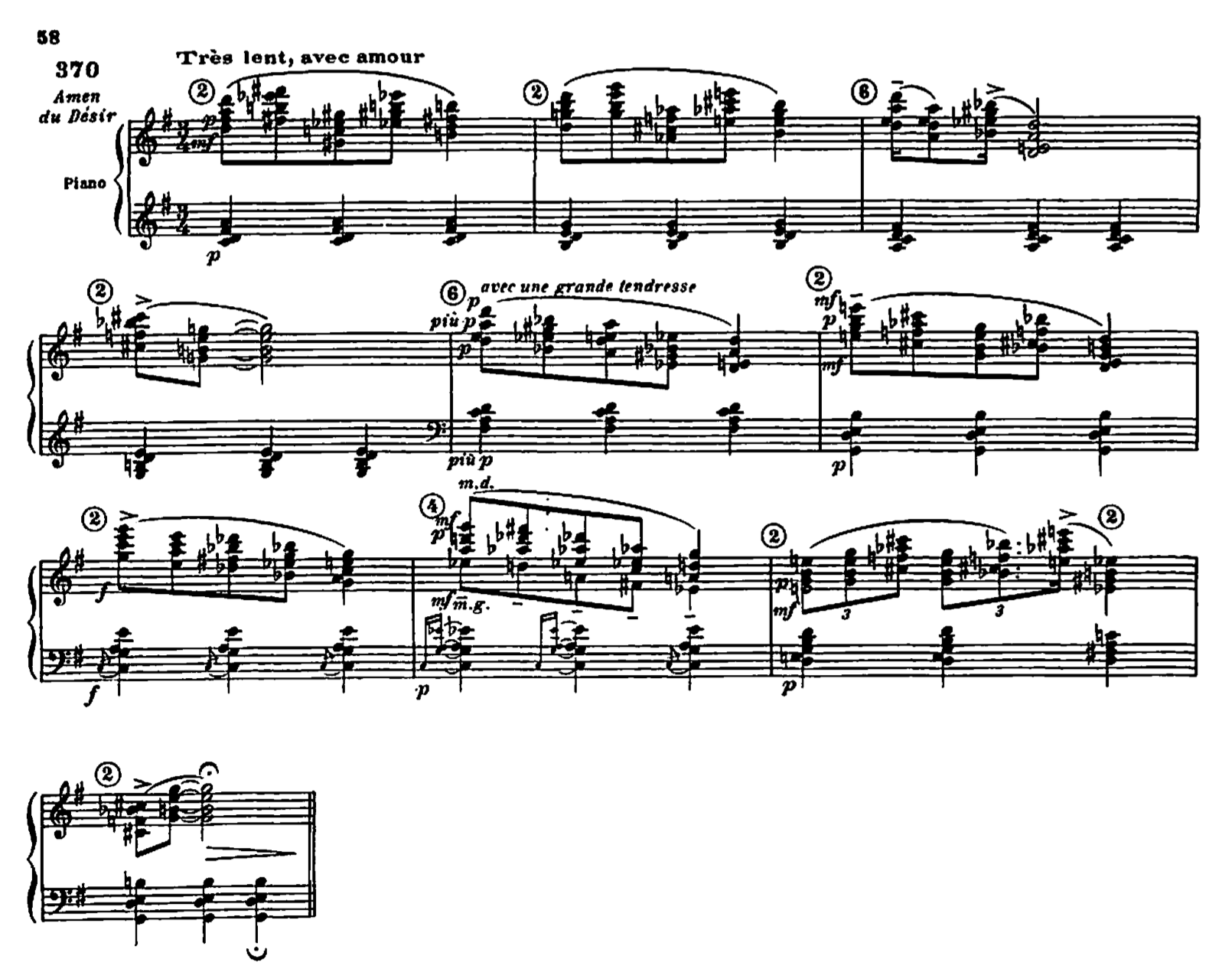
Overview
Chapter XVII addresses the practical question of how Messiaen's modes of limited transpositions interact with traditional tonality and with each other. Despite their symmetrical properties and existence "in the atmosphere of several tonalities at once," these modes can be employed to suggest specific tonal centers through emphasis of particular pitches or through mixing with traditional tonal materials. The chapter demonstrates three types of modal relationships: mixing modes with major tonality, modulation of a mode to itself (changing transposition levels), and modulation from one mode to another. Throughout, Messiaen emphasizes that examples use the chosen mode melodically and harmonically with all notes belonging to the mode, while carefully indicating changes of mode and notes foreign to the mode. The chapter reveals the flexibility of modal practice—modes can function both as autonomous harmonic systems and as elements within larger tonal or multi-modal contexts.
Key Concepts
This chapter introduces three key concepts demonstrating the flexibility of modal practice:
-
Relation to the Major Tonality - The technique of combining modes of limited transpositions with traditional major-key tonality through emphasis or mixing of materials
-
Modulation of a Mode to Itself - The technique of changing transposition levels within a single mode, creating harmonic motion while maintaining the mode's characteristic structure
-
Modulation of a Mode to Another Mode - The technique of moving from one mode to a different mode, creating large-scale harmonic transformation within the modal system
Relation to the Major Tonality
Definition: The technique of combining modes of limited transpositions with traditional major-key tonality, either by emphasizing tonal implications inherent within the mode or by mixing modal and non-modal materials to create tonal orientation while preserving modal coloring.
Messiaen's Treatment: Messiaen reiterates that the modes exist "in the atmosphere of several tonalities at once, without polytonality, the composer being free to give predominance to one of the tonalities or to leave the tonal impression unsettled." Mode 2 in its first transposition (Example 358) can hesitate among the four major tonalities of C, E-flat, F-sharp, and A. Example 359 demonstrates use of this tonal indecision of Mode 2 (same transposition), quoting only the violoncello song and chords while omitting the piano's accompaniment formula. The passage does not leave the mode's notes; three stops on the six-four chords of A, F-sharp, and E-flat major accentuate the unsettledness.
By frequent return of the tonic of the chosen key or by use of the dominant seventh chord in that key (this last means being most efficacious), Messiaen shows how to mix the mode with major tonality (Example 360). This example, written entirely in Mode 2, third transposition, remains in B major, with the holding of B in the bass strongly establishing the tonality (the slurs between common notes concern execution on the organ). In the following paragraph, Example 363 (le Banquet céleste) will demonstrate that nothing is as valuable as the dominant seventh for affirming tonality.
Messiaen also shows how to mix modes with tonalities whose tonics do not appear in the notes of the chosen mode (Example 361). The song of the first two measures uses Mode 2, third transposition; the notes e' and g' (tonic and third) that accompany it do not belong to the mode. Measure X uses Mode 3, second transposition; its expressive and profoundly grievous effort soothes itself on the fifth (b' to f-sharp'), dominant of E, creating tonal impression of E minor. In the same order of ideas, Example 362 presents a small fragment in Mode 2, third transposition, with the b-flat (upper staff) excepted, superposed upon chords made of perfect fourths foreign to the mode (lower staff).
Modern Context: This approach reveals Messiaen's pragmatic flexibility regarding modal purity. While the modes theoretically exist outside traditional tonal systems, practical composition often benefits from suggesting tonal orientation to provide listeners with perceptual anchors. Contemporary neo-Riemannian theory would describe some of these techniques as maximizing common-tone relationships between modal and tonal collections—the octatonic collection shares significant pitch-class content with multiple major and minor keys, allowing smooth voice-leading connections. The emphasis on the dominant seventh chord as the most effective tool for tonal affirmation reflects traditional tonal practice, where the V7–I progression serves as the strongest cadential gesture. Messiaen's willingness to mix modal and non-modal materials anticipates later practices in jazz (where modal and tonal elements freely combine) and in film music (where composers regularly blend modal colors with functional harmony to achieve specific dramatic effects). The technique also demonstrates that Messiaen's modes function as compositional resources rather than rigid systems—they can be deployed flexibly according to expressive and formal needs.
Examples: Examples 358–362
Modulation of a Mode to Itself
Definition: The technique of changing transposition levels within a single mode, creating harmonic motion while maintaining the mode's characteristic intervallic structure and sonority. This process functions analogically to traditional modulation between keys but operates within the constraints of symmetrical pitch collections.
Messiaen's Treatment: Messiaen explains that modes can modulate to themselves or borrow from themselves in their different transpositions. Example 137 from Chapter XI (Les Offrandes oubliées), in which Mode 2 borrows from itself in almost every chord, bears witness to this technique. Example 363 demonstrates another instance: the first measure contains the dominant seventh of F-sharp major in Mode 2, second transposition (Example 364); the second measure presents the perfect chord of F-sharp major in Mode 2, first transposition (Example 365). The e-sharp in the second measure does not belong to the mode, creating very intense tonal impression of F-sharp major and modulation of the mode to itself without the tonality yielding. The pedal, played in droplet-like staccato, sounds an octave above the notation; the true bass is thus in the left hand.
Example 366 provides a last example using exactly the same effect but in more striking fashion: at A, upper staff uses Mode 2, second transposition, with lower staff presenting third inversion of the dominant seventh chord of F-sharp major; at B, upper staff uses Mode 2, first transposition, with lower staff presenting first inversion of the perfect chord of F-sharp major.
Modern Context: This technique parallels what contemporary theory might call "transposition within a pitch-class set" or "rotational transformation." However, Messiaen's approach emphasizes perceptual continuity—the mode's characteristic sound remains recognizable despite transposition, while the change of pitch level creates a sense of harmonic motion analogous to traditional modulation. In jazz theory, similar techniques appear when improvisers or arrangers transpose octatonic or other symmetrical collections to create harmonic progression while maintaining modal consistency. The concept also relates to what theorists call "hexatonic" or "octatonic cycles," where systematically transposing symmetrical collections creates networks of harmonic relationships. Messiaen's specific examples show how modal transposition can be coordinated with traditional tonal materials (dominant seventh chords, perfect triads) to create hybrid harmonic progressions that combine modal color with tonal direction. The technical challenge lies in managing the transition between transposition levels—since the modes contain only certain pitch classes, moving from one transposition to another necessarily involves changing some pitches, and Messiaen demonstrates how to make these changes feel natural rather than disruptive. The pedal-point technique (sustained or reiterated bass) helps smooth these transitions by providing continuous tonal orientation even as upper voices change modal transposition.
Examples: Examples 363–366 (with reference to Example 137 from Chapter XI)
Modulation of a Mode to Another Mode
Definition: The technique of moving from one mode of limited transpositions to a different mode, creating large-scale harmonic transformation while maintaining the principle of symmetrical pitch organization. This process allows composers to access different harmonic colors and intervallic structures while remaining within the modal system.
Messiaen's Treatment: Messiaen demonstrates modulation from the third mode to the second mode (Example 367): at A, third mode in fourth transposition; at B, second mode in first transposition; at C, major tonality; at D, third mode. General impression of G major arises from frequent return of the tonic G and from the dominant seventh at letter C.
Example 368 shows modulation from the second mode to the third mode: from A to C, second mode in first transposition; at B, cadence formula of this mode (referencing Chapter XVI, Example 321); at C, third mode in first transposition; at D, second mode in second transposition.
Example 369 presents alternation of the third mode and the second mode in progression. At A, third mode; at B, second mode; at C, third mode; at D, second mode. At E, second mode transposed; at F, another transposition of the second mode.
Example 370 demonstrates modulation from Mode 2 to Modes 6 and 4. Melodic contours resemble Mozart. The harmonies of the lower staff are simple and tonal; the modes mingled there suffice to communicate infinite tenderness and divine love. The numerals indicate the modes: moving successively through Mode 2 (third transposition), Mode 2 (second transposition), Mode 6, Mode 2, Mode 6, Mode 2 (second transposition), Mode 2 (first transposition), Mode 4, Mode 2 (second, then third, then second transpositions). It is evident that the passage remains in G major.
Modern Context: Inter-modal modulation represents sophisticated harmonic practice, requiring careful voice-leading to manage transitions between collections with different intervallic structures and pitch-class content. Contemporary set theory would analyze these modulations by examining common-tone relationships and voice-leading efficiency between the source and target collections. Some mode pairs share significant pitch-class overlap (for instance, certain transpositions of Mode 2 and Mode 3 might share multiple pitches), facilitating smooth transitions. Other combinations require more dramatic harmonic shifts.
The integration of multiple modes within a single passage (as in Example 370) creates what later theorists might call "patchwork" or "mosaic" form—sections using different harmonic materials juxtaposed to create larger structures. However, Messiaen maintains that these passages can still project clear tonal orientation (Example 370 "is evident that we are in G major") through strategic emphasis of tonal centers and use of traditional harmonic functions. This demonstrates the compatibility of modal and tonal thinking in Messiaen's practice—modes provide harmonic color and intervallic interest, while tonal principles provide large-scale orientation and structural coherence.
The comparison to Mozart in Example 370 is particularly revealing—Messiaen suggests that Classical-era melodic fluency and simplicity can be achieved using modal harmonies, provided the modes are deployed with sensitivity to voice-leading and tonal implication. This contradicts potential assumptions that modal harmony necessarily produces modernist, dissonant, or anti-traditional effects. Instead, Messiaen demonstrates that modes can serve expressive goals (communicating "infinite tenderness and divine love") traditionally associated with tonal music, offering composers expanded harmonic resources without requiring abandonment of expressive clarity or melodic grace.
Examples: Examples 367–370
Relationship to Other Chapters
Chapter XVII directly extends the theoretical foundation established in Chapter XVI, demonstrating practical applications of the modes in contexts requiring tonal orientation or modal variety. The mixing of modes with major tonality connects to discussions of added notes (Chapter XIII) and special chords (Chapter XIV), showing how modal and tonal materials can be combined within single passages. The modulation techniques relate to the "list of connections of chords" in Chapter XIV, paragraph 8, providing additional strategies for harmonic progression. The chapter anticipates Chapter XVIII's discussion of the modes' relationship to various contemporary harmonic systems (modal, atonal, polytonal) and Chapter XIX's systematic treatment of polymodality, where multiple modes operate simultaneously. References to le Banquet céleste (Example 363) and Les Offrandes oubliées (Example 137) demonstrate how these modulation techniques function in actual compositions. The flexibility demonstrated here—modes as both autonomous systems and elements within tonal contexts—reflects the broader aesthetic principle articulated in Chapter I, where Messiaen advocates for technical resources that serve rather than dictate expressive intentions.
Summary
Chapter XVII demonstrates the practical flexibility of Messiaen's modes of limited transpositions through three types of modal relationships: mixing modes with major tonality, modulating a mode to itself through transposition changes, and modulating between different modes. Despite their symmetrical properties and theoretical existence outside traditional tonality, the modes can suggest specific tonal centers through emphasis of particular pitches, use of traditional harmonic functions (especially dominant seventh chords), or mixture with non-modal materials. The chapter reveals that modal practice in Messiaen's hands remains pragmatic rather than dogmatic—modes function as harmonic resources that can be deployed in various contexts according to compositional needs, whether to provide coloristic enrichment within tonal frameworks, to create harmonic motion through transposition, or to access diverse harmonic palettes through inter-modal modulation. This flexibility distinguishes Messiaen's modal practice from more rigid systematic approaches, allowing the modes to serve expressive and formal goals while maintaining their characteristic symmetrical properties and distinctive sonorities.
Chapter XVIII: Relation of These Modes to Modal, Atonal, Polytonal, and Quarter-Tone Music
Original: Page 67 in Satterfield translation
Musical Examples: References to Examples 182, 310 from previous chapters
Overview
Chapter XVIII positions Messiaen's modes of limited transpositions within the landscape of early twentieth-century compositional approaches, distinguishing his system from traditional modal music, atonality, polytonality, and quarter-tone systems. The chapter is brief but conceptually significant, clarifying what the modes are not while affirming what they uniquely accomplish. Messiaen argues that his modes differ fundamentally from historical modal systems (Indian, Chinese, Greek, plainchant) in their basis on symmetrical structure rather than scalar tradition. He distinguishes his approach from atonality by demonstrating how modes can suggest tonal centers while maintaining their distinctive character. He differentiates his practice from polytonality by emphasizing that modes create "the atmosphere of several tonalities at once, without polytonality"—a subtle but important distinction where the modal force absorbs potential polytonal implications. Finally, he acknowledges the theoretical possibility of modes of limited transpositions in quarter-tone systems while declining to explore this territory, noting it would require extensive separate treatment.
Key Concepts
This chapter introduces four key concepts positioning the modes within contemporary compositional practice:
-
Distinction from Traditional Modal Systems - Clarification that Messiaen's modes differ fundamentally from historical modal systems based on scalar traditions transposable twelve times
-
Relation to Atonal Music - The relationship between Messiaen's modes and atonal compositional practices, showing how modes can suggest tonal centers
-
Relation to Polytonal Music - The crucial distinction between polytonality and Messiaen's modal practice, which creates "the atmosphere of several tonalities at once, without polytonality"
-
Quarter-Tone Music - Acknowledgment of theoretical possibility that modes of limited transpositions could exist in microtonal systems, though Messiaen declines to explore this territory
Distinction from Traditional Modal Systems
Definition: The clarification that Messiaen's modes of limited transpositions differ fundamentally from historical modal systems—including those of India, China, ancient Greece, and plainchant—which are based on scalar traditions transposable twelve times within the octave.
Messiaen's Treatment: Messiaen explicitly states that his modes have nothing in common with the three great modal systems of India, China, and ancient Greece, nor with modes of plainchant (which derive from Greek modes). All these different modes constitute what he calls "modal music," and his modes can be opposed to them or mixed with them. In paragraph 8 of Chapter XII, Example 182 ("le Verbe") demonstrates this mixing, combining the second mode of limited transpositions (the song) with tonal harmonies and the seventh mode of plainchant (the mode on G).
Modern Context: This distinction addresses a potential misconception—that Messiaen's "modes" simply represent another contribution to the long history of modal composition extending from medieval plainchant through folk music traditions to the modal jazz of the 1950s-60s. Instead, Messiaen emphasizes that his modes arise from a fundamentally different principle: symmetry and limited transposability rather than scalar tradition or cultural convention. Historical modes (Dorian, Phrygian, Mixolydian, etc., and their non-Western counterparts) are all transposable twelve times—they represent rotations or selections from the chromatic collection rather than symmetrical subsets. Contemporary theory would distinguish between diatonic modality (based on the seven-note diatonic collection and its rotations) and symmetrical modality (based on collections with transpositional limitations). Messiaen's modes belong exclusively to the latter category. This distinction also clarifies that despite the name "modes," Messiaen's system does not invoke historical modal practice's characteristic melodic formulas, cadential patterns, or hierarchical pitch relationships. The possibility of mixing his modes with traditional modal music (as in Example 182) demonstrates their compatibility as harmonic resources, even though they arise from different organizational principles.
Examples: Example 182 (Chapter XII)
Relation to Atonal Music
Definition: The relationship between Messiaen's modes and atonal compositional practices, particularly the distinction between modal harmony (which can suggest tonal centers) and systematic atonality (which avoids tonal reference).
Messiaen's Treatment: Example 310 of Chapter XV ("le Mystère de la Sainte Trinité") demonstrates how Messiaen mixes his modes with atonal music. The principal melody, given to the intermediate voice, is written in the second mode of limited transpositions (third transposition for the first measure, first transposition afterwards). The upbeat and terminations of the upper voice, and the rhythmic pedal of the bass, are written in atonal style, creating a general sensation of the key of D.
Modern Context: The term "atonal" in 1944 carried different connotations than it might today. Messiaen likely refers to freely chromatic writing outside any modal or tonal system—passages using all twelve pitch classes without systematic organization. The example demonstrates that atonal elements can coexist with modal materials within a single texture, provided voice-leading and registral differentiation maintain clarity. The claim that this combination creates "general sensation of the key of D" reveals Messiaen's conviction that even in contexts mixing modal and chromatic materials, tonal orientation remains perceptible through strategic emphasis. Contemporary theory might describe this as "centric" rather than "tonal" music—music projecting a pitch center without employing functional harmony. The combination of modal melody with atonal accompaniment anticipates techniques in later twentieth-century music where composers layer materials from different harmonic systems to create complex textures. This approach differs fundamentally from the systematic atonality of the Second Viennese School (Schoenberg, Berg, Webern), where avoidance of tonal reference constitutes a primary compositional goal. Messiaen's practice remains more eclectic, employing atonal passages as coloristic resources rather than adhering to atonal principles systematically.
Examples: Example 310 (Chapter XV)
Relation to Polytonal Music
Definition: The crucial distinction between polytonality (the simultaneous presentation of multiple distinct tonal centers) and Messiaen's modal practice, which creates "the atmosphere of several tonalities at once, without polytonality."
Messiaen's Treatment: Messiaen reiterates that the modes offer listeners the atmosphere of several tonalities at once, without polytonality—a statement previously made in Chapter XVI. The chords and combinations of notes that the modes generate can be made equivocal with polytonal sonorities, but the modal force always absorbs them. By polymodality (discussed in Chapter XIX), multiple modes are superposed, and again, the listener perceives the coexistence of polytonal aggregations completely absorbed by the chosen polymodality.
Modern Context: This represents one of Messiaen's most subtle theoretical distinctions. Polytonality—as practiced by composers like Milhaud, Stravinsky, or Bartók—typically involves simultaneously presenting materials clearly identified with different key areas (for instance, C major in one hand against F-sharp major in the other). The effect is of two or more tonal streams operating independently. Messiaen argues that his modes produce something fundamentally different: because they exist outside any single tonality while containing pitch subsets that suggest multiple tonalities, they create harmonic ambiguity rather than polytonal juxtaposition. The "modal force" absorbs potential polytonal implications, meaning listeners perceive a unified (if ambiguous) harmonic field rather than competing tonal centers.
Contemporary theory might describe this using concepts from neo-Riemannian analysis or pitch-class set theory: the modes function as common ground containing multiple potential tonal interpretations without committing to any single one. An octatonic collection, for instance, contains diminished seventh chords pointing toward four different keys, yet the collection itself doesn't assert any of these keys—it hovers among them. This differs from polytonal juxtaposition, where distinct key areas are simultaneously asserted. The distinction matters aesthetically: polytonality often creates harmonic tension or humor through the clash of incompatible tonalities, while modal ambiguity creates mysteriousness, suspension, or what Messiaen calls "the atmosphere of several tonalities." The promise that Chapter XIX will demonstrate polymodality (superposition of multiple modes) suggests that even when distinct modal layers operate simultaneously, the result still differs from polytonal practice—modes absorb and unify rather than clash and separate.
Examples: Discussed conceptually; demonstrations reserved for Chapter XIX
Quarter-Tone Music
Definition: Acknowledgment of the theoretical possibility that modes of limited transpositions could exist in microtonal systems dividing the octave into units smaller than semitones, particularly quarter-tone systems, though Messiaen declines to explore this territory in detail.
Messiaen's Treatment: Messiaen briefly mentions (recalling Chapter XVI, article 1) that the tempered quarter-tone system, advocated by composers Haba and Wischnegradsky, offers a series of modes of limited transpositions that continues the series Messiaen has presented. He cites one example: a scale of eight sounds in three-quarters of a tone, where each degree forms with its neighbor an interval of three-quarters of a tone or a neuter second (smaller by a quarter tone than the major second). This system comprises twenty-four sounds, twenty-four intervals, twenty-four transpositions—entirely new melodies and chords requiring special notation and special instruments. Messiaen states he cannot extend himself further on this question, which alone would fill several treatises.
Modern Context: Quarter-tone composition remained relatively marginal in Messiaen's time and has continued as a specialized practice rather than mainstream development. Composers like Alois Hába, Ivan Wyschnegradsky, Julian Carrillo, and later Easley Blackwood explored systematic microtonal divisions of the octave. Messiaen's insight—that symmetrical pitch collections with limited transposability can exist in any equal-tempered system—demonstrates mathematical understanding of the underlying principles. Just as twelve-tone equal temperament yields seven modes of limited transpositions (the maximum number possible in that system), twenty-four-tone equal temperament would yield its own set of symmetrical collections with analogous properties.
Contemporary microtonal composers and theorists have explored these relationships systematically, discovering that any equal division of the octave generates characteristic symmetrical subsets. The number and types of these subsets depend on the divisor's factors—systems with more factors (like 24, which is divisible by 2, 3, 4, 6, 8, and 12) yield more symmetrical collections than systems with fewer factors. Messiaen's decision not to pursue quarter-tone composition reflects practical concerns—in 1944, quarter-tone instruments remained rare, notation unstandardized, and performance traditions undeveloped. His focus on twelve-tone equal temperament reflected the overwhelming dominance of that system in Western art music. The brief mention serves primarily to delimit his treatise's scope rather than to advocate for microtonal exploration. It also demonstrates Messiaen's awareness of contemporary experimental practices even when choosing not to adopt them in his own work.
Examples: Discussed conceptually only; no musical examples provided
Relationship to Other Chapters
Chapter XVIII serves an important clarifying function, positioning the modes within contemporary compositional discourse. It directly references Chapter XVI's theoretical foundation while distinguishing Messiaen's approach from other twentieth-century harmonic systems. The examples of mixing modes with traditional modal music (Example 182 from Chapter XII) and atonal music (Example 310 from Chapter XV) demonstrate the flexibility of modal practice already explored in Chapter XVII. The discussion of polytonality anticipates Chapter XIX's treatment of polymodality, where the distinction between these concepts will be demonstrated through practical examples. The brief mention of quarter-tone systems connects to the mathematical completeness emphasized in Chapter XVI—the seven modes represent all possible modes of limited transpositions within twelve-tone equal temperament, just as quarter-tone systems would yield their own complete set. Throughout, the chapter reinforces the fundamental aesthetic principle from Chapter I: Messiaen's modes create a distinctive harmonic atmosphere—"the charm of impossibilities"—that differs from all other contemporary approaches while remaining compatible with them in various combinations.
Summary
Chapter XVIII positions Messiaen's modes of limited transpositions within the landscape of early twentieth-century compositional practice by clarifying what they are not. The modes differ fundamentally from traditional modal systems (Indian, Chinese, Greek, plainchant) through their basis in symmetrical structure rather than scalar tradition. They differ from atonality by maintaining capacity to suggest tonal centers while offering distinctive harmonic colors. They differ from polytonality through a subtle but crucial distinction: rather than juxtaposing incompatible tonal centers, the modes create "the atmosphere of several tonalities at once, without polytonality"—the modal force absorbs potential polytonal implications into unified harmonic fields. Finally, Messiaen acknowledges that analogous systems of limited-transposition modes could exist in quarter-tone systems but declines to explore this territory, focusing instead on the complete set of seven modes available within twelve-tone equal temperament. This brief but conceptually dense chapter establishes Messiaen's modal practice as distinctive from other contemporary approaches while demonstrating its compatibility with various harmonic systems through judicious mixing and combination.
Chapter XIX: Polymodality
Original: Pages 68–70 in Satterfield translation
Musical Examples:
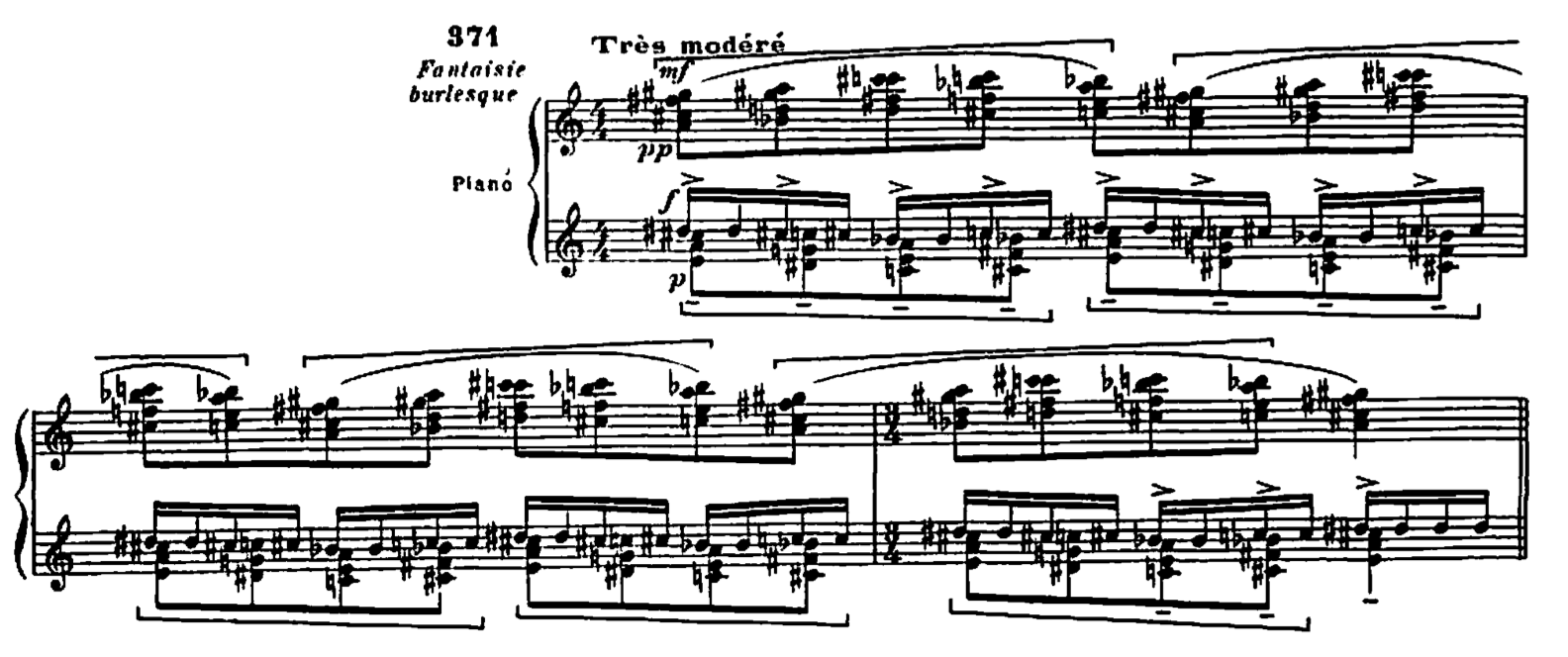


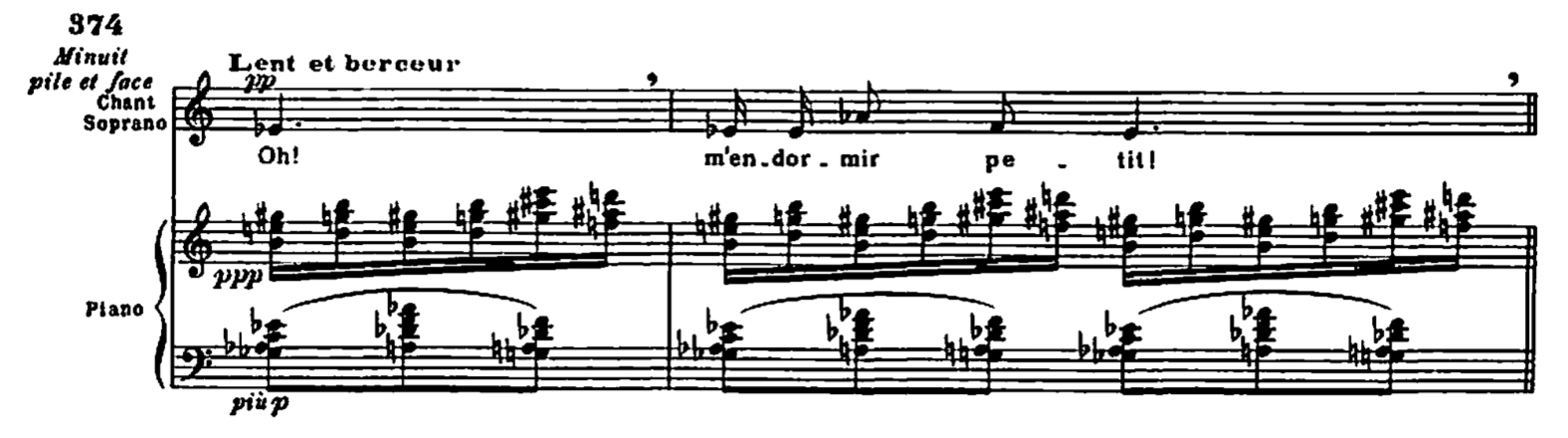
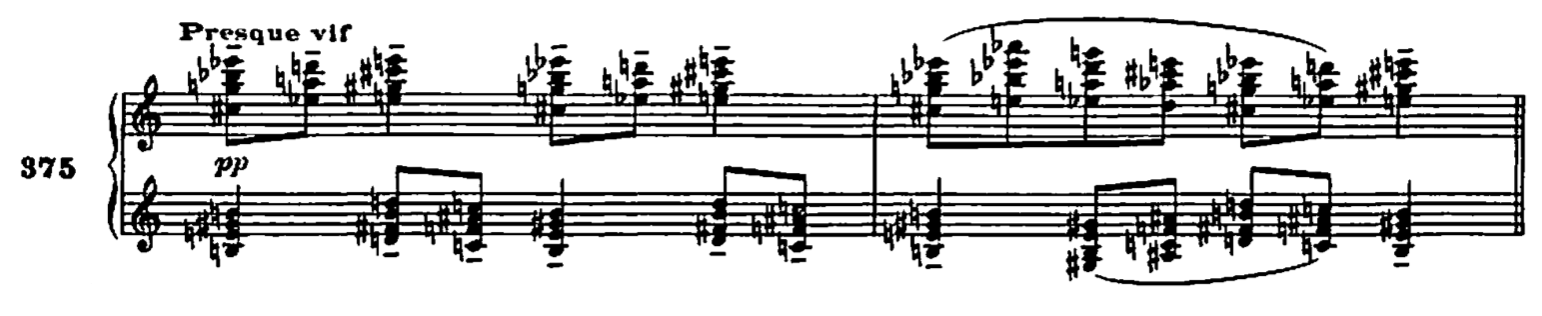
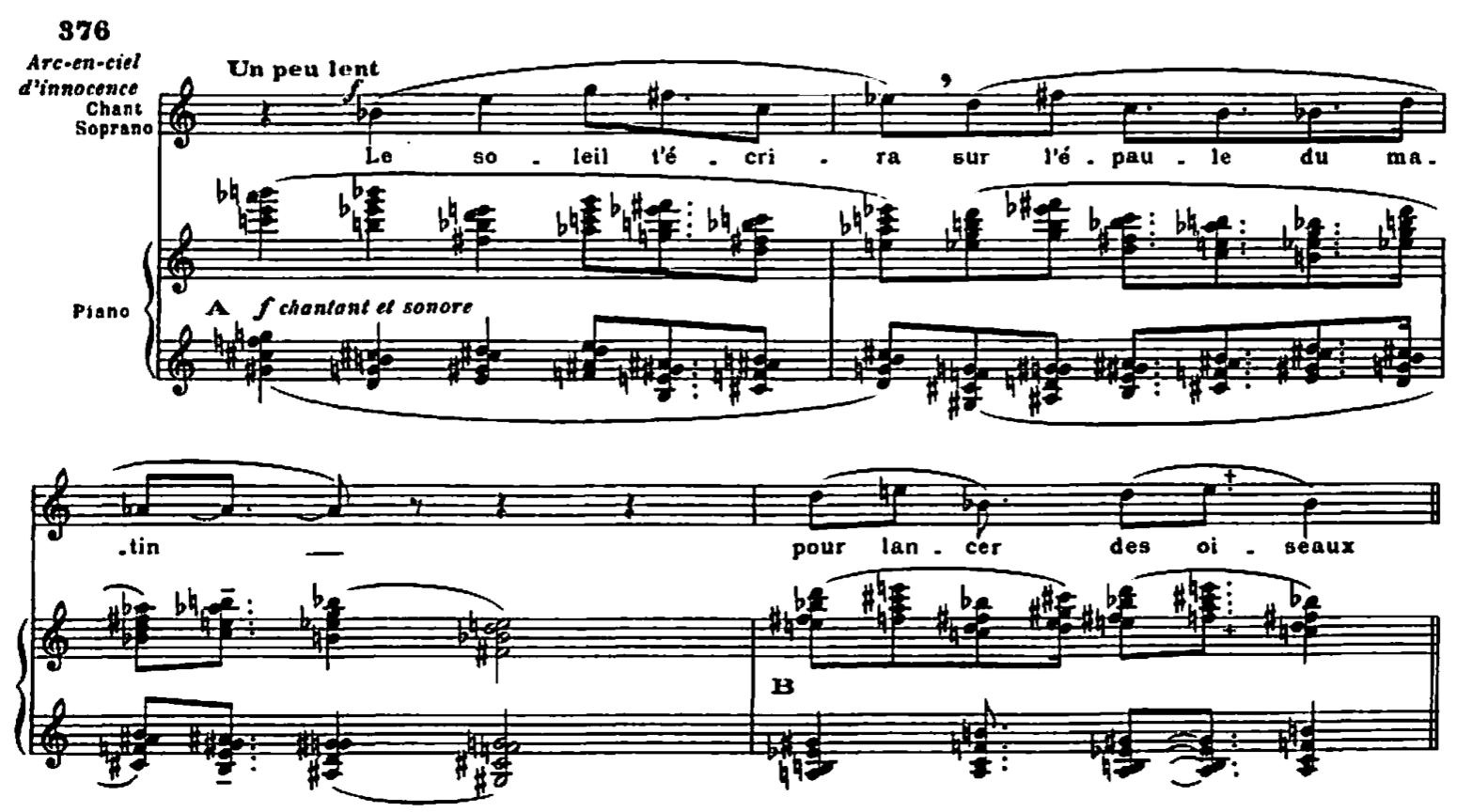
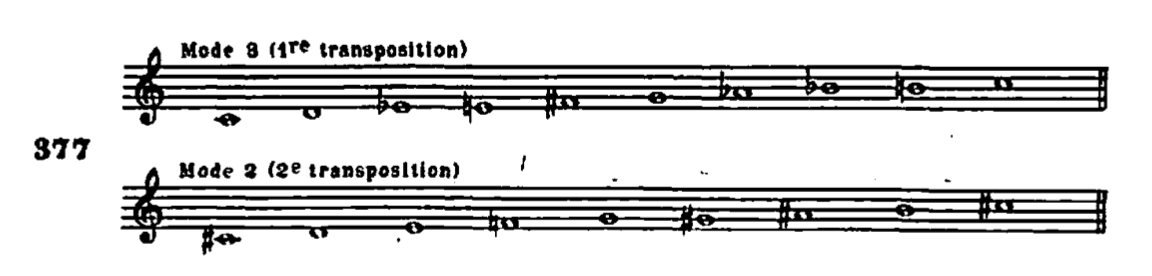
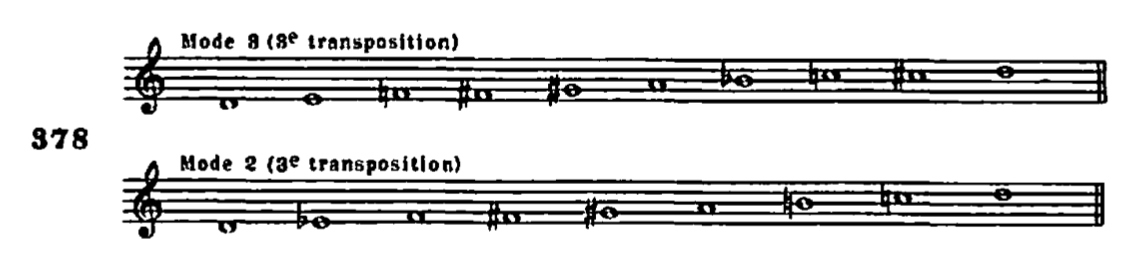

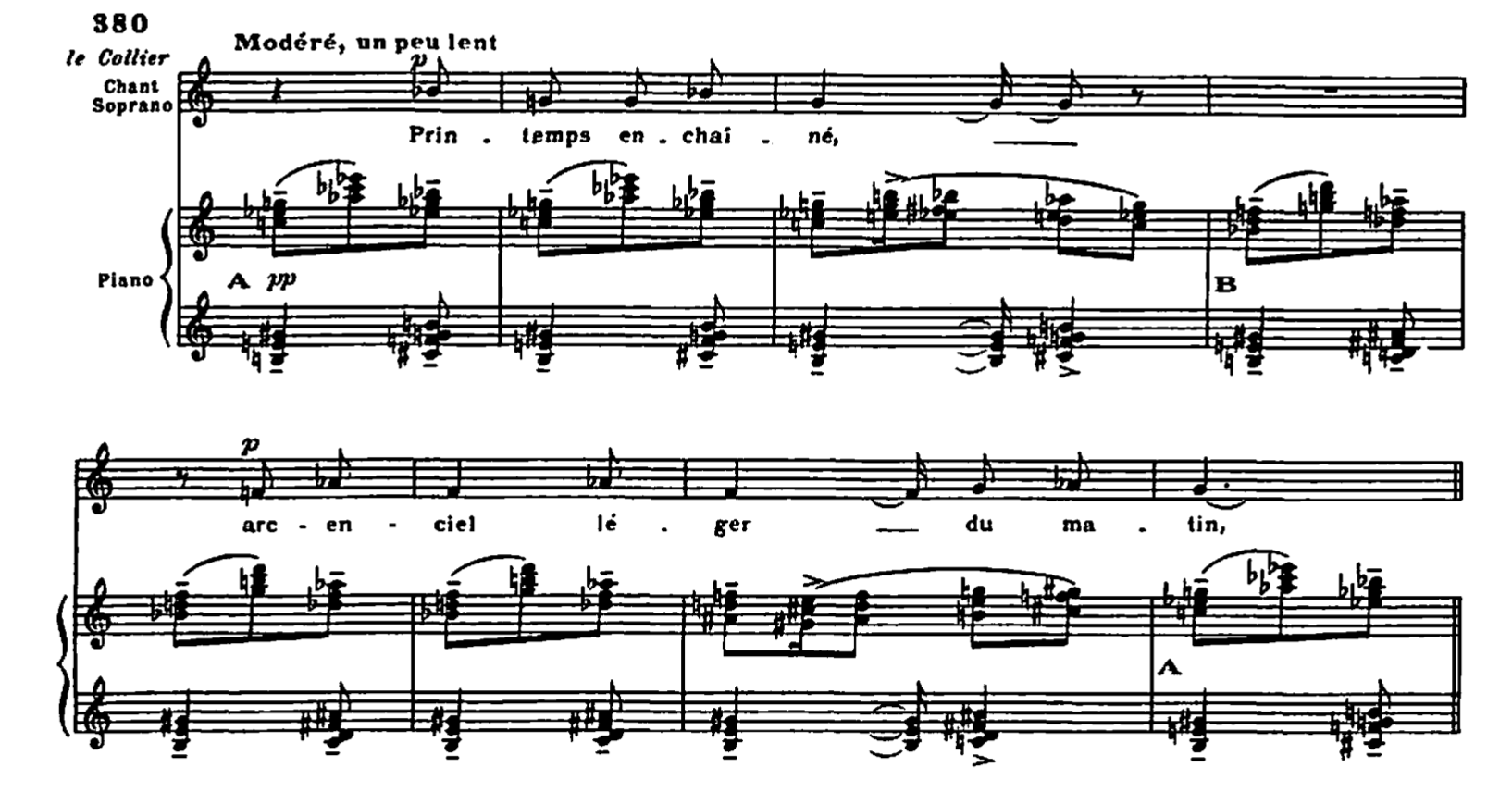

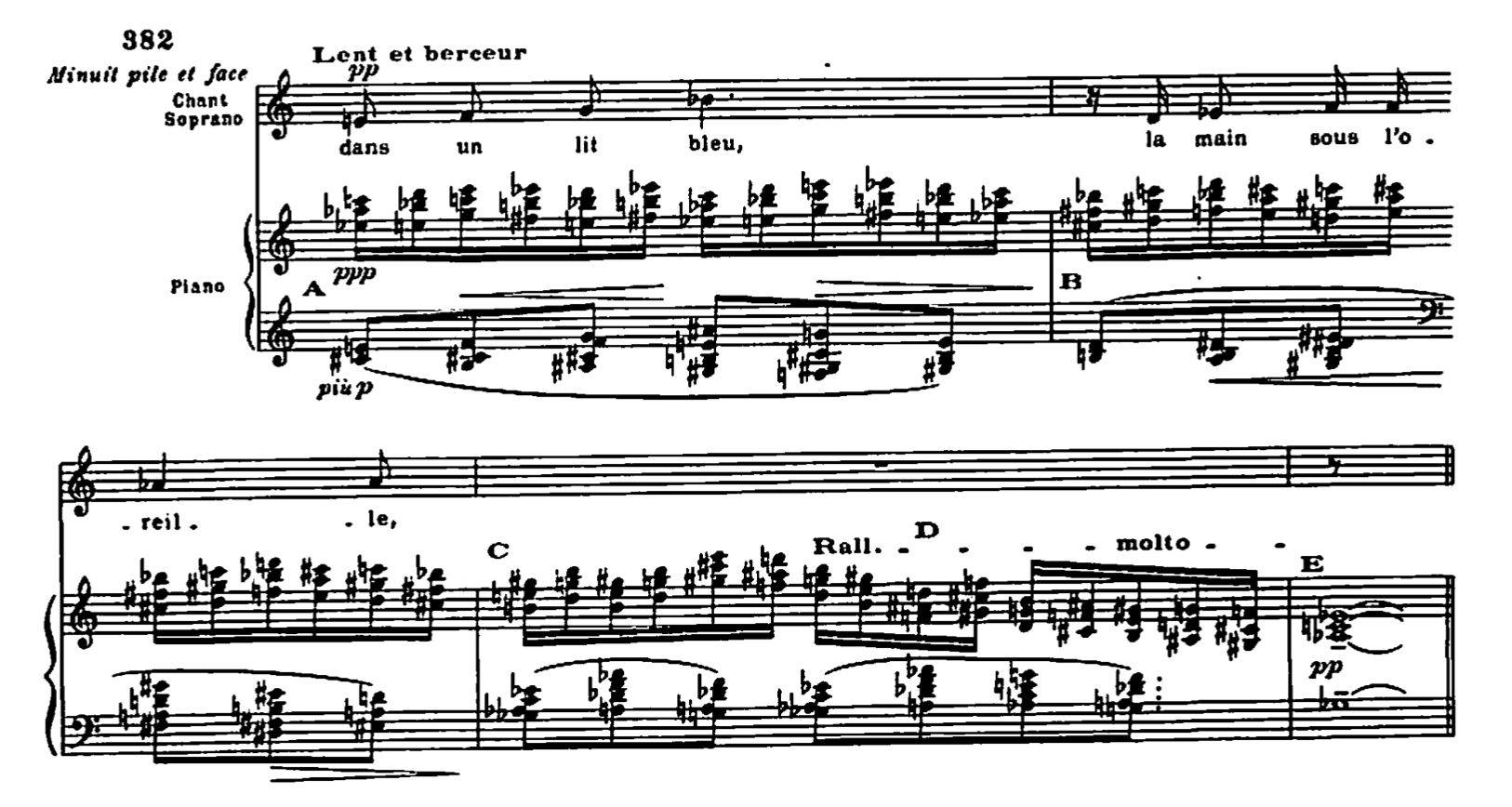
Overview
Chapter XIX concludes the treatise's harmonic section by presenting polymodality—the superposition of multiple modes of limited transpositions operating simultaneously in different voices or textural layers. This technique represents the culmination of Messiaen's modal practice, demonstrating how the modes can be combined to create complex harmonic textures while maintaining the clarity and distinctive character of each constituent mode. The chapter emphasizes that in polymodal passages, each staff uses its assigned mode both melodically and harmonically, with all notes belonging to that mode. Messiaen explores polymodal combinations systematically, beginning with two superposed modes, advancing to three-mode superpositions, and concluding with polymodal modulation where the modal combinations themselves change over time. Throughout, the chapter demonstrates that polymodality differs fundamentally from polytonality: rather than creating the clash of incompatible key areas, superposed modes produce unified harmonic fields with distinctive coloristic properties, their "modal force" absorbing potential polytonal implications into coherent sonic atmospheres.
Key Concepts
This chapter introduces four key concepts culminating Messiaen's harmonic practice:
-
Polymodality: Definition and Principle - The simultaneous superposition of two or more different modes of limited transpositions, with each textural layer operating within its assigned mode
-
Two Superposed Modes - The fundamental polymodal texture, consisting of two different modes operating simultaneously in different textural layers
-
Three Modes Superposed - An expansion of polymodal technique to three simultaneous modal layers, creating highly complex vertical sonorities
-
Polymodal Modulation - The technique of transitioning from one polymodal combination to another, representing the highest level of modal-harmonic organization
Polymodality: Definition and Principle
Definition: The simultaneous superposition of two or more different modes of limited transpositions (potentially at different transposition levels), with each textural layer or staff operating within its assigned mode for both melodic and harmonic purposes. This creates stratified harmonic textures where each layer maintains modal consistency while combining to produce complex vertical sonorities.
Messiaen's Treatment: Messiaen establishes the chapter's scope immediately: all examples will concern only modes of limited transpositions, demonstrating either the superposition of these modes (polymodality) or the connection of one polymodality to another (polymodal modulation). The fundamental principle: in each example, the modes are used melodically and harmonically, meaning that when Messiaen designates "upper staff, such and such a mode," all notes of the upper staff belong to that mode, and similarly for "lower staff, such and such a mode," all notes of the lower staff belong to that mode. This strict modal consistency within each layer distinguishes polymodality from freer approaches where modes might function only melodically or where pitch materials mix less systematically.
Modern Context: Polymodality represents a systematic approach to textural stratification based on pitch-class organization. Contemporary theory might describe this technique using concepts from transformational theory or voice-leading spaces—each layer occupies its own modal "space" while the combined texture creates a resultant harmonic field. The technique anticipates later developments in textural composition, particularly in the music of composers like Ligeti (whose micropolyphony involves similar superposition of distinct pitch collections), Carter (whose simultaneous streams employ different harmonic materials), and Lutosławski (whose aleatory counterpoint superimposes independent harmonic layers). What distinguishes Messiaen's approach is the systematic basis in symmetrical pitch collections—each mode possesses distinctive intervallic properties and limited transposability, ensuring that polymodal combinations maintain coherence rather than devolving into undifferentiated chromaticism. The restriction that all notes within each layer belong to the assigned mode creates compositional discipline while allowing substantial harmonic complexity through the vertical combination of modal layers. This differs from freely chromatic stratification where layers might employ any pitch materials without systematic constraints.
Examples: Principle demonstrated throughout Examples 371–382
Two Superposed Modes
Definition: The fundamental polymodal texture, consisting of two different modes of limited transpositions (or the same mode at different transposition levels) operating simultaneously in different textural layers, typically distributed between upper and lower staves or between different instrumental or vocal forces.
Messiaen's Treatment: Messiaen notes that several superpositions of modes have already appeared in preceding chapters, providing multiple examples of two-mode polymodality. He references Chapter VI, article 4, Example 49 ("Action de grâces"), which superposes Mode 3 (second transposition) upon Mode 2 (first transposition), except for the last measure which uses Mode 6, creating a modulation from polymodality to modality—this fragment serves as a model of rhythmic canon.
Example 302 from Chapter XV, article 1 ("Les sons impalpables du rêve") superposes Mode 3 (third transposition) upon Mode 2 (first transposition), with the upper staff music constituting a model of pedal group. Another example presents repetitions of a fragment of five chords in Mode 3 (third transposition) in the upper staff, with repetitions of a fragment of four chords in Mode 2 (first transposition) in the lower staff. These two pedal groups of unequal length repeat one above the other until meeting again at the point of departure (Example 371).
The following example proceeds from the same principle with this difference: the pedal groups undergo rhythmic variants. Upper staff presents repetitions of a fragment of seven chords in Mode 3 (third transposition); lower staff presents repetitions of a fragment of five chords in Mode 2 (first transposition). This second fragment is abbreviated at each repetition; its total duration is of ten, then nine, then seven, then five eighth-notes (Example 372).
Additional two-mode superpositions include: Mode 3, first transposition (upper staff), upon Mode 2, second transposition (lower staff), with the second measure transposing the polymodality a tone lower (Example 373); Mode 2, second transposition (upper staff of the piano), upon Mode 7, first transposition (song and lower staff of the piano) (Example 374); Mode 4, third transposition (upper staff), upon Mode 6, first transposition (lower staff) (Example 375). Messiaen also references Chapter XIV, article 4, Example 217 ("Cloches d'angoisse et larmes d'adieu"), which superposes Mode 6, first transposition (cluster of chords B), upon Mode 2, second transposition (cluster of chords C).
Modern Context: Two-mode polymodality creates what contemporary set theory would analyze as the union of two distinct pitch-class collections. Depending on which modes are superposed and at which transposition levels, the resultant aggregate can range from near-chromatic saturation (if the modes share few common tones) to more restricted collections (if they share substantial pitch-class overlap). The technique of using pedal groups of unequal length (as in Examples 371–372) creates phasing or minimalist-like effects where the rhythmic relationship between layers constantly shifts—the layers gradually move in and out of synchronization, creating evolving vertical sonorities even though each layer internally remains consistent. This anticipates techniques later systematized by composers like Steve Reich and Philip Glass, though Messiaen's application remains more harmonically complex through the use of distinct modal collections rather than simple melodic patterns.
The rhythmic abbreviation technique (Example 372) demonstrates integration of parametric processes—the lower layer undergoes systematic rhythmic compression (ten, nine, seven, five eighth-notes) while maintaining modal consistency, creating simultaneous harmonic and temporal transformation. Contemporary composers working with process music or algorithmic composition would recognize this as systematic manipulation of multiple musical parameters according to independent procedures. The specific modal combinations chosen (Mode 2 with Mode 3 appears frequently, as do Mode 2 with Mode 6, Mode 2 with Mode 7, Mode 4 with Mode 6) suggest that Messiaen found these particular unions produced especially rich or characteristic sonorities, though he doesn't explicitly articulate principles for selecting compatible mode pairs.
Examples: Examples 371–375 (with references to Examples 49, 217, 302 from previous chapters)
Three Modes Superposed
Definition: An expansion of polymodal technique to three simultaneous modal layers, creating highly complex vertical sonorities while maintaining the principle that each layer operates consistently within its assigned mode.
Messiaen's Treatment: Messiaen references Chapter VI, article 3, Example 43 ("l'Ange aux parfums"), which superposes three rhythmic pedals—the second being the retrograde of the first, the third being nonretrogradable. This example unites polyrhythm and polymodality, using Mode 2, first transposition in the upper staff; Mode 3, third transposition in the middle staff; and the whole-tone scale (Mode 1) in the lower staff. This last mode is transformed by the polymodal sonority, excusing its use, which is otherwise forbidden in Messiaen's language (as established in Chapter XVI).
Modern Context: Three-mode polymodality approaches chromatic saturation—the union of three distinct modal collections typically contains ten or eleven of the twelve available pitch classes, leaving little "outside" material. This creates extremely dense harmonic textures while maintaining theoretical distinction from free chromaticism through the systematic modal organization of each layer. The integration of polyrhythm with polymodality (as in Example 43) demonstrates Messiaen's holistic compositional approach where rhythmic and harmonic stratification reinforce each other—distinct temporal layers correlate with distinct pitch-class layers, creating multi-dimensional structural independence.
The "rehabilitation" of the whole-tone scale (Mode 1) through polymodal combination reveals an important principle: materials Messiaen considers overused or clichéd when employed in isolation can regain freshness and interest when embedded in more complex contexts. The polymodal sonority "transforms" or "excuses" the whole-tone scale's presence, suggesting that polymodality functions not merely as additive combination but as transformative interaction—the modes don't simply coexist but mutually modify each other's perceptual effect. Contemporary composers working with spectral techniques or complex harmonic fields would recognize similar phenomena where individual components contribute to emergent sonic properties not predictable from the isolated materials. The rarity of three-mode examples in the chapter (only one is cited) suggests that Messiaen found two-mode textures more practical or musically effective, reserving three-mode combinations for special coloristic effects or particularly dense passages.
Examples: Example 43 (Chapter VI)
Polymodal Modulation
Definition: The technique of transitioning from one polymodal combination to another, creating large-scale harmonic transformation through systematic change of the modal layers, their transposition levels, or both. This represents the highest level of modal-harmonic organization in Messiaen's system.
Messiaen's Treatment: Messiaen distinguishes three cases of polymodal modulation. First case: modulation by a change of transposition of the superposed modes (Example 376). At A, Mode 3, first transposition (voice and upper staff of the piano), upon Mode 2, second transposition (lower staff of the piano)—these are the two constituent modes (Example 377). At B, Mode 3, third transposition (voice and upper staff of the piano), upon Mode 2, third transposition (lower staff of the piano)—these are the two modes (Example 378). Messiaen notes that in the last measure of Example 376, at the cross, the lengthening of the rhythmic descent by addition of the dot, and in its first three measures, the use of the often-quoted rhythmic succession (Example 379).
Second case: modulation by inversion of the superposed modes (Example 380). This fragment was already seen in Chapter III, Example 14, concerning preparation of the rhythmic accent elongated by the added value. It superposes at A, Mode 3, first transposition (upper staff of the piano), upon Mode 2, second transposition (lower staff); at B, Mode 2, second transposition (upper staff of the piano), upon Mode 3, first transposition (lower staff). This second polymodality is exactly the inverse of the preceding. In the last measure of the example, a new inversion occurs: the first polymodality is found again.
Third case: modulation to a different polymodality, using at least one new mode (Example 381). To read this example well, Messiaen provides detailed performance instructions: the pedal part sounds an octave higher than the notation, the true bass is the counterpoint in sixteenth-notes of the left hand, and this true bass has a very particular timbre due to the harmonics (fifth and third) which the mixtures give it. As for the chords of the right hand, the sixteen-foot doubles them at the lower octave. The structural analysis: At A, Mode 3 in the hands (first transposition) over Mode 2 in the pedal (first transposition). At B, the same polymodality lowered a semitone—Mode 3 in the hands (fourth transposition) over Mode 2 in the pedal (third transposition). The sixteenth-notes cause some notes foreign to Mode 3 to be heard; in all fragment B, not a single E natural appears—the union of the two modes using all notes of the chromatic scale except one, the E. The arrival of this note will augment the effect of the following modulation. At C, new polymodality—Mode 2 in the hands (second transposition) over the whole-tone scale in the pedal; the sixteenth-notes repeat the expected E.
Another example of modulation to a different polymodality (Example 382): At A, Mode 3, first transposition (chords in sixteenth-notes), upon Mode 2, second transposition (voice and chords in eighth-notes). At B, the same thing lowered a tone. At C, new polymodality—Mode 2, second transposition (sixteenth-notes), over Mode 7, first transposition (eighth-notes). At D, the same Mode 2 (sixteenth-notes) over Mode 3, second transposition (eighth-notes). At E, chord of the tritone.
Modern Context: Polymodal modulation represents sophisticated harmonic planning operating at multiple hierarchical levels simultaneously. Contemporary analysis might employ transformational networks or voice-leading graphs to model these transitions, examining how pitch-class content shifts between polymodal combinations and evaluating the voice-leading efficiency of the transformations. The three types of polymodal modulation represent distinct transformational operations: (1) transposition of one or both modal layers while maintaining mode identities; (2) exchange of modal assignments between layers (inversion in Messiaen's terminology, though not pitch-class inversion in the modern theoretical sense); (3) substitution of one or more modes with different modes.
The detailed performance instructions for Example 381 (regarding pedal pitch, true bass location, mixture stops, and sixteen-foot doubling) reveal how timbral differentiation supports polymodal clarity—distinct modal layers receive distinct timbres, helping listeners perceive the stratification. The observation that fragment B uses all chromatic pitch classes except E, with E's arrival augmenting the effect of the following modulation, demonstrates Messiaen's awareness of aggregate completion and pitch-class saturation as compositional resources—the single excluded pitch becomes structurally significant through its absence and subsequent appearance.
The progression of polymodal modulation types from simple transposition changes through layer exchange to complete modal substitution parallels traditional tonal modulation techniques ranging from direct modulation (sudden key change) through pivot-chord modulation (shared harmonic element) to sequential or chromatic modulation (gradual transformation). However, Messiaen's polymodal modulations operate with more complex materials—each "key" (polymodal combination) itself consists of multiple modal layers, creating transformations that affect multiple dimensions simultaneously. The final arrival on "chord of the tritone" in Example 382 suggests reduction from polymodal complexity to simpler harmonic material, functioning as cadential simplification analogous to arrival on tonic harmony in tonal music.
Examples: Examples 376–382 (with references to Examples 14 and 379 from previous chapters)
Relationship to Other Chapters
Chapter XIX synthesizes concepts from throughout the treatise, particularly the entire harmonic section (Chapters XIII–XVIII). The modes of limited transpositions established in Chapter XVI provide the foundation, with their characteristic intervallic structures and limited transposability enabling polymodal combinations that maintain coherence rather than dissolving into chromaticism. The modulation techniques from Chapter XVII (modulation of modes to themselves or to other modes) extend to polymodal contexts, where multiple modal layers undergo transformation simultaneously or independently. The distinction from polytonality articulated in Chapter XVIII finds practical demonstration—the polymodal combinations create unified harmonic fields rather than conflicting tonal centers, the "modal force" absorbing potential polytonal implications.
The integration of polymodality with rhythmic techniques pervades the chapter: pedal groups from Chapter XV function polymodally (Examples 302, 371), rhythmic canons from Chapter VI appear in polymodal contexts (Example 49), added values and rhythmic preparation from Chapter III coordinate with polymodal modulation (Examples 14, 376, 379), and polyrhythm from Chapter VI combines with polymodality (Example 43). This demonstrates Messiaen's fundamental compositional principle: all musical parameters—rhythm, melody, harmony—operate according to parallel organizational principles, creating multi-dimensional structural coherence. The frequent references to actual compositions (Les sons impalpables du rêve, Action de grâces, l'Ange aux parfums, Cloches d'angoisse et larmes d'adieu) show how polymodality functions in practical compositional contexts rather than remaining merely theoretical possibility.
Summary
Chapter XIX presents polymodality—the simultaneous superposition of multiple modes of limited transpositions—as the culminating technique of Messiaen's harmonic practice. Beginning with two-mode combinations (the fundamental polymodal texture), advancing through three-mode superpositions (creating maximum harmonic density), and concluding with polymodal modulation (large-scale transformation of modal combinations), the chapter demonstrates systematic approaches to creating complex stratified textures while maintaining the distinctive character of each constituent mode. The technique differs fundamentally from polytonality through the "modal force" that absorbs potential tonal conflicts into unified harmonic atmospheres. Throughout, polymodality integrates with rhythmic procedures—pedal groups, rhythmic canons, added values, polyrhythm—demonstrating Messiaen's holistic approach where all musical parameters operate according to parallel organizational principles. The chapter concludes the treatise's harmonic section by showing how the modes of limited transpositions can be combined and transformed at multiple hierarchical levels, providing composers with resources for creating harmonic complexity and coloristic variety while avoiding both traditional tonal functions and undifferentiated chromaticism. Polymodality thus represents the full realization of the "theological rainbow" Messiaen envisioned—a musical language based on symmetry, impossibility of transposition, and the mysterious charm of existing simultaneously in multiple tonal atmospheres without committing to any single one.
Concept Index
An alphabetical reference to key concepts in Messiaen's Technique of My Musical Language, with chapter locations.
A
Added Notes (Notes Ajoutées) — Ch. XIII : Pitches added to conventional chords that function as integral chord members rather than nonharmonic tones requiring resolution. The added sixth and added augmented fourth are the most characteristic. Debussy is credited with establishing these sonorities as structural elements.
Added Value (Valeur Ajoutée) — Ch. III : A short duration (note, rest, or dot) added to a rhythm, creating asymmetrical augmentation that disrupts metric regularity. The technique produces rhythmic patterns that suggest regularity while constantly evading it. Related conceptually to added notes (Ch. XIII).
Ametrical Music — Ch. II : Music organized by precise durational values rather than regular metric framework. Distinguished from "unmeasured"—ametrical music maintains exact rhythmic precision while avoiding periodic accent patterns.
Amplification — Ch. X : The developmental procedure opposite to elimination—building up material rather than reducing it.
Augmentation — Ch. IV : Proportional scaling of rhythmic values by multiplication. Classical augmentation doubles values (2×); Messiaen extends this to various ratios including dot addition (1.5×) and other fractions.
B
Binary Sentence — Ch. XI : Formal structure alternating theme (A) and commentary (B) in pattern ABAB', where commentary develops thematic fragments through rhythmic, melodic, and harmonic variation.
Bird Song (Style Oiseau) — Ch. IX : Compositional style inspired by avian vocalizations, characterized by rhythmic freedom, melodic unpredictability, ornamental density, and registral extremes. Messiaen emphasizes transformation and interpretation rather than literal transcription.
C
Central Common Value — Ch. V : The durational value or pitch-class functioning as pivot point in palindromic structures, connecting mirrored sections and serving as axis of symmetry.
Charm of Impossibilities (Charme des Impossibilités) — Ch. I, V, XVI : Messiaen's central aesthetic principle: musical pleasure derived from mathematical structures exhibiting internal symmetries that prevent certain transformations—modes that cannot be transposed beyond certain limits, rhythms that read identically forwards and backwards.
Chord in Fourths — Ch. XIV : Harmonic structure built from stacked perfect and augmented fourths, abandoning tertian construction. Contains all notes of Mode 5 of limited transpositions.
Chord of Resonance — Ch. XIV : Harmonic structure derived from the acoustically perceptible overtones of a low fundamental pitch. Connected to Mode 3 of limited transpositions.
Chord on the Dominant — Ch. XIV : Saturated harmonic structure containing all seven pitch-classes of the major scale, functioning as enriched dominant sonority. Subject to "stained-glass window" treatment through varied inversions.
Clusters of Chords — Ch. XIV : Resonance effects created by adding small chord groups above or below principal chords, creating harmonic halos. "Superior resonance" adds pitches above; "inferior resonance" adds pitches below.
Commentary — Ch. XI : Developmental section in sentence forms that varies thematic fragments through rhythmic, melodic, and harmonic transformation. Distinguished from theme by its developmental function.
D
Deforming Prism — Ch. VIII, XI : Messiaen's metaphor for the transformation process through which source materials (folk songs, plainchant, ragas, other composers' techniques) become unrecognizable while retaining structural principles.
Diminution — Ch. IV : Proportional scaling of rhythmic values by division. Classical diminution halves values; Messiaen extends to various ratios including dot withdrawal (×0.667).
Dot Addition/Withdrawal — Ch. IV : Hybrid transformation combining proportional scaling with added values. Adding dots creates 1.5× augmentation; removing dots creates ×0.667 diminution.
E
Elimination — Ch. X : Developmental procedure consisting of repeating a thematic fragment while progressively removing notes, concentrating material toward essential elements. Credited to Beethoven (Fifth Symphony).
Embellishment Group — Ch. XV : Complex ornamental gesture, often realized as extended scalar flourish, that elaborates a single structural pitch while functioning as complete musical unit. Distinguished from upbeat-accent-termination by absence of accent.
Enlargement — Ch. XV : The transformation of traditional single-note dissonances (pedals, passing notes, embellishments) into multi-note structures possessing their own internal rhythmic, harmonic, and melodic organization.
F
Fugue — Ch. XII : Traditional contrapuntal form from which Messiaen retains episode (canonic progression of harmony) and stretto (overlapping entries) while adapting to modal contexts.
G
Gathering into Meter — Ch. VI, VII : Notational practice of organizing ametric polyrhythmic music within conventional metric frameworks for performance practicality, despite contradicting the music's underlying ametric conception.
H
Harmonic Litany — Ch. XIV : Melodic fragment repeated with different harmonizations, creating varied coloristic treatments of same melodic material.
Hindu Rhythm (Deçî-Tâlas) — Ch. II : Rhythmic patterns from Çârngadeva's thirteenth-century catalog, providing source material for Messiaen's rhythmic innovations. Rāgavardhana analyzed to derive principles of added values, augmentation/diminution, and nonretrogradable structure.
I
Inexact Augmentation — Ch. IV : Simultaneous rhythmic layers undergoing different rates of augmentation or diminution, creating complex proportional relationships rather than uniform scaling.
Inferior Resonance — Ch. XIV : Cluster of chords added below principal chord, creating resonance effect. See also Superior Resonance.
Interversion of Notes — Ch. X : Transformational procedure involving reordering pitches within a melodic fragment while maintaining same pitch-class content.
K
Kyrie (Form) — Ch. XII : Plainchant-derived formal structure based on nine invocations (3×3), with tripartite organization reflecting Trinity symbolism.
M
Melodic Cadence Formulas — Ch. VIII : Characteristic melodic patterns functioning as closural gestures, derived from historical models (Moussorgsky, Grieg, Debussy) and adapted to Messiaen's harmonic language.
Melodic Supremacy — Ch. I, VIII : Hierarchical principle that melody constitutes the primary generative element, with rhythm serving melodic development and harmony chosen to fulfill melodic implications—harmony must be "true" (wanted by the melody).
Modes of Limited Transpositions — Ch. XVI–XIX : Symmetrical pitch collections that can only be transposed a limited number of times before reproducing original pitch content. Seven modes exist in twelve-tone equal temperament:
- Mode 1 (Whole-tone): 6 notes, 2 transpositions
- Mode 2 (Octatonic): 8 notes, 3 transpositions
- Mode 3: 9 notes, 4 transpositions
- Modes 4–7: Various structures, 6 transpositions each
N
Natural Harmony — Ch. XIV : Conception of harmony as emerging from acoustic phenomena, pre-existing in nature rather than constructed by theoretical systems.
Nonretrogradable Rhythm — Ch. V : Rhythmic structure that reads identically forwards and backwards due to palindromic organization. Realizes in horizontal (temporal) dimension what modes of limited transposition realize in vertical (pitch) dimension.
P
Parametric Analogy — Ch. I, III, XIII : Structural principle that techniques in one musical domain find analogous application in another: added values (rhythm) ↔ added notes (harmony); polyrhythm ↔ polymodality; nonretrogradable rhythms ↔ modes of limited transposition.
Passing Group — Ch. XV : Enlarged passing-tone structure where entire progressions move between structural harmonic pillars, functioning as single prolonged passing motion.
Pedal Group — Ch. XV : Sustained or repeated musical structure foreign to surrounding harmonic context, possessing its own internal organization while functioning analogically to traditional pedal point.
Plainchant Forms — Ch. XII : Formal structures derived from liturgical chant genres including anthem, alleluia, psalmody, Kyrie, and sequence. Used as models for contemporary instrumental and vocal works.
Polymodality — Ch. XIX : Simultaneous superposition of multiple modes of limited transpositions operating in different textural layers. Distinguished from polytonality—modal force absorbs potential tonal conflicts into unified harmonic atmospheres.
Polymodal Modulation — Ch. XIX : Transition from one polymodal combination to another through: (1) transposition changes, (2) layer exchange, or (3) modal substitution.
Polyrhythm — Ch. VI : Simultaneous layering of multiple independent rhythmic streams, including superposition of unequal lengths, different augmentation rates, rhythm with its retrograde, and rhythmic canons.
Prime Number Groupings — Ch. II, III : Rhythmic patterns organized in prime-numbered quantities (5, 7, 11, 13) that inherently resist subdivision into equal metric units, creating maximal metric dissonance.
R
Rāgavardhana — Ch. II : Specific Hindu rhythm (deçî-tâla #93) analyzed to extract principles of added values, asymmetrical augmentation, and nonretrogradable structure. Conceptual seed for Messiaen's entire rhythmic system.
Registral Change — Ch. X : Developmental technique involving dramatic octave displacement, moving low notes to extreme treble and vice versa. Combined with augmentation creates "crushing power."
Resonance Effects — Ch. XIV : Coloristic techniques adding chord clusters above (superior resonance) or below (inferior resonance) principal harmonies, creating harmonic halos.
Retrograde Rhythm — Ch. V : Temporal reversal of rhythmic pattern, reading from right to left. Distinguished from nonretrogradable rhythms, which are invariant under retrograde operation.
Rhythmic Canon — Ch. VI : Canonic imitation applied to rhythmic material, including canon by addition of the dot (where following voice adds dots to all values) and canon of nonretrogradable rhythms.
Rhythmic Notation — Ch. VII : Four approaches to notating ametric rhythms: (1) exact values without measure; (2) metric changes (Stravinsky method); (3) short measures with rhythmic signs; (4) false meter with exact accentuation.
Rhythmic Pedal — Ch. VI : Rhythm repeating ostinato-fashion, independent of surrounding rhythmic activity. Analogous to harmonic pedal but operating in temporal domain.
Rhythmic Preparations and Descents — Ch. III : Temporal gestures where preparation precedes accent and descent follows it, analogous to melodic upbeats and terminations. Added values modify their character.
S
Sequence (Form) — Ch. XII : Plainchant-derived form where each period is heard twice and all end on same note. Messiaen combines with Hindu raga character and Bach chorale ornamentation.
Song-Sentence (Phrase Musicale) — Ch. XI : Three-period structure: theme (antecedent-consequent), middle period inflected toward dominant, final period as issue of theme. Creates miniature ABA' form.
Stained-Glass Window Effect — Ch. XIV : Coloristic treatment arranging different inversions of a chord over common bass note, creating harmonic halos. Named for visual association with cathedral windows.
Superior Resonance — Ch. XIV : Cluster of chords added above principal chord, creating resonance effect. See also Inferior Resonance.
Superposition of Rhythms — Ch. VI : Layering of rhythmic patterns including: unequal lengths (cycling until realignment), different augmentation forms, rhythm upon its retrograde, and rhythmic canons.
T
Terminal Development — Ch. XII : Developmental section built over understood dominant and tonic pedals, creating climactic conclusion. Messiaen declares recapitulation "obsolete" and emphasizes terminal development as essential.
Ternary Sentence — Ch. XI : Five-part arch structure: theme-consequent-commentary-consequent-theme, creating symmetrical formal organization.
Theological Rainbow — Ch. I, V, XVI : Messiaen's metaphor for the spiritual dimension of his musical language—modes and rhythms embodying divine order and eternal truth through mathematical symmetry and impossible structures.
U
Upbeat-Accent-Termination — Ch. XV : The most expressive combination of foreign notes, consisting of anacrustic preparation (upbeat), moment of arrival (accent), and consequent resolution (termination). Elements may be "immense," separated by rests, or appear independently.
V
Vocalise — Ch. XII : Extended melodic passage without text, derived from alleluia jubilus. Characterized by ornamental freedom and expressive elaboration.
Rhythmic Techniques: Quick Reference
A practical guide to Messiaen's rhythmic innovations.
Core Principle: Ametric Precision
Messiaen's rhythms are ametric but not unmeasured:
- Exact durational values, precisely notated
- No periodic accent patterns or regular barlines
- Organization by pulse multiplication, not metric hierarchy
1. Added Values (Valeurs Ajoutées)
What: Add a small duration (note, rest, or dot) to disrupt symmetry.
How:
- Added note: Insert sixteenth-note into pattern
- Added rest: Insert sixteenth-rest into pattern
- Added dot: Extend one note by half its value
Effect: Creates "delicious limping"—patterns that suggest regularity while constantly evading it.
Example pattern:
Original:    ♩  ♩  ♩  ♩     (4 quarter-notes)
With added:  ♩  ♩. ♩  ♩     (added dot on 2nd note)
Tip: The "original" rhythm rarely appears unmodified—added values are present from the start.
2. Augmentation & Diminution
Classical (Proportional)
All values scale by same factor:
| Operation | Factor | Example |
|---|---|---|
| Double augmentation | 2× | ♩ → 𝅗𝅥 |
| Triple augmentation | 3× | ♩ → 𝅗𝅥. |
| Quadruple augmentation | 4× | ♩ → 𝅝 |
| Halving diminution | 0.5× | ♩ → ♪ |
By Dot Addition/Withdrawal
| Operation | Factor | Effect |
|---|---|---|
| Add dots to all notes | 1.5× | Creates dotted version |
| Remove dots from all notes | 0.667× | Creates undotted version |
Inexact Augmentation
Different voices augment at different rates simultaneously → creates polytempo effect.
3. Nonretrogradable Rhythms
What: Palindromic rhythms that read identically forwards and backwards.
Construction:
- Choose a central value (the axis)
- Build outward symmetrically
- Values at equal distances from center must be identical
Simple example:
♪  ♩  ♪     (short-long-short)
← same →
Complex example:
♪ ♩ ♩. ♩ ♪
  ←──axis──→
Aesthetic significance: Creates sense of timelessness—no inherent beginning or end.
4. Prime Number Groupings
What: Organize rhythms in groups of 5, 7, 11, 13 (prime numbers).
Why: Primes cannot be evenly subdivided, creating maximum resistance to metric assimilation.
Example: Group of 7 sixteenth-notes
- Cannot parse as 2+2+2+1 comfortably
- Cannot parse as 3+3+1 comfortably
- Remains irreducibly "7"
5. Polyrhythm
Superposition of Unequal Lengths
Layer rhythms of different durations; they realign at their least common multiple.
Example: 5 against 7
- Voice A: pattern of 5 sixteenth-notes, repeating
- Voice B: pattern of 7 sixteenth-notes, repeating
- Realign after 35 sixteenth-notes
Superposition of Different Augmentations
Same rhythm at different time-scales simultaneously.
Rhythm Against Its Retrograde
Forward and backward versions sound together.
Rhythmic Canon
- Regular canon: staggered entries of same rhythm
- Canon by dot addition: following voice adds dots (1.5× stretch)
- Canon of nonretrogradables: palindromic material in canon
6. Rhythmic Pedal
What: A rhythm repeating ostinato-fashion, independent of surrounding material.
Function: Creates temporal anchor while other voices move freely—the rhythmic equivalent of a harmonic pedal point.
Can combine with:
- Melodic pedal (repeating pitch pattern of different length)
- Harmonic pedal (repeating chord pattern of different length)
- Creates three-dimensional phasing
7. Rhythmic Preparations & Descents
What: Apply melodic gesture concepts to rhythm.
| Gesture | Rhythmic Realization |
|---|---|
| Preparation (upbeat) | Building tension before accent |
| Accent | Point of arrival |
| Descent (termination) | Dissipation after accent |
Modification by added values:
- Elongated preparation → increased anticipation
- Slackened descent → prolonged resolution
- Retarded final descent → dissipating ending
8. Notation Strategies
First Notation: No Barlines
- Most faithful to ametric conception
- Best for solo or small ensemble
- Performers internalize durations directly
Second Notation: Changing Meters
- Stravinsky's method
- Meter changes match rhythmic accents
- Demanding for conductors
Third Notation: Rhythmic Signs
- Short measures with beat-count numbers
- Special signs indicate beat durations
- Requires ensemble training
Fourth Notation: False Meter
- Regular barlines with syncopation/accents
- Contradicts conception but aids performance
- Most practical for large ensembles
Key principle: Regardless of notation, exact values are non-negotiable.
Transformation Cheat Sheet
| Want to... | Use... |
|---|---|
| Disrupt regularity subtly | Added value |
| Change time-scale proportionally | Classical augmentation/diminution |
| Create non-integer stretching | Dot addition (1.5×) |
| Generate palindrome | Nonretrogradable construction |
| Layer independent tempi | Inexact augmentation |
| Create phasing | Unequal-length superposition |
| Anchor texture | Rhythmic pedal |
| Build/release tension | Preparation-accent-descent |
Historical Sources
| Source | What Messiaen Derived |
|---|---|
| Rāgavardhana (Hindu tāla) | Added values, nonretrogradable structure |
| Greek rhythmic theory | Prime number preferences |
| Stravinsky | Metric change notation |
| Beethoven development | Rhythmic elimination |
The "Charm" Test
A successful Messiaen-influenced rhythm should:
- ✓ Be precisely measurable (not vague)
- ✓ Avoid regular metric accent
- ✓ Contain some asymmetry or "impossibility"
- ✓ Be related to other rhythms by clear transformation
- ✓ Serve expressive purpose (not just technical display)
Melodic Techniques: Quick Reference
A practical guide to Messiaen's melodic language.
Core Principle: Melodic Supremacy
Melody is "sovereign"—the generative element from which rhythm and harmony emerge.
- Harmony must be "true" (wanted by the melody)
- Rhythm remains "pliant," serving melodic development
- The melody teaches you its harmonic needs
1. Preferred Intervals
The Descending Tritone (Augmented Fourth)
- Acoustically justified: 11th partial of harmonic series
- Characteristic resolution: F♯ → C (down, not up)
- Creates distinctive Messiaen gesture
The Descending Major Sixth
- Historical precedent: Mozart's melodic practice
- Connected to added sixth chord
- Open, consonant quality contrasts with tritone
Chromatic Formulas
- Small chromatic inflections within modal contexts
- "Returning" chromatic gestures (Bartók influence)
2. Melodic Contours
Cadential Formulas (from Ch. VIII)
| Type | Derivation | Character |
|---|---|---|
| Three descending notes | Debussy, Moussorgsky | Melancholy, closure |
| Tritone resolution down | Acoustic/modal | Characteristic Messiaen |
| Major sixth descent | Mozart tradition | Lyrical openness |
| Chromatic returning | Bartók influence | Modal inflection |
Contour Types
| Contour | Character | Use |
|---|---|---|
| Ascending | Building tension | Preparation, development |
| Descending | Resolution, closure | Cadences, terminations |
| Arch (up-down) | Complete gesture | Self-contained phrases |
| Circling | Stasis, meditation | Pedal-based passages |
| Disjunct/leaping | Energy, drama | Bird style, climaxes |
3. Source Materials
Plainchant
What to extract: Melodic contours, phrase shapes, modal character How to transform: Reharmonize with modes of limited transposition; apply added values Not to imitate: Actual chant melodies, chant rhythm literally
Hindu Ragas
What to extract: Unexpected contours, ornamental character, characteristic gestures How to transform: Combine with Western rhythmic/harmonic techniques Note: Messiaen's approach is impressionistic, not systematic raga study
Folk Songs
What to extract: Structural principles, interval preferences, phrase organization How to transform: Pass through "deforming prism"—complete transformation Goal: "Destroy resemblance to the model"
Bird Song
What to extract: Rhythmic freedom, melodic unpredictability, ornamental density, registral extremes Process: Transcription → Transformation → Interpretation Not: Literal imitation (birds use microtones; "ridiculous to servilely copy nature")
4. Development Techniques
Elimination
Process: Repeat fragment while progressively removing notes Direction: Complete → reduced → schematic (often single note) Model: Beethoven Fifth Symphony Effect: Concentration, intensification, "crisis"
Theme:        8 notes
First pass:   4 notes (same material, fewer)
Second pass:  2 notes
Final:        1 note or minimal gesture
Interversion
Process: Reorder pitches while maintaining pitch-class content Effect: Same "ingredients," different "recipe" Works well with: Modes of limited transposition (bounded pitch content)
Original:     C - E - G - B♭
Interversion: G - C - B♭ - E
Interversion: B♭ - G - E - C
(etc.)
Change of Register
Process: Extreme octave displacement—low ↔ high Effect: Textural transformation, new character Combined with augmentation: Creates "crushing power"
Original:     c' - e' - g'  (middle register)
Transformed:  c''' - E - g'  (extreme displacement)
5. Sentence Structures
Song-Sentence (ABA')
| Section | Function |
|---|---|
| A: Theme | Antecedent + consequent |
| B: Middle | Development, dominant inflection |
| A': Final | Return, resolution |
Binary Sentence (ABAB')
| Section | Function |
|---|---|
| A: Theme | Statement |
| B: Commentary | Development of A |
| A: Theme | Restatement |
| B': Commentary | Varied development |
Ternary Sentence (ABCBA)
| Section | Function |
|---|---|
| A: Theme | Opening |
| B: Consequent | Answer |
| C: Commentary | Central development |
| B: Consequent | Return |
| A: Theme | Closing frame |
6. Bird Style Characteristics
| Feature | Realization |
|---|---|
| Rhythmic freedom | Irregular groupings, no metric pulse |
| Wide leaps | Unexpected interval jumps |
| Ornamental density | Trills, volleys, rapid figurations |
| Registral extremes | High-register passages |
| Unpredictable contour | Defies melodic expectations |
Key insight: Bird style provides melody freed from human conventions of singability and phrase balance.
7. The "Deforming Prism"
Messiaen's metaphor for transforming sources:
Input: Any melodic material (folk song, raga, plainchant, other composers)
Process:
- Extract structural principle (not surface features)
- Apply personal harmonic language (modes)
- Apply personal rhythmic language (added values, etc.)
- Filter through personal aesthetic
Output: Material that sounds like Messiaen, not like source
Test: Can you identify the source? If easily yes → not enough transformation.
8. Integration with Other Parameters
Melody + Added Values
Apply rhythmic added values to melodic phrases:
- Elongated preparations before melodic peaks
- Slackened descents after climaxes
Melody + Modes
Write melodies using only pitches from chosen mode:
- Mode determines available intervals
- Characteristic mode intervals become melodic fingerprints
Melody Generating Harmony
- Write complete melody first
- Analyze its interval content
- Determine what harmonies it "wants"
- Supply those harmonies (from modes, added-note chords, etc.)
Historical Models Referenced
| Composer | What Messiaen Takes |
|---|---|
| Mozart | Major sixth usage, melodic grace |
| Moussorgsky | Cadential formulas, modal color |
| Debussy | Three-note descents, added-note implications |
| Grieg | Descending gestures |
| Ravel | Melodic contours (through "prism") |
| Bartók | Chromatic formulas, folk integration |
| Berg | Registral displacement |
| Jolivet | Contemporary French style |
Quick Diagnostic
Is your melody "Messiaen-esque"?
- Uses characteristic intervals (tritone, M6)?
- Avoids regular metric accent?
- Fits within a mode of limited transposition?
- Contains some element of unpredictability?
- Can undergo systematic development (elimination, interversion)?
- Suggests its own harmony?
- Transforms sources beyond recognition?
Harmonic Techniques: Quick Reference
A practical guide to Messiaen's harmonic language.
Core Principle: Natural Harmony
Harmony is "pre-existent in the melody, awaiting manifestation"—not constructed but revealed.
- Derived from acoustic resonance (overtone series)
- Serves coloristic and expressive purposes
- Filtered through "sacred instinct of the natural and true"
1. Added Notes
Concept
Traditional nonharmonic tones (passing, neighbor, appoggiatura) become permanent chord members—no preparation or resolution required.
Most Important Added Notes
| Added Note | Interval | Character |
|---|---|---|
| Added sixth | M6 above root | Debussy's signature; warm, open |
| Added augmented fourth | A4/tritone above root | Distinctive tension; Mode 2 chord |
| Both together | 6 + ♯4 | Characteristic Messiaen sonority |
Application
Basic triad:         C - E - G
With added 6th:      C - E - G - A
With added ♯4:       C - E - F♯ - G
With both:           C - E - F♯ - G - A  (Mode 2 chord)
Key insight: Added notes transform chord color without destroying chord identity.
2. Three Special Chords
Chord on the Dominant
Content: All 7 notes of major scale simultaneously Function: Saturated dominant sonority Treatment: "Stained-glass window"—varied inversions over common bass
Contains: C - D - E - F - G - A - B (in C major)
Chord of Resonance
Content: Pitches audible in overtone series of low fundamental Function: Acoustic foundation of "natural harmony" Connection: Yields all notes of Mode 3
Approximates: C - E - G - B♭ - D - F♯ (and higher partials)
Chord in Fourths
Content: Stacked perfect and augmented fourths Function: Quartal alternative to tertian harmony Connection: Contains all notes of Mode 5
Example: C - F - B - E - A
3. Resonance Effects
Superior Resonance
Add cluster of chords above principal chord → upward harmonic "halo"
Inferior Resonance
Add cluster of chords below principal chord → downward harmonic "shadow"
Stained-Glass Window Effect
Multiple inversions of same chord, colored differently, over common bass → kaleidoscopic shimmer
Aesthetic: Named for cathedral windows—colored light through harmony.
4. Modes of Limited Transposition
Quick Reference Table
| Mode | Notes | Transpositions | Character |
|---|---|---|---|
| 1 | 6 | 2 | Whole-tone; "exhausted" |
| 2 | 8 | 3 | Octatonic; most used |
| 3 | 9 | 4 | Near-chromatic; rich |
| 4 | 8 | 6 | Minor 3rd gaps |
| 5 | 6 | 6 | Major 3rd gaps; quartal |
| 6 | 8 | 6 | Whole-tone segments |
| 7 | 10 | 6 | Near-chromatic |
Mode 2 (Octatonic) — The Primary Mode
Pattern: Semitone-Tone-Semitone-Tone-Semitone-Tone-Semitone-Tone Transposition 1: C - C♯ - D♯ - E - F♯ - G - A - B♭
Characteristic chord: Added 6th + augmented 4th Tonal implications: Suggests 4 major keys simultaneously (C, E♭, F♯, A)
Mode 3 — The Second Primary Mode
Pattern: Tone-Semitone-Semitone (×3) Contains: 9 of 12 chromatic pitches
Characteristic chord: Chord of resonance Character: Dense but not chromatic; distinctive gaps
Using Modes Harmonically
- All chord tones must belong to chosen mode
- Melody also stays within mode
- Change transposition for harmonic motion
- Change mode for larger contrast
5. Modal Modulation
Within Same Mode (Change Transposition)
Effect: Harmonic motion while maintaining modal character Example: Mode 2, transposition 1 → Mode 2, transposition 2
To Different Mode
Effect: Change of harmonic color/intervallic structure Example: Mode 2 → Mode 3 (octatonic to nine-note)
Mixing with Tonality
Tools:
- Emphasize specific pitches (tonic, dominant)
- Use dominant seventh chord
- Return frequently to tonal center
Result: Modal color within tonal orientation
6. Polymodality
Definition
Simultaneous superposition of different modes in different layers.
Two-Mode Combinations
Most common; each staff uses different mode (both melodically and harmonically).
Upper staff: Mode 3, first transposition
Lower staff: Mode 2, second transposition
Three-Mode Combinations
Maximum density; three distinct modal layers.
Polymodal Modulation
Change the modal combination over time:
- Transposition change: Same modes, different transposition levels
- Layer exchange: Swap which mode is in which voice
- Modal substitution: Replace one or more modes with different modes
Key Distinction: Polymodality ≠ Polytonality
- Polytonality: Clash of competing key areas
- Polymodality: Unified field; "modal force absorbs" potential conflicts
7. Enlargement of Foreign Notes
Pedal Group
Traditional pedal point → complete repeating musical structure
- Has its own rhythm, melody, harmony
- Functions as single "pedal" analytically
Passing Group
Traditional passing tone → complete harmonic progression
- Moves between structural pillars
- Functions as single "passing" motion
Embellishment Group
Traditional ornament → extended scalar flourish
- "Immense scroll" elaborating single pitch
- Functions as single embellishment
Upbeat-Accent-Termination
The most expressive configuration:
- Upbeat: "Immense" preparation
- Accent: Point of arrival
- Termination: "Immense" resolution
Elements may be separated by rests or appear independently.
8. Chord Connection Strategies
Harmonic Litany
Same melody, different harmonizations on each repetition.
Retrograde Connection
Second chord is retrograde voicing of first.
Parallel Motion
All voices move in same direction (contrary to traditional rules).
Stained-Glass Progressions
Same chord type, different inversions, over pedal bass.
Modal Progression
All chords from same mode; motion by transposition within mode.
9. Relationship to Other Systems
| System | Messiaen's Modes Are... |
|---|---|
| Traditional modes (church, Greek) | Different principle (symmetry vs. scalar tradition) |
| Atonality | Compatible but distinct (modes can suggest centers) |
| Polytonality | Different effect (absorption vs. clash) |
| Quarter-tone systems | Analogous structures exist but unexplored |
Practical Workflow
Starting from Melody
- Write melody using chosen mode
- Identify characteristic intervals
- Build chords from mode's pitch content
- Apply added notes for color
- Consider resonance effects for texture
Starting from Harmony
- Choose mode(s) and transposition(s)
- Build characteristic chords
- Plan progressions (within mode or modulating)
- Add resonance/cluster effects
- Derive melody from harmonic implications
Creating Polymodal Texture
- Assign mode + transposition to each layer
- Ensure each layer is internally consistent
- Check vertical combinations for interest
- Plan any polymodal modulations
- Use timbral differentiation to clarify layers
Quick Diagnostic
Is your harmony "Messiaen-esque"?
- Uses modes of limited transposition?
- Contains added notes (especially 6th, ♯4)?
- Avoids standard functional progressions?
- Creates "atmosphere of several tonalities"?
- Employs coloristic/resonance effects?
- Serves melodic expression?
- Has some "impossible" quality (limited transposition)?
Modes of Limited Transpositions: Quick Reference
Overview
The seven modes of limited transpositions are symmetrical pitch collections that cannot be transposed beyond a certain number of times without reproducing their original pitch content. This "impossibility" of unlimited transposition creates their distinctive harmonic character—existing "in the atmosphere of several tonalities at once, without polytonality."
Mode 1: Whole-Tone Scale
| Property | Value |
|---|---|
| Pitch count | 6 |
| Transpositions | 2 |
| Interval pattern | Tone–Tone–Tone–Tone–Tone–Tone |
| Set class | 6-35 [02468T] |
Character: Maximum symmetry; divides octave into six equal parts. Creates ambiguous, floating harmonies lacking perfect fifths.
Messiaen's assessment: "Exhausted" by Debussy and Dukas; Messiaen avoids except when concealed in polymodal superpositions.
Associated chord: Augmented triad
Mode 2: Octatonic Scale
| Property | Value |
|---|---|
| Pitch count | 8 |
| Transpositions | 3 |
| Interval pattern | Semitone–Tone–Semitone–Tone–Semitone–Tone–Semitone–Tone |
| Set class | 8-28 [0134679T] |
Three transpositions:
- C–C♯–D♯–E–F♯–G–A–B♭
- C♯–D–E–F–G–A♭–B♭–B
- D–E♭–F–F♯–A♭–A–B–C
Character: The most frequently used mode. Suggests four major/minor tonalities simultaneously (in transposition 1: C, E♭, F♯, A). Rich in tritones and minor thirds.
Associated chord: Perfect chord with added sixth and augmented fourth (the characteristic Messiaen sonority)
Tonal implications: Each transposition contains four diminished seventh chords, suggesting four major and four minor keys.
Mode 3
| Property | Value |
|---|---|
| Pitch count | 9 |
| Transpositions | 4 |
| Interval pattern | Tone–Semitone–Semitone (repeated 3×) |
| Set class | 9-12 [01245689T] |
Four transpositions:
- C–D–E♭–E–F♯–G–A♭–B♭–B
- C♯–D♯–E–F–G–A♭–A–B–C
- D–E–F–F♯–G♯–A–B♭–C–C♯
- E♭–F–F♯–G–A–B♭–B–C♯–D
Character: Approaches chromatic saturation (9 of 12 pitches) while maintaining modal identity through characteristic gaps.
Associated chord: Chord of resonance (derived from overtone series)
Mode 4
| Property | Value |
|---|---|
| Pitch count | 8 |
| Transpositions | 6 |
| Interval pattern | Semitone–Semitone–Minor 3rd–Semitone (repeated 2×) |
| Set class | 8-9 [01236789] |
Character: One of the "lesser interest" modes due to greater transposability. Contains characteristic minor third gaps.
Usage: Messiaen employs sparingly; appears in specific coloristic contexts.
Mode 5
| Property | Value |
|---|---|
| Pitch count | 6 |
| Transpositions | 6 |
| Interval pattern | Semitone–Major 3rd–Semitone (repeated 2×) |
| Set class | 6-7 [012678] |
Character: Distinctive major-third gaps create ambiguity between major and minor.
Associated chord: Chord in fourths (quartal harmony)
Associated melodic formula: Specific contour connected to this mode (discussed in Ch. X)
Mode 6
| Property | Value |
|---|---|
| Pitch count | 8 |
| Transpositions | 6 |
| Interval pattern | Tone–Tone–Semitone–Semitone (repeated 2×) |
| Set class | 8-25 [0124678T] |
Character: Contains two tritones; creates whole-tone segments interrupted by semitone clusters.
Usage: Appears in Les Bergers and La Vierge et l'Enfant from La Nativité du Seigneur.
Mode 7
| Property | Value |
|---|---|
| Pitch count | 10 |
| Transpositions | 6 |
| Interval pattern | Semitone–Semitone–Semitone–Tone–Semitone (repeated 2×) |
| Set class | 10-6 [012346789T] |
Character: Near-chromatic (10 of 12 pitches); most pitches of any mode. Minimal gaps create subtle coloring.
Usage: Used in specific passages; referenced in Ch. XIV examples.
Comparative Table
| Mode | Pitches | Transpositions | Intervals per group | Messiaen's "Interest" |
|---|---|---|---|---|
| 1 | 6 | 2 | 6 tones | Low (exhausted) |
| 2 | 8 | 3 | S–T–S–T | High (most used) |
| 3 | 9 | 4 | T–S–S | High |
| 4 | 8 | 6 | S–S–m3–S | Moderate |
| 5 | 6 | 6 | S–M3–S | Moderate |
| 6 | 8 | 6 | T–T–S–S | Moderate |
| 7 | 10 | 6 | S–S–S–T–S | Moderate |
S = Semitone, T = Tone, m3 = minor third, M3 = major third
The Symmetry Principle
All modes share the defining property: internal symmetry creates transpositional limitation.
- Modes divide the octave into equal segments
- Each segment contains the same interval pattern
- After a certain number of transpositions, the same pitch-classes recur
This connects to nonretrogradable rhythms (Ch. V):
- Modes: cannot transpose without repetition → "tonal ubiquity"
- Rhythms: cannot retrograde without identity → "unity of movement"
Both embody the "charm of impossibilities"—structures whose mathematical properties create perceptual effects of suspension, timelessness, and transcendence.
Practical Applications
Melodic Use
All pitches in a melodic line belong to the chosen mode. Characteristic intervals emerge naturally from modal content.
Harmonic Use
All chord tones belong to the mode. Characteristic sonorities:
- Mode 2 → Added sixth + augmented fourth chord
- Mode 3 → Chord of resonance
- Mode 5 → Chord in fourths
Modal Modulation (Ch. XVII)
- To same mode, different transposition: Shifts pitch content while maintaining modal character
- To different mode: Changes intervallic structure and color
- Mixing with tonality: Dominant seventh chords or tonic emphasis create tonal orientation within modal context
Polymodality (Ch. XIX)
Superposing different modes in different textural layers:
- Two-mode combinations: foundational polymodal texture
- Three-mode combinations: maximum harmonic density
- Polymodal modulation: large-scale transformation of modal combinations
Historical Note
Messiaen emphasizes these modes have nothing in common with:
- Indian modal systems (ragas)
- Chinese modal systems
- Greek modes
- Plainchant modes
Those systems are all transposable twelve times within equal temperament. Messiaen's modes are defined precisely by their limited transposability—a fundamentally different organizational principle based on symmetry rather than scalar tradition.
Cross-Reference Tables
This section maps the interconnections across Messiaen's system—the parametric analogies, technique clusters, and conceptual threads that unify rhythm, melody, and harmony.
The Fundamental Analogy: Symmetry Across Parameters
| Rhythm (Horizontal) | Harmony (Vertical) | Shared Principle |
|---|---|---|
| Nonretrogradable rhythms (Ch. V) | Modes of limited transposition (Ch. XVI) | Symmetry creates "impossibility" |
| Added values (Ch. III) | Added notes (Ch. XIII) | Enrichment through supplementation |
| Polyrhythm (Ch. VI) | Polymodality (Ch. XIX) | Independence of simultaneous layers |
| Rhythmic pedal (Ch. VI) | Pedal group (Ch. XV) | Repetition as structural anchor |
The "Charm of Impossibilities" (Ch. I) unifies all:
- Nonretrogradable rhythms → "unity of movement" (beginning and end identical)
- Limited transposition modes → "tonal ubiquity" (multiple tonalities at once)
- Both → "theological rainbow" pointing toward transcendence
Technique Families
The Added/Supplementary Family
| Technique | Domain | Chapter | Effect |
|---|---|---|---|
| Added value | Rhythm | III | Metric displacement, "delicious limping" |
| Added note | Harmony | XIII | Harmonic enrichment, color |
| Dot addition | Rhythm | IV | 1.5× augmentation |
| Added sixth | Harmony | XIII | Characteristic Debussy sonority |
| Added aug. fourth | Harmony | XIII | Mode 2 chord color |
Shared aesthetic: "Somewhat perverse charm" of foreign elements that enrich without destroying identity.
The Symmetry Family
| Technique | Domain | Chapter | Symmetry Type |
|---|---|---|---|
| Nonretrogradable rhythm | Rhythm | V | Temporal palindrome |
| Mode of limited transposition | Harmony | XVI | Pitch-class invariance |
| Central common value | Rhythm | V | Axis of reflection |
| Ternary sentence | Form | XI | Formal arch (ABCBA) |
Shared property: Structure reads same in multiple directions or positions.
The Enlargement Family
| Original | Enlarged Form | Chapter |
|---|---|---|
| Pedal tone | Pedal group | XV |
| Passing tone | Passing group | XV |
| Embellishment | Embellishment group | XV |
| Appoggiatura | Upbeat-accent-termination | XV |
Shared principle: Single-note phenomena become complete musical structures.
Source Material → Technique Derivations
From Rāgavardhana (Ch. II):
Hindu rhythm analysis
    ├── Added values (Ch. III)
    ├── Inexact augmentation (Ch. IV)
    └── Nonretrogradable rhythms (Ch. V)
From Debussy (Ch. XIII, XIV):
Impressionist harmony
    ├── Added notes
    ├── Added sixth chord
    ├── Whole-tone scale (Mode 1)
    └── Stained-glass window effect
From Plainchant (Ch. XII):
Liturgical chant
    ├── Anthem forms
    ├── Alleluia/vocalise
    ├── Kyrie structure (3×3)
    ├── Sequence form
    └── Psalmody
From Bird Song (Ch. IX):
Avian vocalization
    ├── Rhythmic freedom
    ├── Melodic unpredictability
    ├── Ornamental density
    └── Registral extremes
Formal Structures by Type
Development-Based Forms (Ch. XII)
| Form | Structure | Key Technique |
|---|---|---|
| Terminal development | Build to climax over pedals | Elimination, amplification |
| Three-theme development | Themes → final theme emerges | Teleological form |
| Theme 1 variations + Theme 2 developments | Alternating structure | Developmental contrast |
Plainchant-Derived Forms (Ch. XII)
| Form | Structure | Liturgical Origin |
|---|---|---|
| Anthem | Refrain alternating with verses | Antiphonal psalmody |
| Alleluia | Intonation + jubilus + verse | Mass Proper |
| Psalmody | Reciting tone + cadence | Office psalmody |
| Kyrie | 3×3 invocations | Mass Ordinary |
| Sequence | Paired strophes, same final | Medieval sequence |
Sentence Types (Ch. XI)
| Type | Pattern | Periods |
|---|---|---|
| Song-sentence | ABA' | 3 (theme, middle, final) |
| Binary | ABAB' | 4 (theme, commentary alternation) |
| Ternary | ABCBA | 5 (arch form) |
Chord ↔ Mode Connections
| Chord Type | Source Mode | Chapter |
|---|---|---|
| Added sixth + aug. fourth | Mode 2 | XIII, XIV, XVI |
| Chord of resonance | Mode 3 | XIV, XVI |
| Chord in fourths | Mode 5 | XIV, XVI |
| Dominant with all scale tones | Diatonic (not a mode) | XIV |
Rhythmic Transformation Taxonomy
Proportional (Preserves Ratios)
| Operation | Factor | Chapter |
|---|---|---|
| Classical augmentation | 2× | IV |
| Classical diminution | 0.5× | IV |
| Triple augmentation | 3× | IV |
| Quadruple augmentation | 4× | IV |
Non-Proportional (Alters Ratios)
| Operation | Effect | Chapter |
|---|---|---|
| Added note | +1 small value | III |
| Added rest | +1 small rest | III |
| Added dot | +0.5 original | III, IV |
| Dot withdrawal | −0.33 original | IV |
Hybrid (Combines Both)
| Operation | Components | Chapter |
|---|---|---|
| Inexact augmentation | Different rates per layer | IV |
| Augmentation + added value | Proportional + non-proportional | IV |
Melodic Development Operations
| Operation | Effect | Historical Model | Chapter |
|---|---|---|---|
| Elimination | Progressive reduction | Beethoven 5th Symphony | X |
| Interversion | Pitch reordering | Dupré improvisation | X |
| Registral change | Octave displacement | Berg Lyric Suite | X |
| Contrary motion | Melodic inversion | Traditional counterpoint | VIII |
| Retrograde | Temporal reversal | Traditional counterpoint | V, VIII |
Polyrhythmic Textures (Ch. VI)
| Type | Layers | Result |
|---|---|---|
| Unequal lengths | Different periods | Phasing until realignment |
| Different augmentations | Same rhythm, different rates | Tempo stratification |
| Rhythm + retrograde | Forward + backward | Mirror counterpoint |
| Rhythmic canon | Staggered entries | Imitative texture |
| Canon by dot addition | Following voice dotted | 1.5× stretching |
| Canon of nonretrogradables | Palindromic entries | Symmetrical canon |
| Rhythmic pedal | Ostinato layer | Temporal anchor |
The Theological Rainbow: Spiritual Associations
| Technique | Spiritual Meaning |
|---|---|
| Nonretrogradable rhythm | Eternity (no beginning/end distinction) |
| Modes of limited transposition | Divine presence in multiple "tonalities" |
| Symmetry | Divine order, perfection |
| Bird song | "Servants of immaterial joy" |
| Alleluia/vocalise | Sacred jubilation |
| Kyrie (3×3) | Trinity |
| Stained-glass window effect | Cathedral light, sacred space |
| Natural harmony | Pre-existent in divine creation |
Chapter Dependency Map
Ch. I: Aesthetic Foundation
    ↓
Ch. II–VII: RHYTHM                    Ch. VIII–XII: MELODY
    II: Hindu source                      VIII: Intervals, contours
    III: Added values ←──────────────→    XIII: Added notes
    IV: Augmentation/diminution           IX: Bird song
    V: Nonretrogradable ←────────────→    XVI: Limited transposition
    VI: Polyrhythm ←─────────────────→    XIX: Polymodality
    VII: Notation
                                          X: Development
                                          XI: Sentences
                                          XII: Forms
                            ↓
                    Ch. XIII–XIX: HARMONY
                        XIII: Added notes
                        XIV: Special chords
                        XV: Enlargement
                        XVI: Modes (KEYSTONE)
                        XVII: Modal modulation
                        XVIII: Relations to other systems
                        XIX: Polymodality (CULMINATION)
Quick Lookup: "What Chapter Covers...?"
| Topic | Primary Chapter | Related Chapters |
|---|---|---|
| Rhythm basics | II, III | IV, V, VI, VII |
| Polyrhythm | VI | III, IV, V |
| Melodic intervals | VIII | X |
| Bird song | IX | VIII |
| Development techniques | X | VIII, XI |
| Phrase/sentence structure | XI | XII |
| Large forms | XII | XI |
| Debussy's influence | XIII | VIII, XIV |
| Chords | XIV | XIII, XVI |
| Dissonance/foreign notes | XV | XIII, XIV |
| Modes | XVI | XVII, XVIII, XIX |
| Mixing modes with tonality | XVII | XVI, XVIII |
| Modes vs. other systems | XVIII | XVI, XVII |
| Polymodality | XIX | VI, XVI, XVII |
Part IV: Technique of Your Musical Language
A Composer's Workbook
Introduction: Why Systematize Your Language?
Messiaen's Technique of My Musical Language is remarkable not just for what it contains but for what it is: a composer's rigorous self-examination. He didn't document techniques to impress theorists—he systematized his own practice to understand it more deeply, to teach it more clearly, and to develop it more consciously.
This workbook invites you to do the same.
The goal isn't to replicate Messiaen's categories (modes of limited transposition, added values, nonretrogradable rhythms). The goal is to replicate his method: systematic observation of your own compositional fingerprints, extraction of underlying principles, and conscious development of personal vocabulary.
What This Workbook Is
- A structured framework for documenting your compositional practice
- A set of prompts for self-observation and principle extraction
- A template for building your own catalog of techniques
- A tool for identifying connections across parameters (your own "charm of impossibilities")
What This Workbook Is Not
- A prescription for what your language should contain
- A judgment about which techniques are valid
- A requirement to work in any particular style
- A replacement for compositional intuition
How to Use This Workbook
Work through the sections in order, or jump to wherever connection feels strongest. Return periodically—your language evolves, and so should your documentation of it. Some sections may fill quickly; others may require months of reflection. There's no timeline.
The prompts are suggestions, not requirements. Adapt them. Skip what doesn't resonate. Add what's missing. This is your technique of your musical language.
Section A: Sources and Influences
The Deforming Prism
Messiaen drew from plainchant, Hindu rhythms, birdsong, Debussy, Russian music, stained-glass windows, and the mountains of Dauphiné. He didn't imitate these sources—he passed them through what he called "the deforming prism" of his language, transforming them so completely that the sources became unrecognizable while their structural DNA remained.
Your task: Identify your sources. Then identify how you transform them.
Inventory of Influences
List everything that has shaped your musical thinking. Be comprehensive and honest—include the embarrassing early influences alongside the sophisticated later ones. Include non-musical sources.
Musical Sources:
| Source | What draws you to it | What you take from it (structural principle, not surface style) |
|---|---|---|
Non-Musical Sources:
| Source | What draws you to it | How it manifests in your music |
|---|---|---|
Your Deforming Prism
How do influences enter your music without becoming quotation or pastiche? What transformation processes do you apply (consciously or unconsciously)?
Describe in your own words:
_______________________________________________

_______________________________________________

_______________________________________________
Source Synthesis Exercise
Choose three sources from completely different traditions. For each, identify one structural principle (not surface feature). Now write a short passage using all three principles simultaneously. Does it sound like any of the sources? If not, you've found your prism.
Section B: Rhythmic Vocabulary
Your Relationship to Meter
Messiaen distinguished sharply between ametric (precisely measured but non-periodic) and metric (organized by recurring downbeats) rhythm. Where do you fall on this spectrum?
Circle or mark your tendencies:
Strictly metric ←――――――――――――――――――――――――→ Completely ametric
       1     2     3     4     5     6     7     8     9     10
Do you use:
- Regular barlines with regular meter
- Regular barlines with irregular meter (Stravinsky-style)
- Barlines as convenience, contradicting actual rhythm
- No barlines / proportional notation
- Mixed approaches depending on context
Describe your typical relationship to pulse and periodicity:
_______________________________________________

_______________________________________________
Rhythmic Fingerprints
What rhythmic gestures recur in your music? These might be:
- Characteristic durations (preference for long notes? short? specific values?)
- Characteristic groupings (3s? 5s? 7s? mixed?)
- Characteristic articulation patterns
- Characteristic tempo relationships
List your recurring rhythmic gestures:
1. _____________________________________________

2. _____________________________________________

3. _____________________________________________

4. _____________________________________________

5. _____________________________________________
Rhythmic Transformation Techniques
How do you develop rhythmic material? Check all that apply and add specifics:
-
Augmentation/Diminution (proportional scaling)
- Ratios you use: _______________________________
-
Addition/Subtraction (non-proportional modification)
- What you typically add/remove: _________________
-
Retrograde (reversal)
- Do you use palindromic/nonretrogradable structures? ____
-
Permutation (reordering)
- How do you reorder rhythmic cells? ______________
-
Superposition (polyrhythm/polymetric layering)
- Characteristic combinations: ___________________
-
Other:
- Describe: ___________________________________
Rhythmic Catalog
Create your own catalog of characteristic rhythmic cells—the building blocks you return to. Notate them or describe them:
| Cell | Notation/Description | Where it appears | What it expresses |
|---|---|---|---|
| 1 | |||
| 2 | |||
| 3 | |||
| 4 | |||
| 5 |
Section C: Melodic Vocabulary
Melodic Primacy
Messiaen insisted that melody is "sovereign"—that harmony should emerge from melodic necessity rather than melody fitting into predetermined progressions. What's your hierarchy?
Rank these by priority in your typical practice (1 = highest):
___Melody ___ Harmony ___Rhythm ___ Timbre/Texture ___Form ___ Text (if applicable) ___ Other: ___________
Does this hierarchy change depending on context? Explain:
_______________________________________________

_______________________________________________
Intervallic Preferences
What intervals characterize your melodic writing?
Intervals you favor:
Intervals you avoid:
Characteristic interval combinations (e.g., "tritone followed by minor second"):
Contour Tendencies
How do your melodies move through pitch space?
-
Primarily stepwise
-
Primarily leaping
-
Mixed (describe pattern): _____________________
-
Primarily ascending
-
Primarily descending
-
Arched (up then down)
-
Inverted arch (down then up)
-
Circling around central pitch
-
Other: ___________________________________
Typical registral range:
Do you use extreme registers? How?
Melodic Development Techniques
How do you develop melodic material?
- Elimination (progressive reduction)
- Interversion (pitch reordering)
- Registral displacement (octave transfer)
- Fragmentation (extracting motives)
- Sequence (transposed repetition)
- Variation (ornamented repetition)
- Inversion (melodic mirror)
- Retrograde (reversal)
- Other: ________________________________
Phrase Structure
What are your typical phrase lengths?
In measures: _______________________________
In beats/durations: _________________________
Do you use regular phrase lengths or irregular?
Describe your typical phrase-to-phrase relationships (continuation, contrast, return, development):
_______________________________________________

_______________________________________________
Melodic Catalog
Document your characteristic melodic gestures—the fingerprints that make your melodies recognizably yours:
| Gesture | Description/Notation | Expressive character | Example piece |
|---|---|---|---|
| 1 | |||
| 2 | |||
| 3 | |||
| 4 | |||
| 5 |
Section D: Harmonic Vocabulary
Harmonic Orientation
Where does your harmony sit on these spectra?
Triadic ←――――――――――――――――――――――――→ Non-triadic
    1    2    3    4    5    6    7    8    9    10

Functional ←――――――――――――――――――――――――→ Non-functional
    1    2    3    4    5    6    7    8    9    10

Consonant ←――――――――――――――――――――――――→ Dissonant
    1    2    3    4    5    6    7    8    9    10

Simple ←――――――――――――――――――――――――→ Complex
    1    2    3    4    5    6    7    8    9    10
Chord Vocabulary
What chord types do you use most?
- Major/minor triads
- Seventh chords (specify types): ________________
- Extended tertian (9ths, 11ths, 13ths)
- Quartal/quintal structures
- Clusters
- Added-note chords (specify): __________________
- Symmetrical structures (diminished, augmented, etc.)
- Polychords
- Other: ___________________________________
Scale/Mode Usage
What pitch collections organize your music?
- Major/minor scales
- Church modes (specify favorites): ______________
- Pentatonic
- Whole-tone
- Octatonic (diminished)
- Hexatonic (augmented)
- Messiaen's modes (specify): __________________
- Synthetic scales (describe): __________________
- Chromatic/atonal
- Microtonal (describe): ______________________
- Other: ___________________________________
Harmonic Motion
How do your harmonies progress?
Characteristic progressions (describe or notate):
1. _____________________________________________

2. _____________________________________________

3. _____________________________________________
Do you favor:
- Root motion by fifth
- Root motion by third
- Root motion by second
- Chromatic voice-leading
- Common-tone connections
- Parallel motion
- Static harmony (pedal, ostinato)
- Other: ___________________________________
Harmonic Catalog
Document your characteristic chord voicings and progressions:
| Voicing/Progression | Description/Notation | Color/Character | Example piece |
|---|---|---|---|
| 1 | |||
| 2 | |||
| 3 | |||
| 4 | |||
| 5 |
Section E: Formal Vocabulary
Preferred Durations
What scale do you typically work at?
- Miniatures (under 3 minutes)
- Short pieces (3-10 minutes)
- Medium pieces (10-20 minutes)
- Extended works (20-45 minutes)
- Large-scale works (45+ minutes)
Formal Archetypes
What shapes do your pieces tend to take?
- Binary (AB, AA')
- Ternary (ABA, ABA')
- Rondo (ABACA...)
- Variation (A, A', A'', A'''...)
- Through-composed (ABC...)
- Arch (ABCBA)
- Spiral (returning but never identical)
- Developmental (working-out of material)
- Sectional (discrete blocks)
- Continuous (seamless transformation)
- Open/Indeterminate
- Other: ________________________________
Formal Fingerprints
What formal gestures characterize your work?
Beginnings: How do your pieces typically start?
_______________________________________________
Endings: How do your pieces typically conclude?
_______________________________________________
Climaxes: How do you build toward and execute climactic moments?
_______________________________________________
Transitions: How do you move between sections?
_______________________________________________
Relationship to Traditional Forms
Do you use sonata, fugue, or other traditional forms? How do you modify them?
_______________________________________________

_______________________________________________

_______________________________________________
Section F: Interconnections
Your "Charm of Impossibilities"
Messiaen found deep connections between nonretrogradable rhythms and modes of limited transposition—both embody symmetry, both create "impossible" structures (rhythms that don't change when reversed, modes that run out of transpositions). This wasn't coincidence; it was unified aesthetic vision.
What connects your techniques across parameters?
Do your rhythmic and harmonic choices share underlying logic? Do your melodic and formal preferences relate? What's the deeper principle unifying your language?
_______________________________________________

_______________________________________________

_______________________________________________

_______________________________________________
Cross-Parameter Relationships
Fill in connections you notice:
| If I use this rhythm... | ...I tend to use this harmony |
|---|---|
| If I use this melodic gesture... | ...I tend to use this form |
|---|---|
| If I use this texture... | ...I tend to use this rhythm |
|---|---|
Technique Clusters
Do certain techniques appear together? Document your characteristic combinations:
Cluster 1:
- Rhythm: _____________________________________

- Melody: _____________________________________

- Harmony: ____________________________________

- Form: ______________________________________

- Expressive character: _________________________
Cluster 2:
- Rhythm: _____________________________________

- Melody: _____________________________________

- Harmony: ____________________________________

- Form: ______________________________________

- Expressive character: _________________________
Cluster 3:
- Rhythm: _____________________________________

- Melody: _____________________________________

- Harmony: ____________________________________

- Form: ______________________________________

- Expressive character: _________________________
Section G: Aesthetic Grounding
Expressive Territory
What emotional/expressive territory does your music inhabit?
Circle or list the affects your music most often embodies:
Joy — Sorrow — Anger — Fear — Love — Longing — Peace — Agitation — Wonder — Mystery — Tenderness — Violence — Ecstasy — Desolation — Hope — Despair — Other: _______________
Are there affects you avoid? Why?
_______________________________________________
Extra-Musical Connections
Does your music connect to:
- Spiritual/religious experience (describe): _________
- Nature (describe): __________________________
- Visual art (describe): ________________________
- Literature/poetry (describe): __________________
- Philosophy (describe): _______________________
- Mathematics/science (describe): ________________
- Social/political concerns (describe): _____________
- Personal narrative (describe): __________________
- Pure sonic exploration (describe): _______________
- Other: ___________________________________
Aesthetic Statement
In one paragraph, describe what you're trying to achieve with your music. What experience do you want to create for listeners? What do you want your music to do?
_______________________________________________

_______________________________________________

_______________________________________________

_______________________________________________

_______________________________________________
Section H: Evolution and Development
Historical Arc
How has your language changed over time?
Early period:
- Dates: _____________________________________

- Characteristics: ______________________________

- Key works: _________________________________
Middle period:
- Dates: _____________________________________

- Characteristics: ______________________________

- Key works: _________________________________
Current period:
- Dates: _____________________________________

- Characteristics: ______________________________

- Key works: _________________________________
Techniques Abandoned
What did you used to do that you no longer do? Why did you stop?
_______________________________________________

_______________________________________________
Techniques Acquired
What have you added to your vocabulary over time? Where did it come from?
_______________________________________________

_______________________________________________
Future Directions
What aspects of your language do you want to develop further?
_______________________________________________

_______________________________________________
What new territories do you want to explore?
_______________________________________________

_______________________________________________
Section I: Catalog of Works
Work List
| Title | Date | Duration | Forces | Key techniques used |
|---|---|---|---|---|
Representative Works
Which pieces best represent your language at each stage of development?
**Early:** _____________________________________

**Middle:** ___________________________________

**Current:** __________________________________
Technique-to-Work Index
Which pieces best demonstrate specific techniques?
| Technique | Best demonstrated in |
|---|---|
Appendix: Blank Templates
Rhythmic Cell Template
| Cell name | Notation | Duration values | Grouping structure | Character | Transformations available |
|---|---|---|---|---|---|
Melodic Gesture Template
| Gesture name | Intervals | Contour | Range | Rhythm | Character | Development potential |
|---|---|---|---|---|---|---|
Harmonic Voicing Template
| Voicing name | Pitches (low to high) | Intervals | Doubling | Spacing | Color | Typical context |
|---|---|---|---|---|---|---|
Formal Section Template
| Section name | Duration | Function | Material | Character | Transitions to |
|---|---|---|---|---|---|
Final Reflection
Messiaen concluded his treatise with acknowledgment of influences and gratitude to those who helped him. Consider:
Who taught you?
_______________________________________________
Who influenced you?
_______________________________________________
Who supports your work?
_______________________________________________
What are you grateful for in your musical life?
_______________________________________________

_______________________________________________
This workbook is a living document. Return to it. Revise it. Let it grow as your language grows.
The technique of your musical language is already present in your music—this workbook simply helps you see it more clearly, develop it more consciously, and articulate it more precisely.
Now: compose.