Rhythmic Canons
Definition: Contrapuntal structures where multiple voices present the same rhythmic pattern in temporal displacement (imitation), independent of whether melodic canon occurs—pure rhythmic counterpoint without necessary pitch imitation.
Messiaen's Treatment: Messiaen emphasizes that rhythmic canons may exist without melodic canons—rhythm alone can be treated contrapuntally. Example 49 demonstrates: upper staff (right hand) repeats a melodic and harmonic succession of six chords; lower staff (left hand) repeats a different melodic and harmonic succession of five chords. These are "entirely independent of the rhythmic canon established between the two hands at a quarter-note's distance"—the rhythmic imitation occurs at the quarter-note interval while melodic/harmonic content remains independent.
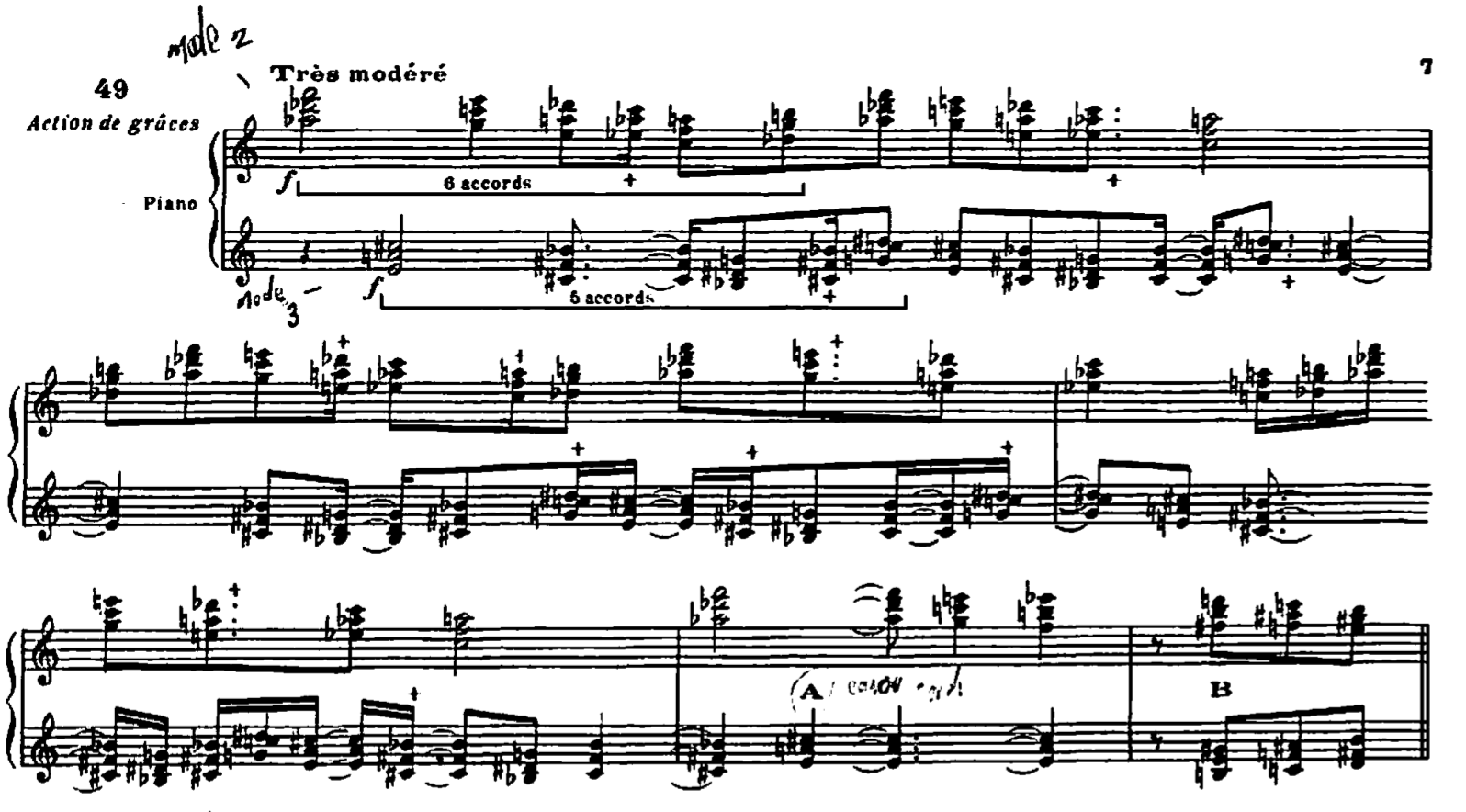
At point A, the canon ends. The example employs added values (at crosses), superposition of modes of limited transposition (Mode 3 over Mode 2), and use of the sixth mode creating modal modulation and placing the passage in A major.
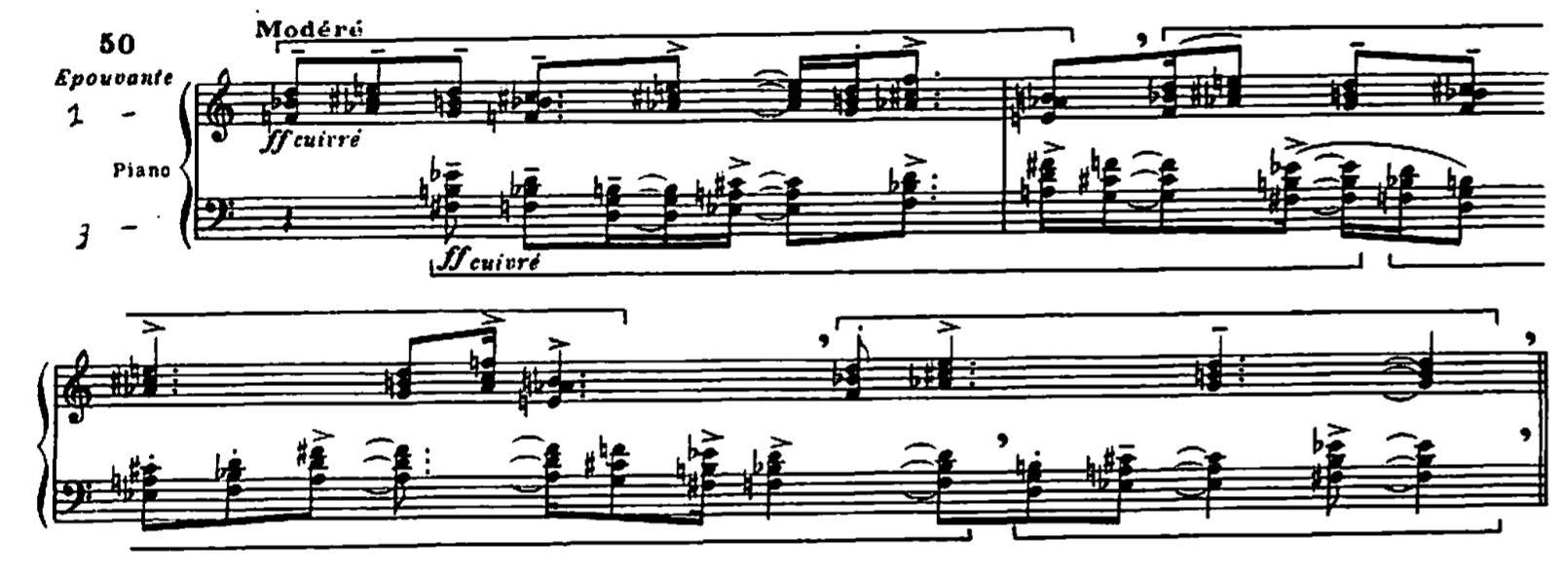
Example 50 presents another instance: superposition of Mode 2 (upper) over Mode 3 (lower), no melodic canon, but rhythmic canon at a quarter-note's distance. Brackets mark rhythmic divisions facilitating perception of the canon.
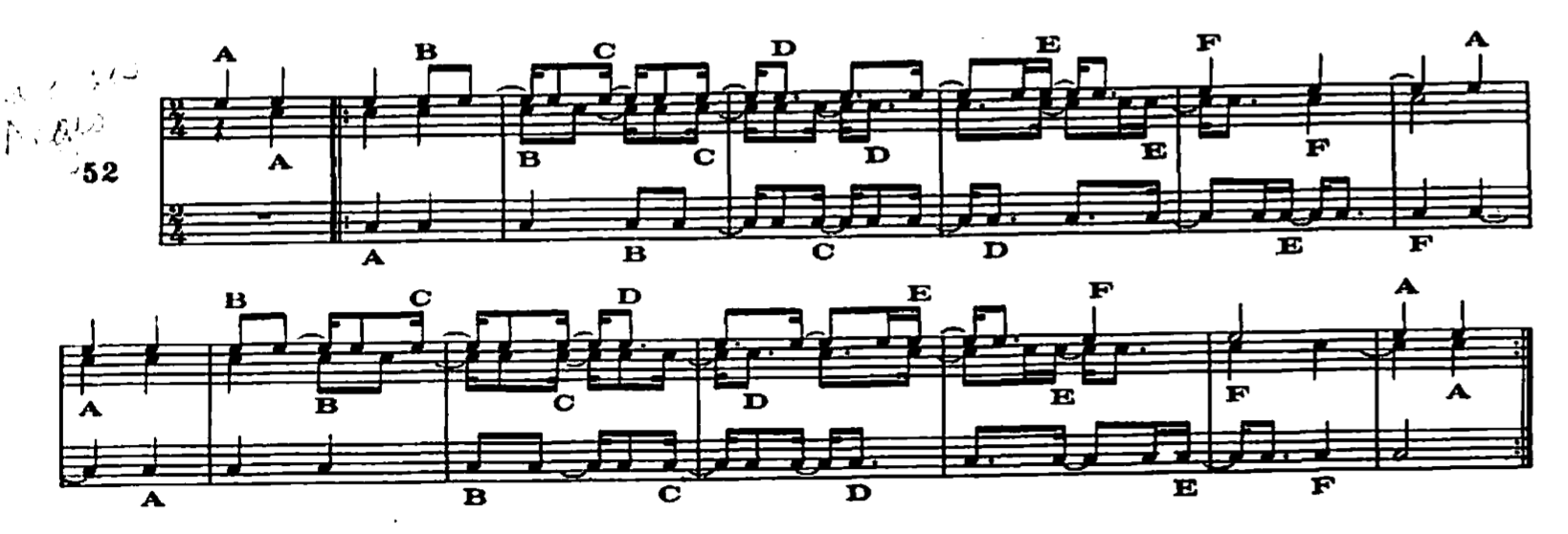
Example 51 recalls the typical rhythmic formula from Chapter V (Example 28), which Example 52 treats in triple canon gathered into 2/4 meter. Letters A–F indicate small rhythmic divisions; reproducing these letters over each part of Example 52 facilitates viewing the triple canon. The latter occurs twice in the example, with reprise indicating infinite repeatability.


Modern Context: Rhythmic canon represents the application of contrapuntal principles to rhythm independent of pitch. This separates two traditionally linked parameters:
- Traditional canon: Both pitch and rhythm imitate (Bach, Palestrina)
- Rhythmic canon: Only rhythm imitates, pitch remains independent (Messiaen's innovation)
- Pitch canon without rhythmic canon: Rare but theoretically possible
This parametric independence anticipates serial and post-serial techniques where pitch, rhythm, dynamics, and articulation undergo independent transformations. Messiaen's rhythmic canons demonstrate that contrapuntal thinking—imitation, temporal displacement, voice independence—can apply to any musical parameter.
Contemporary music theory recognizes this through concepts of:
- Parametric counterpoint: Contrapuntal relationships in non-pitch domains
- Temporal canons: Imitative structures based purely on temporal relationships (Nancarrow)
- Transformation networks: Systematic relationships between musical objects regardless of specific parametric content
The triple canon (Example 52) represents particular complexity—three voices in rhythmic imitation, each delayed by the same interval, creating dense temporal layering. This anticipates the rhythmic complexity of post-war European modernism (Boulez, Stockhausen) while remaining grounded in traditional contrapuntal thinking.
Examples: Examples 49–52 demonstrate various rhythmic canons from simple two-voice to complex triple canon.