Canon by the Addition of the Dot
Definition: Canonic structures where each successive voice presents an augmented version of the preceding voice through dot addition (1.5× multiplication), creating canons where imitative voices progressively slow down.
Messiaen's Treatment: Messiaen proposes writing rhythmic canons by augmentation or diminution using the forms from Chapter IV's table. He tries canon by dot addition: Example 53 presents a proposing rhythm spanning thirteen eighth-notes (prime number). Example 54 responds with all values dotted (1.5× augmentation).


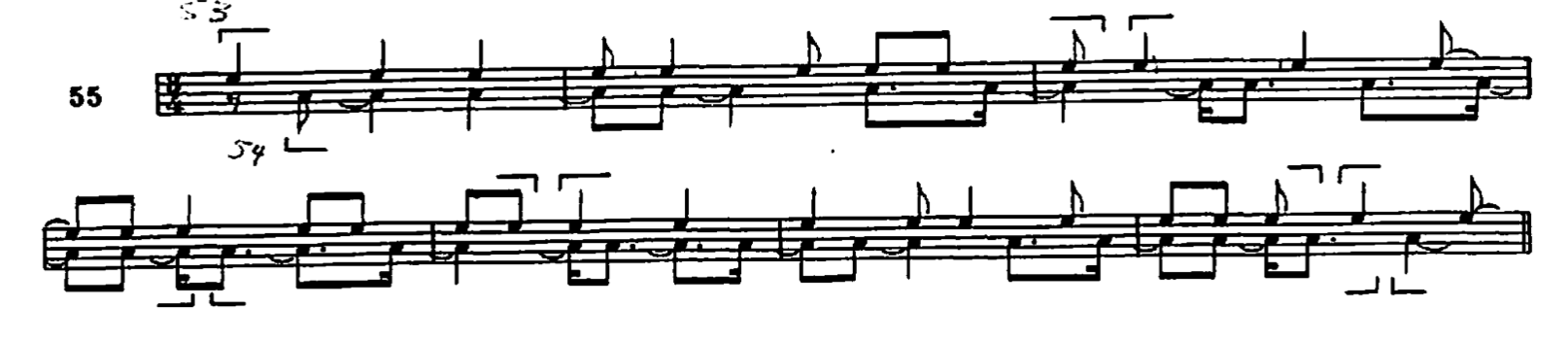
Example 55 combines three repetitions of the proposing rhythm with two repetitions of the responding rhythm, gathered into 3/4 meter. Brackets mark each repetition.
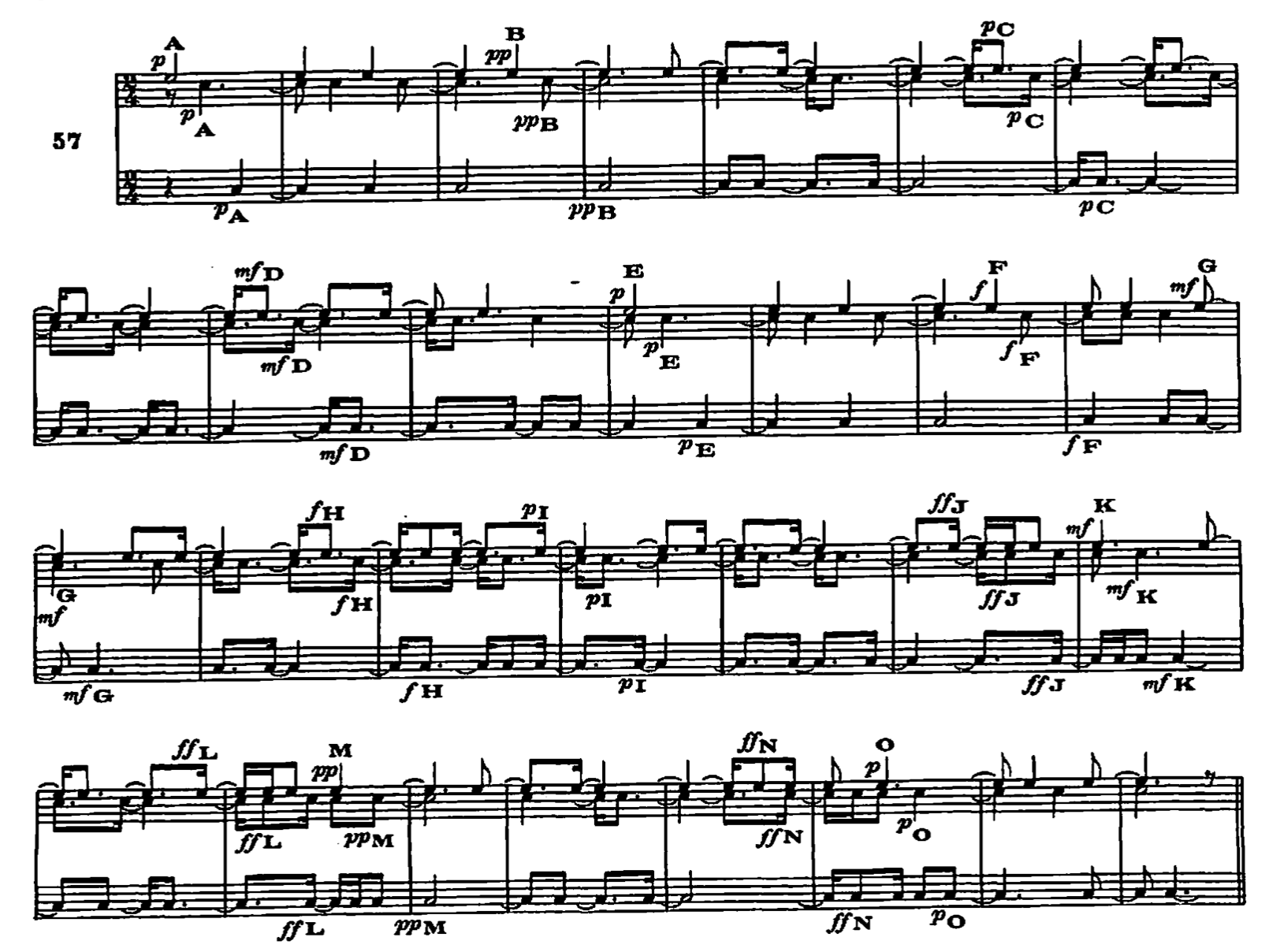
Example 56 presents a rhythmic succession exploiting all augmentation and diminution forms from Chapter IV's table (Article 3), with letters A–O indicating which transformation each segment employs:

- A: initial rhythm
- B: addition of a quarter of values
- C: withdrawal of a fifth of values
- D: withdrawal of a fourth of values
- E: addition of a third of values
- F: classic diminution
- G: addition of the dot
- H: withdrawal of the dot
- I: classic augmentation
- J: withdrawal of three-fourths of values
- K: addition of twice the values
- L: withdrawal of two-thirds of values
- M: addition of four times the values
- N: withdrawal of four-fifths of values
- O: addition of three times the values, forming a final recall of the initial rhythm
Example 57 treats this succession in triple canon gathered into 2/4 meter, with letters marking rhythmic divisions over each part to facilitate comprehension.
Modern Context: Canon by dot addition creates a specific species of augmentation canon where the augmentation ratio is 3:2 (dotted to undotted). This produces intermediate tempo relationships between voices—not the simple 2:1 or 3:1 ratios of traditional augmentation but the sesquialtera proportion (3:2).
This relates to:
- Renaissance proportional canons: Mensuration canons where different voices read the same notation in different mensural interpretations
- Tempo canons: Nancarrow's canons at complex tempo ratios including irrational proportions
- Metric modulation: Carter's use of proportional relationships to pivot between tempi
The systematic exploitation of all Chapter IV transformation types in canon (Example 56–57) demonstrates Messiaen's algorithmic thinking—systematically working through all possibilities within a defined system. This anticipates computer-assisted composition and systematic exploration of compositional possibility spaces.
Examples: Examples 53–57 demonstrate dot-addition canons and comprehensive transformation canons.