Canon of Nonretrogradable Rhythms
Definition: Canonic structures where all voices employ palindromic rhythms, creating imitative textures where each voice is internally symmetrical (nonretrogradable) while voices enter in temporal displacement.
Messiaen's Treatment: Messiaen recalls Example 33 from Chapter V—a succession of nonretrogradable rhythms (one per measure). Example 58 presents this material. Example 59 treats it in triple canon gathered into 2/4 meter, with each nonretrogradable rhythm bracketed for clarity.
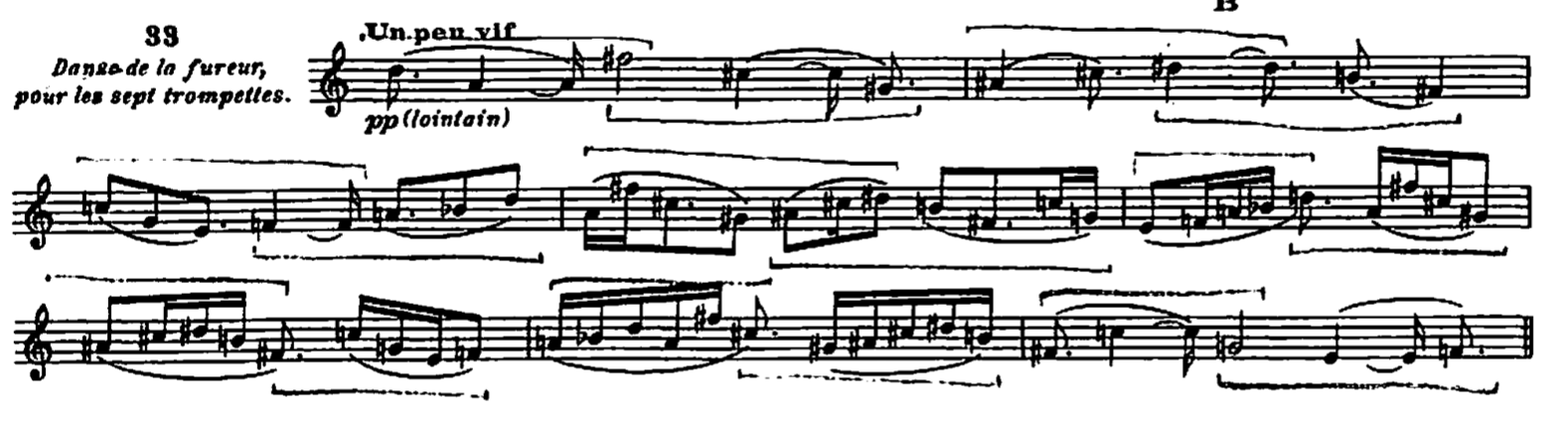

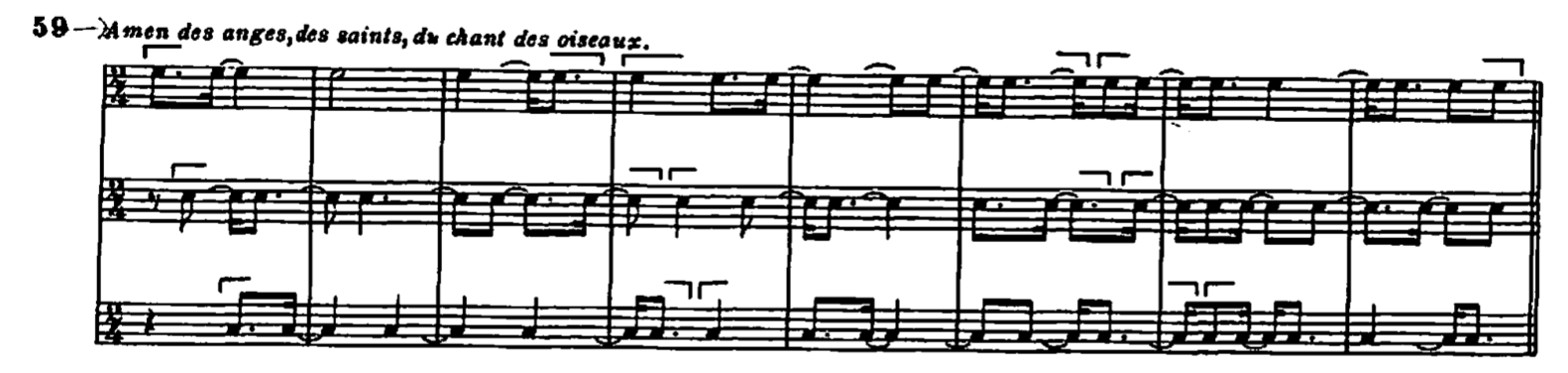
This creates a distinctive texture: each individual voice possesses retrograde invariance (no inherent temporal direction), yet the voices enter successively in traditional canonic fashion. The combination of internal palindromic symmetry with external canonic imitation produces music simultaneously stable (palindromic voices) and dynamic (imitative entries).
Modern Context: Canons of nonretrogradable rhythms represent a sophisticated combination of two temporal symmetry types:
- Internal symmetry: Each voice is palindromic
- External symmetry: Voices imitate each other through time-delay
This creates nested symmetries—palindromes within canonic structure. The perceptual effect is unusual: the lack of inherent temporal direction in individual voices (due to palindromic structure) combines with the clearly directed temporal unfolding of canonic entries.
This technique demonstrates that Messiaen's various innovations combine rather than exclude: palindromic rhythms (Chapter V) can participate in canonic structures (Chapter VI), showing the compositional system's internal coherence and flexibility.
Examples: Examples 58–59 demonstrate triple canon of nonretrogradable rhythms.