Superposition upon Its Retrograde
Definition: The simultaneous layering of a rhythmic pattern with its temporal reversal, creating polyrhythmic texture where one voice proceeds forward while another proceeds backward through the same durational sequence.
Messiaen's Treatment: Example 43 presents what Messiaen calls a "curious mixture of timbres" that superposes different rhythms and modes while combining polymodality and polyrhythm. The upper staff presents a rhythm in Mode 2 (octatonic scale), middle staff presents Mode 3, and bass (pedal part) uses the whole-tone scale. Rhythmically, the right hand repeats a rhythm (Example 46) while the left hand repeats its retrograde (Example 47).
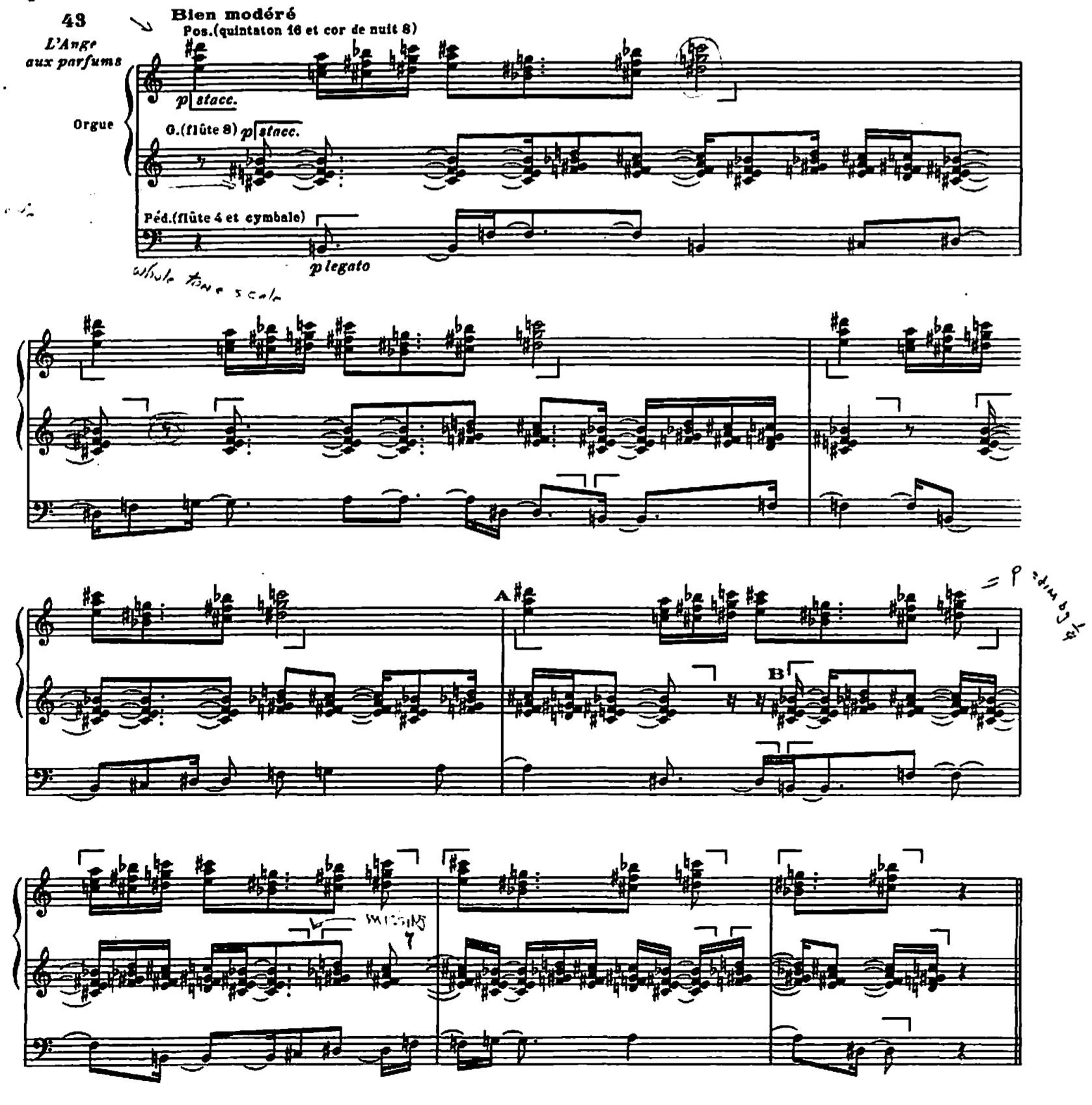
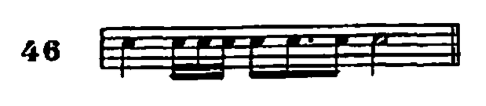
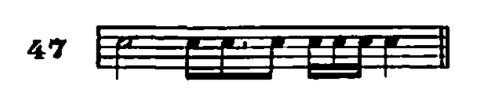
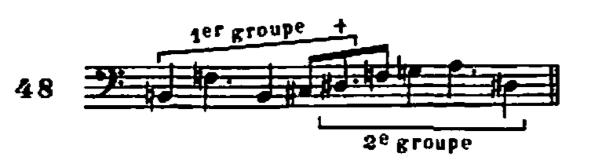
The superposition occurs "several times consecutively," with elements an eighth-note farther apart each time—the retrograde relationship maintains throughout but with progressive phase shifting. The bass presents a nonretrogradable rhythm (Chapter V) divisible into two groups with a central common value.
Example 48 identifies the three simultaneous rhythms: three rhythmic pedals where the second is the retrograde of the first and the third is nonretrogradable. This creates a complex texture where forward motion, backward motion, and temporal palindrome coexist.
Modern Context: Simultaneous presentation of a pattern and its retrograde represents sophisticated temporal counterpoint. This technique relates to:
- Contrapuntal inversion: Simultaneous presentation of a subject and its inversion in fugue, though Messiaen applies this to rhythm rather than pitch
- Temporal canons: Canons where voices move in opposite temporal directions (rare but explored by some modernist composers)
- Transformation theory: Simultaneous presentation of a musical object and its transformation under some operation (here, retrograde)
The perceptual effect is complex: listeners may not consciously recognize the retrograde relationship, but the resulting texture possesses a particular temporal symmetry. Since retrograde reverses the order of durations, long-to-short progressions in one voice align with short-to-long progressions in the other, creating complementary temporal trajectories.
The example also demonstrates Messiaen's integration of multiple techniques: polyrhythm (three independent layers), polymodality (three different modes), retrograde relationship, and nonretrogradable structure—all operating simultaneously. This represents the culmination of his systematic approach: individual techniques combine to create rich, multi-dimensional complexity.
Examples: Examples 43–48 demonstrate the complete technique with modal and timbral dimensions integrated.