Superposition upon Different Forms of Augmentation and Diminution
Definition: Polyrhythmic textures created by simultaneously presenting a rhythmic pattern at multiple time-scales—original, augmented, and/or diminished versions layered vertically.
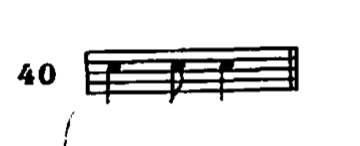
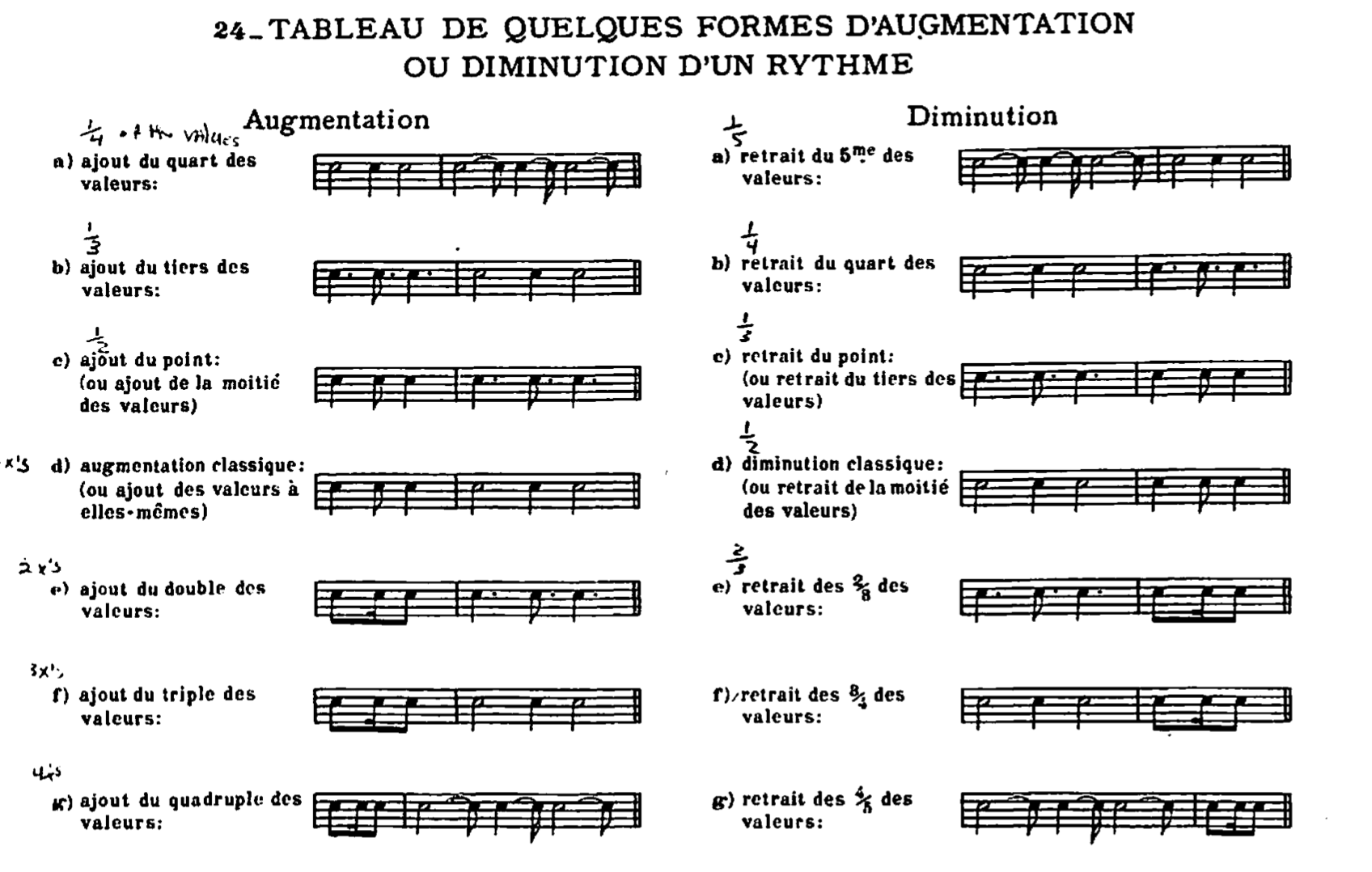
Messiaen's Treatment: Example 40 proposes a basic rhythm. Example 41 joins some forms of augmentation and diminution from the Chapter IV table (Example 24), creating a series of transformations. Example 42 combines this series with repetitions of the initial rhythm, gathering the whole into 5/8 meter. Brackets in the upper part mark the different augmentation/diminution forms; the lower part repeats the initial rhythm.

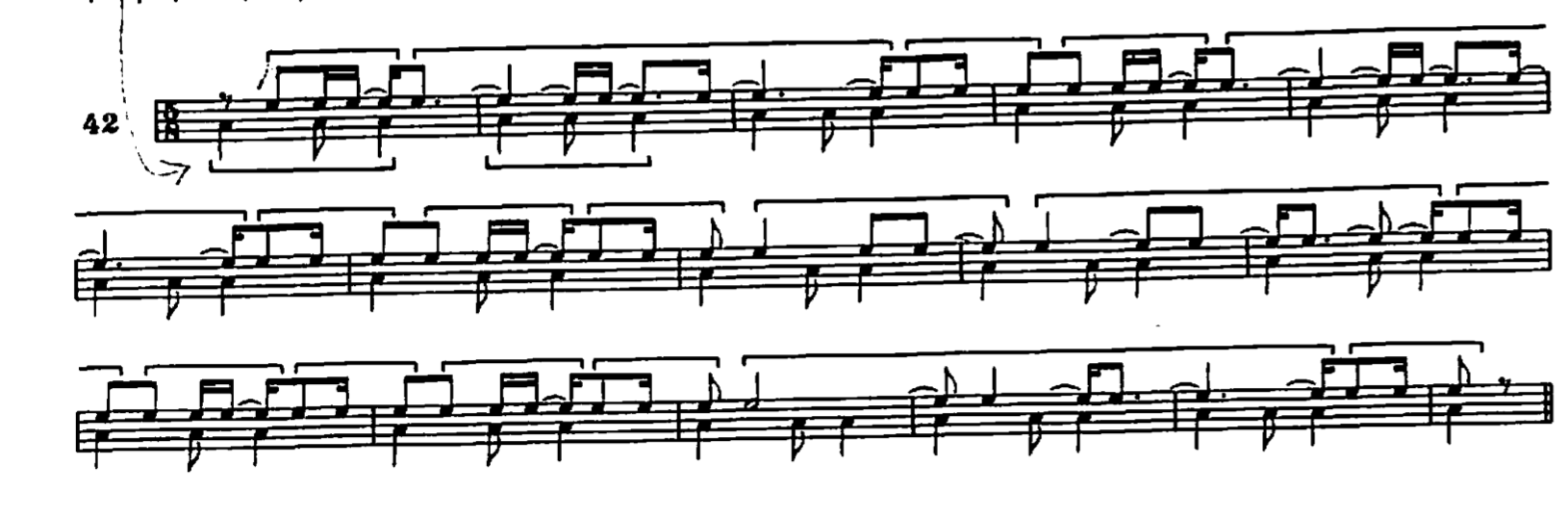
This creates a specific species of polyrhythm where all layers derive from the same source material but operate at different time-scales. The original rhythm and its proportionally transformed versions sound simultaneously, creating temporal stratification—the same pattern unfolding at multiple rates.
Modern Context: This technique relates to several compositional approaches:
- Temporal counterpoint: Independent voices moving at different speeds but derived from shared material (Renaissance proportional canons, Nancarrow's tempo canons)
- Fractal music: Self-similar structures appearing at multiple time-scales (Ligeti's rhythmic structures in piano études)
- Metric modulation: Carter's technique of using tempo relationships to create proportional connections between sections, though Messiaen applies this simultaneously rather than successively
The simultaneous presentation of original and transformed versions creates what might be termed "temporal heterophony"—multiple versions of the same musical idea sounding together but at different rates, analogous to heterophonic textures where multiple versions of a melody sound with slight variations.
This also demonstrates Messiaen's systematic approach: having catalogued augmentation/diminution forms in Chapter IV, he now shows how they can combine vertically. The technique enriches single-layer rhythmic variety (Chapter IV) through multi-layer interaction.
Examples: Examples 40–42 demonstrate the technique systematically.