Superposition of Rhythms of Unequal Length
Definition: The simultaneous layering of two or more rhythmic patterns of different durations, repeated cyclically until they realign at their common multiple, creating polyrhythmic textures where layers phase in and out of synchronization.
Messiaen's Treatment: Messiaen identifies this as the simplest and "most childish" form of polyrhythm—two rhythms of unequal length repeated until their combination returns to the starting configuration. Example 35 demonstrates: one rhythm spans ten sixteenth-notes (using added values and dot addition/withdrawal techniques from Chapter IV), another spans nine sixteenth-notes. The upper part requires nine repetitions, the lower part requires ten repetitions before both return simultaneously to their starting point (their common multiple: 90 sixteenth-notes, or least common multiple of 9 and 10).
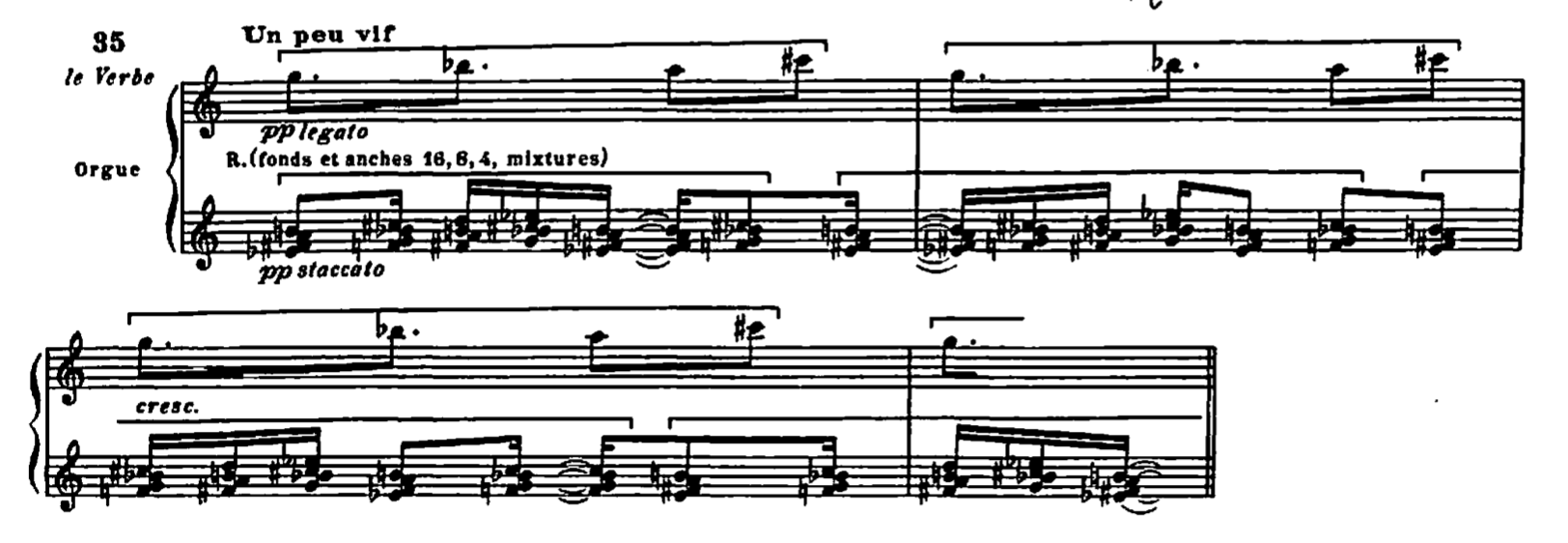
Examples 36–37 show further instances: rhythmic successions employing diminution by withdrawal of two-thirds (producing triplets and quintuplets, each totaling one quarter-note) and augmentation by addition of a fourth combined with diminution by withdrawal of a fifth.

Example 39 demonstrates gathering this into 2/4 meter while repeating the superposition. The second rhythmic succession (lower part) is much shorter than the first (upper part), creating a situation where the shorter pattern cycles multiple times against each statement of the longer pattern.
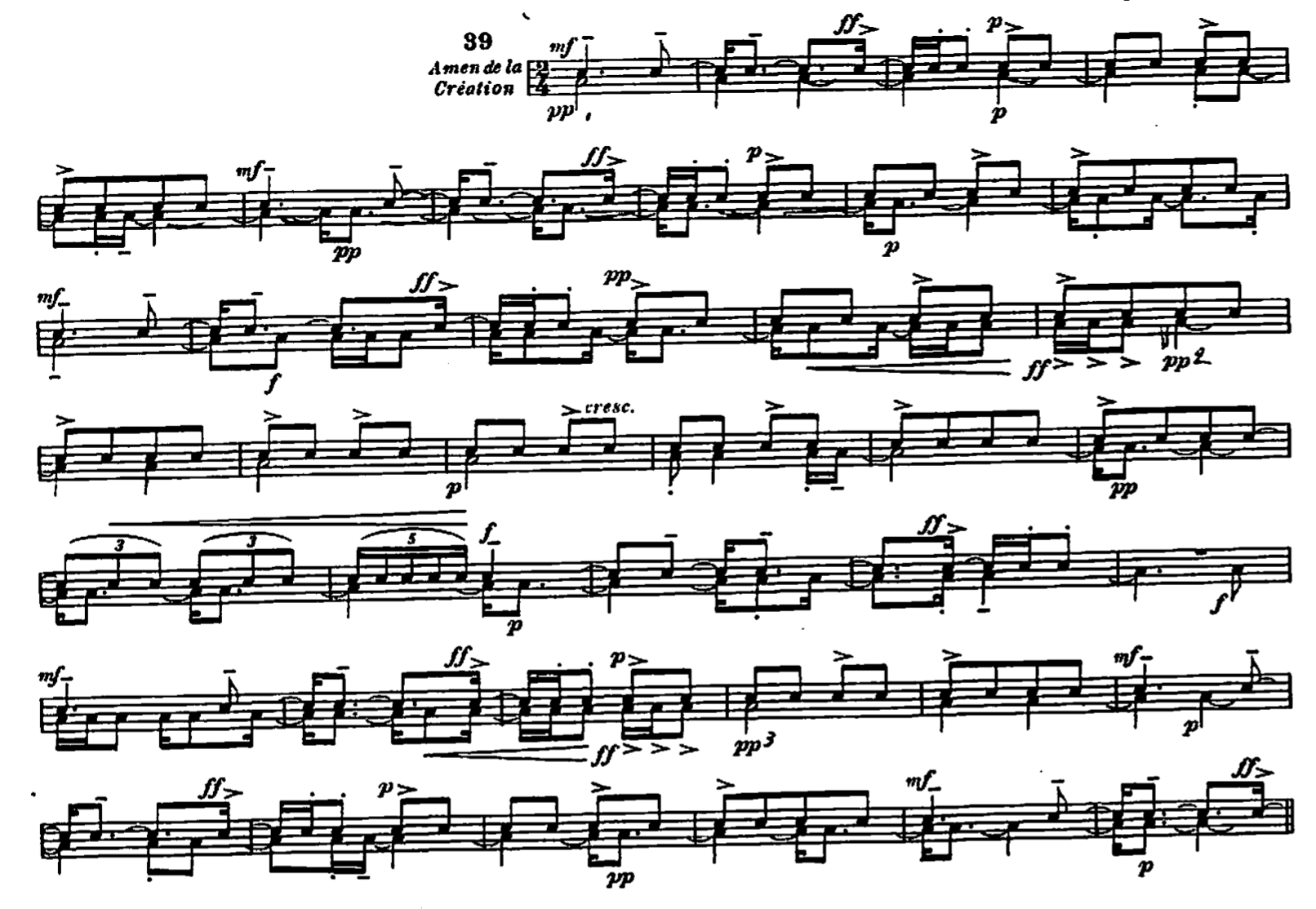
This technique creates temporal complexity through differential periodicity—patterns cycling at different rates produce continually changing vertical alignments. The music exhibits both local rhythmic variety (different alignments at each moment) and large-scale cyclic structure (eventual return to starting alignment).
Modern Context: This polyrhythmic approach has deep historical roots and widespread application:
- African and Afro-Caribbean music: Polyrhythmic textures based on simultaneous patterns of different lengths (3 against 2, 4 against 3, etc.) creating "timeline patterns"
- Minimalist phase music: Reich's phase pieces where identical patterns played at slightly different tempi gradually move out of and back into phase (though Reich's process differs from Messiaen's fixed-length cycling)
- Medieval isorhythm: Color (pitch pattern) and talea (rhythmic pattern) of different lengths cycling through each other in motet tenors
- Mathematical music: Composers using least common multiples to determine large-scale formal structures (Nancarrow, Xenakis)
Contemporary rhythm theory analyzes these structures through concepts of:
- Rhythmic period: The span before patterns realign (LCM of component lengths)
- Phase relationships: The continually changing alignments between layers
- Hypermetric structure: Large-scale metric organization generated by cycling patterns
The technique creates temporal non-alignment—simultaneous layers operating with different periodicities, preventing establishment of unified metric hierarchy. This reinforces Messiaen's ametric aesthetic while creating rhythmic richness through controlled complexity.
Examples: Examples 35–39 demonstrate various applications with different length relationships and transformations.