Development of Three Themes, Preparing a Final Issued from the First
Definition: A formal procedure resembling sonata development but presenting three distinct themes in condensed exposition, then developing them toward a climactic final statement derived from the first theme—creating teleological trajectory toward thematic synthesis.
Messiaen's Treatment: This form resembles the preceding sonata-based model. Used in the ninth part of La Nativité du Seigneur: "Dieu parmi nous."
Analysis (Examples 156–160):
-
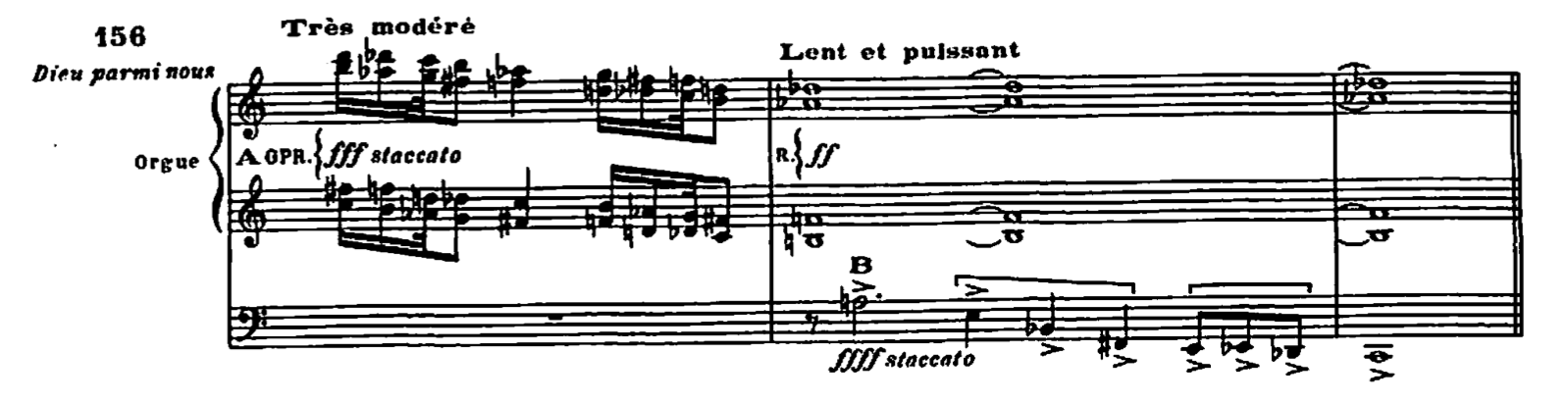
(a) Condensed exposition of three themes in eight measures:
-
First theme (rhythmic): Example 156—divided into A and B; A written in Mode 4, B written in Mode 2; B contains three quarter-notes and three eighth-notes (diminution of three quarter-notes), a rhythm recalling rāgavardhana which will be the basis of the final toccata
-
Like Bach's chorale Adam's Fall (for organ), like the descent of Ariane (light to midst of darkness where Bluebeard's wives suffered in Paul Dukas's opera), this element B assimilates rhythmic precipitation and the passage from treble to bass into the idea of fall—but it is a question of the glorious and ineffable fall of the second person of the Holy Trinity into human form (if permissible to employ this term on the subject of the Incarnation of the Word)
-
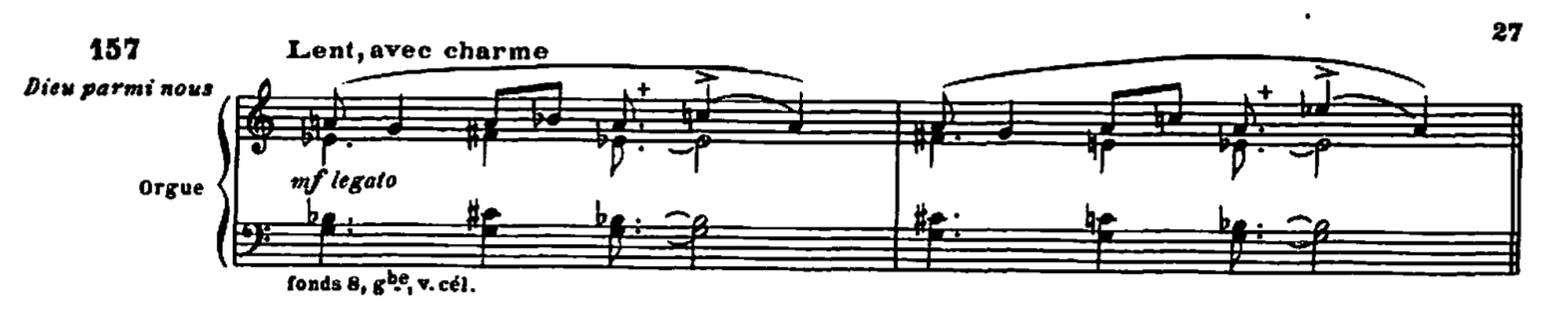
Second theme (melodic and harmonic): Example 157—expressing love for Jesus Christ of the communicant, of the Virgin, of the entire Church
-
Without added value at crosses (Chapter III), this theme could have been written in 5/8 time
-
Third theme (melodic): Example 158—a Magnificat, alleluiatic praise in bird style
-
-
(b–e) Development sections:
- Development of first and third themes (159)
- Development of third theme in jubilatory counterpoint in two voices
- More impassioned development of second theme
- Element A of first theme over dominant pedal in E major; element B in contrary motion bursts like thunder and engenders a joyous and vigorous toccata
-
(f) Toccata in E major is the piece itself, all the large development which precedes having been only the preparation of it. Except for a passage recalling the third theme and a new melodic element (Example 159), the whole toccata is built upon element B of the first theme (Example 160), whose four quarter-notes are developed at length, repeated, triturated, hesitating in the bass around F-natural before concluding on E (tonic) in a triumphant glee.



Modern Context: This form represents Messiaen's distinctive contribution to developmental procedures:
Key characteristics:
- Multiple thematic exposition: Three contrasting themes presented in compressed form
- Differential development: Each theme receives varied developmental treatment
- Teleological trajectory: All development prepares climactic final section
- Thematic derivation: Final toccata derives from element of first theme, creating unity through transformation
Comparison with traditional forms:
- Sonata development: Works out exposition themes but returns them in recapitulation
- Lisztian transformation: Generates multiple themes from single germ, transforms throughout
- Messiaen's approach: Multiple independent themes converge toward single derived climax
This anticipates later compositional thinking:
- Goal-directed forms: Trajectory toward predetermined arrival (Carter, Ferneyhough)
- Thematic synthesis: Combination or derivation of final material from earlier themes (Lutosławski)
- Accumulation forms: Building intensity through progressive layering (Varèse, Xenakis)
The theological program is explicit: first theme's element B represents the Incarnation (fall from heaven to earth, divinity to humanity), developed throughout until finally erupting in the toccata—musical form embodies theological narrative. The rāgavardhana reference connects this theological meaning to Hindu rhythmic source (Chapter II), demonstrating cross-cultural synthesis serving Christian theology.
The observation that the entire large development is "only the preparation" for the toccata inverts traditional formal hierarchy—what appears to be the main body (development) is actually preparation for what appears to be coda (toccata). This resembles Sibelius's practice of building entire movements toward final thematic revelation.
Examples: Examples 156–160 systematically present themes and trace their development toward final toccata.