The Embellishment Group
Definition: A complex ornamental gesture, often realized as an extended scalar figure or flourish, that elaborates a single structural pitch while functioning as a complete musical unit rather than a simple melodic decoration.
Messiaen's Treatment: Example 306 demonstrates this concept: at points A and C, the real structural note is D, while at point B, an immense scroll forms a single embellishment of that D—it constitutes an embellishment group. The "immense scroll" functions analogically to how a single trill or turn would ornament a note in classical style, but now the embellishment itself contains substantial musical content.
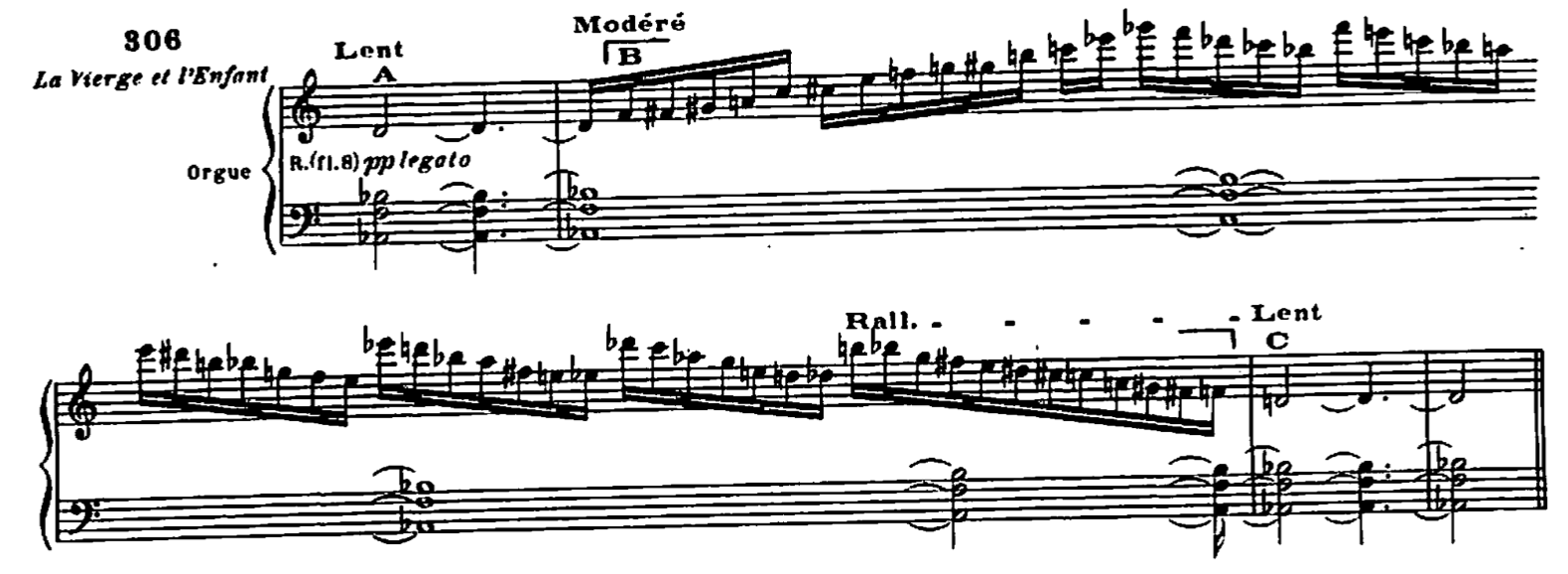
Modern Context: The embellishment group extends traditional diminution concepts where simple ornaments (trills, mordents, turns) elaborate structural tones. What Messiaen proposes is the inflation of these gestures into cadenza-like passages or extensive scalar runs that maintain ornamental function despite their temporal extent. This concept relates to improvised embellishment traditions in Baroque music (where performers would ornament written melodic lines with elaborate divisions) and to the cadenza in Classical concerto form (where an extended improvisation ultimately elaborates dominant harmony before final resolution). Contemporary theory might analyze such passages using Schenkerian neighbor-note or incomplete-neighbor prolongations operating across multiple measures. The embellishment group also anticipates extended techniques in later twentieth-century music where what appears to be substantial musical material functions structurally as decoration—for instance, the elaborate flourishes in the music of Boulez or the virtuosic instrumental writing in Berio, which often serves ornamental rather than thematic functions. Messiaen's characterization of the embellishment as an "immense scroll" reveals his visual-musical synesthesia and suggests connections to visual ornamental traditions (Gothic tracery, Arabic calligraphy, Art Nouveau decorative excess) where elaborate surface detail coexists with simple underlying structure.
Examples: Example 306