Upbeats and Terminations
Definition: The structural articulation points that frame and define musical gestures, consisting of anacrustic preparation (upbeat), moment of arrival or emphasis (accent), and consequent resolution (termination). When combined into the upbeat-accent-termination complex, these elements constitute the most expressive configuration in Messiaen's harmonic vocabulary.
Messiaen's Treatment: Messiaen identifies Mozart as the distant herald of this technique, notes that Schönberg and Alban Berg employed it with rare emotional intensity, but credits Arthur Honegger as the composer who carried it to maximum effect (citing Judith, Horace victorious, Antigone, and Danse des morts). The essential element in the appoggiatura is the expressive accent, which Messiaen proposes to prepare through an immense upbeat and resolve through an equally immense termination. The result—upbeat-accent-termination—gains augmented expressive power through proportional expansion. Importantly, the upbeat and termination may be separated from the accent by rests or may exist independently without any accent. In the embellishment group (unlike the pedal and passing groups, which could possess their own harmonies), all notes are foreign, and the combination upbeat-accent-termination operates exclusively with melody. The distinguishing principle: the combination centers on the expressive accent, which provides its reason for being, whereas the embellishment group lacks an accent.
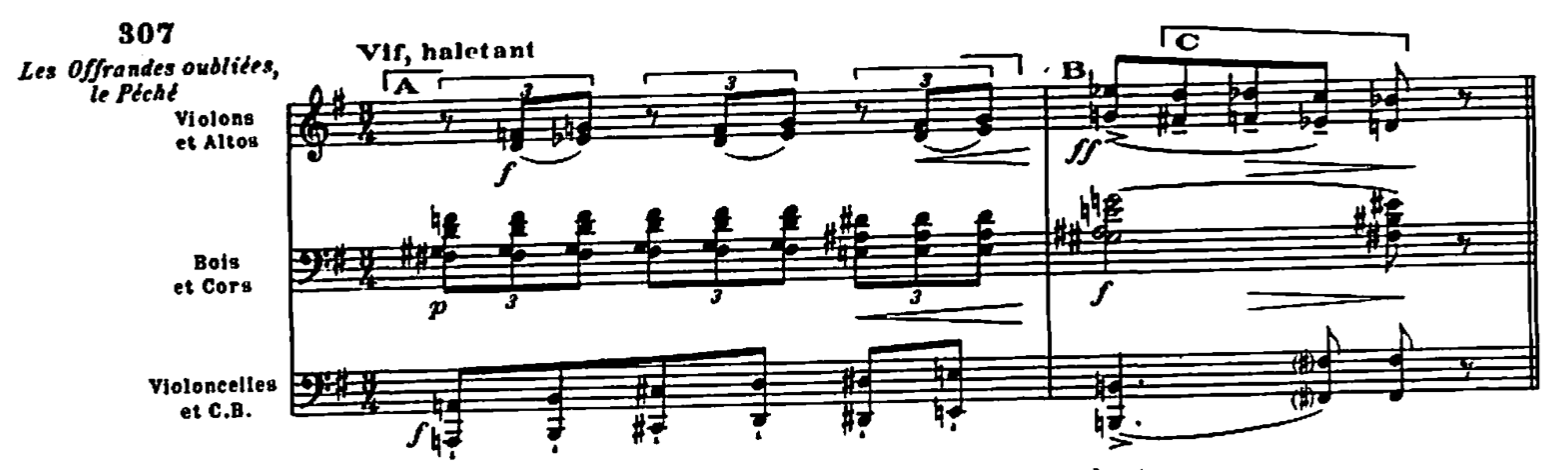
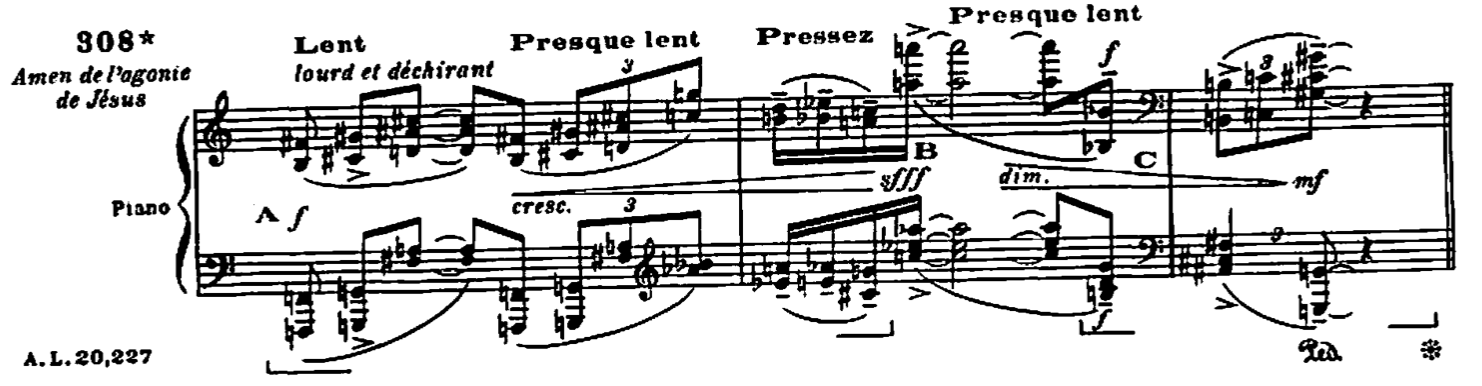
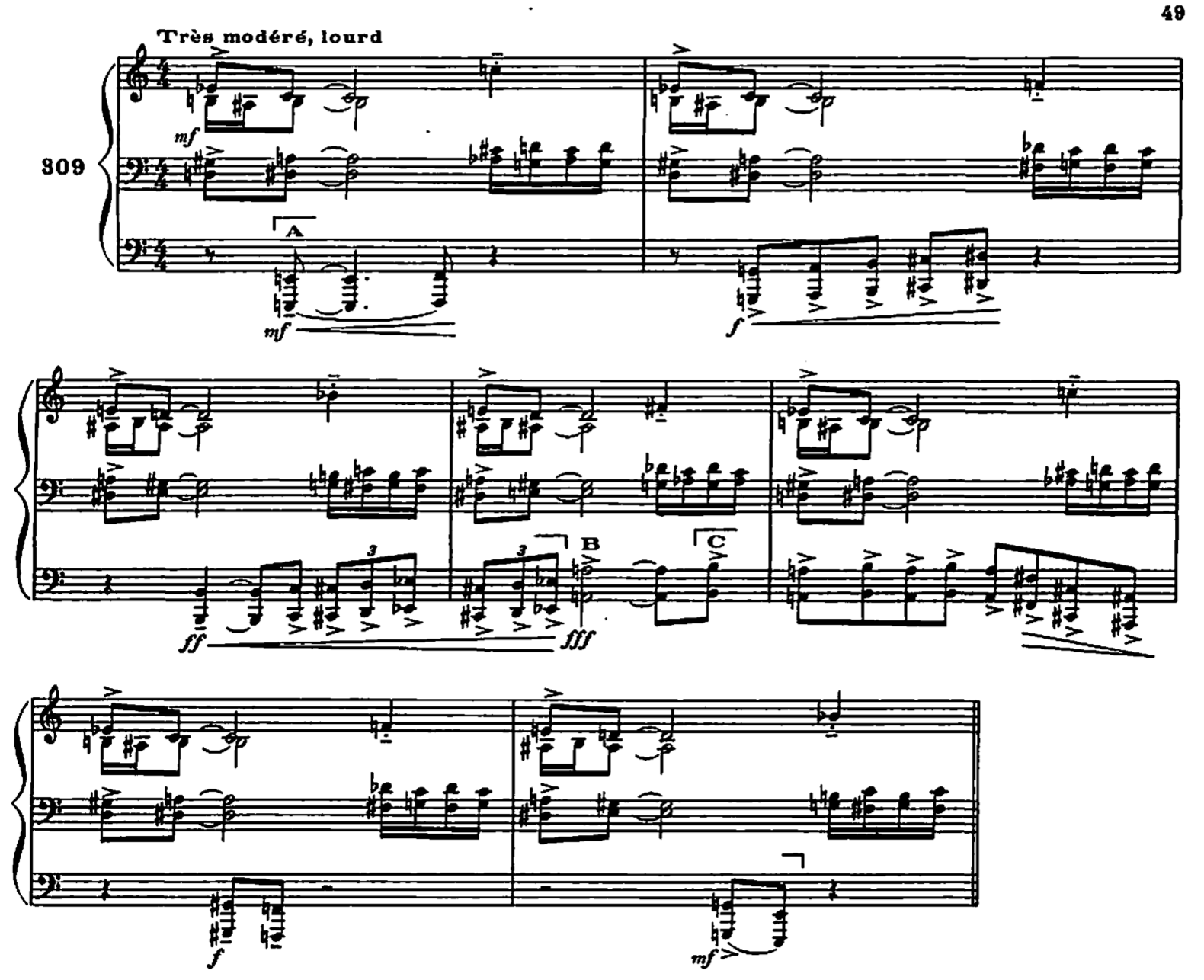
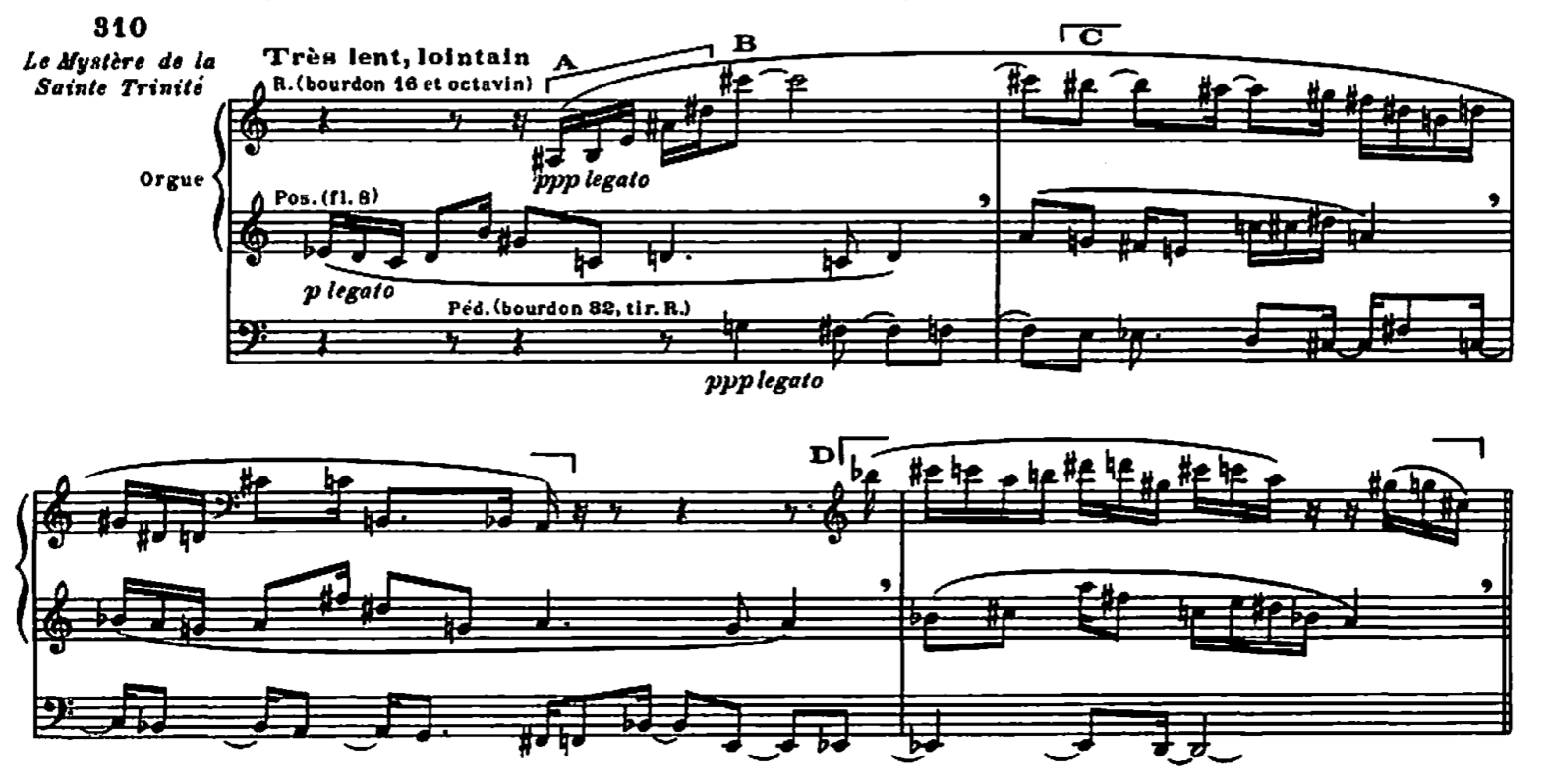
Messiaen provides multiple demonstrations: Example 307 shows the fundamental principle, with the combination revolving around the expressive accent. Example 308 presents a "course of anguish, of desire, and of horror" with panting upbeat at A, accent at B, and termination at C. Example 309 demonstrates how direct movement and chord cruelty provide great expressive strength, with lacerating accent at B, upbeat and rhythmic precipitation at A, and termination at C. Example 310 shows upbeat A and termination C cut by rests, creating impression of effort and exhaustion despite—or precisely because of—this interruption; the combination exceptionally begins and ends on the same note (E). Example 311 presents accent B as distant, upbeat A as more calm, with a very long termination in quasi-atonal style at C and a termination at D not preceded by accent. The bass reveals a rhythmic succession previously quoted in Chapter VI concerning rhythmic pedals, demonstrating how this harmonic technique integrates with rhythmic procedures.

Modern Context: The upbeat-accent-termination complex represents Messiaen's most significant contribution to understanding phrase articulation and gesture in twentieth-century music. This formulation anticipates later theoretical work on musical grouping, particularly the "beginning-middle-end" paradigm in form-functional theory and the "anacrusis-strong beat-aftermath" categories in metric theory. What distinguishes Messiaen's approach is the emphasis on proportional expansion—the upbeat and termination must be "immense" to properly frame the accent—and the allowance for discontinuity (rests separating elements or elements appearing without their expected complements). This thinking parallels developments in twentieth-century phrase rhythm, where traditional period structures fragment into more discontinuous gestures. The emotional characterizations ("anguish," "desire," "horror," "effort," "exhaustion") reveal Messiaen's consistent attention to expressive content—these structures serve psychological and dramatic functions, not merely formal ones. The integration with rhythmic pedals (Example 311) demonstrates the synthetic nature of Messiaen's technique, where harmonic, melodic, and rhythmic procedures reinforce unified expressive goals. Contemporary composers working with gestural music (Berio, Ligeti, Saariaho) employ similar principles of expanded anacrusis and extended resolution, often without explicit theoretical formulation—Messiaen provides the conceptual framework for understanding such practices. The technique also relates to concepts of "statistical climax" or "textural intensification" in electroacoustic and spectral music, where density and activity increase toward arrival points before dissipating.
Examples: Examples 307–311