The Passing Group
Definition: A musical structure that reproduces the terms of a harmonic progression symmetrically (ascending or descending by degree) while functioning analogically to traditional passing motion between two structural harmonies.
Messiaen's Treatment: Messiaen states that just as on-the-spot repetition equates to sustaining (making it appropriate for pedal groups), the reproduction of progression terms constitutes the equivalent of symmetrical movement—ascending or descending degree by degree—characteristic of passing notes. Example 305 demonstrates this: the middle voice (B) contains a pedal group, while the two outer voices (at A) present groups of foreign notes reproduced symmetrically, in ascending progression for the upper part and descending for the bass. These constitute passing groups connecting structural points.
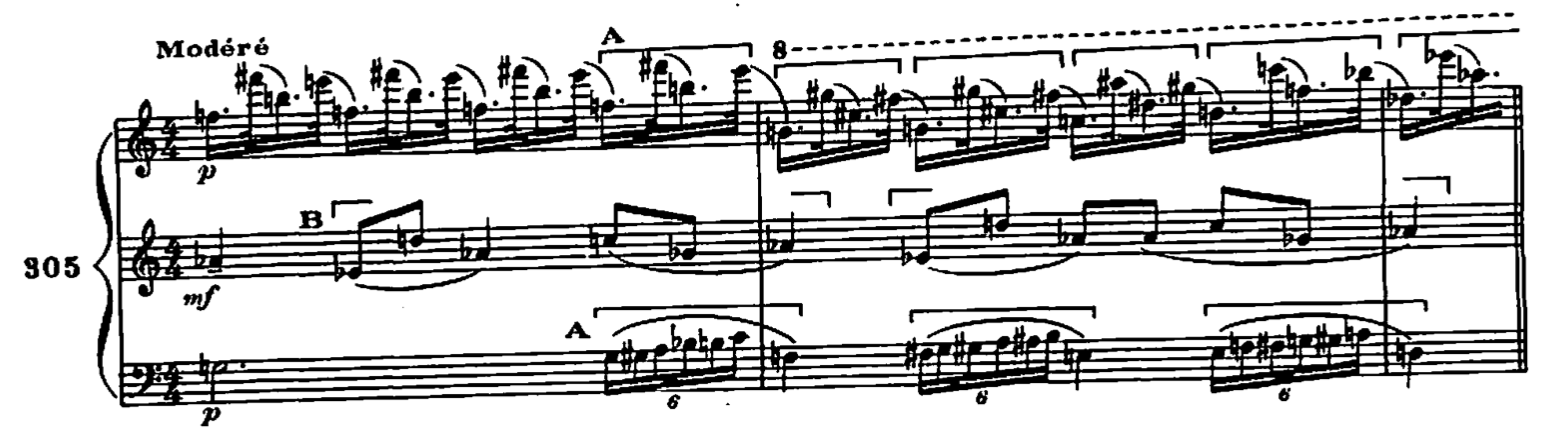
Modern Context: The passing group concept parallels Schenkerian concepts of "passing motion" operating at deeper structural levels, though Messiaen's approach remains more surface-oriented and less concerned with background voice leading. Contemporary harmony textbooks typically treat passing motion as stepwise connection between chord tones, operating primarily at the foreground level. Messiaen's enlargement allows passing function to operate across entire phrases or sections, where sequences or transposed repetitions of harmonic progressions create directed motion between structural pillars. This thinking anticipates William Caplin's form-functional categories, particularly "sequential progression" as a distinct formal function. The symmetrical aspect (simultaneous contrary motion in outer voices) creates what traditional counterpoint would call "wedge motion" or "expanding/contracting intervals," now applied to complete harmonic progressions rather than individual melodic lines. The integration of pedal group (middle voice) with passing groups (outer voices) demonstrates Messiaen's synthetic approach where multiple types of prolongation operate simultaneously across different textural layers.
Examples: Example 305