The Pedal Group
Definition: A sustained or repeated musical structure, foreign to the surrounding harmonic context, possessing its own internal musical organization while functioning analogically to a traditional pedal point.
Messiaen's Treatment: Instead of a single sustained note foreign to surrounding chords, Messiaen employs repeated music (he notes that "repetition and sustaining are equivalent") that remains foreign to other music situated above or below it. Each musical layer maintains its own rhythm, melody, and harmonies. Example 302 demonstrates this principle: the upper staff music repeats from measure to measure, independent of the lower staff; it constitutes a pedal group. The entire passage operates in A major while being polymodal and superposing two modes of limited transpositions—the third mode for the upper staff (Example 303) and the second mode for the lower staff (Example 304). Messiaen notes that this polymodality will be discussed further in Chapter XIX.
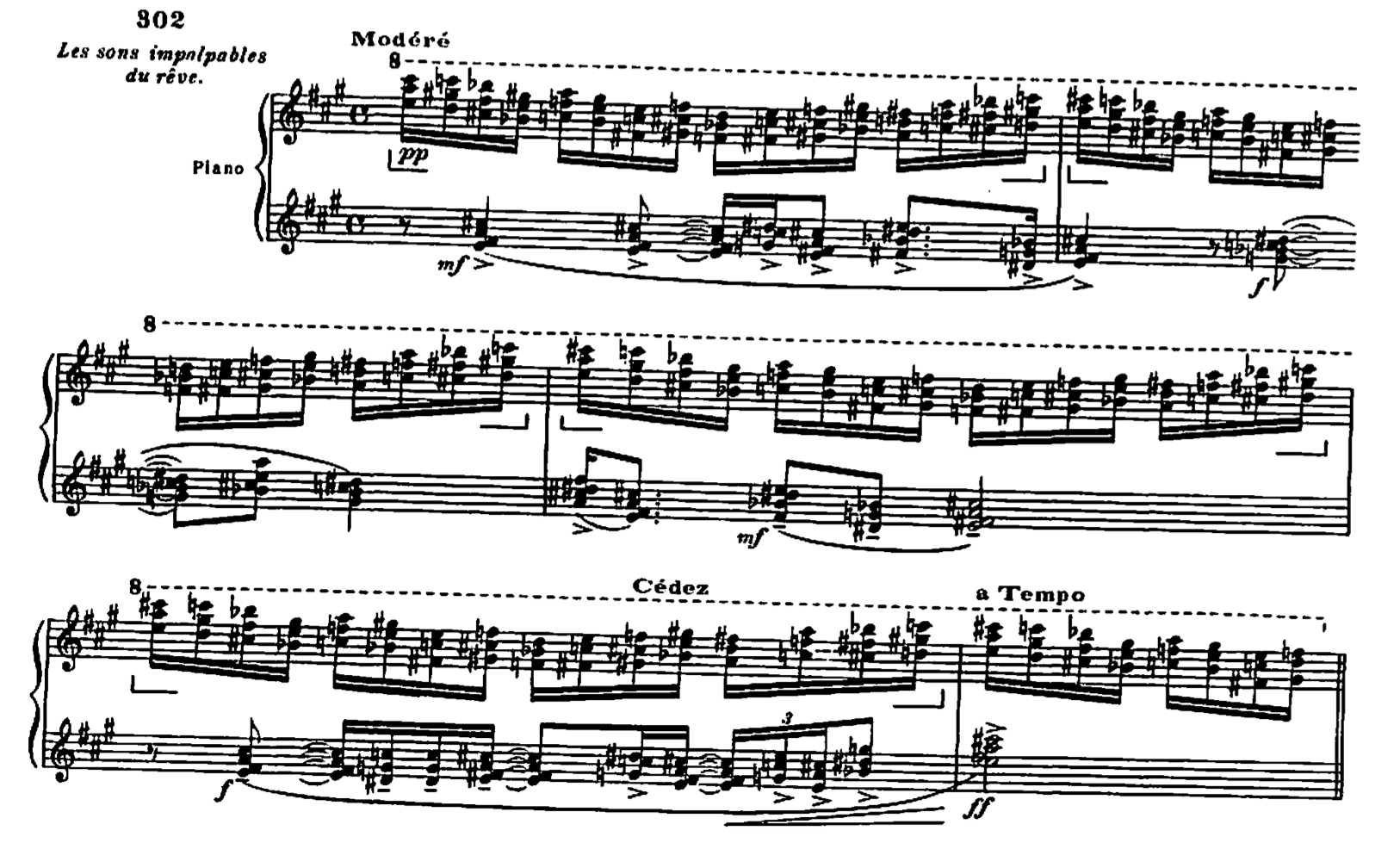


Modern Context: The pedal group concept extends the traditional pedal point—typically a single pitch (usually tonic or dominant) sustained beneath changing harmonies—into a more complex polystylistic or polymodal structure. What distinguishes this from mere textural layering is the analytical claim that the entire repeating layer functions as a single "pedal" despite containing complete musical material. This approach anticipates techniques in minimalist music (particularly Steve Reich and Philip Glass) where repeating patterns function as stable structural layers against which other materials move. It also relates to concepts of "stratification" in the music of Charles Ives and Elliott Carter, where independent musical streams coexist without syntactic integration. The modal differentiation between layers (third mode versus second mode) demonstrates how Messiaen's modes of limited transpositions enable clear structural differentiation while maintaining harmonic consistency—each layer remains internally coherent within its own modal framework. The polymodal technique here serves both coloristic and formal functions, creating timbral differentiation between structural layers.
Examples: Examples 302–304