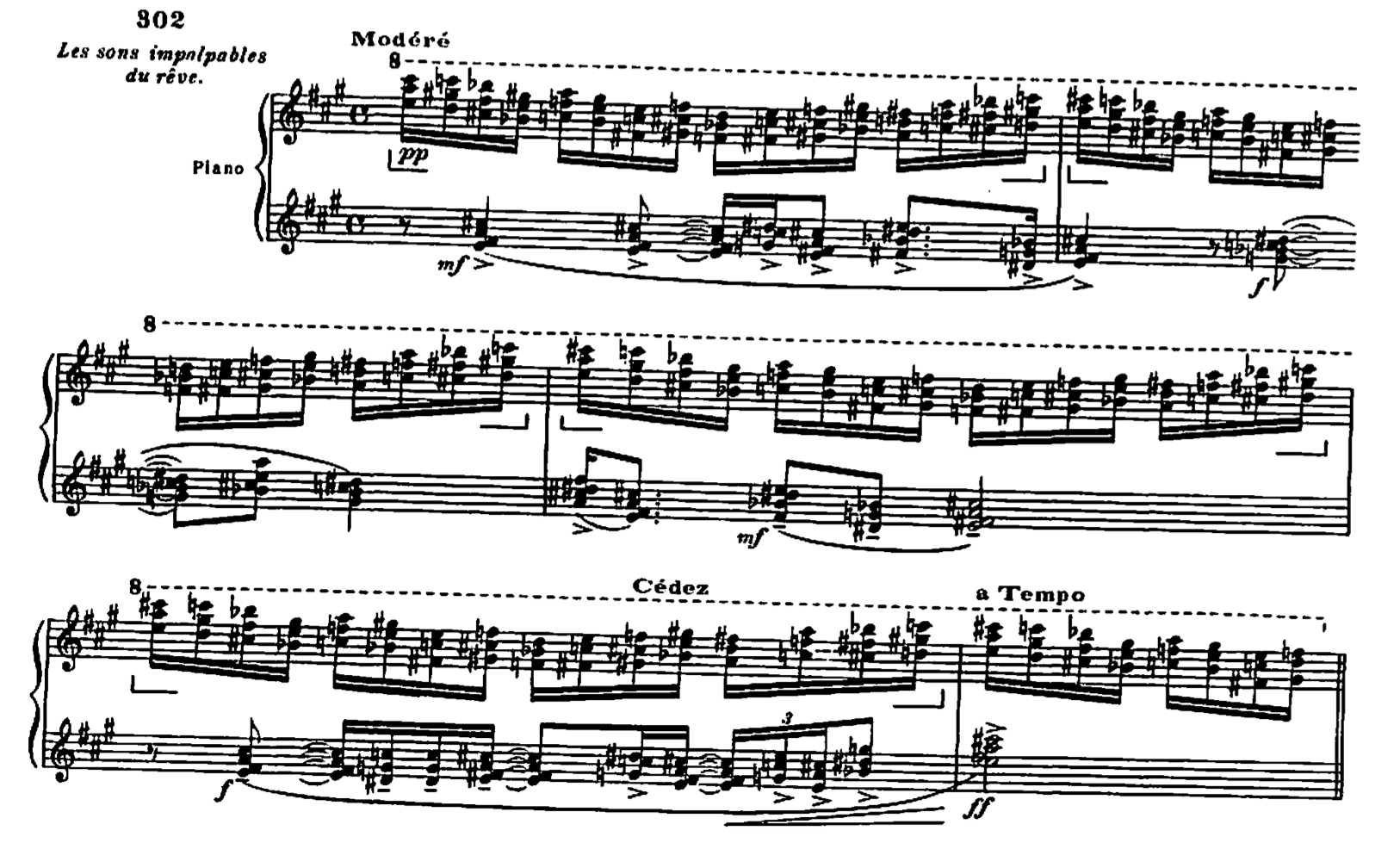
Enlargement of Foreign Notes into Groups
Definition: The transformation of traditional single-note dissonances (pedal tones, passing notes, embellishments, appoggiature) into multi-note structures that function as complete, self-contained musical units, each with its own internal organization of rhythm, harmony, and melody.
Messiaen's Treatment: Messiaen opens the chapter by questioning whether dissonance remains possible given the complexity of modern chords saturated with added notes. Rather than abandoning the expressive function of foreign notes, he proposes preserving them through enlargement: the pedal becomes the pedal group, the passing note becomes the passing group, and the embellishment becomes the embellishment group. Each group contains several foreign notes and constitutes complete "whole music" (rhythm, harmony, melody) while simultaneously functioning analytically as a single unit—"a single pedal, a single passing note, a single embellishment." Messiaen explicitly states that traditional anticipation and escape tones (which had served prophetic functions in the context of added notes) have been erased by the suspension, which itself has diminished before the appoggiatura. The most important and expressive foreign note configuration in the classical style—the combination of upbeat, accent, and termination—will receive special attention.
Modern Context: This concept represents a significant theoretical innovation that anticipates later developments in prolongational analysis and form-functional theory. What Heinrich Schenker conceived as voice-leading diminutions operating at multiple structural levels, Messiaen reformulates as the inflation of ornamental gestures into autonomous musical passages. Contemporary theory might describe this as recursive application of dissonance categories across different temporal scales—what functions ornamentally at the surface can function structurally at deeper levels. The approach also parallels concepts in phrase rhythm theory, where anacrusis-downbeat-continuation patterns operate at multiple hierarchical levels. Messiaen's insistence that these groups possess complete musical identity (rhythm, harmony, melody) while simultaneously functioning as single analytical units reveals sophisticated understanding of how musical categories operate simultaneously at multiple levels of structure. This thinking prefigures the "grouping structures" later formalized by Fred Lerdahl and Ray Jackendoff in A Generative Theory of Tonal Music.
Examples: Discussed conceptually throughout the chapter; specific realizations in Examples 302–311