Prime Number Groupings
Definition: Rhythmic patterns organized in prime-numbered quantities (five, seven, eleven, thirteen, etc.) that inherently resist subdivision into equal metric units.
Messiaen's Treatment: Throughout the chapter's examples, Messiaen consistently employs prime-number groupings. Example 10 features five eighth-notes plus a sixteenth-note (added value). Example 13 references the sixth mode of limited transpositions with rhythmic divisions of seven eighth-notes, eight eighth-notes, and seven eighth-notes—where the sevens represent prime groupings complicated by added values. The fragment from Quatuor pour la fin du Temps (Example 13) demonstrates added values creating groups of five, seven, eleven, and thirteen sixteenth-notes.
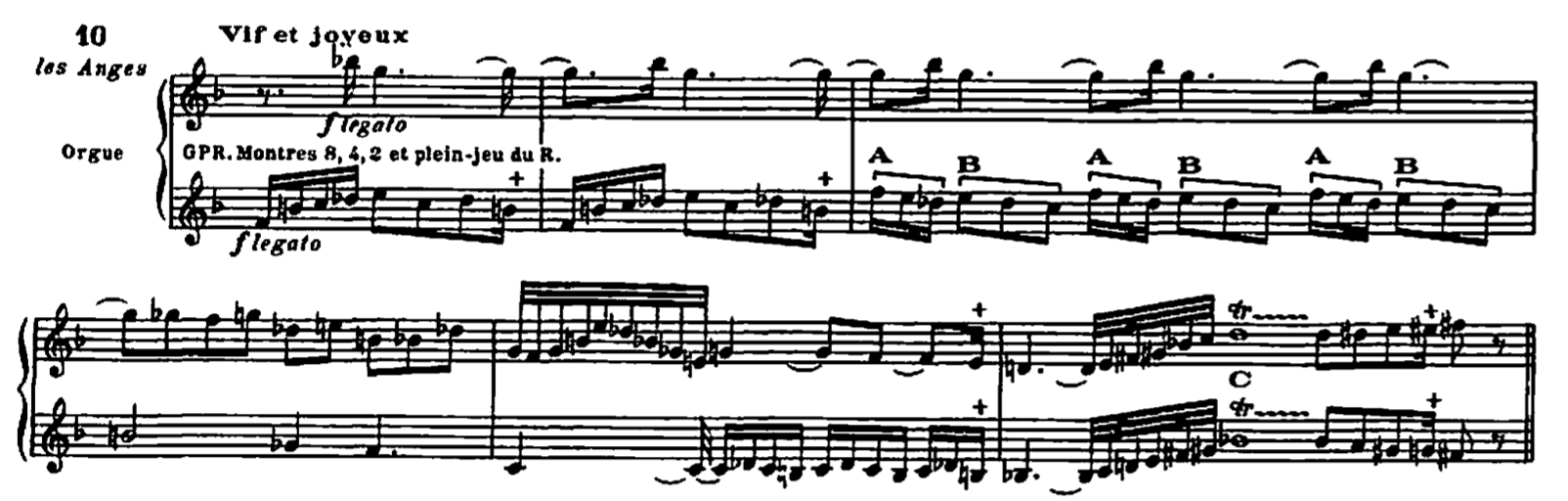
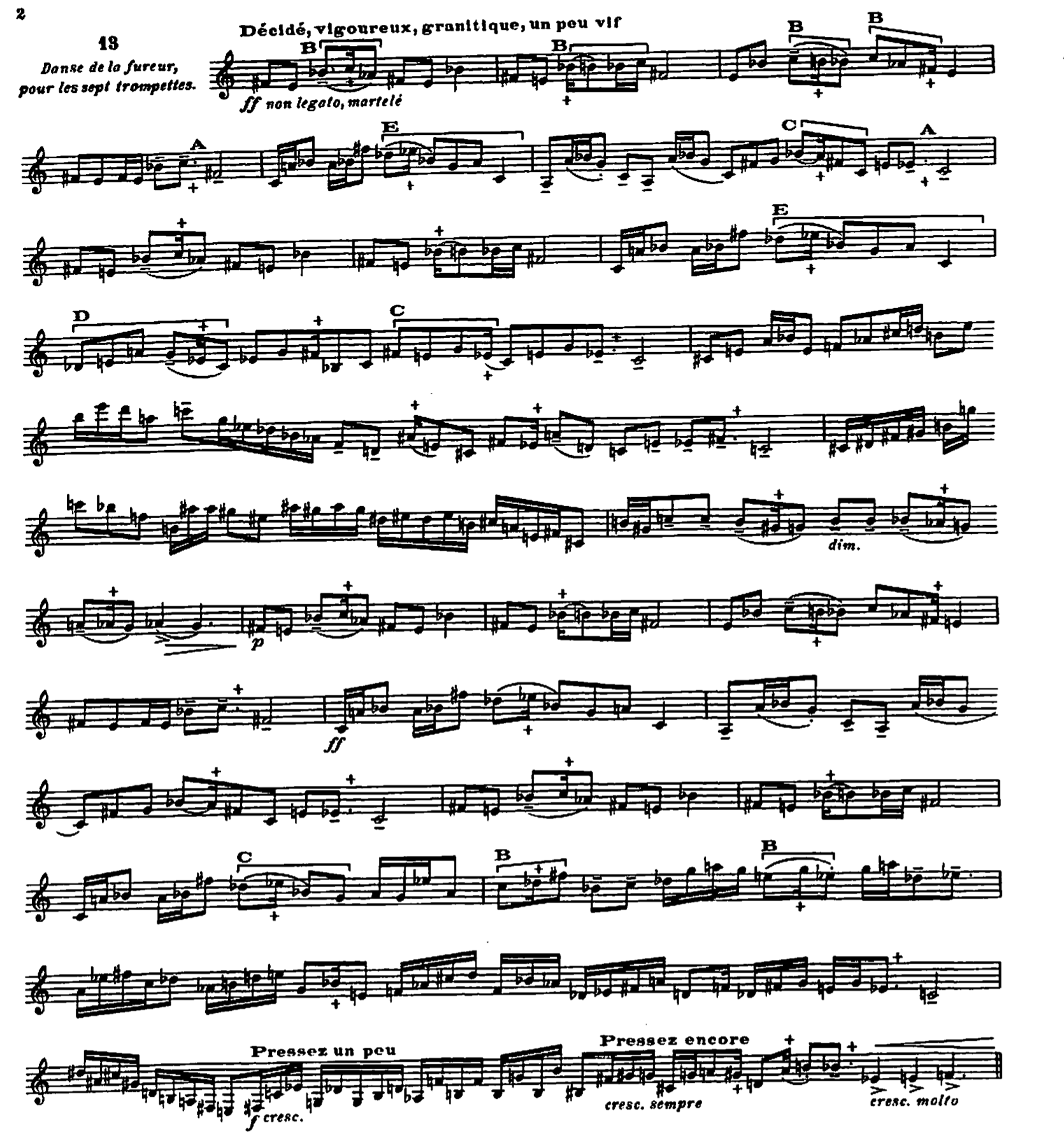
Messiaen explicitly connects prime numbers to his "predilection for these numbers" mentioned in Chapter II. Prime-numbered groups resist metric assimilation because they cannot be evenly divided—a span of seven cannot be organized into twos or threes without remainder, preventing easy metric parsing and reinforcing ametric character.
Modern Context: Contemporary metric theory analyzes prime-numbered groupings through concepts of metric consonance and dissonance (Lerdahl/Jackendoff) and non-isochronous periodicity (London). Prime numbers create maximal metric dissonance when set against duple or triple metric frameworks—they share no common factors, preventing alignment.
Composers working with additive rhythm frequently exploit prime numbers: Bartók's "Bulgarian rhythms" (2+2+3, 2+3+2, 3+2+2), Nancarrow's temporal canons with prime-number ratios, and Xenakis's stochastic distributions often emphasize prime-numbered structures. The mathematical indivisibility of primes translates to rhythmic structures that resist reduction to simpler metric schemes, maintaining complexity and avoiding predictable periodicity.
Examples: Example 10 (five plus one), Example 13 (five, seven, eleven, thirteen).