Added Value (Valeur Ajoutée)
Definition: A short durational value—realized through a note, rest, or dot—added to any rhythm, creating asymmetrical augmentation that disrupts metric regularity without destroying rhythmic definition.
Messiaen's Treatment: Messiaen defines added value through operational procedure: start with a simple, often symmetrical rhythm, then augment it by adding a small value. He demonstrates three mechanisms:
- Addition by note: Insert an additional short note into the rhythmic pattern (Example 7)
- Addition by rest: Insert an additional short rest into the rhythmic pattern (Example 8)
- Addition by dot: Extend one note within the pattern through dotting (Example 9)
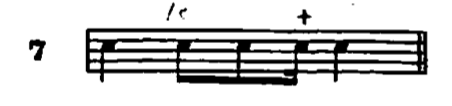
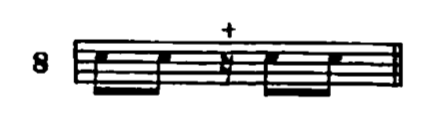
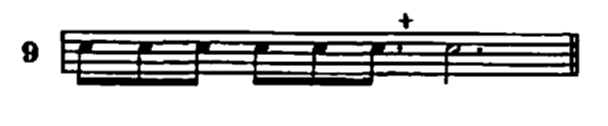
Crucially, Messiaen notes that in practice, the original simple rhythm almost never appears unmodified—the added value is present from the outset, not perceived as a subsequent alteration. The analytical separation of "original rhythm" and "added value" represents compositional process, not listener experience. The technique produces rhythmic patterns that suggest regularity but constantly evade it, creating what Messiaen describes as metric imbalance.
The added values are typically small relative to the basic rhythmic unit (often a sixteenth-note added to eighth-note-based patterns) but their placement creates significant perceptual effects—disrupting expected downbeats, extending or compressing phrase lengths, and preventing rhythmic patterns from establishing predictable periodicity.
Modern Context: Contemporary rhythm theory recognizes added values as a species of non-proportional augmentation. Traditional augmentation multiplies all durations by a constant factor (2x, 3x, etc.), producing isomorphic relationships—the augmented version preserves all proportional relationships of the original. Added values create non-isomorphic transformations—the relationship between original and modified versions cannot be expressed as simple scalar multiplication.
This technique anticipates later developments in rhythmic complexity:
- Metric modulation (Elliott Carter): Added values can function as pivot durations enabling tempo/metric shifts
- Irrational rhythms (Ferneyhough, new complexity): Added values represent early exploration of non-integer durational relationships
- Additive processes (Reich, Glass): Though minimalist additive processes operate differently, they share the principle of rhythmic transformation through addition rather than multiplication
The added value technique also relates to rhythmic "spreading" or "deformation"—taking regular patterns and introducing calibrated irregularity. This creates music that hovers between regularity and irregularity, metric and ametric, fostering a particular kind of temporal ambiguity that characterizes much of Messiaen's rhythmic language.
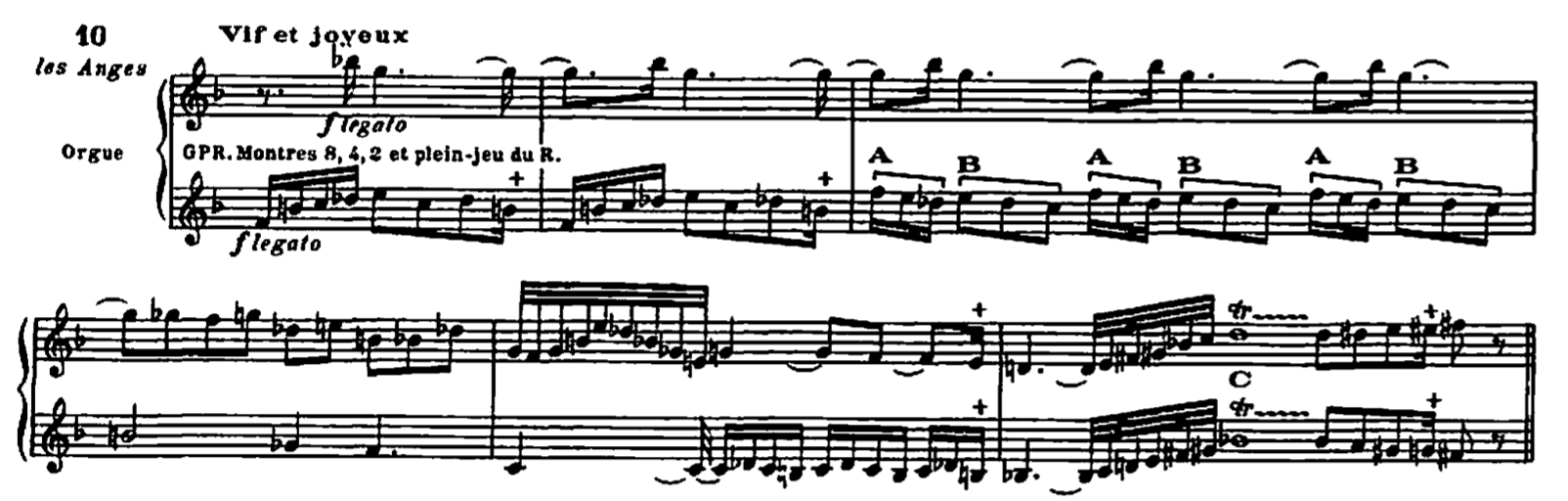
Examples: Examples 6–9 demonstrate basic added value operations; subsequent examples (10–19) show applications in musical contexts.