Nonretrogradable Rhythms (Palindromic Rhythms)
Definition: Rhythmic structures that, due to symmetrical organization around a central value, read identically forwards and backwards, possessing retrograde invariance such that the retrograde operation produces the original pattern.
Messiaen's Treatment: Messiaen defines nonretrogradable rhythms through their defining property: whether read from right to left or left to right, the order of values remains identical. Example 30 provides the simplest instance: outer values identical, middle value free. This creates a three-element palindrome (A-B-A) where the outer values frame a central pivot.
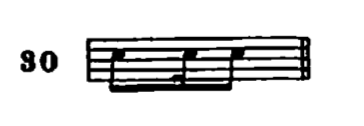
Example 31 demonstrates that all three-value rhythms disposed in this manner (outer values identical, middle value free) are inherently nonretrogradable. The principle extends beyond three values: any rhythm divisible into two groups where one group is the retrograde of the other, with a central common value connecting them, creates a nonretrogradable structure (Example 32).


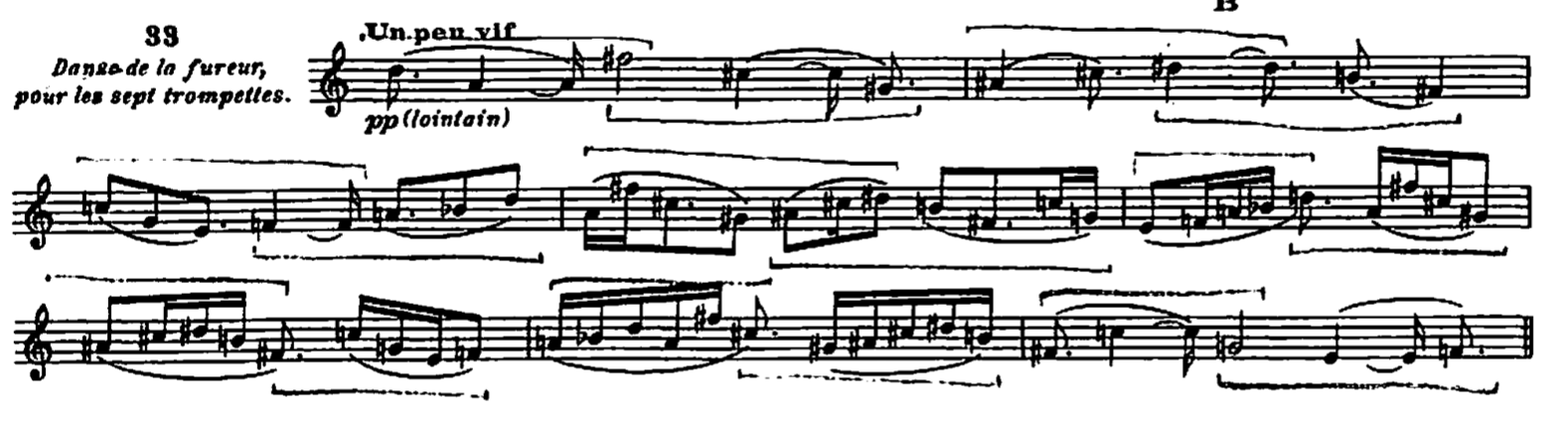
Example 32 shows a longer nonretrogradable rhythm where group B retrogrades group A, and a quarter tied to a sixteenth-note (a central value whose duration equals five sixteenth-notes) serves as the pivot connecting the two mirrored groups. Example 33 demonstrates a succession of nonretrogradable rhythms, showing how these structures can be deployed sequentially, and Example 34 presents a melodic movement that undergoes important rhythmic variants while maintaining nonretrogradable properties.

The construction principle is architectural: build outward from a central value (or central point between two values), adding durational values symmetrically to create mirrored wings. The central value functions as an axis of symmetry—values at equal distances from this axis must be identical for the structure to remain palindromic.
Modern Context: Contemporary music theory recognizes nonretrogradable rhythms as temporal palindromes—structures exhibiting bilateral symmetry in the time domain. These can be analyzed through:
- Symmetry operations: Nonretrogradable rhythms are invariant under retrograde transformation R, where R(x) = x. This represents a fixed point under R.
- Group theory: Palindromic structures form a subset of all rhythmic structures closed under retrograde operation, constituting a mathematical subgroup.
- Formal linguistics: Palindromes appear across multiple domains (words, DNA sequences, visual patterns) as instances of mirror symmetry, suggesting deep cognitive and aesthetic significance.
Nonretrogradable rhythms relate to other palindromic musical structures:
- Pitch palindromes: Melodic lines that retrograde themselves (though these are rarer due to harmonic implications)
- Formal palindromes: Arch forms (ABCBA) in larger-scale structures (Bartók, Berg)
- Harmonic palindromes: Chord progressions that mirror themselves (I-IV-V-IV-I)
The aesthetic and perceptual properties of palindromes have long fascinated composers. Palindromic structures can create:
- Temporal stasis: The absence of directional motion (no beginning vs. ending)
- Formal balance: Perfect symmetry suggesting completion and closure
- Perceptual ambiguity: Difficulty determining temporal direction when listening
Messiaen explicitly connects palindromic structure to aesthetic effect: the "charm of impossibilities" derives partly from the perceptual peculiarity of structures that sound the same regardless of temporal direction, suggesting a music outside normal temporal flow.
Examples: Examples 30–34 demonstrate various nonretrogradable constructions from simple to complex.