Third Mode of Limited Transpositions
Definition: A nine-note collection, transposable four times, consisting of three symmetrical groups of four notes each. These "tetrachords," taken in ascending movement, are divided into three intervals—a tone and two semitones.
Messiaen's Treatment: Messiaen demonstrates Mode 3 with the first transposition (Example 329), the second, third, and fourth transpositions (Examples 330–332), noting again that the fifth transposition duplicates the first, the sixth the second, and so on, according to the phenomenon observed in Mode 2. One can begin the scale on the second or third degree, but as with Mode 2, this produces only a new order of tones and semitones for each group without changing the notes constituting the mode or the chords it generates.


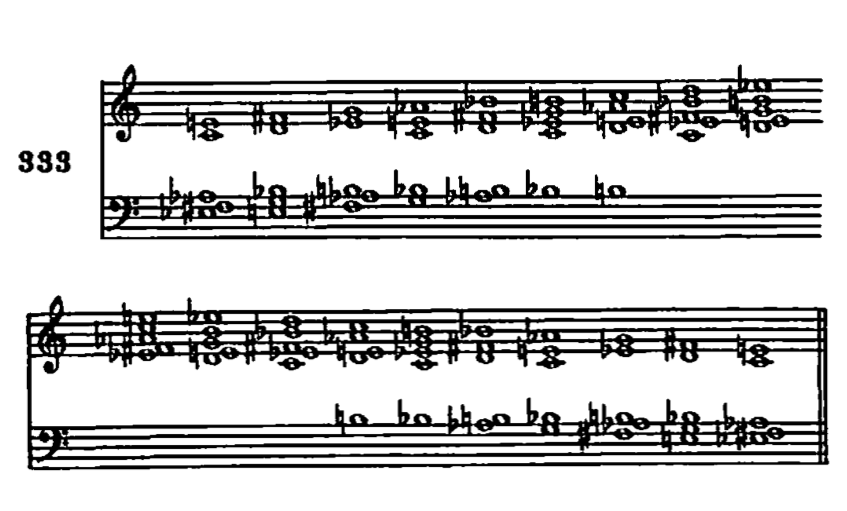
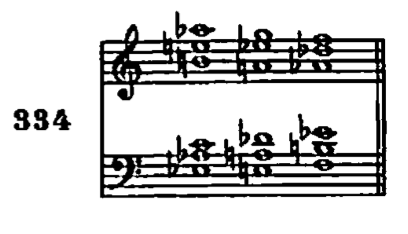
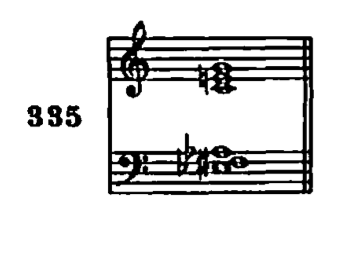
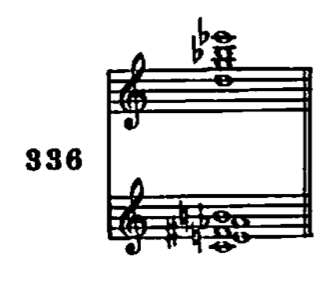
Mode 3 appears in parallel succession of chords with each voice realizing the entire mode starting on different degrees (Example 333). Example 334 shows contrary motion in second transposition, Example 335 presents the typical chord in first transposition, and Example 336 demonstrates a chord containing all notes of the mode in the same transposition. Two cadence formulas appear: the first in fourth transposition (Example 337), the second in contrary motion in first transposition (Example 338).
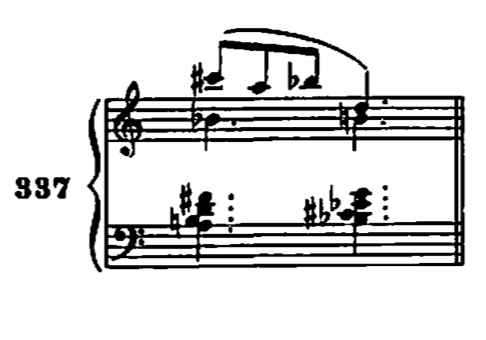
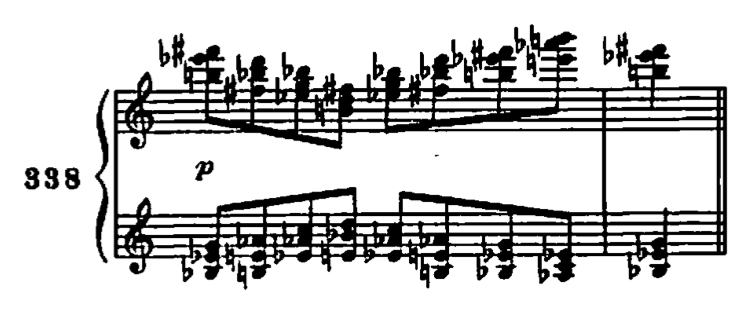
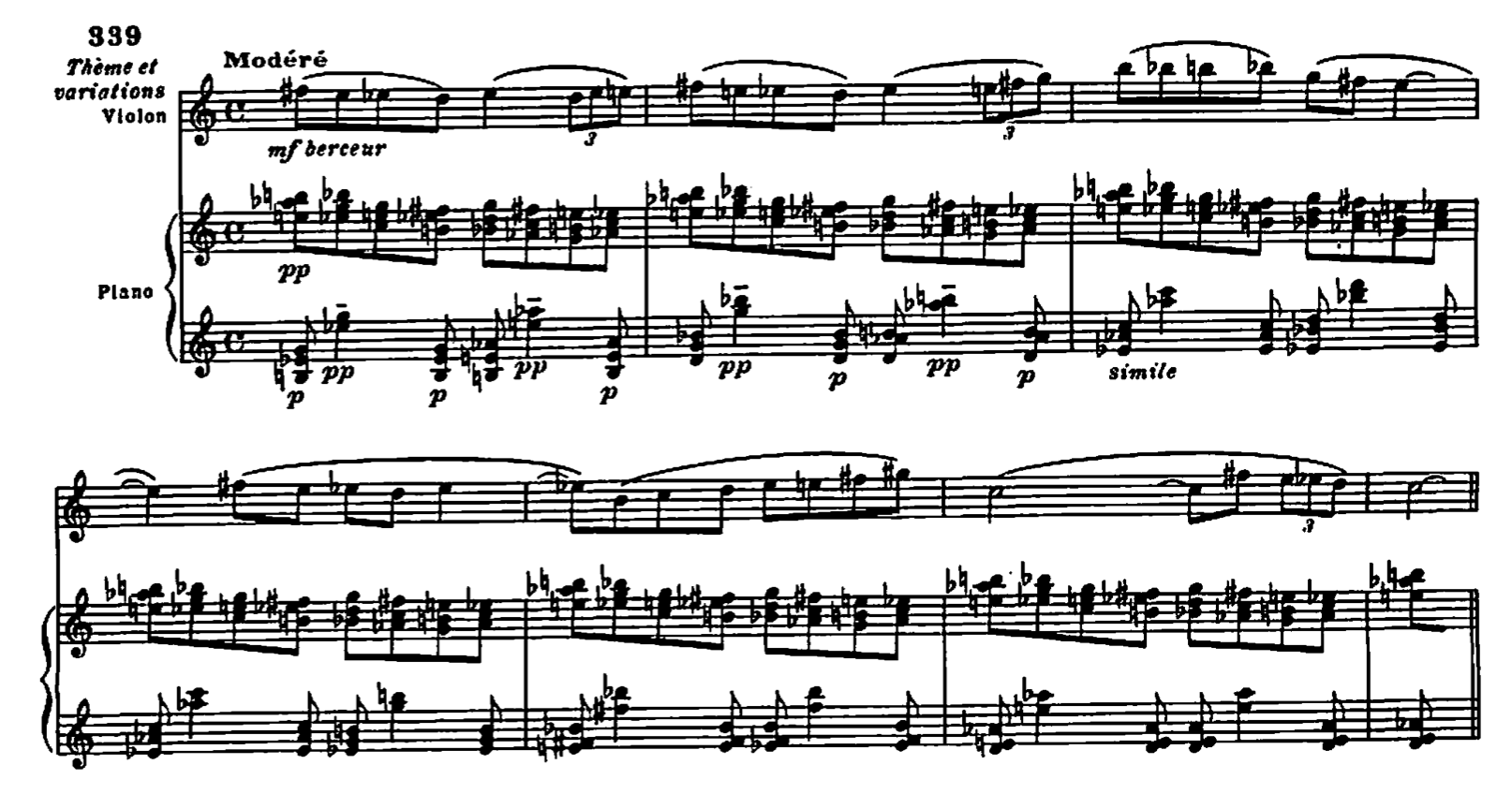
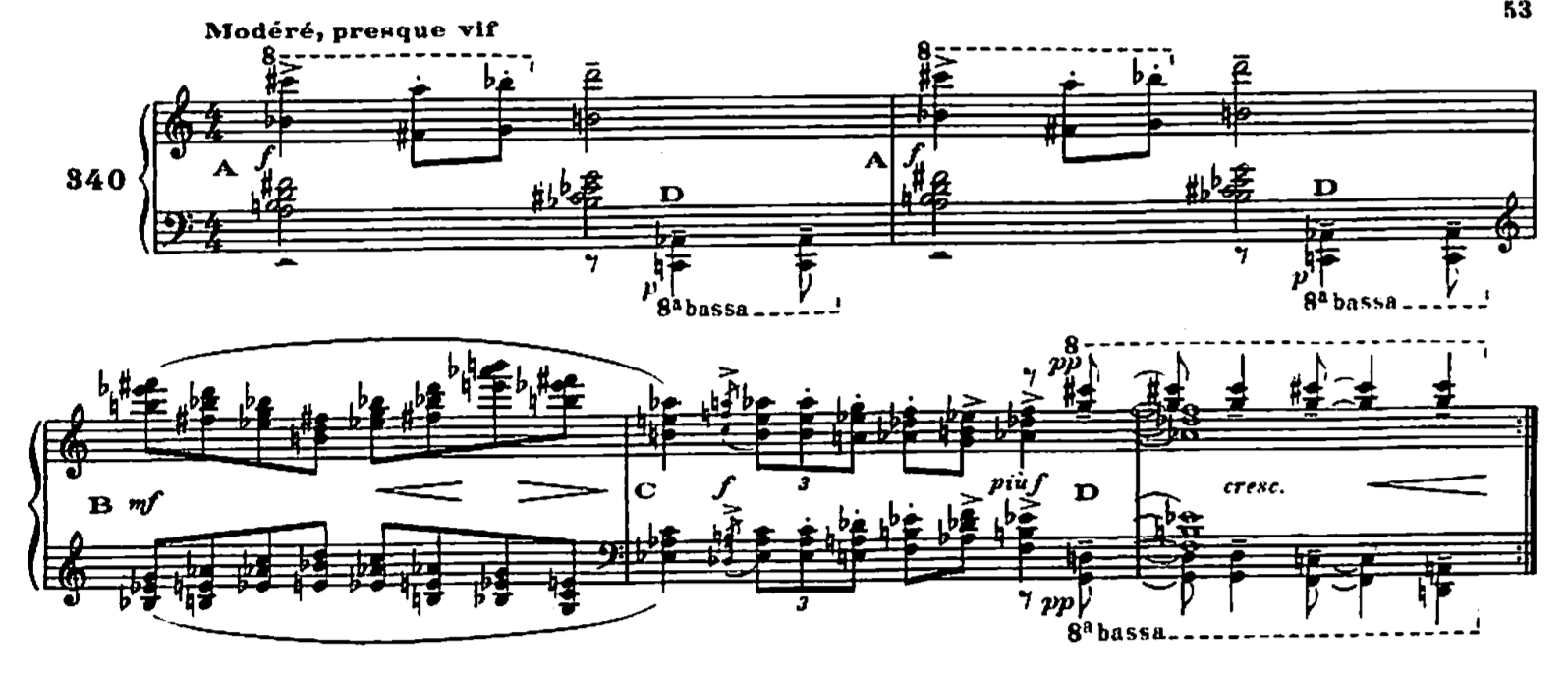
Example 339 demonstrates use of the third mode in a fragment that does not leave the mode's notes in first transposition. The cluster of chords repeated measure to measure in the upper staff of the piano constitutes a pedal group (referencing Chapter XV). Example 340 shows another use of the third mode employing cadence formulas from Examples 337 and 338 with contrary motion from Example 334: at A, fourth transposition; at B, first transposition; at C, second transposition. The three instances of the letter D indicate notes foreign to the mode, forming effects of superior and inferior resonances (referencing Chapter XIV, article 4).
Modern Context: The third mode of limited transpositions, while less frequently discussed in contemporary theory than the octatonic collection, appears in various twentieth-century works, particularly in passages employing augmented triads or hexatonic (augmented) relationships. Its interval-class vector reveals particular intervallic properties that distinguish it from other symmetrical collections. The mode's structure—alternating larger and smaller intervals—creates harmonic ambiguity similar to Mode 2 but with different coloristic properties. The nine-note collection approaches chromatic saturation (containing three-quarters of the chromatic total), yet maintains sufficient gaps to preserve modal identity.
Contemporary theorists recognize relationships between Mode 3 and hexatonic systems (collections built around augmented triads), as the mode contains multiple augmented triads and can be understood as a partial union of hexatonic collections. The mode's four distinct transpositions reflect its tetrachordal symmetry—each transposition represents a rotation of the underlying three-fold division of the octave. Messiaen's demonstration of how beginning on different scale degrees changes interval ordering but not pitch-class content parallels later theoretical concepts of rotational equivalence. The extensive use of Mode 3 in Messiaen's examples, combined with its integration with pedal groups and resonance effects, demonstrates how modal structures function not as abstract pitch collections but as practical harmonic resources that can be combined with other compositional techniques to create specific coloristic and formal effects.
Examples: Examples 329–340