Second Mode of Limited Transpositions (Octatonic Scale)
Definition: An eight-note collection consisting of four symmetrical groups of three notes each, with each "trichord" taken in ascending movement divided into two intervals—a semitone and a tone. The mode is transposable three times and corresponds to what later theorists call the octatonic or diminished scale.
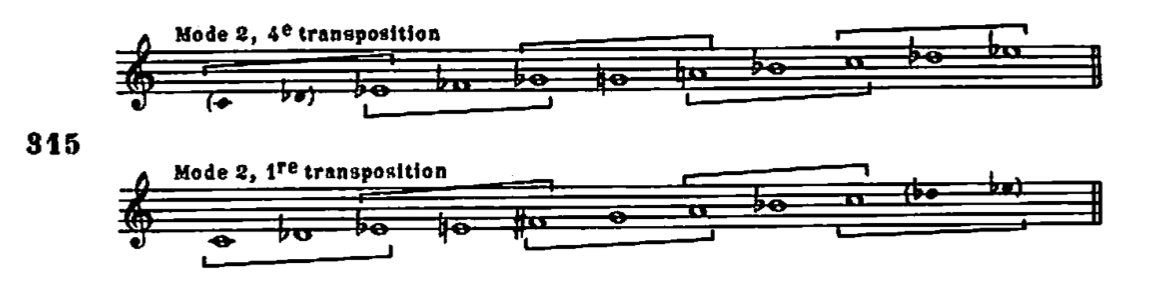
Messiaen's Treatment: Messiaen traces historical precedents: traces appear in Rimsky-Korsakov's Sadko, Scriabin uses it more consciously, and Ravel and Stravinsky employ it transiently, though the modal effect remains absorbed by classified sonorities rather than emerging distinctly. Mode 2 connects directly to the diminished seventh chord. Messiaen provides the first transposition (Example 312), the second and third transpositions (Examples 313 and 314), and notes that the fourth transposition reproduces the first enharmonically (Example 315). The fifth and sixth transpositions duplicate the second and third respectively.


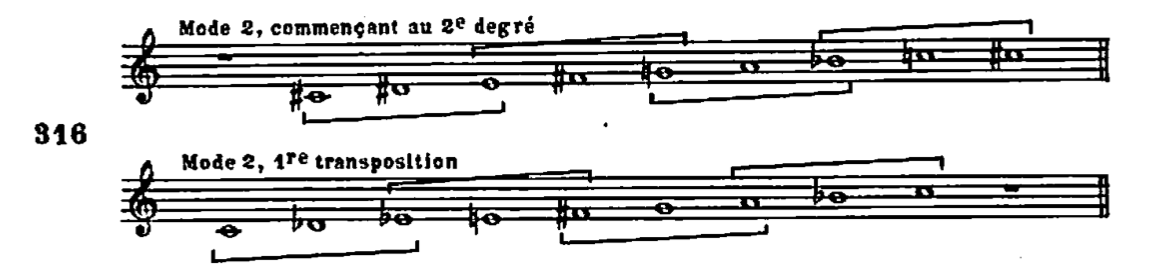
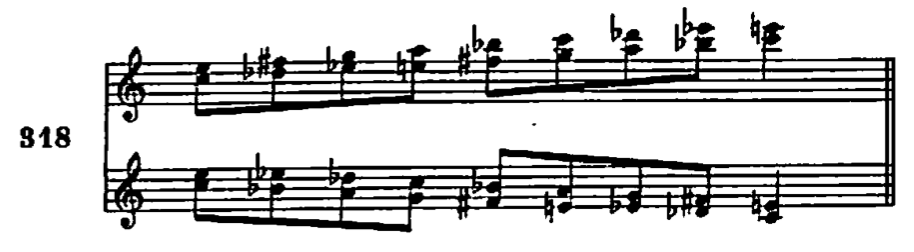
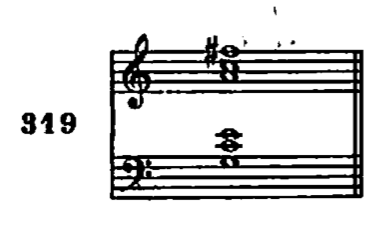
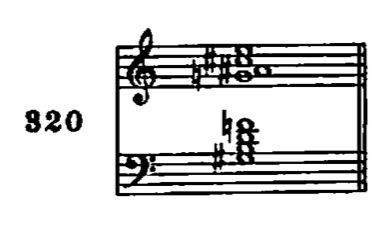
One can begin the scale on the second degree, producing intervals of a tone, then a semitone (instead of semitone, then tone), but this changes nothing in the chords created by the mode—one falls again enharmonically into the notes of the first transposition (Example 316). Messiaen demonstrates Mode 2 in parallel chord succession with each voice realizing the entire mode starting on different degrees (Example 317), showing how this succession alternates the six-four chord with added augmented fourth and the dominant seventh chord with added sixth (referencing Chapter XIII). Example 318 presents contrary motion in the same transposition, while Example 319 shows the typical chord of the mode. Example 320 demonstrates a chord containing all notes of the mode in its second transposition.

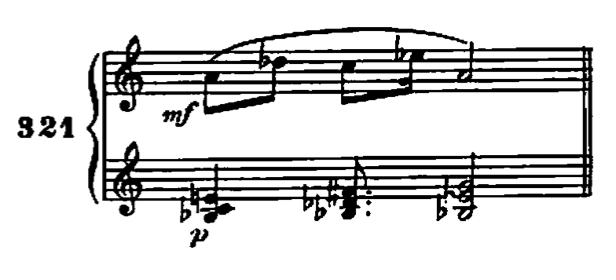
Various cadence formulas belonging to the second mode appear in Examples 321–324. The first formula constitutes the typical cadence of the mode in first transposition, already seen in Chapter VIII (Example 77, "la Vierge et l'Enfant"). The second formula uses the mode in second transposition. The third formula presents a progression of harmony: at A, first term in third transposition; at the cross, added value giving more force to accent preparation; at B, second term in first transposition with rhythmic variation; at the cross, value elongated by dot addition, slackening the descent. The fourth formula uses the second transposition.
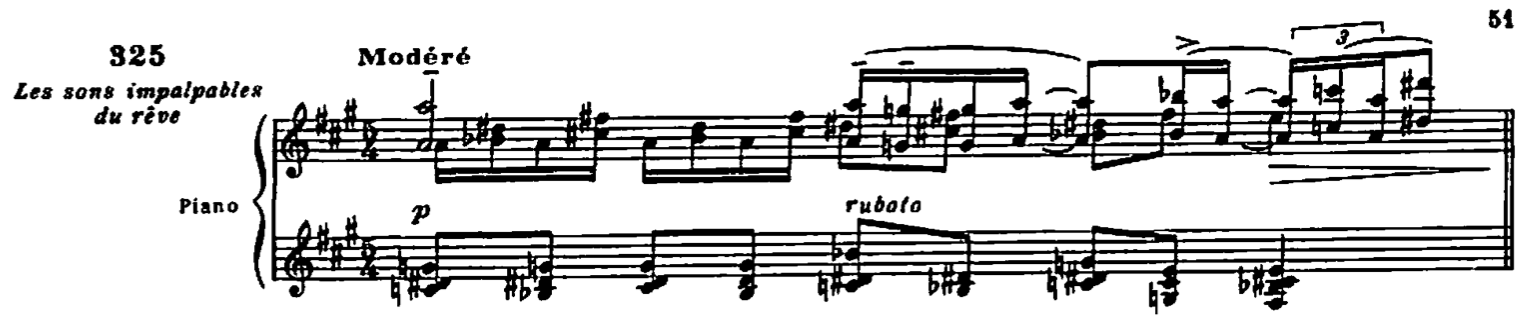
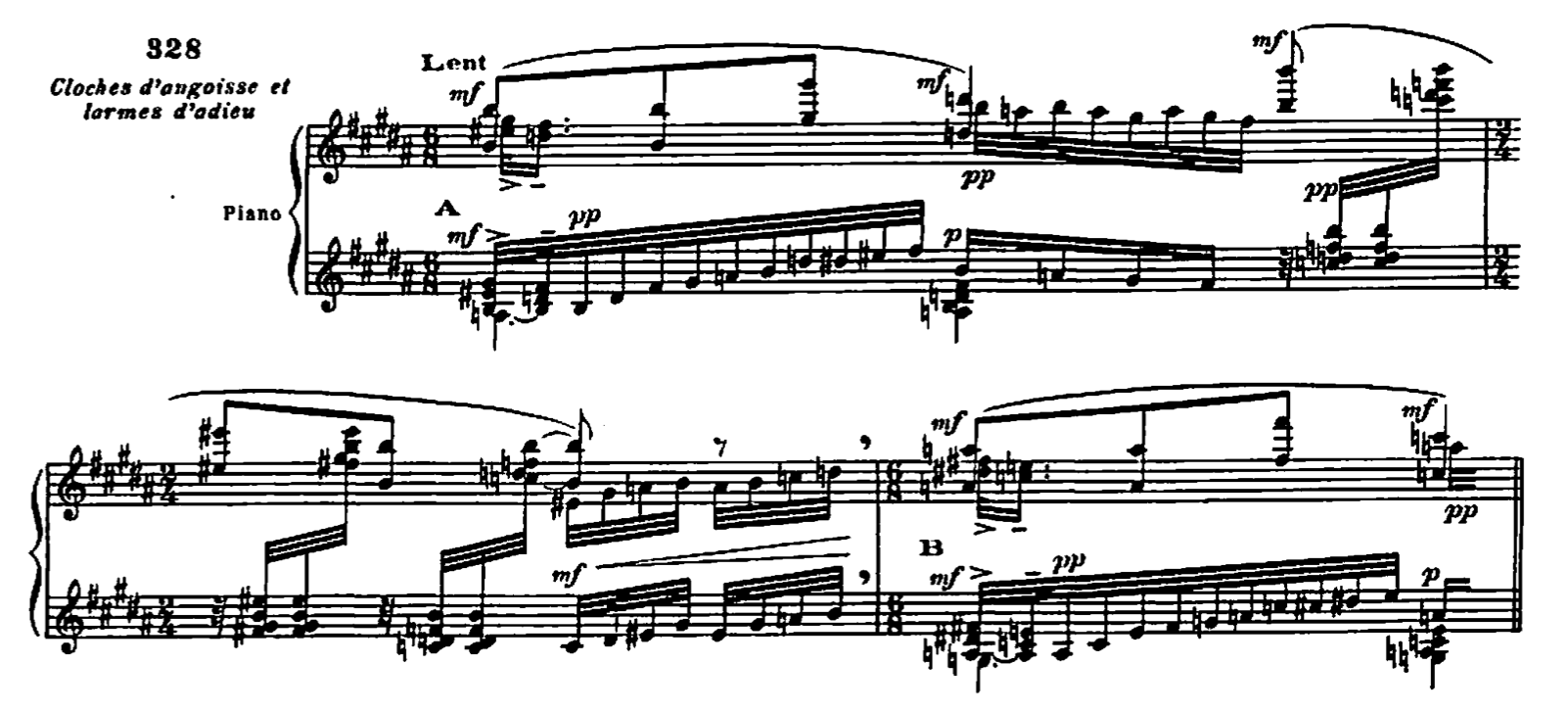
Messiaen notes frequent borrowings from the second mode in preceding chapter examples, providing new demonstrations (Examples 325–327) that do not leave the mode's notes in first transposition. The third example contains an interesting accompaniment formula in the piano (referencing Chapter XIV, paragraph 8), with melodic movement comparable to Chapter VIII Example 113 ("l'Ange aux parfums"). Example 328 uses Mode 2 at A in third transposition and at B in first transposition.
Modern Context: The octatonic collection represents one of the most important pitch structures in twentieth-century music, appearing prominently in works by Stravinsky, Bartók, and numerous later composers. Its interval-class vector (448444) reveals balanced distribution of interval classes, containing abundant semitones, minor thirds, tritones, and perfect fourths/fifths while excluding major thirds and major seconds. This intervallic content allows construction of various symmetrical harmonies: diminished seventh chords, French augmented sixth chords, half-diminished seventh chords, and dominant seventh chords with various alterations—all derivable from a single octatonic collection. Contemporary theory recognizes three distinct octatonic collections (corresponding to Messiaen's three transpositions), often designated OCT(0,1), OCT(1,2), and OCT(2,3) in pitch-class set notation.
The scale's alternating semitone-tone structure creates what Messiaen identifies as its characteristic sound, and its symmetrical properties make it particularly suitable for the kinds of parallel voice leading and symmetrical chord progressions he demonstrates. The connection to the diminished seventh chord—a structure long recognized for its symmetrical properties and enharmonic flexibility—provides historical continuity with nineteenth-century chromaticism while offering expanded harmonic possibilities. Jazz musicians independently rediscovered similar properties, naming this collection the "diminished scale" or "octatonic scale" and using it extensively for improvisation over diminished chords and altered dominants. The mode's capacity to simultaneously suggest multiple tonal centers while committing to none makes it ideal for Messiaen's aesthetic goal of existing "in the atmosphere of several tonalities."
Examples: Examples 312–328