Modes 4, 5, 6, and 7
Definition: Four additional modes of limited transpositions, each transposable six times and divided into two symmetrical groups. These modes present less compositional interest than Modes 1–3 due to their greater number of transpositions, but offer distinctive harmonic colors and connect importantly to Messiaen's melodic formulas and quartal harmonies.
Messiaen's Treatment: Messiaen notes that these modes are transposable six times, like the interval of the augmented fourth, and divide into two symmetrical groups. Four of these modes exist, bringing the total number of modes of limited transpositions to seven. One cannot find others transposable six times because all other combinations dividing the octave into two symmetrical groups either commence the scales of modes 4, 5, 6, and 7 upon other degrees than the first (which changes interval order but not the notes or chords of the modes, as previously established), or form arpeggios of classified chords, or form truncated versions of modes 2 and 5, or form truncated mode 5 specifically.
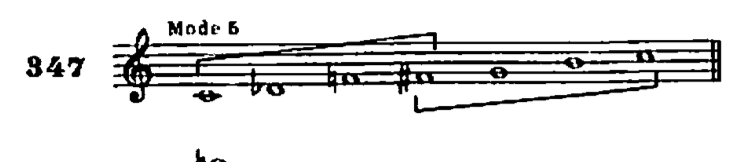
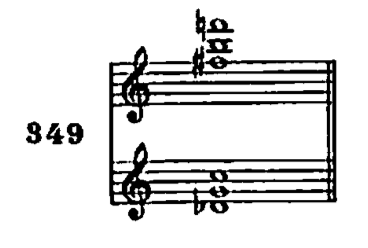
Messiaen provides examples demonstrating these modes: Mode 4 appears in Example 345, the same in parallel succession of chords (Example 346). He used this mode in "Prière exaucée" from his Poèmes pour Mi. Example 347 shows Mode 5 (the same scale less two notes); this truncated Mode 4 has quotation rights only because it engenders the melodic formula already seen in Chapter X (Example 348) and the chord in fourths analyzed in Chapter XIV, paragraph 3 (Example 349). Both the chord in fourths and the melodic formula contain all notes of Mode 5.



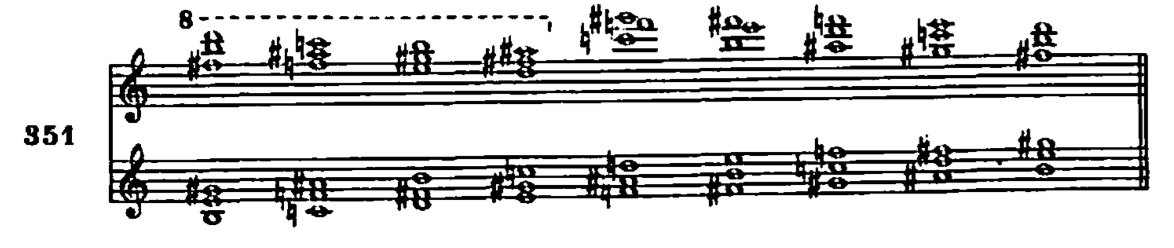
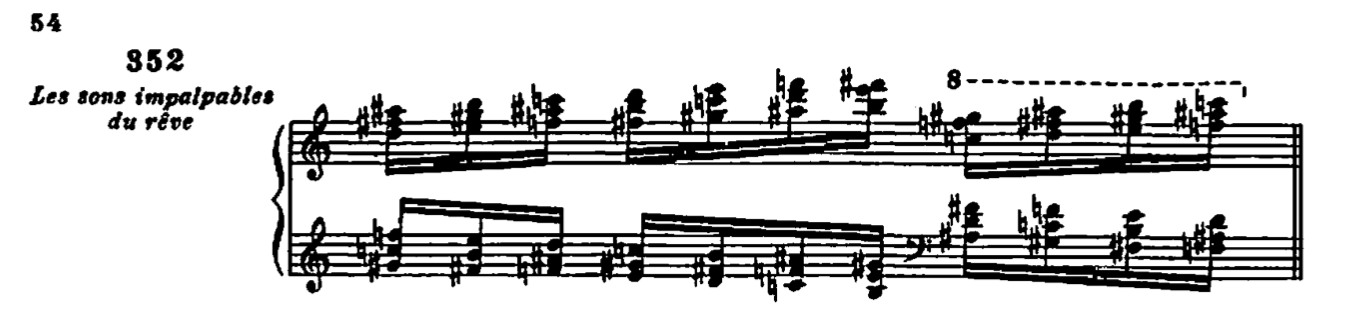
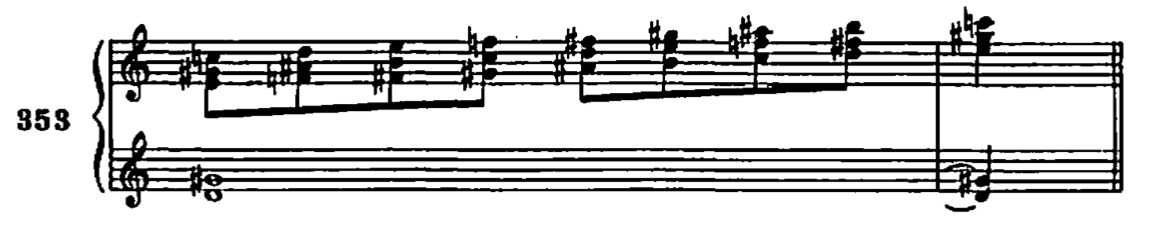
Mode 6 appears in Example 350, with contrary movement (Example 351), another contrary movement (Example 352), and the same mode in parallel succession of chords over a sustained augmented fourth (Example 353). For use of Mode 6, Messiaen references Chapter III, paragraph 2, Example 12 ("les Bergers"), which uses the mode in its fifth transposition, and Chapter VIII, paragraph 4, Example 109 ("la Vierge et l'Enfant"), which uses the mode in first transposition.

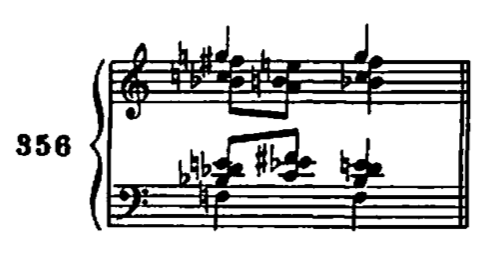
Finally, Mode 7 appears in Example 354, the same in parallel succession of chords (Example 355). Messiaen used this mode in the fourth part of l'Ascension: "Prière du Christ montant vers son Père," and recalls Example 253 of the list of chord connections (Chapter XIV, paragraph 8; Example 356), which uses all notes of Mode 7 in its fifth transposition (Example 357).



Modern Context: These modes represent what contemporary set theory would classify as additional symmetrical hexachords (six-note collections with two distinct transpositions each). Their lesser prominence in Messiaen's practice—and in subsequent theoretical discourse—reflects the observation that greater transposability correlates with reduced harmonic distinctiveness. Collections transposable six times approach the flexibility of fully chromatic materials while losing some of the characteristic "modal" flavor that modes with fewer transpositions possess. However, their connection to specific melodic formulas and chord types (particularly quartal harmonies) demonstrates how even these "less interesting" modes fulfill specific compositional functions.
The truncation relationships Messiaen identifies (Mode 5 as truncated Mode 4) reveal how these modes exist within a network of subset and superset relationships. Contemporary theorists might analyze these relationships using inclusion lattices or Z-relation concepts, though Messiaen's practical compositional perspective focuses on functional rather than abstract mathematical relationships. The integration of Mode 5 with both the melodic formula (Chapter X) and the chord in fourths (Chapter XIV) exemplifies Messiaen's synthetic approach where pitch collections serve multiple parametric functions—the same mode generates both horizontal (melodic) and vertical (harmonic) materials, ensuring consistency across compositional dimensions.
The reference to actual compositional usage (Poèmes pour Mi, l'Ascension) demonstrates that despite their theoretical "lesser interest," these modes proved sufficiently distinctive for practical application. This suggests that Messiaen's evaluation of "interest" relates not to absolute quality but to the degree of constraint and therefore distinctiveness that limited transposability provides—modes with fewer transpositions offer more constraints and thus more recognizable identity.
Examples: Examples 341–357
