Two Superposed Modes
Definition: The fundamental polymodal texture, consisting of two different modes of limited transpositions (or the same mode at different transposition levels) operating simultaneously in different textural layers, typically distributed between upper and lower staves or between different instrumental or vocal forces.
Messiaen's Treatment: Messiaen notes that several superpositions of modes have already appeared in preceding chapters, providing multiple examples of two-mode polymodality. He references Chapter VI, article 4, Example 49 ("Action de grâces"), which superposes Mode 3 (second transposition) upon Mode 2 (first transposition), except for the last measure which uses Mode 6, creating a modulation from polymodality to modality—this fragment serves as a model of rhythmic canon.
Example 302 from Chapter XV, article 1 ("Les sons impalpables du rêve") superposes Mode 3 (third transposition) upon Mode 2 (first transposition), with the upper staff music constituting a model of pedal group. Another example presents repetitions of a fragment of five chords in Mode 3 (third transposition) in the upper staff, with repetitions of a fragment of four chords in Mode 2 (first transposition) in the lower staff. These two pedal groups of unequal length repeat one above the other until meeting again at the point of departure (Example 371).
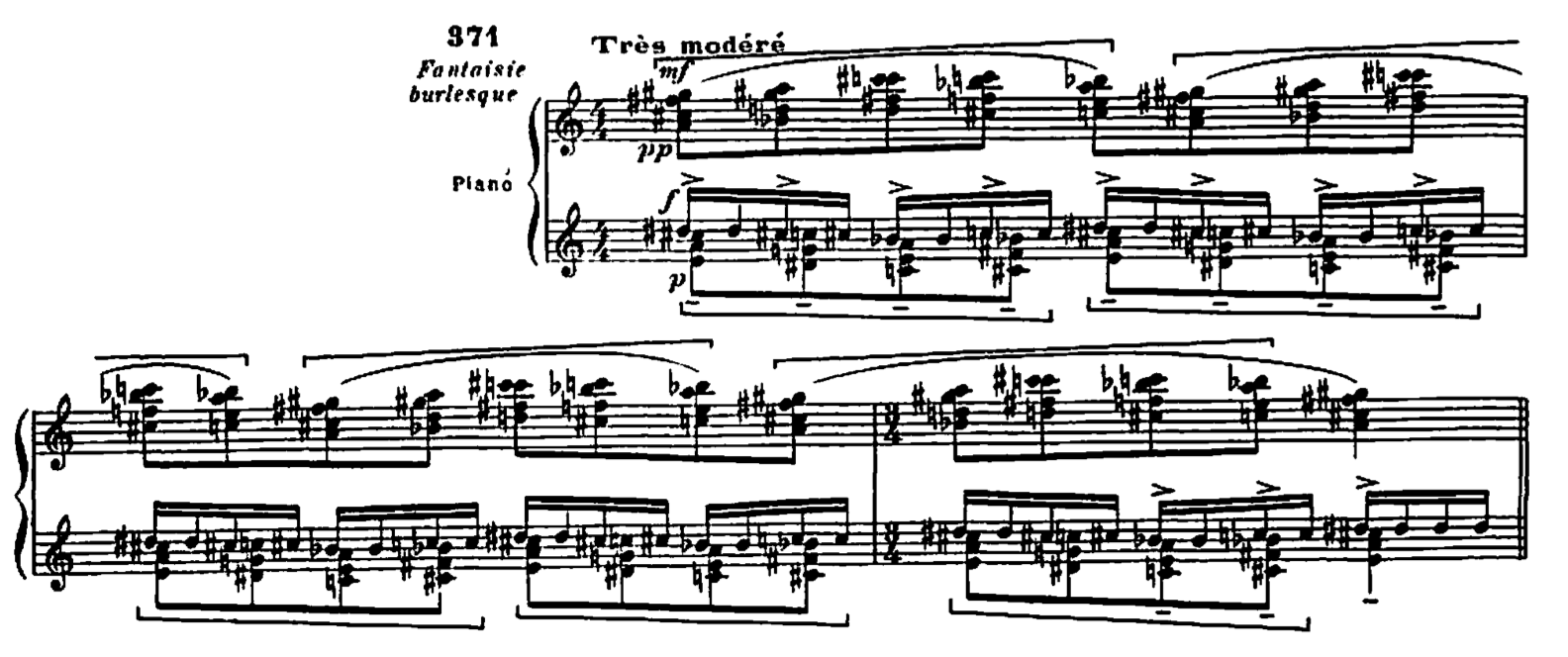
The following example proceeds from the same principle with this difference: the pedal groups undergo rhythmic variants. Upper staff presents repetitions of a fragment of seven chords in Mode 3 (third transposition); lower staff presents repetitions of a fragment of five chords in Mode 2 (first transposition). This second fragment is abbreviated at each repetition; its total duration is of ten, then nine, then seven, then five eighth-notes (Example 372).

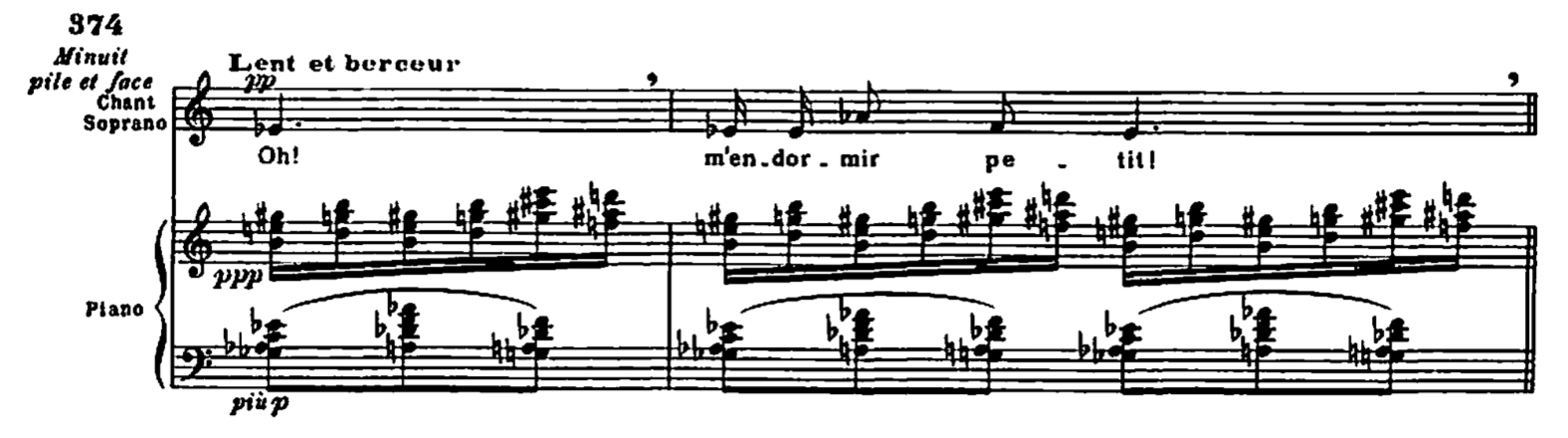
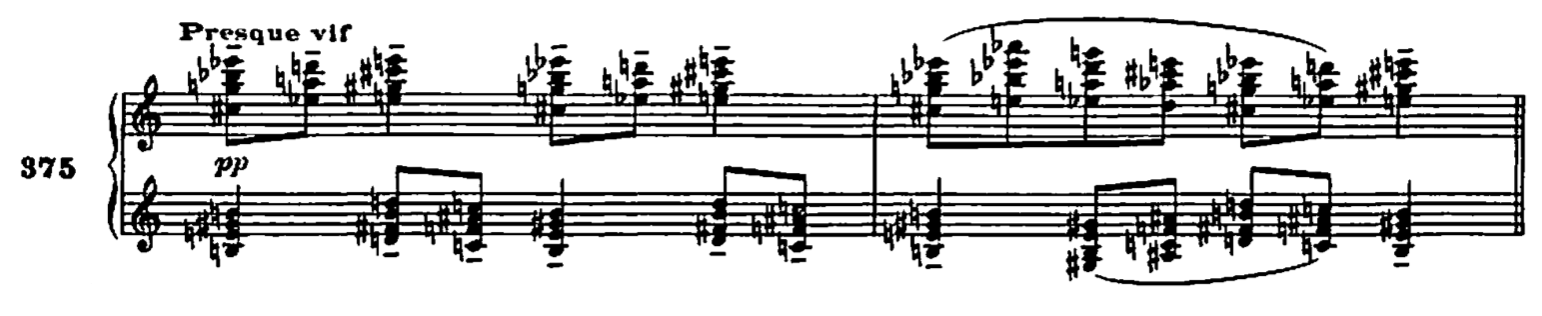
Additional two-mode superpositions include: Mode 3, first transposition (upper staff), upon Mode 2, second transposition (lower staff), with the second measure transposing the polymodality a tone lower (Example 373); Mode 2, second transposition (upper staff of the piano), upon Mode 7, first transposition (song and lower staff of the piano) (Example 374); Mode 4, third transposition (upper staff), upon Mode 6, first transposition (lower staff) (Example 375). Messiaen also references Chapter XIV, article 4, Example 217 ("Cloches d'angoisse et larmes d'adieu"), which superposes Mode 6, first transposition (cluster of chords B), upon Mode 2, second transposition (cluster of chords C).

Modern Context: Two-mode polymodality creates what contemporary set theory would analyze as the union of two distinct pitch-class collections. Depending on which modes are superposed and at which transposition levels, the resultant aggregate can range from near-chromatic saturation (if the modes share few common tones) to more restricted collections (if they share substantial pitch-class overlap). The technique of using pedal groups of unequal length (as in Examples 371–372) creates phasing or minimalist-like effects where the rhythmic relationship between layers constantly shifts—the layers gradually move in and out of synchronization, creating evolving vertical sonorities even though each layer internally remains consistent. This anticipates techniques later systematized by composers like Steve Reich and Philip Glass, though Messiaen's application remains more harmonically complex through the use of distinct modal collections rather than simple melodic patterns.
The rhythmic abbreviation technique (Example 372) demonstrates integration of parametric processes—the lower layer undergoes systematic rhythmic compression (ten, nine, seven, five eighth-notes) while maintaining modal consistency, creating simultaneous harmonic and temporal transformation. Contemporary composers working with process music or algorithmic composition would recognize this as systematic manipulation of multiple musical parameters according to independent procedures. The specific modal combinations chosen (Mode 2 with Mode 3 appears frequently, as do Mode 2 with Mode 6, Mode 2 with Mode 7, Mode 4 with Mode 6) suggest that Messiaen found these particular unions produced especially rich or characteristic sonorities, though he doesn't explicitly articulate principles for selecting compatible mode pairs.
Examples: Examples 371–375 (with references to Examples 49, 217, 302 from previous chapters)