Fugue: Episode and Stretto
Definition: The traditional contrapuntal form built on systematic imitative entries of a subject, with Messiaen identifying episode (progression of harmony concealed by canonic entrances at symmetrical intervals) and stretto (overlapping entries creating intensification) as essential elements adaptable to modal contexts.
Messiaen's Treatment: Messiaen states he will pass over fugue and sonata rapidly, assuming reader familiarity. Without constraining himself to making regular fugues, he will keep the most essential parts: episode and stretto.
The episode is a progression of harmony concealed by entrances in canonic imitation at symmetrical intervals, generally fifth to fifth. He cites Bach's Kyrie from Mass in B minor, the first movement of Sixth Trio Sonata for organ, and Fugue in G minor for organ as support for this definition.
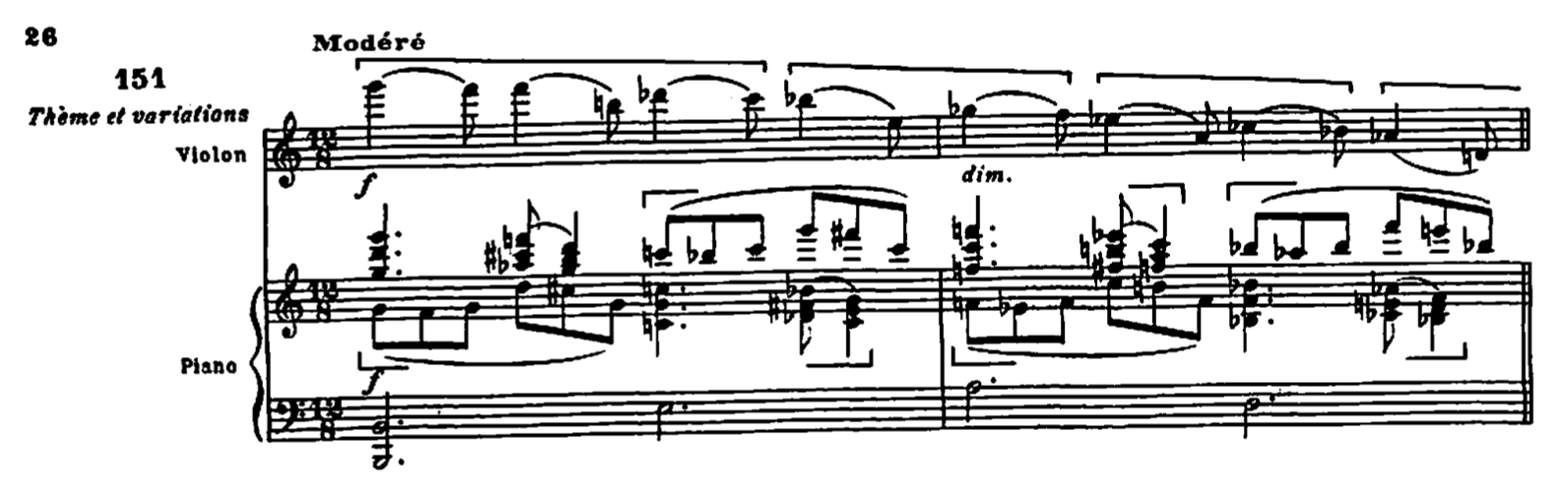
Example 151 demonstrates an episode: in piano, harmonic progression with symmetrical entrances from fifth to fifth upon the head of the subject elongated by a coda; in violin, descent upon the head of the countersubject.
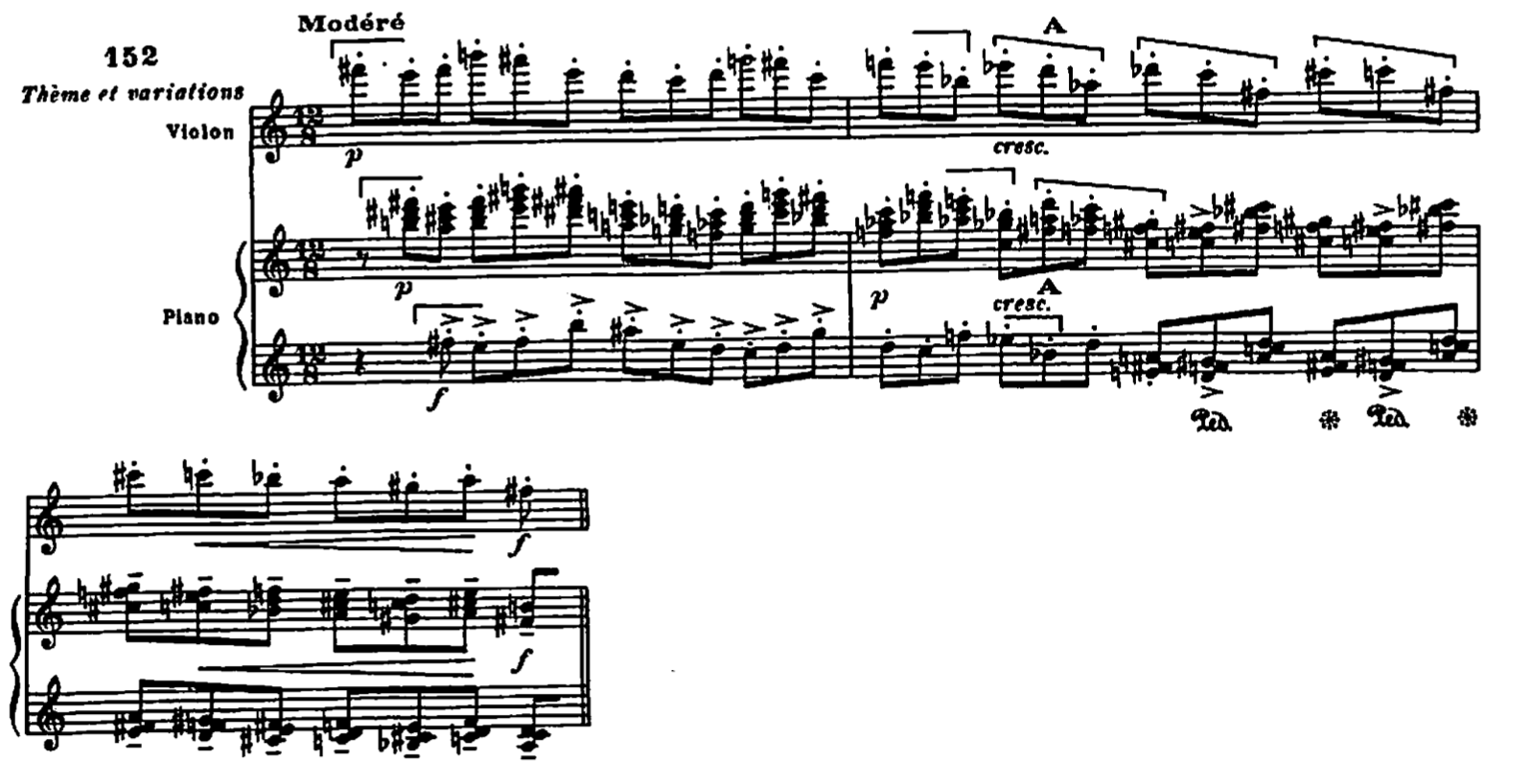
Example 152 shows stretto in triple canon at the octave, at one note's distance, using Mode 3 in its third transposition from point A forward.
Modern Context: Messiaen's approach to fugue reflects modernist selective appropriation of Baroque procedures:
Traditional fugue elements retained:
- Subject: Thematic material for imitative development
- Episode: Developmental sections with sequential treatment
- Stretto: Overlapping entries creating climactic intensification
- Canonic imitation: Systematic voice leading at specific intervals
Elements transformed or omitted:
- Tonal answer: Real vs. tonal answer distinction irrelevant in modal context
- Counter-exposition: Formal rigidity relaxed
- Functional harmony: Episodes no longer modulate through tonal regions but rather shift modal transpositions
Historical context:
- Baroque fugue: Strict formal procedures, tonal hierarchy (Bach, Handel)
- Romantic fugue: Freer treatment, integration with other forms (Brahms, Mendelssohn)
- Modernist fugue: Adaptation to atonal/modal contexts (Hindemith's Ludus Tonalis, Shostakovich's 24 Preludes and Fugues, Berg's use in Wozzeck)
Messiaen's "canonic imitation at symmetrical intervals, generally fifth to fifth" adapts traditional fugal spacing (dominant answer) to modal context. In modes of limited transposition, the fifth may function differently than in tonal music, but the intervallic relationship provides structural consistency.
The triple canon stretto (Example 152) at "one note's distance"—each voice entering immediately after the previous—creates maximum contrapuntal density, characteristic of climactic fugal stretti.
Examples: Examples 151–152 demonstrate episode and stretto adapted to modal contexts.