Modulation of a Mode to Another Mode
Definition: The technique of moving from one mode of limited transpositions to a different mode, creating large-scale harmonic transformation while maintaining the principle of symmetrical pitch organization. This process allows composers to access different harmonic colors and intervallic structures while remaining within the modal system.
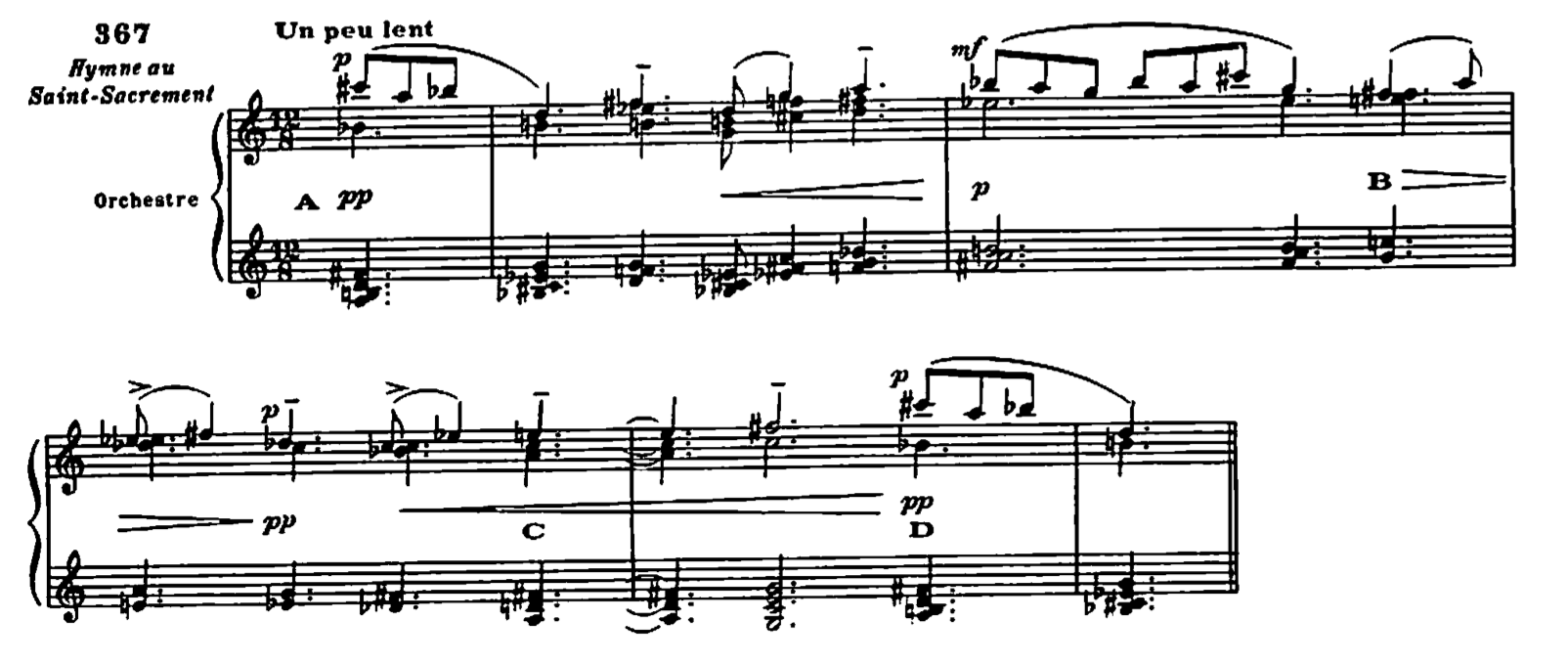
Messiaen's Treatment: Messiaen demonstrates modulation from the third mode to the second mode (Example 367): at A, third mode in fourth transposition; at B, second mode in first transposition; at C, major tonality; at D, third mode. General impression of G major arises from frequent return of the tonic G and from the dominant seventh at letter C.
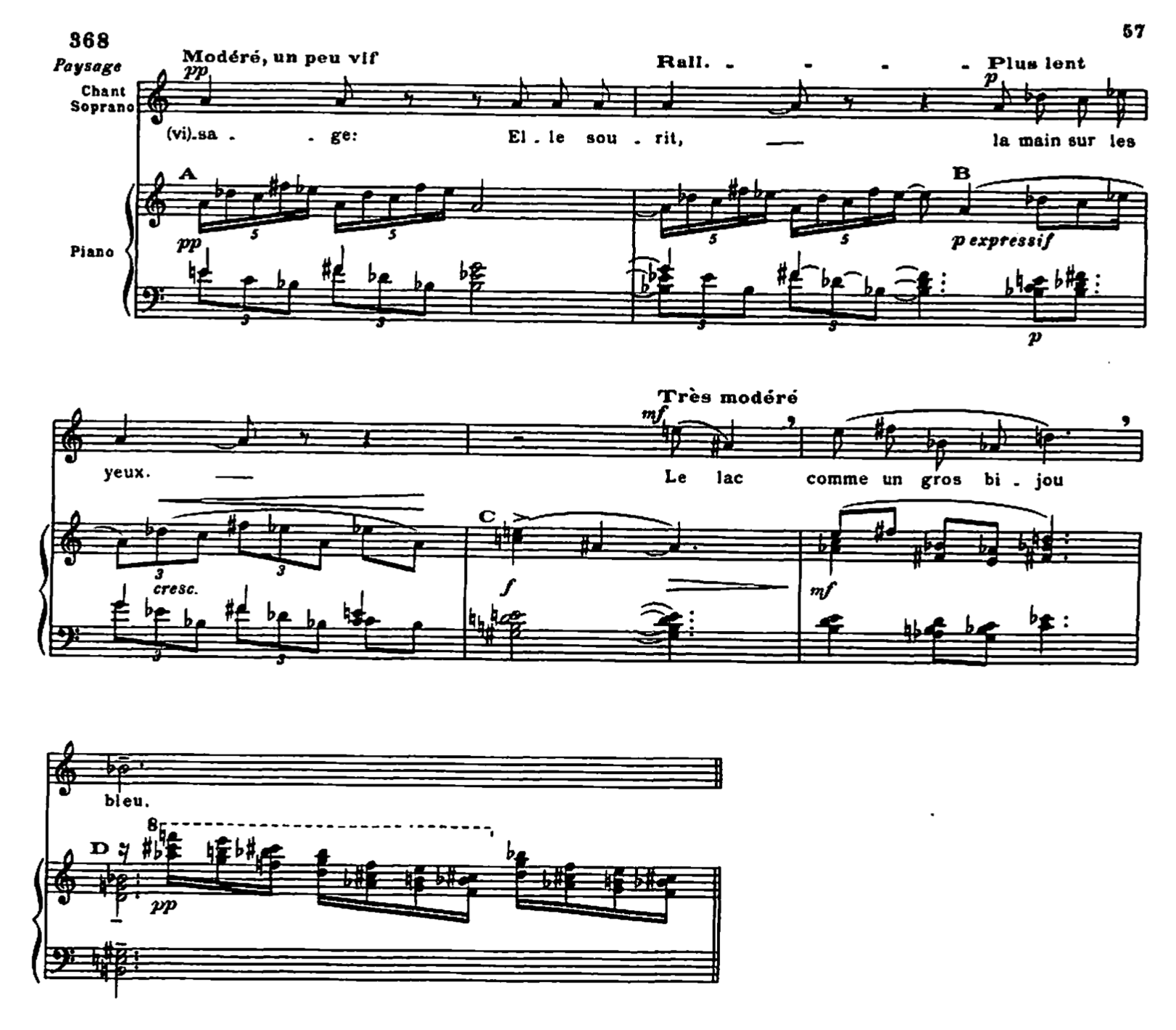
Example 368 shows modulation from the second mode to the third mode: from A to C, second mode in first transposition; at B, cadence formula of this mode (referencing Chapter XVI, Example 321); at C, third mode in first transposition; at D, second mode in second transposition.
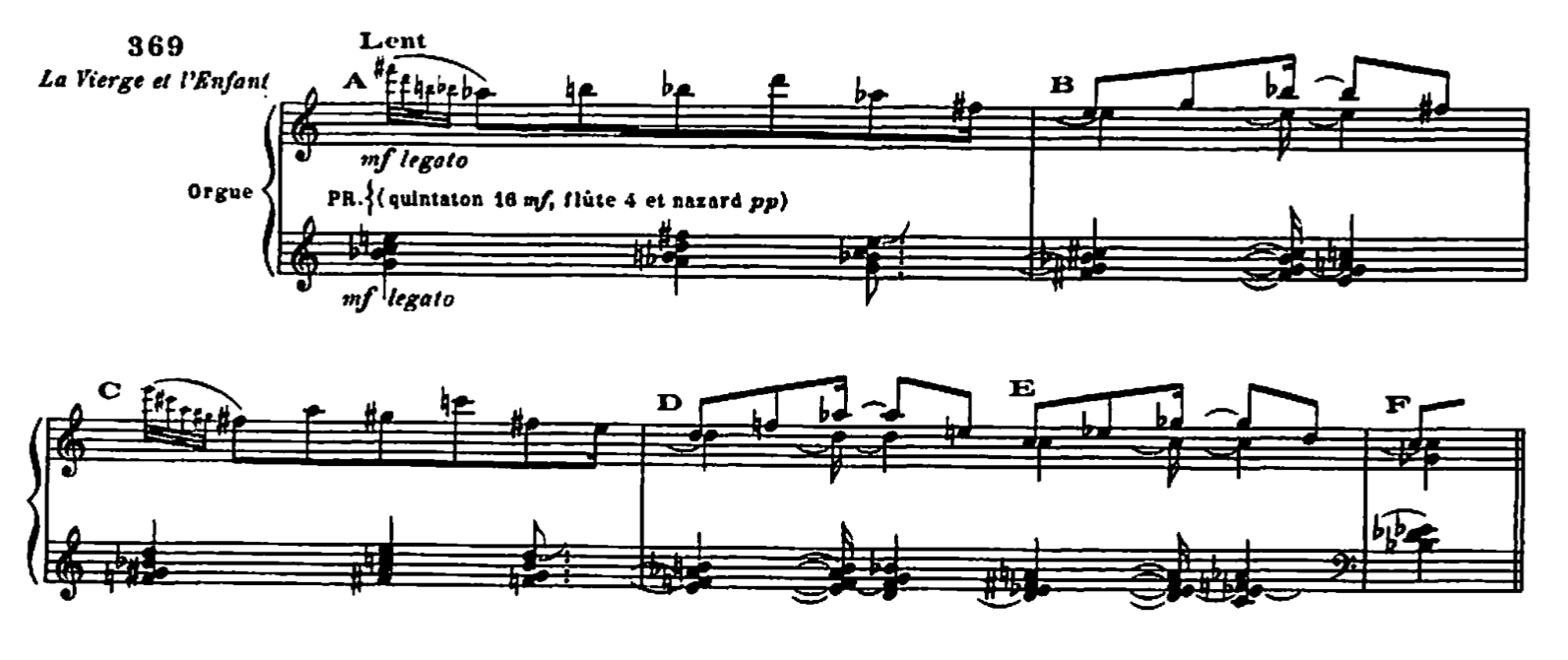
Example 369 presents alternation of the third mode and the second mode in progression. At A, third mode; at B, second mode; at C, third mode; at D, second mode. At E, second mode transposed; at F, another transposition of the second mode.
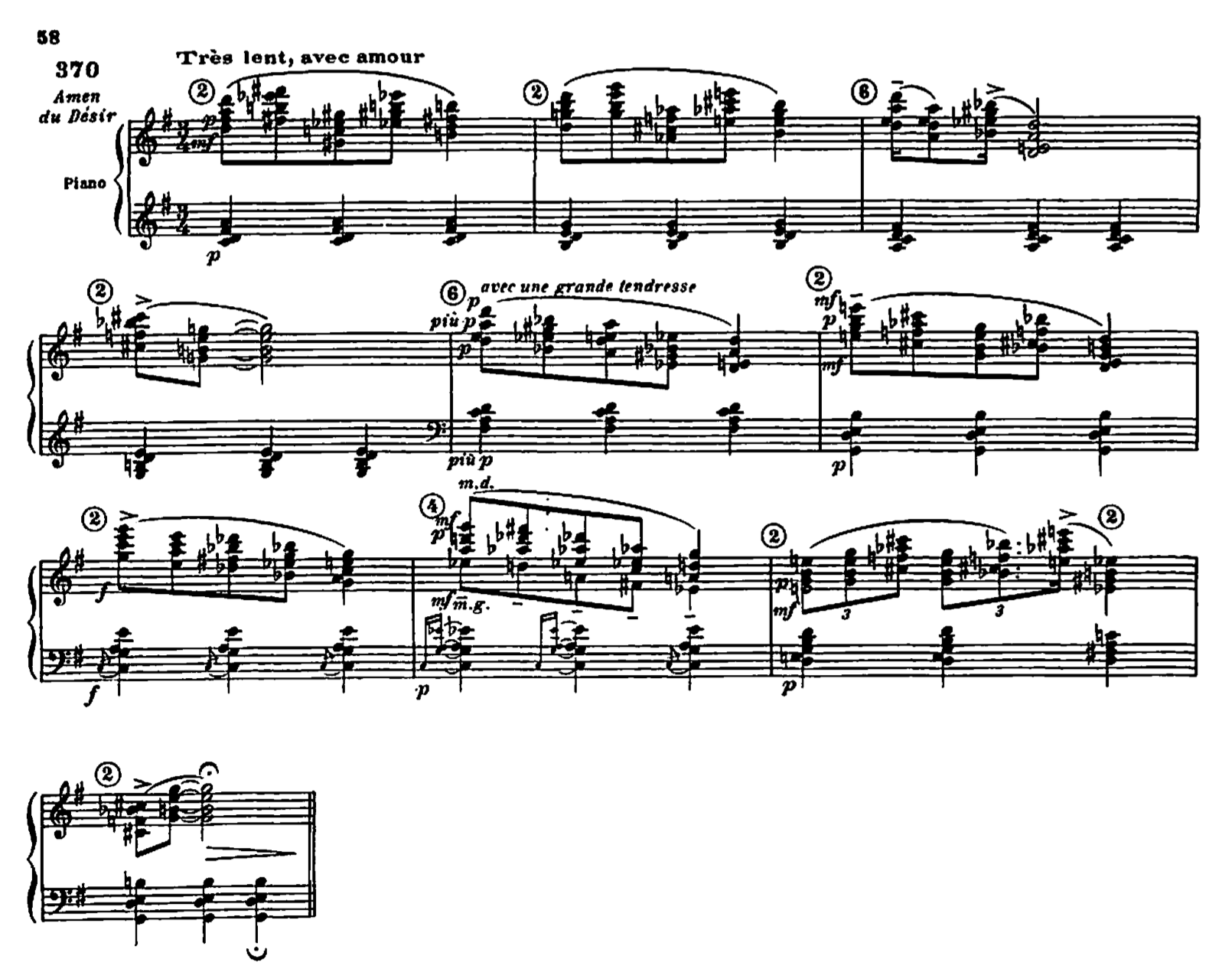
Example 370 demonstrates modulation from Mode 2 to Modes 6 and 4. Melodic contours resemble Mozart. The harmonies of the lower staff are simple and tonal; the modes mingled there suffice to communicate infinite tenderness and divine love. The numerals indicate the modes: moving successively through Mode 2 (third transposition), Mode 2 (second transposition), Mode 6, Mode 2, Mode 6, Mode 2 (second transposition), Mode 2 (first transposition), Mode 4, Mode 2 (second, then third, then second transpositions). It is evident that the passage remains in G major.
Modern Context: Inter-modal modulation represents sophisticated harmonic practice, requiring careful voice-leading to manage transitions between collections with different intervallic structures and pitch-class content. Contemporary set theory would analyze these modulations by examining common-tone relationships and voice-leading efficiency between the source and target collections. Some mode pairs share significant pitch-class overlap (for instance, certain transpositions of Mode 2 and Mode 3 might share multiple pitches), facilitating smooth transitions. Other combinations require more dramatic harmonic shifts.
The integration of multiple modes within a single passage (as in Example 370) creates what later theorists might call "patchwork" or "mosaic" form—sections using different harmonic materials juxtaposed to create larger structures. However, Messiaen maintains that these passages can still project clear tonal orientation (Example 370 "is evident that we are in G major") through strategic emphasis of tonal centers and use of traditional harmonic functions. This demonstrates the compatibility of modal and tonal thinking in Messiaen's practice—modes provide harmonic color and intervallic interest, while tonal principles provide large-scale orientation and structural coherence.
The comparison to Mozart in Example 370 is particularly revealing—Messiaen suggests that Classical-era melodic fluency and simplicity can be achieved using modal harmonies, provided the modes are deployed with sensitivity to voice-leading and tonal implication. This contradicts potential assumptions that modal harmony necessarily produces modernist, dissonant, or anti-traditional effects. Instead, Messiaen demonstrates that modes can serve expressive goals (communicating "infinite tenderness and divine love") traditionally associated with tonal music, offering composers expanded harmonic resources without requiring abandonment of expressive clarity or melodic grace.
Examples: Examples 367–370