Modulation of a Mode to Itself
Definition: The technique of changing transposition levels within a single mode, creating harmonic motion while maintaining the mode's characteristic intervallic structure and sonority. This process functions analogically to traditional modulation between keys but operates within the constraints of symmetrical pitch collections.
Messiaen's Treatment: Messiaen explains that modes can modulate to themselves or borrow from themselves in their different transpositions. Example 137 from Chapter XI (Les Offrandes oubliées), in which Mode 2 borrows from itself in almost every chord, bears witness to this technique. Example 363 demonstrates another instance: the first measure contains the dominant seventh of F-sharp major in Mode 2, second transposition (Example 364); the second measure presents the perfect chord of F-sharp major in Mode 2, first transposition (Example 365). The e-sharp in the second measure does not belong to the mode, creating very intense tonal impression of F-sharp major and modulation of the mode to itself without the tonality yielding. The pedal, played in droplet-like staccato, sounds an octave above the notation; the true bass is thus in the left hand.
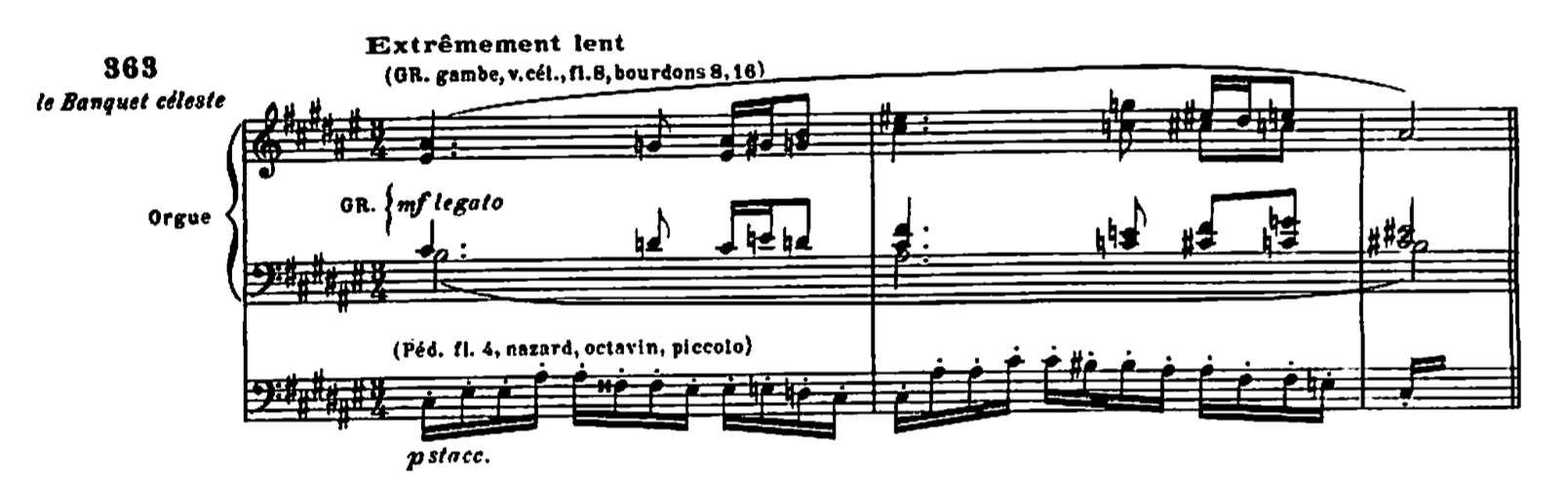


Example 366 provides a last example using exactly the same effect but in more striking fashion: at A, upper staff uses Mode 2, second transposition, with lower staff presenting third inversion of the dominant seventh chord of F-sharp major; at B, upper staff uses Mode 2, first transposition, with lower staff presenting first inversion of the perfect chord of F-sharp major.

Modern Context: This technique parallels what contemporary theory might call "transposition within a pitch-class set" or "rotational transformation." However, Messiaen's approach emphasizes perceptual continuity—the mode's characteristic sound remains recognizable despite transposition, while the change of pitch level creates a sense of harmonic motion analogous to traditional modulation. In jazz theory, similar techniques appear when improvisers or arrangers transpose octatonic or other symmetrical collections to create harmonic progression while maintaining modal consistency. The concept also relates to what theorists call "hexatonic" or "octatonic cycles," where systematically transposing symmetrical collections creates networks of harmonic relationships. Messiaen's specific examples show how modal transposition can be coordinated with traditional tonal materials (dominant seventh chords, perfect triads) to create hybrid harmonic progressions that combine modal color with tonal direction. The technical challenge lies in managing the transition between transposition levels—since the modes contain only certain pitch classes, moving from one transposition to another necessarily involves changing some pitches, and Messiaen demonstrates how to make these changes feel natural rather than disruptive. The pedal-point technique (sustained or reiterated bass) helps smooth these transitions by providing continuous tonal orientation even as upper voices change modal transposition.
Examples: Examples 363–366 (with reference to Example 137 from Chapter XI)