Relation to the Major Tonality
Definition: The technique of combining modes of limited transpositions with traditional major-key tonality, either by emphasizing tonal implications inherent within the mode or by mixing modal and non-modal materials to create tonal orientation while preserving modal coloring.
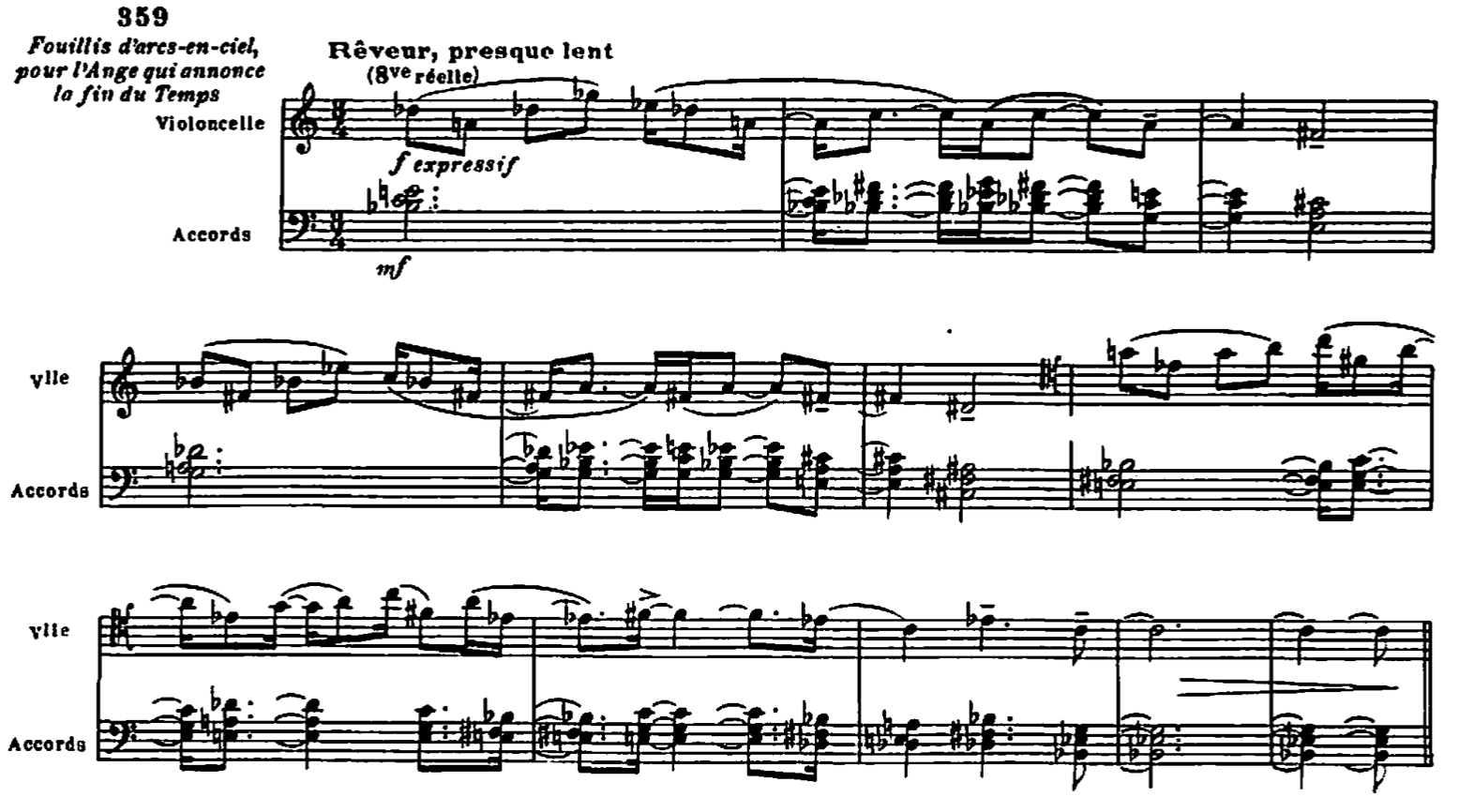
Messiaen's Treatment: Messiaen reiterates that the modes exist "in the atmosphere of several tonalities at once, without polytonality, the composer being free to give predominance to one of the tonalities or to leave the tonal impression unsettled." Mode 2 in its first transposition (Example 358) can hesitate among the four major tonalities of C, E-flat, F-sharp, and A. Example 359 demonstrates use of this tonal indecision of Mode 2 (same transposition), quoting only the violoncello song and chords while omitting the piano's accompaniment formula. The passage does not leave the mode's notes; three stops on the six-four chords of A, F-sharp, and E-flat major accentuate the unsettledness.

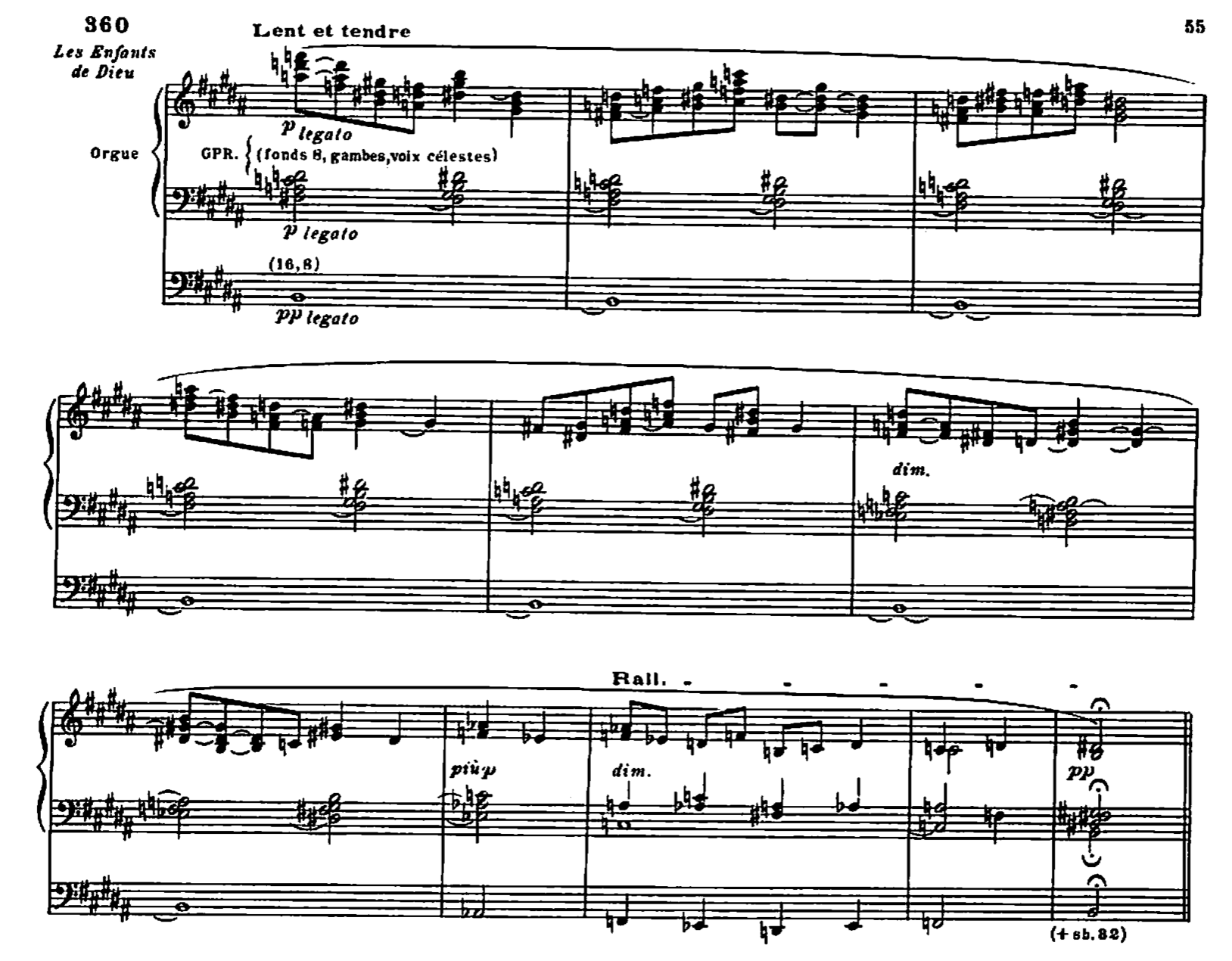
By frequent return of the tonic of the chosen key or by use of the dominant seventh chord in that key (this last means being most efficacious), Messiaen shows how to mix the mode with major tonality (Example 360). This example, written entirely in Mode 2, third transposition, remains in B major, with the holding of B in the bass strongly establishing the tonality (the slurs between common notes concern execution on the organ). In the following paragraph, Example 363 (le Banquet céleste) will demonstrate that nothing is as valuable as the dominant seventh for affirming tonality.
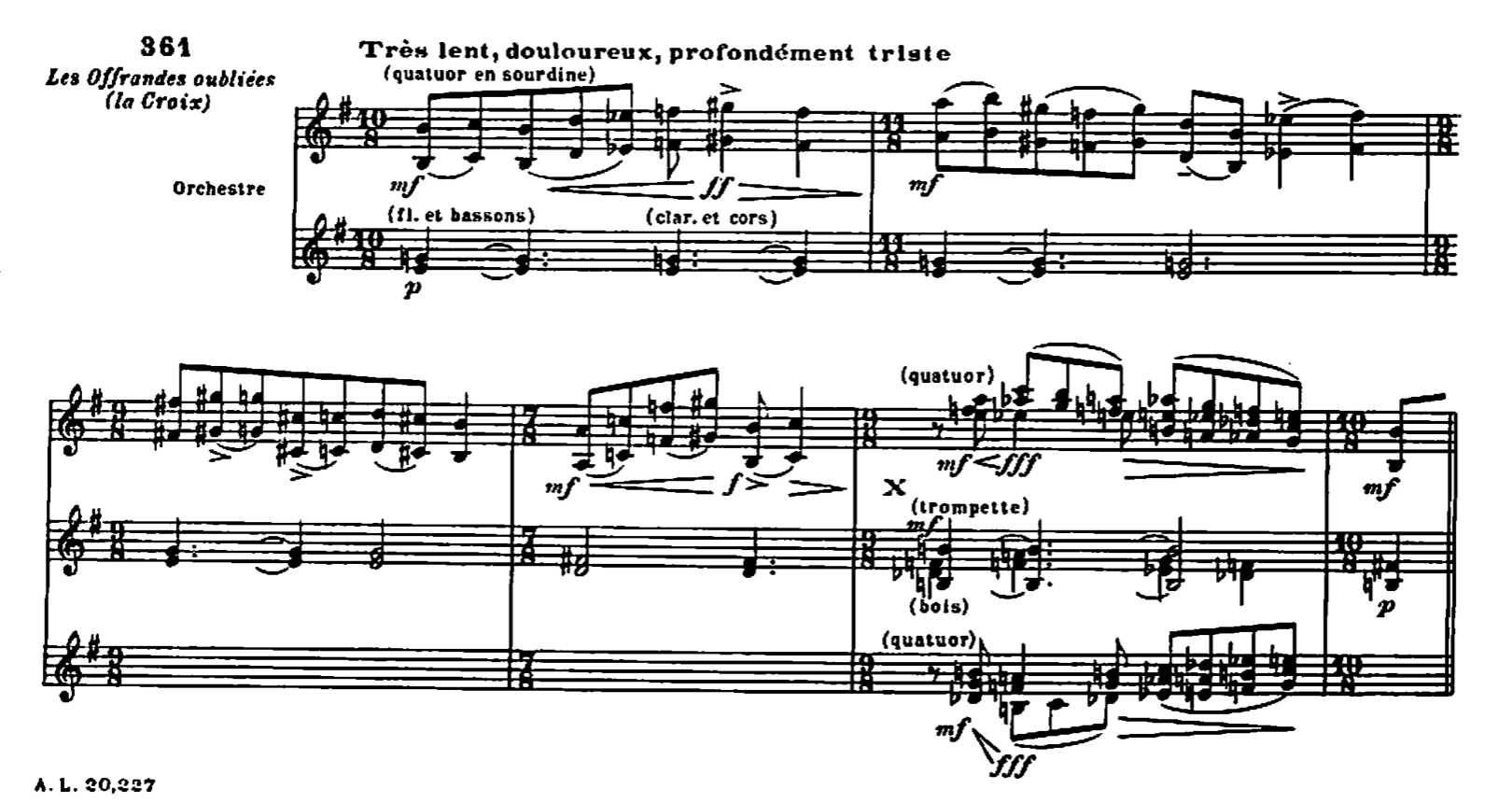
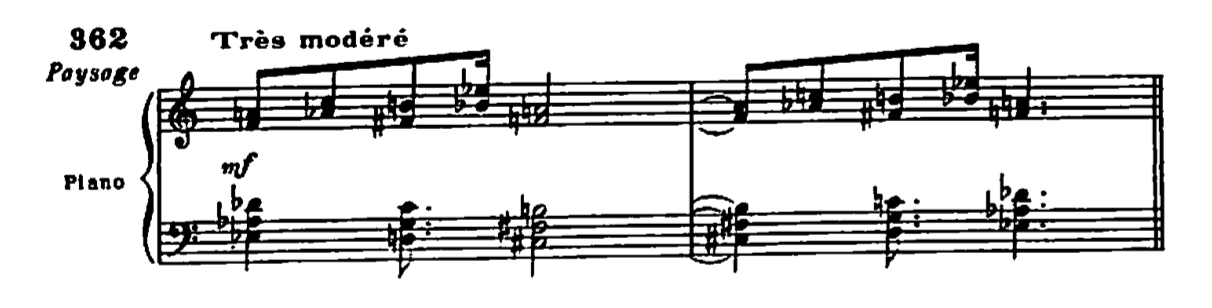
Messiaen also shows how to mix modes with tonalities whose tonics do not appear in the notes of the chosen mode (Example 361). The song of the first two measures uses Mode 2, third transposition; the notes e' and g' (tonic and third) that accompany it do not belong to the mode. Measure X uses Mode 3, second transposition; its expressive and profoundly grievous effort soothes itself on the fifth (b' to f-sharp'), dominant of E, creating tonal impression of E minor. In the same order of ideas, Example 362 presents a small fragment in Mode 2, third transposition, with the b-flat (upper staff) excepted, superposed upon chords made of perfect fourths foreign to the mode (lower staff).
Modern Context: This approach reveals Messiaen's pragmatic flexibility regarding modal purity. While the modes theoretically exist outside traditional tonal systems, practical composition often benefits from suggesting tonal orientation to provide listeners with perceptual anchors. Contemporary neo-Riemannian theory would describe some of these techniques as maximizing common-tone relationships between modal and tonal collections—the octatonic collection shares significant pitch-class content with multiple major and minor keys, allowing smooth voice-leading connections. The emphasis on the dominant seventh chord as the most effective tool for tonal affirmation reflects traditional tonal practice, where the V7–I progression serves as the strongest cadential gesture. Messiaen's willingness to mix modal and non-modal materials anticipates later practices in jazz (where modal and tonal elements freely combine) and in film music (where composers regularly blend modal colors with functional harmony to achieve specific dramatic effects). The technique also demonstrates that Messiaen's modes function as compositional resources rather than rigid systems—they can be deployed flexibly according to expressive and formal needs.
Examples: Examples 358–362