The Chord of Resonance
Definition: A harmonic structure derived from the acoustically perceptible overtones of a low fundamental pitch, forming the basis of Messiaen's conception of "natural harmony."
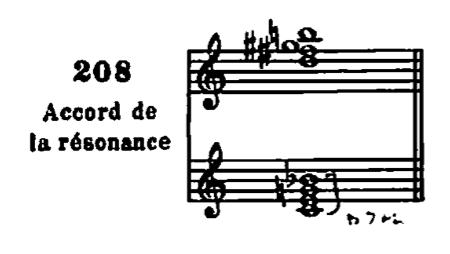
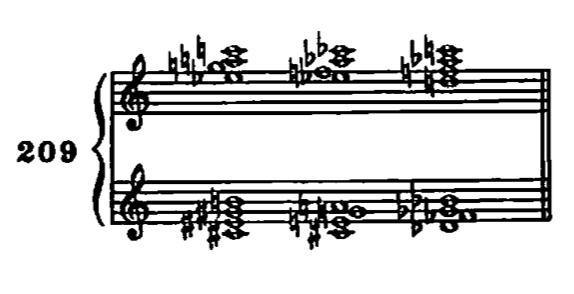
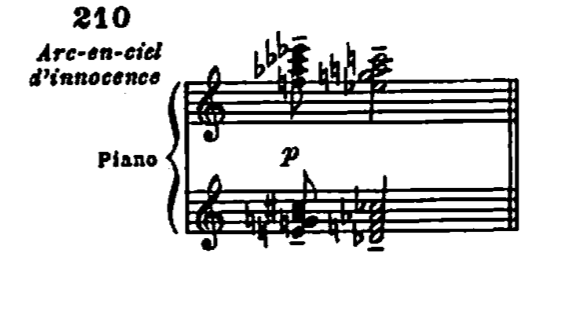
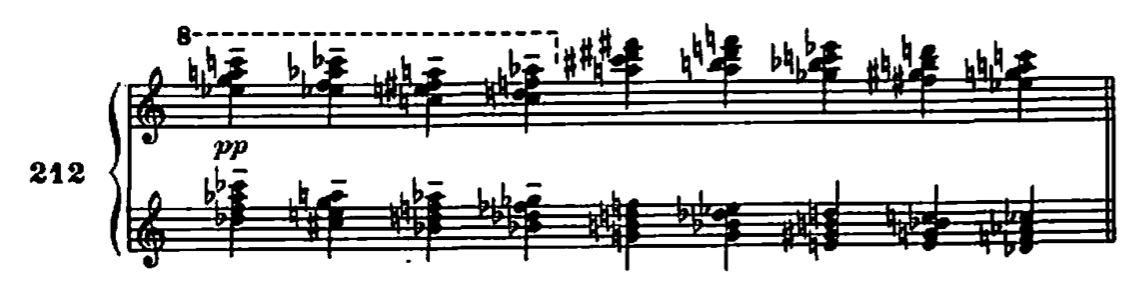
Messiaen's Treatment: Messiaen describes this chord as containing nearly all the notes perceptible to an extremely fine ear in the resonance of a low C (Example 208). Like the chord on the dominant, this sonority receives the stained-glass window treatment—inversions arranged over a common bass note (C-sharp or D-flat) to create coloristic effects (Example 209). When connected to its second inversion (Example 210), the chord of resonance yields all notes of the third mode of limited transpositions (Example 211). A progression alternating the chord and its first inversion appears in Example 212. This chord becomes a fundamental building block in Messiaen's harmonic language, representing the acoustic foundation from which "natural" harmony emerges.

Modern Context: The chord of resonance reflects early twentieth-century interest in acoustical foundations for harmony, paralleling work by theorists such as Hindemith and Schoenberg. The overtone series provides pitches approximating a major triad with added sixth, ninth, and sharp eleventh—essentially creating what contemporary jazz theory calls a "Lydian" chord quality. Messiaen's claim that this chord "gives all the notes of the third mode of limited transpositions" reveals the systematic relationship between acoustic phenomena and the symmetrical modes discussed in Chapter XVI. Contemporary spectral music composers would later pursue similar acoustic derivations, though with more precise frequency relationships. The concept of "natural harmony" here functions both as acoustic justification and aesthetic principle—harmony as pre-existing in nature rather than constructed by compositional artifice.
Examples: Examples 208–212