The Chord on the Dominant
Definition: A saturated harmonic structure containing all seven pitch-classes of the major scale, functioning as an enriched dominant sonority.
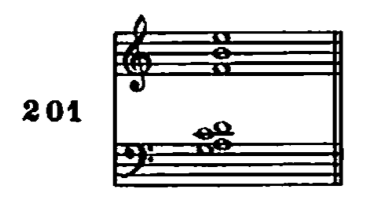
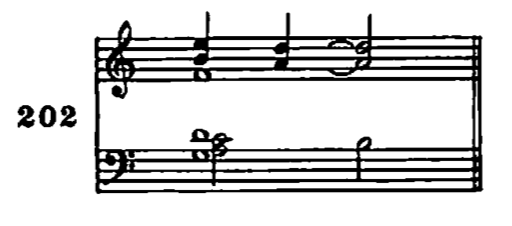
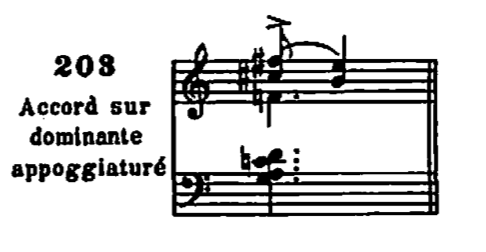
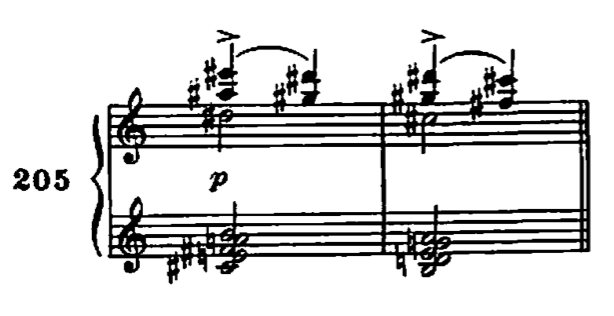
Messiaen's Treatment: Messiaen presents this chord as containing all notes of the major scale (Example 201), with its supposed resolution shown in Example 202. However, rather than treating these pitches as appoggiature requiring resolution, Messiaen transforms them into added notes (Example 203), thereby creating a stable, self-sufficient sonority. The chapter demonstrates various coloristic treatments of this chord, particularly through what Messiaen calls "multicolor work"—arranging different inversions of the chord with appoggiature over a common bass note (C-sharp or D-flat) to create a stained-glass window effect (Example 204). Additional dispositions and transformations appear in Examples 205–207, showing how the chord functions both as a functional dominant and as a coloristic entity in its own right.

Modern Context: This chord anticipates what jazz theory would later systematize as the dominant thirteenth chord with various alterations. The seven-note collection represents maximal saturation within diatonic space—every scale degree appears simultaneously, creating a sonority that hovers between extreme tension and stasis. Contemporary set theory would identify this as set class 7-35 (the diatonic collection), though Messiaen's emphasis on bass pedal and inversion places the structure within a quasi-functional rather than purely set-theoretical context. The "stained-glass window" metaphor reveals Messiaen's visual-sonic synesthesia and his concern with harmony as color rather than merely as functional progression.
Examples: Examples 201–207