Elimination
Definition: A developmental procedure consisting of repeating a thematic fragment while progressively removing notes from it, concentrating the material toward essential elements through successive reduction until reaching a schematic state—often a single note or minimal gesture.
Messiaen's Treatment: Messiaen credits Beethoven with creating melodic development through elimination, citing the first movement of the Fifth Symphony in C minor as an immortal model. This procedure is the basis of all thematic life, consisting of repeating a theme fragment while successively taking away from it a part of its notes up to concentration upon itself—reduction to a schematic state, shrunken by strife, by crisis.
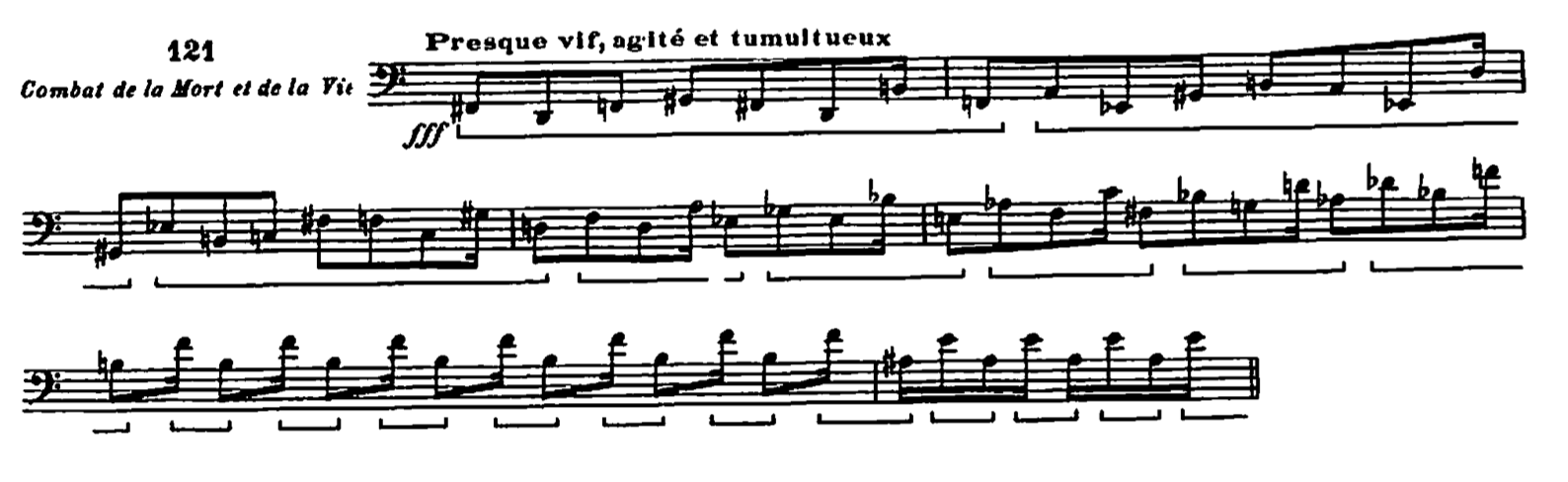
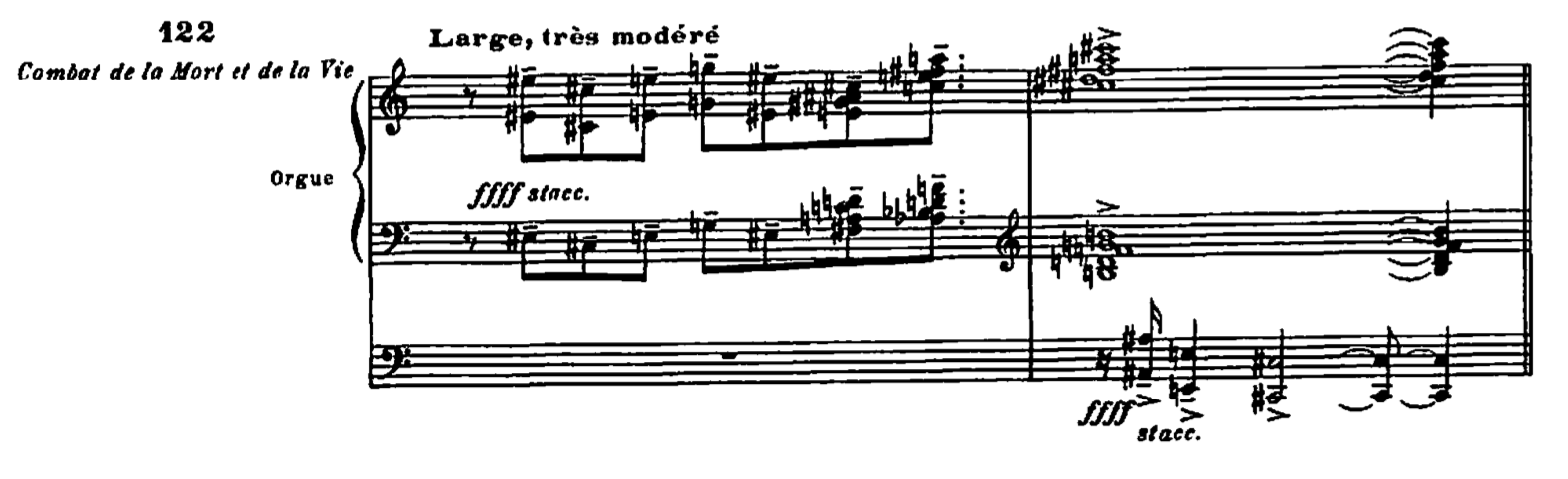
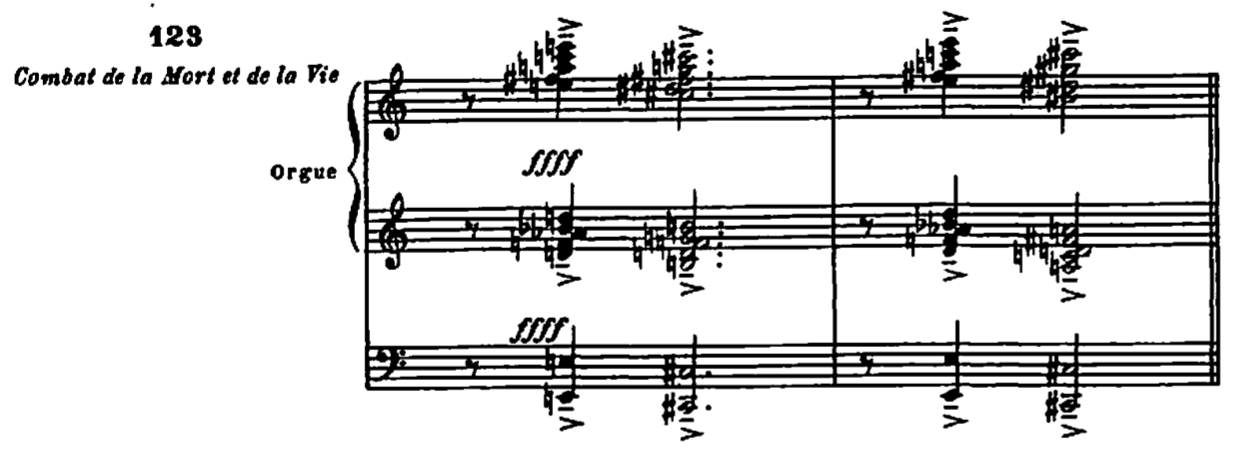
Vincent d'Indy explained this technique well in his Cours de composition musicale. Messiaen proposes a theme (Example 120) and develops it by elimination (Example 121). The thematic fragments are bracketed, showing progression: eight notes, then four notes, then two notes. On this basis, a veritable flood of chords in sixteenth-notes ascends that cannot be quoted—afterwards, the theme is cut in two (Example 122) and developed once more by elimination (Example 123), borrowing harmonies from the chord of resonance (Chapter XIV).

Amplification is the procedure exactly opposite to elimination—building up rather than reducing material.
Modern Context: Elimination represents one of the fundamental developmental procedures in Western tonal music, particularly from Beethoven forward:
Historical precedents:
- Beethoven: Fifth Symphony's famous four-note motive subjected to constant fragmentation and reduction
- Wagner: Leitmotif fragmentation in Ring cycle
- Brahms: Developing variation systematically reducing thematic material
- Schoenberg: Developing variation theory formalizing motivic reduction
Theoretical frameworks:
- Grundgestalt theory (Schoenberg): All musical material derives from a basic shape subjected to variation, fragmentation, and reduction
- Developing variation: Continuous transformation of basic ideas through progressive alteration
- Liquidation (Schoenberg): Process of eliminating characteristic features to prepare cadences or transitions
Messiaen's approach maintains the traditional concept while applying it to melodic material within his modal/rhythmic systems rather than tonal contexts. The technique works particularly well with his added values and augmentation/diminution procedures—elimination can occur through:
- Removing notes (pitch reduction)
- Removing rhythmic values (temporal reduction)
- Combined pitch and rhythmic reduction
The reference to d'Indy's Cours de composition musicale (1903–1905) positions Messiaen within French pedagogical tradition. D'Indy, a student of Franck and founder of the Schola Cantorum, emphasized systematic developmental procedures and cyclical form—influences evident in Messiaen's thinking.
The "veritable flood of chords in sixteenth-notes" that "cannot be quoted" indicates that elimination serves dramatic purposes—the reduction creates tension and anticipation, with the eliminated material replaced by harmonic activity that eventually resolves or transforms into the next developmental stage.
Amplification as the inverse procedure suggests that thematic material can also develop through accretion—adding notes, expanding fragments, building from minimal materials toward complex statements. This parallels the rhythmic technique of augmentation (Chapter IV) applied to melodic content.
Examples: Examples 120–123 systematically demonstrate elimination applied to original material.