Interversion of Notes
Definition: A transformational procedure involving reordering the pitches within a melodic fragment—changing the sequence of notes while maintaining the same pitch-class content, creating melodic variants that share intervallic material but present it in different configurations.
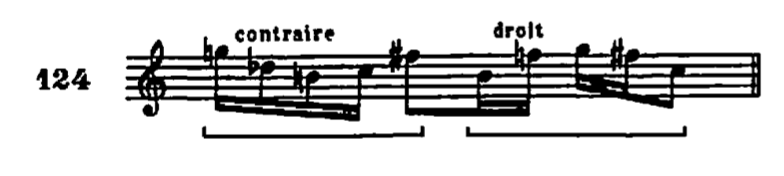
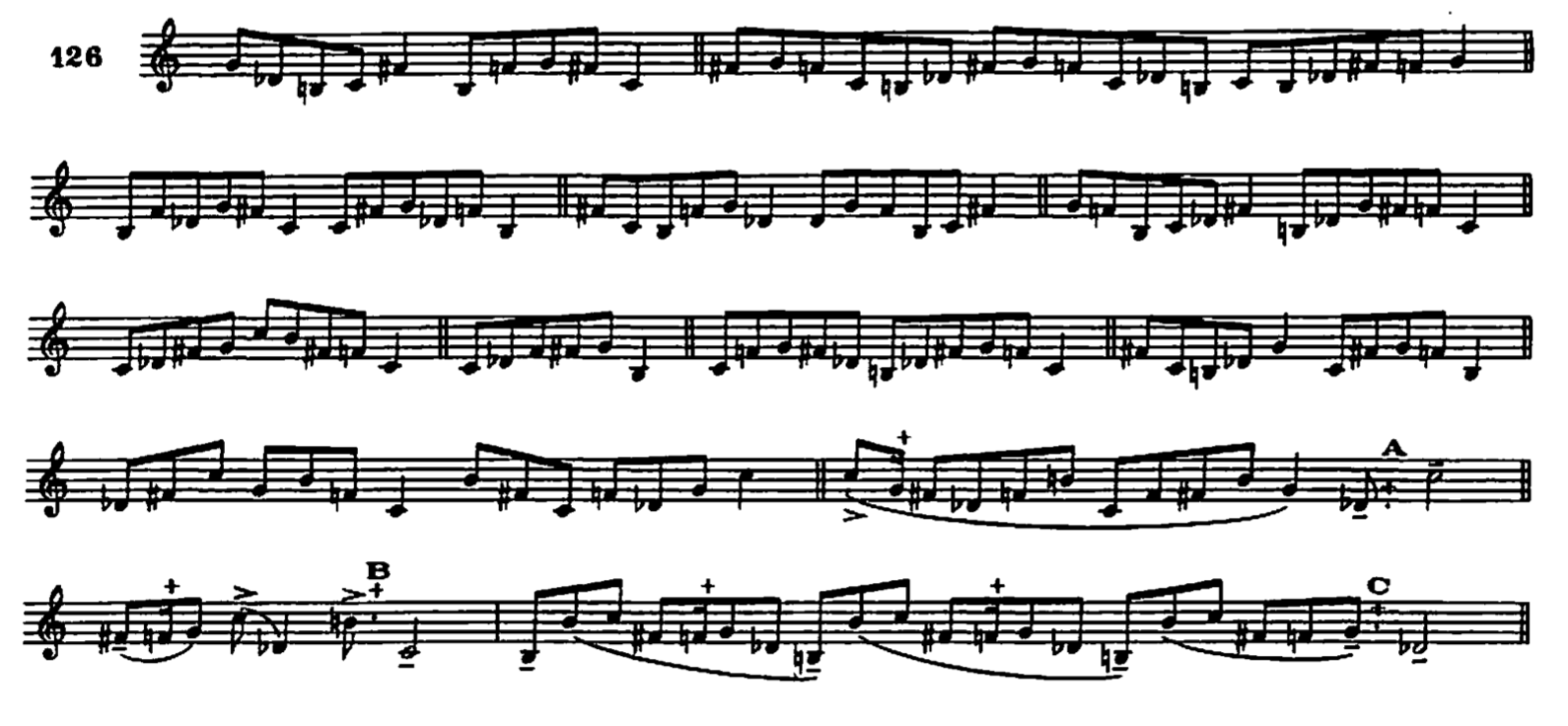
Messiaen's Treatment: Messiaen notes that this procedure, analyzed by Marcel Dupré in his Traité d'improvisation, had already been foreseen in Chapter VIII. Taking the fragment previously used in contrary and normal movement (Example 124), he finds all the notes of Mode 5 (Example 125) and presents them in a large number of different orders (Example 126), noting that combinations could be multiplied. In the last two reorderings, added values appear at crosses and descents are elongated by dot addition (Chapter III).

Modern Context: Interversion represents a specific type of pitch-class transformation distinct from traditional variation techniques:
Comparison with other techniques:
- Transposition: Changes pitch level, preserves interval sequence
- Inversion: Reflects intervals around an axis, changes interval directions
- Retrograde: Reverses temporal order, preserves pitch sequence backwards
- Interversion: Reorders pitches, changes both interval sequence and temporal relationships
Theoretical frameworks:
- Twelve-tone technique: Row forms (prime, retrograde, inversion, retrograde-inversion) represent systematic reorderings, though interversion is more flexible than serial transformations
- Set theory: Pitch-class sets can be presented in any order; interversion explores this reordering freedom
- Combinatoriality: Different orderings of the same pitch-class collection create distinct melodic profiles while maintaining harmonic identity
Dupré's Traité d'improvisation (1925) addresses organ improvisation techniques, including melodic transformation procedures. This reference connects Messiaen to French organ tradition and improvisation pedagogy—skills central to his work as organist at La Trinité.
The connection to Mode 5 (Example 125) demonstrates that interversion works particularly well within symmetrical collections (modes of limited transposition). Since these modes contain limited pitch-class content, reordering creates variety while maintaining modal unity. This represents a compositional solution to the limitation of symmetrical modes—though transpositionally limited, they permit extensive reordering.
The integration of added values and dot addition (Chapter III) shows that interversion combines with rhythmic techniques—the reordered pitches receive varied rhythmic treatment, creating further developmental possibilities. This represents multi-parametric transformation: pitch reordering (melodic) + added values (rhythmic) + modal consistency (harmonic).
The notation that "combinations could be multiplied" indicates that interversion generates a large number of variants from limited source material—a systematic procedure for creating variety within constraints. This reflects algorithmic thinking: given a pitch-class set, generate all (or many) possible orderings.
Examples: Examples 124–126 demonstrate the technique, showing one melodic fragment reordered extensively while maintaining Mode 5 content.