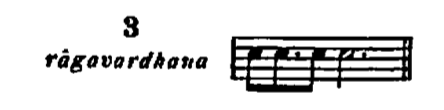
Rāgavardhana Analysis
Definition: The specific Hindu rhythm (deçî-tâla) that Messiaen analyzes to extract compositional principles, consisting of a pattern involving quarter-notes, eighth-notes, and dotted values.
Messiaen's Treatment: Messiaen identifies several structural features within rāgavardhana:
-
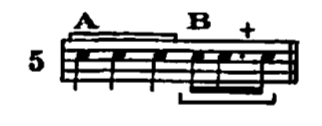
Asymmetrical augmentation/diminution: The rhythm contains both quarter-notes (A) and eighth-notes (B) in the pattern where A undergoes progressive diminution while B remains constant (Example 1, referencing Stravinsky's similar technique with simhavikrîdita).
-
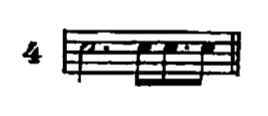
Added values: When reversed (Example 4), the rhythm reveals a classic diminution of three quarter-notes followed by three eighth-notes, but with an added dot on the second eighth-note. This dot—a small added value—disrupts what would otherwise be a straightforward diminution, introducing metric imbalance. This added dot opens the concept of augmentation and diminution through addition or withdrawal of small values (the dot) rather than proportional scaling.
-
Nonretrogradable structure: Fragment B of the rhythm, when isolated, forms a nonretrogradable (palindromic) rhythm—it reads the same forwards and backwards (Example 5).

From these observations, Messiaen extracts three general principles that become fundamental to his rhythmic language:
- Small values can be added to any rhythm to transform its metric balance (developed in Chapter III)
- Rhythms can undergo asymmetrical augmentation/diminution following complex formal patterns (developed in Chapter IV)
- Rhythms impossible to retrograde exist and possess special structural properties (developed in Chapter V)
Modern Context: Contemporary analysis would recognize these as distinct transformational operations on rhythmic structures:
-
Added values represent non-proportional rhythmic transformation—altering duration by addition rather than multiplication. This differs from traditional augmentation (2x, 3x) and diminution (1/2, 1/3), introducing irrational relationships between original and transformed versions.
-
Asymmetrical augmentation/diminution can be understood through transformation theory as partial application of scalar operations—some elements scale while others remain invariant, creating complex proportional relationships.
-
Nonretrogradable rhythms are temporal palindromes, possessing retrograde invariance. Set theory and transformational theory recognize palindromic structures as exhibiting symmetry under retrograde operation (R), where R(x) = x.
Messiaen's analysis method itself deserves note: he reverse-engineers compositional techniques from existing patterns. Rather than accepting rāgavardhana as a complete, culturally-embedded structure, he dissects it to understand how it might have been constructed, then generalizes these constructive principles into compositional rules. This analytical approach—seeking generative processes behind surface patterns—characterizes his entire treatise.
Examples: Examples 2–5 provide the complete analysis: Example 2 presents simhavikrîdita (related pattern), Example 3 presents rāgavardhana itself, Example 4 shows its retrograde revealing the added-value structure, Example 5 isolates the nonretrogradable fragment.