Binary Sentence
Definition: A four-period structure comprising (a) theme, (b) first commentary modulating more or less and inflected toward the dominant of the initial key, (c) theme, (d) second commentary concluding upon the tonic of the original key—creating an ABAB' structure with thematic statements framing developmental sections.
Messiaen's Treatment: The binary sentence divides into:
- Theme
- First commentary, modulating more or less, inflected toward dominant of initial key
- Theme
- Second commentary, concluding upon tonic of original key
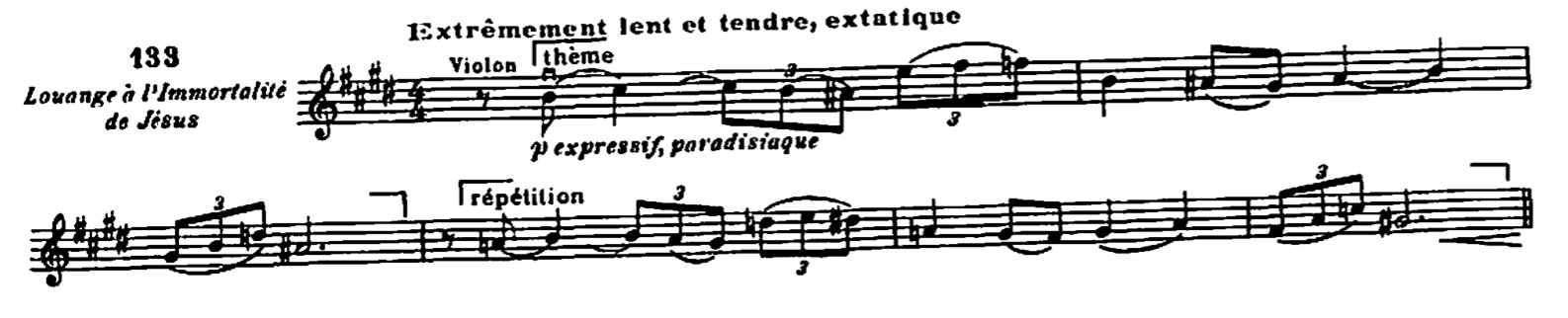
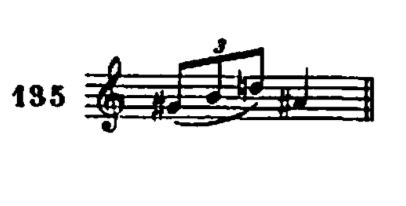
Example 133 presents the binary sentence: theme and its repetition a degree lower with harmonic variation. Example 134 shows the first commentary. Example 135, built entirely upon this theme fragment, uses Mode 2 from X to X (Chapter XVI)—afterwards, restatement of the theme.

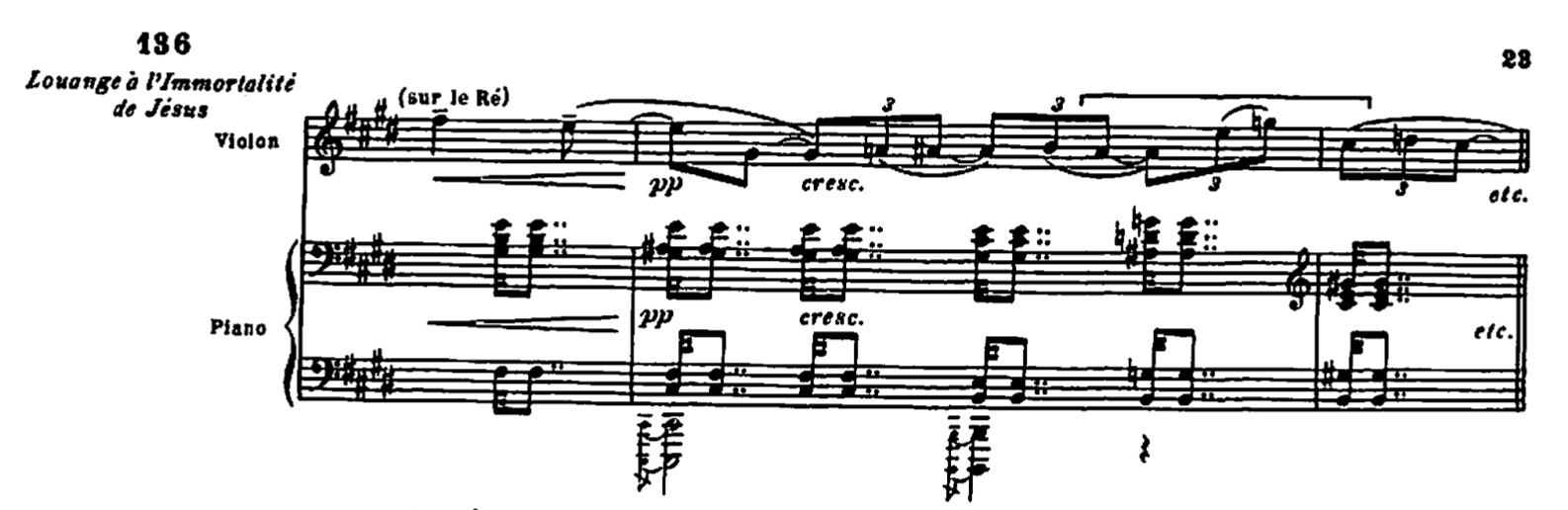
Example 136 presents the second commentary developing the same fragment as the first. Departing from a lower point, it rises higher and ends in the initial key in the extreme treble.
Modern Context: Binary sentence structure creates alternating stability (theme statements) and development (commentaries):
Formal analogies:
- Rondo form: ABACA... alternating ritornello (theme) and episodes (commentaries)
- Verse-chorus: Pop song form alternating verses (commentaries with new text) and choruses (thematic returns)
- Variation form: Theme followed by varied versions
The modulation to dominant in first commentary followed by return to tonic in second commentary reflects traditional tonal practice adapted to modal context. In Messiaen's system:
- "Dominant" may refer to modal inflection rather than V chord
- "Modulation" may mean mode change rather than key change
- "Tonic" represents initial modal center rather than tonal tonic
The use of Mode 2 "from X to X" (Example 135) demonstrates modal consistency—the commentary remains within a single transposition of the mode throughout, creating harmonic unity despite melodic development.
The registral trajectory—second commentary "rises higher" and ends "in the extreme treble"—creates formal intensification and climax through registral ascent (combining with the change-of-register technique from Chapter X).
Examples: Examples 133–136 systematically demonstrate binary sentence structure and its components.