Ternary Sentence
Definition: A five-period structure comprising (a¹) theme, (a²) consequent of the theme, (b¹) commentary, (b²) consequent of the commentary inflected toward the dominant, (c¹) theme, (c²) consequent of the theme—creating a symmetrical arch form A-A'-B-A-A' with central commentary flanked by thematic statements.
Messiaen's Treatment: The ternary sentence divides into:
- Theme
- Consequent of the theme
- Commentary
- Consequent of the commentary, inflected toward dominant
- Theme
- Consequent of the theme
Example 137 demonstrates ternary sentence structure:
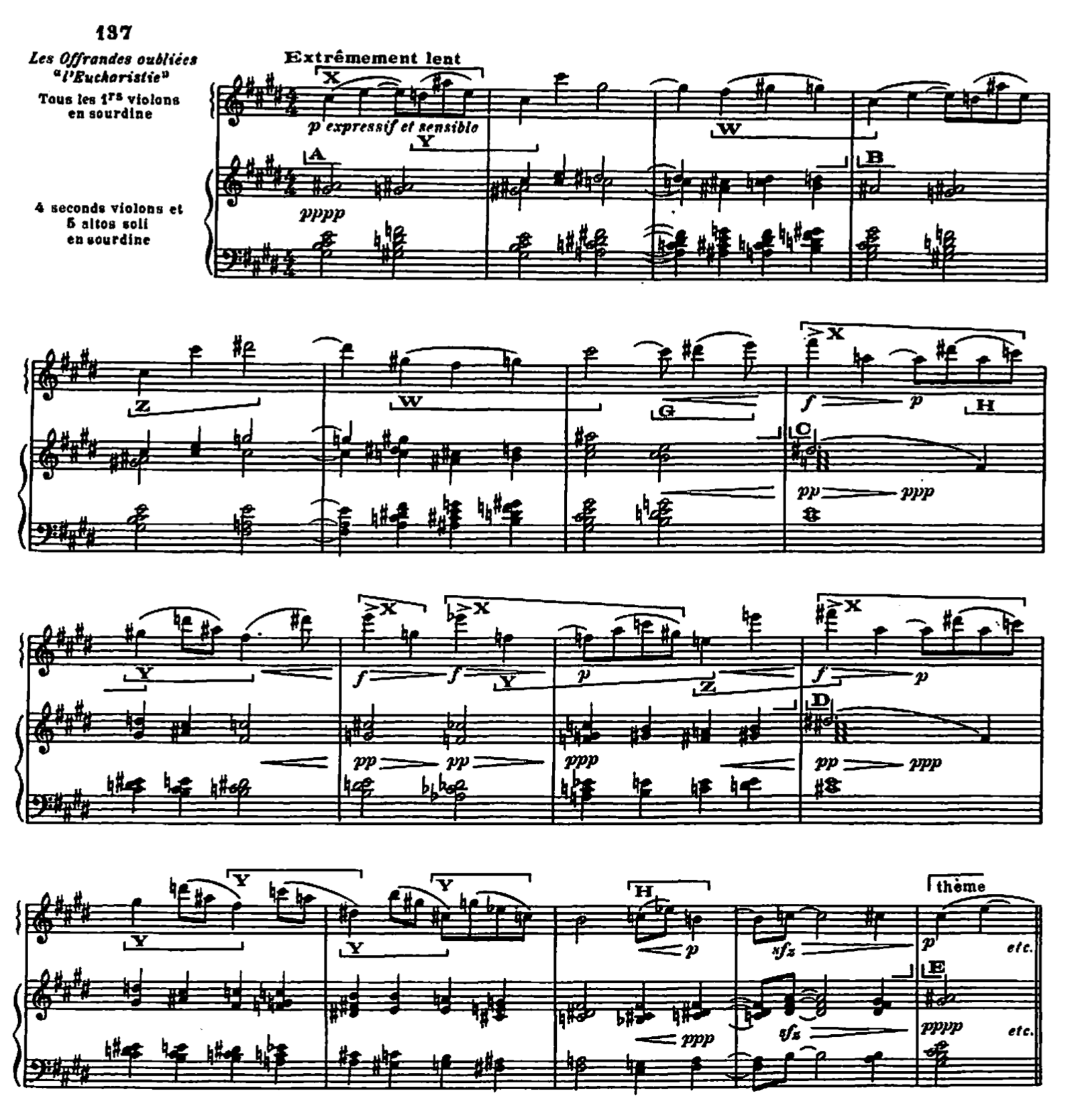
- A: The theme
- B: Consequent of the theme; fragment W ends antecedent and consequent in normal motion (first) and contrary motion (second)
- G: Fragment leading to commentary at C, which starts out upon X (rhythm of the head of the theme) and H and develops fragments X, Y, Z
- D: Consequent of the commentary, inflected toward dominant and developing especially fragment Y
- Recall of H leads to re-entrance of the theme at E (Messiaen notes he was obliged to abridge the quotation)
The antecedent of the theme is succeeded by a consequent identical to the preceding consequent and followed by a brief coda in the extreme treble upon fragment W. The entire sentence mixes E major tonality and Mode 2, borrowing constantly from itself in its different transpositions.
Orchestration: All first violins sing muted, very slowly, with love; four second violins soli and five violas soli (all also muted) form around them "a halo of mysterious chords; a harmonic tapestry of such softness that one scarcely hears it!"
Modern Context: Ternary sentence represents the most complex of the three sentence types, creating symmetrical arch form:
Formal structure:
- A-A' (theme and consequent)
- B-B' (commentary and consequent)
- A-A' (theme and consequent return)
This creates both:
- Palindromic symmetry: ABA structure reflecting Chapter V's nonretrogradable principle in large-scale form
- Progressive intensification: Movement from theme through commentary (development) back to theme with accumulated complexity
Comparison with other arch forms:
- Bartók's bridge forms: Symmetrical structures (ABCBA) in string quartets and other works
- Medieval estampie: Medieval dance form with repeated sections creating arch-like structures
- Rondo form: Multiple returns create symmetrical patterns (ABACA, ABACABA)
The mixture of E major tonality and Mode 2 "borrowing constantly from itself in its different transpositions" demonstrates modal/tonal synthesis—traditional tonal center (E major) coexists with symmetrical modal collection (Mode 2/octatonic) through strategic transposition of modal segments.
The orchestrational description reveals Messiaen's timbral sensitivity: solo strings "muted, very slowly, with love" create intimate, personal expression; the accompanying chords as "halo of mysterious chords" and "harmonic tapestry of such softness that one scarcely hears it" demonstrate his interest in creating enveloping, numinous sonorities—technique serving expressive/spiritual purposes.
Examples: Example 137 demonstrates ternary sentence with extensive analysis of its components and transformations.