List of Melodic Periods (Catalog of Historical Models)
Definition: An extensive catalog of melodic periods derived from diverse historical sources, demonstrating how models from various composers, traditions, and eras can be transformed through Messiaen's compositional language—each example showing both the original source's influence and its "deforming prism" transformation.
Messiaen's Treatment: Messiaen sets up a list of melodic periods, with each example comprising one or several connected periods. He notes that in Chapter XIV's paragraph 6 ("A Look at Other Styles"), he will draw essence from procedures of contemporary composers. Here, he presents shadows of former times alongside salutes to modern masters, but clarifies that all borrowings will be "passed through the deforming prism of our language," receiving from his style "a different blood, an unexpected melodic and rhythmic color" in which fantasy and research unite to destroy resemblance to the model.
Examples 138–150 reference diverse sources:
- 138–139: Evoke Ravel (who would have believed that?)
- 140–141: Reference Adam de la Halle (patron), even more unlikely
- 140: Opposition of dynamics calls to mind alternations of solo and tutti; the two periods A and B could have been used for refrain; note their curious rhythmic symmetry—B responds with ascending intervals to A's descending intervals and vice versa
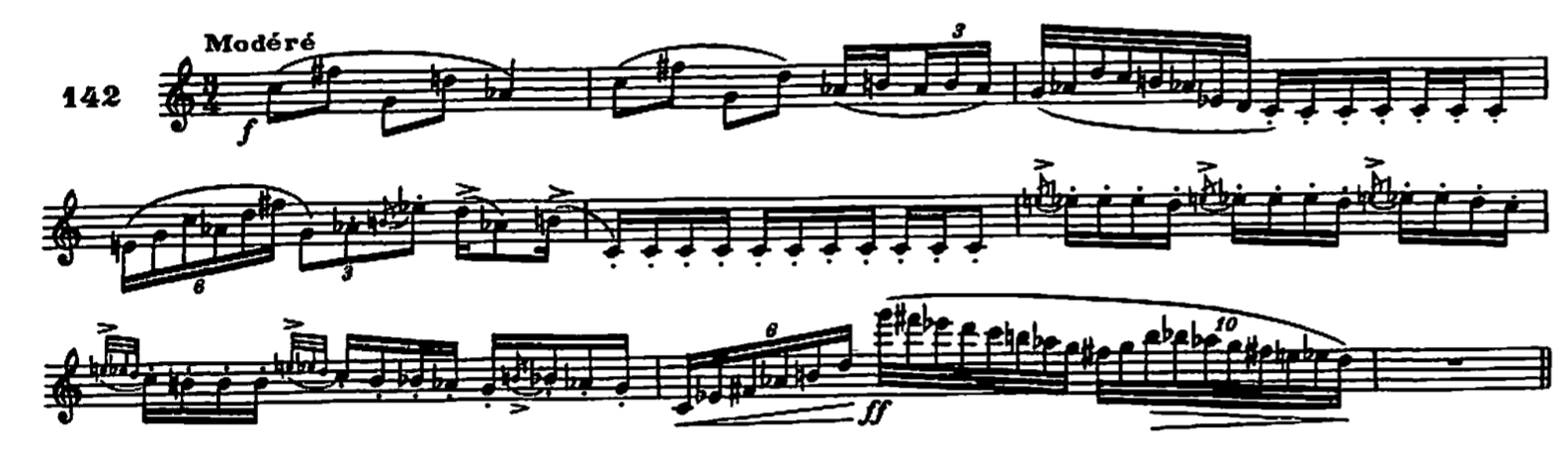
- 142: Mixes Mozart and Manuel de Falla
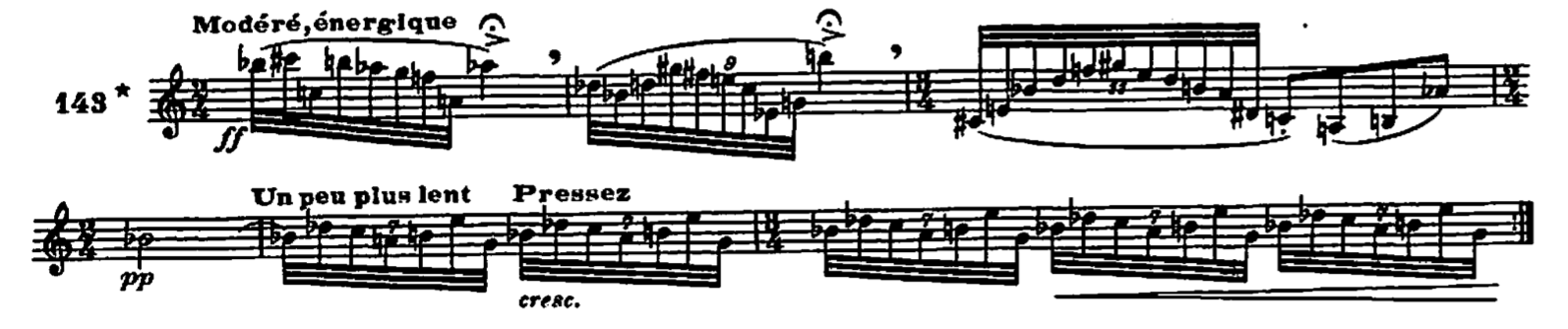
- 143: Unites Béla Bartók and André Jolivet with a touch of bird style (Chapter IX)
- 144–145: Completely bird style
- 146: Allied to Hindu music
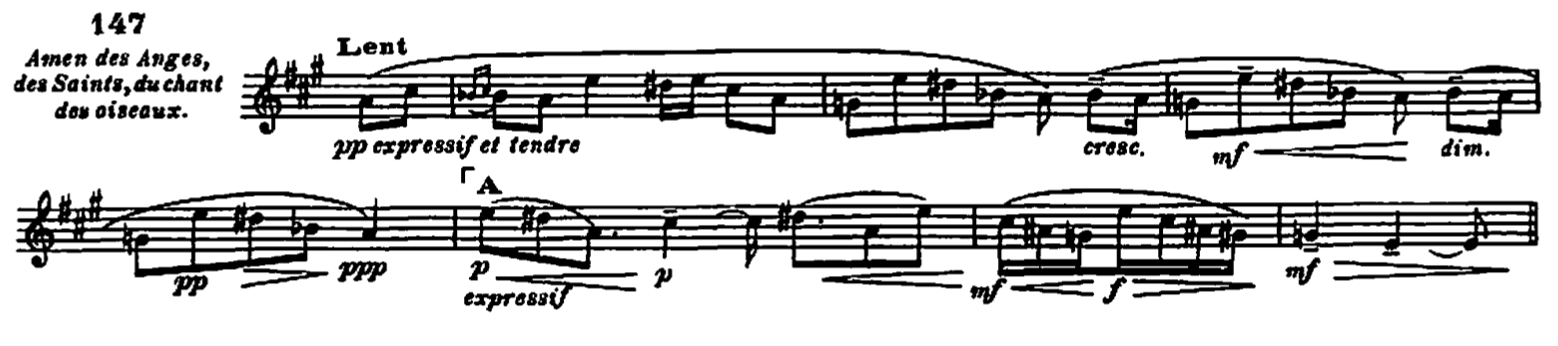
- 147–148: Proceed from Russian songs
- 147: Written in Mode 2; measure A contains nonretrogradable rhythm (Chapters XVI and V)
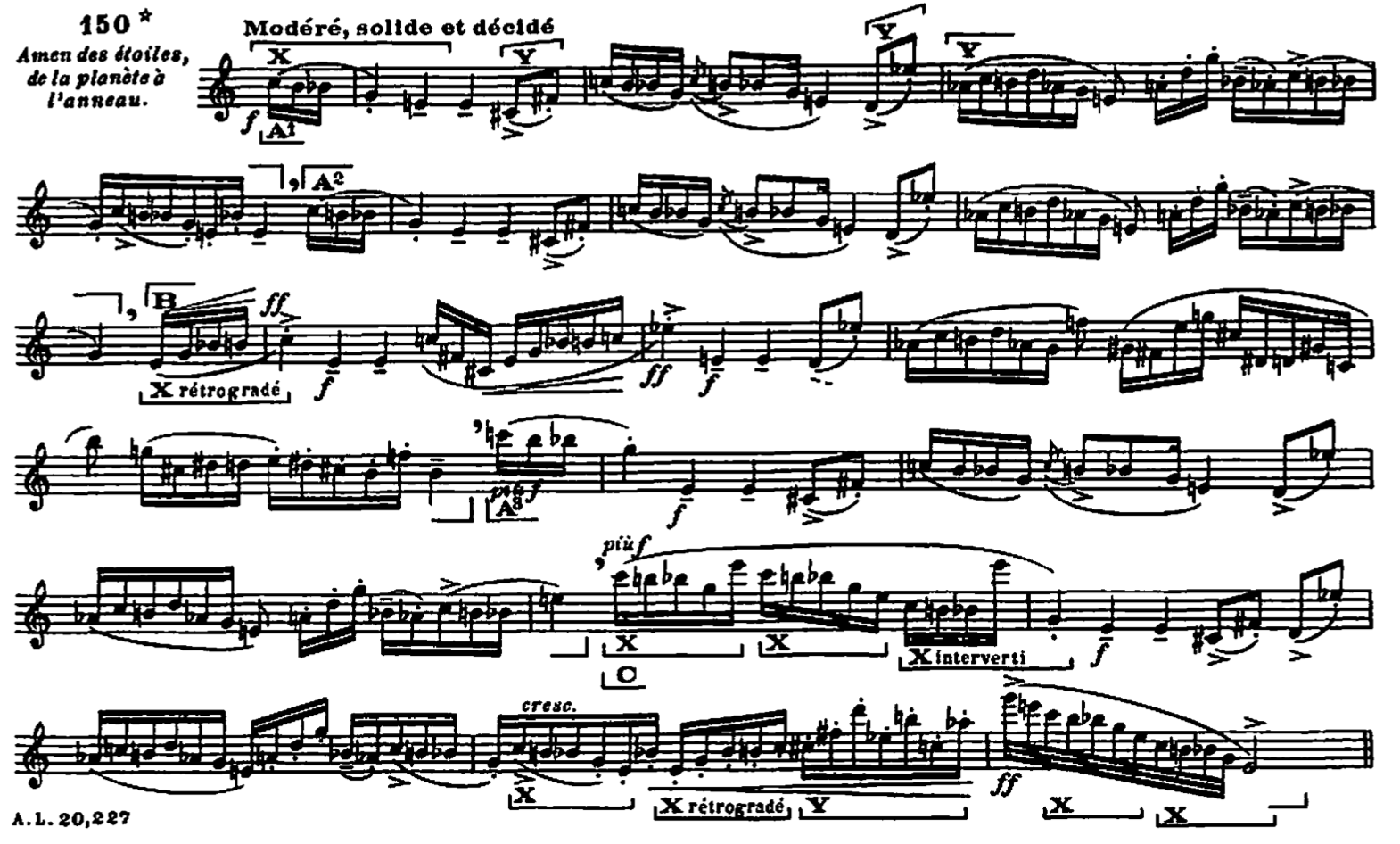
- 149–150: Refer to Rameau; far away from him
- 150: Complete sentence in five periods with rigadoon-like shape:
- A¹: First period starting upon X; A²: First period repeated and concluding on third degree
- Period B: Starting upon X in retrograde, modulating to dominant
- Restatement of period A (slightly varied)
- Period C: Developing especially X, used to conclude in rapid arpeggio; bracketed notes Y of first period restated here in new order





Modern Context: This catalog demonstrates Messiaen's synthetic compositional method—drawing from maximum stylistic diversity while transforming everything through personal language:
Source diversity:
- Medieval: Adam de la Halle (trouvère, 13th century)
- Baroque: Rameau (18th century)
- Classical: Mozart (18th century)
- Romantic/Nationalist: Falla (Spanish), Russian songs
- Early 20th century: Ravel (French impressionist)
- Contemporary modernists: Bartók (Hungarian), Jolivet (French)
- Non-Western: Hindu music
- Natural sources: Bird song
This eclecticism reflects modernist cosmopolitanism—rejecting nationalistic insularity in favor of global musical culture. However, Messiaen's "deforming prism" approach transforms all sources into personal idiom rather than producing pastiche or quotation collage.
Contemporary composition precedents:
- Neoclassicism (Stravinsky, Poulenc): Transformation of historical models
- Musical tourism: Debussy's gamelan influences, Ravel's Spanish references
- Synthetic modernism: Combining diverse traditions (Bartók's synthesis of folk and art music)
The phrase "fantasy and research will be united to destroy the least resemblance to the model" is crucial—Messiaen claims both creative imagination ("fantasy") and systematic analysis ("research") while insisting on transformation so complete that source models become unrecognizable. This represents sophisticated understanding of influence—acknowledging sources while asserting originality.
The specific analytical observations (rhythmic symmetry in Example 140, Mode 2 in Example 147, nonretrogradable rhythm, rigadoon structure in Example 150) demonstrate that these periods incorporate techniques from previous chapters—added values, modal content, rhythmic symmetry, developmental procedures all operate within period structures.
Examples: Examples 138–150 provide extensive catalog demonstrating stylistic synthesis and transformation.