Folk Song Influences
Definition: Melodic characteristics derived from folk music traditions, particularly Russian and French folk songs, providing Messiaen with modal resources and characteristic contours distinct from Western art music conventions.
Messiaen's Treatment: Messiaen identifies remarkable melodies in old French songs and especially Russian folklore, advocating remembering them and passing them through the "deforming prism of our language." The Russian song Point n'était de vent ("There was no wind") haunted his youth; he finds in it the five notes of Boris that inspired the first formula of melodic cadence (Example 100).

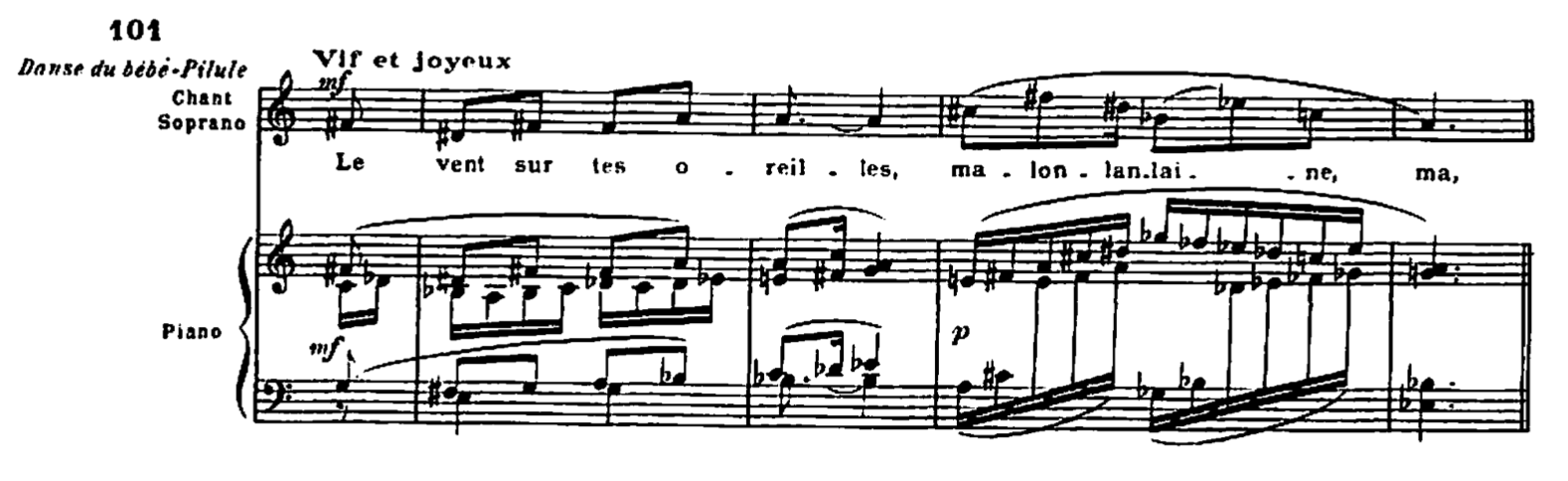
One can also create false folk songs without forgetting the "little refrain in onomatopes" (Example 101).
Modern Context: This represents Messiaen's engagement with folk sources, paralleling his use of Hindu rhythm (Chapter II) and plainchant (discussed later in this chapter). His approach involves:
- Source identification: Recognizing specific folk melodies with distinctive characteristics
- Analytical extraction: Identifying the essential features (modal content, characteristic intervals, contour patterns)
- Stylistic transformation: Passing sources through the "deforming prism" of his personal language—reharmonizing, rhythmicizing, and recontextualizing folk materials
The phrase "deforming prism" is significant—Messiaen does not claim faithful preservation of folk sources but rather their transformation through his compositional lens. This represents a different relationship to folk material than:
- Nationalist composers (Bartók, Kodály): Systematic collection, transcription, and analysis of folk music with efforts toward authentic preservation
- Quotation practice (Ives, Berio): Direct quotation of folk melodies in art music contexts
- Neoclassicism (Stravinsky): Stylistic evocation without necessarily using actual folk melodies
Messiaen's approach more closely resembles Debussy's transformation of gamelan influences—absorption and reinterpretation rather than quotation or ethnographic fidelity.
The creation of "false folk songs" (Example 101) demonstrates that folk characteristics can be abstracted into generative principles—modal content, characteristic intervals, simple phrase structures, onomatopoetic elements—and applied to create new melodies in folk style without being actual folk melodies. This anticipates later practices of "imaginary folklore" (Ligeti's Hungarian Rock, Janáček's invented folk materials).
Examples: Examples 100–101 demonstrate Russian folk influence and false folk song creation.