Plainchant Contours
Definition: Melodic patterns derived from Gregorian chant and other plainchant traditions, representing a vast repository of modal melodic writing that Messiaen adapts to his compositional practice.
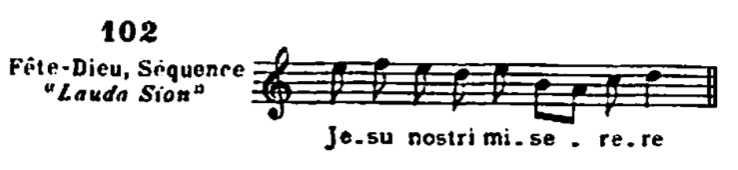
Messiaen's Treatment: Messiaen identifies plainchant as an "inexhaustible mine of rare and expressive melodic contours" (Examples 102–107). He proposes making use of them while forgetting their modes and rhythms for the use of ours.
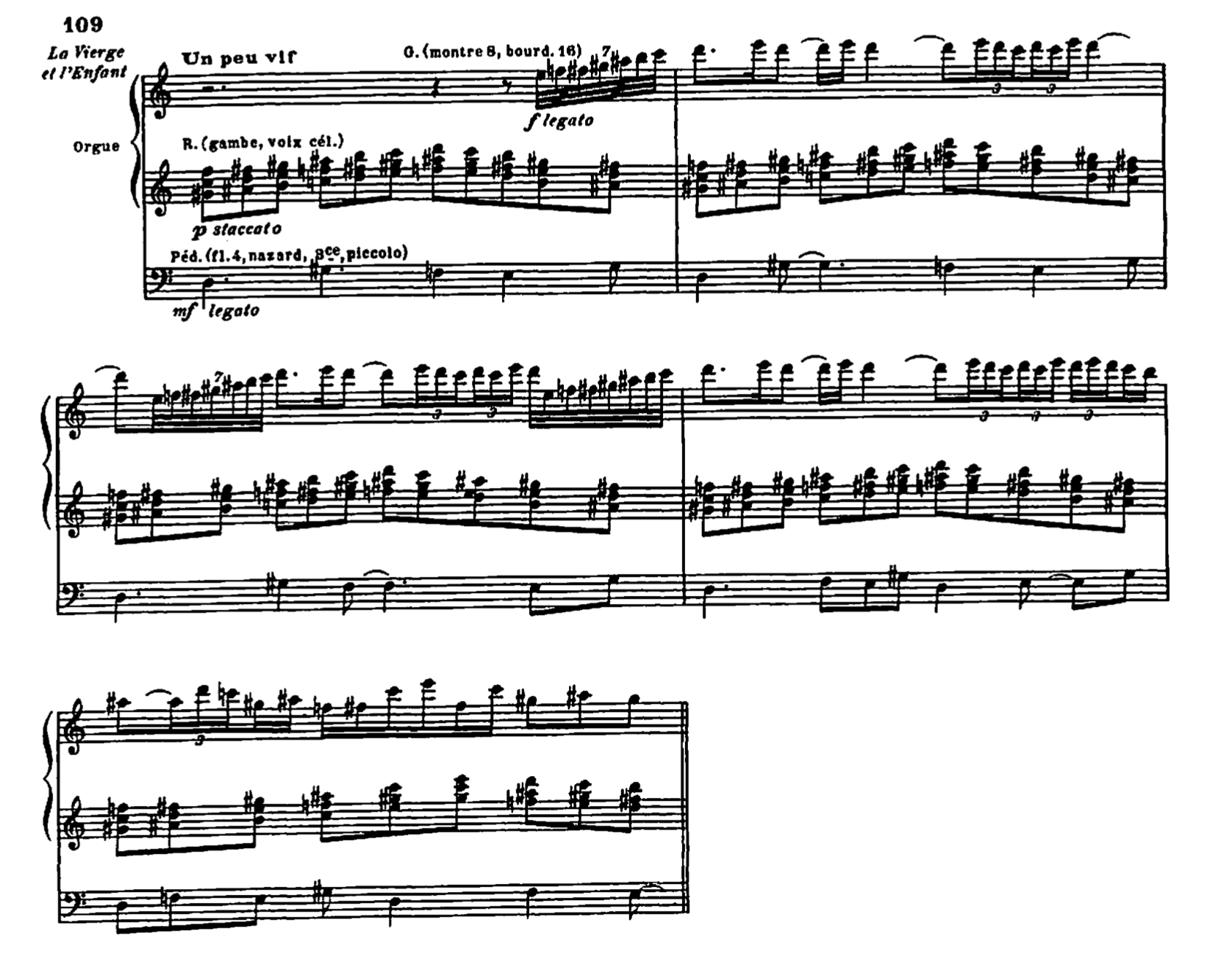
A single example of this transformation: from a fragment of the Introit de Noël (Example 108) he draws a transformed version (Example 109). The transformation employs the strange choice of timbres, Mode 6 (Chapter XVI), repetitions of melodic dominant, final melodic descent, foundation of chords repeating themselves in groups of eleven eighth-notes, and rhythmic variations of the shrill carillon of the pedal accentuate the change.

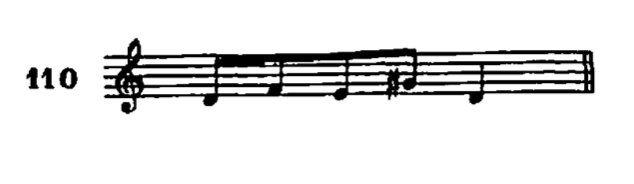
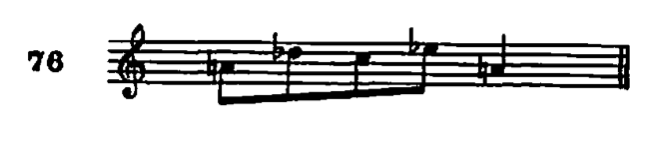
Example 110 shows the pedal carillon based upon a fragment in which he recognizes the first formula of melodic cadence (Example 76), noting it sounds an octave higher than notation. Messiaen emphasizes that more than to melodic contours of plainchant, he will apply himself to its forms: Anthems, Alleluias, Psalmodics, Kyrie, Sequence, etc., which will be treated at length in Chapter XII.
Modern Context: Plainchant represents one of the most significant influences on Messiaen's melodic language. His approach involves:
- Contour extraction: Taking the melodic shapes and characteristic gestures from plainchant
- Modal and rhythmic transformation: Recontextualizing plainchant melodies in his modes of limited transposition (rather than church modes) and his rhythmic system (rather than traditional chant rhythm)
- Formal influence: Beyond melodic contours, plainchant forms provide structural models (detailed in Chapter XII)
This parallels other twentieth-century engagements with plainchant:
- Debussy: Modal harmony and melodic freedom influenced by chant
- Stravinsky: Chant-based works (Symphony of Psalms, Mass)
- Pärt: Tintinnabuli style drawing on medieval sacred music
- Post-Vatican II sacred music: Revival of chant-influenced composition
Messiaen's Catholic faith makes plainchant a particularly significant source—it represents both musical resource and liturgical/spiritual tradition. His transformation of plainchant parallels his treatment of Hindu rhythm—respectful appropriation and adaptation rather than preservation or quotation.
The specific transformation demonstrated (Examples 108–109) shows how radically he reconceives source material: the chant fragment becomes embedded in complex harmonic (Mode 6), timbral (strange choice of timbres), rhythmic (groups of eleven, rhythmic variations), and textural (repeated chords, carillon pedal) contexts far removed from monophonic liturgical chant. The melodic contour persists, but everything else transforms.
Examples: Examples 102–110 demonstrate plainchant sources and transformations.