Hindu Ragas
Definition: Melodic modes from Indian classical music, characterized by specific pitch collections, characteristic phrases, ornamentations, and expressive associations, providing Messiaen with additional non-Western melodic resources.
Messiaen's Treatment: Messiaen observes that Hindu music abounds in curious, exquisite, unexpected melodic contours which native improvisers repeat and vary following raga rules. He provides two ravishing examples ending on repeated notes (Examples 111–112).

A theme uniting added value (Chapter III) and Hindu melodic color appears in Example 113, with added values marked by crosses.
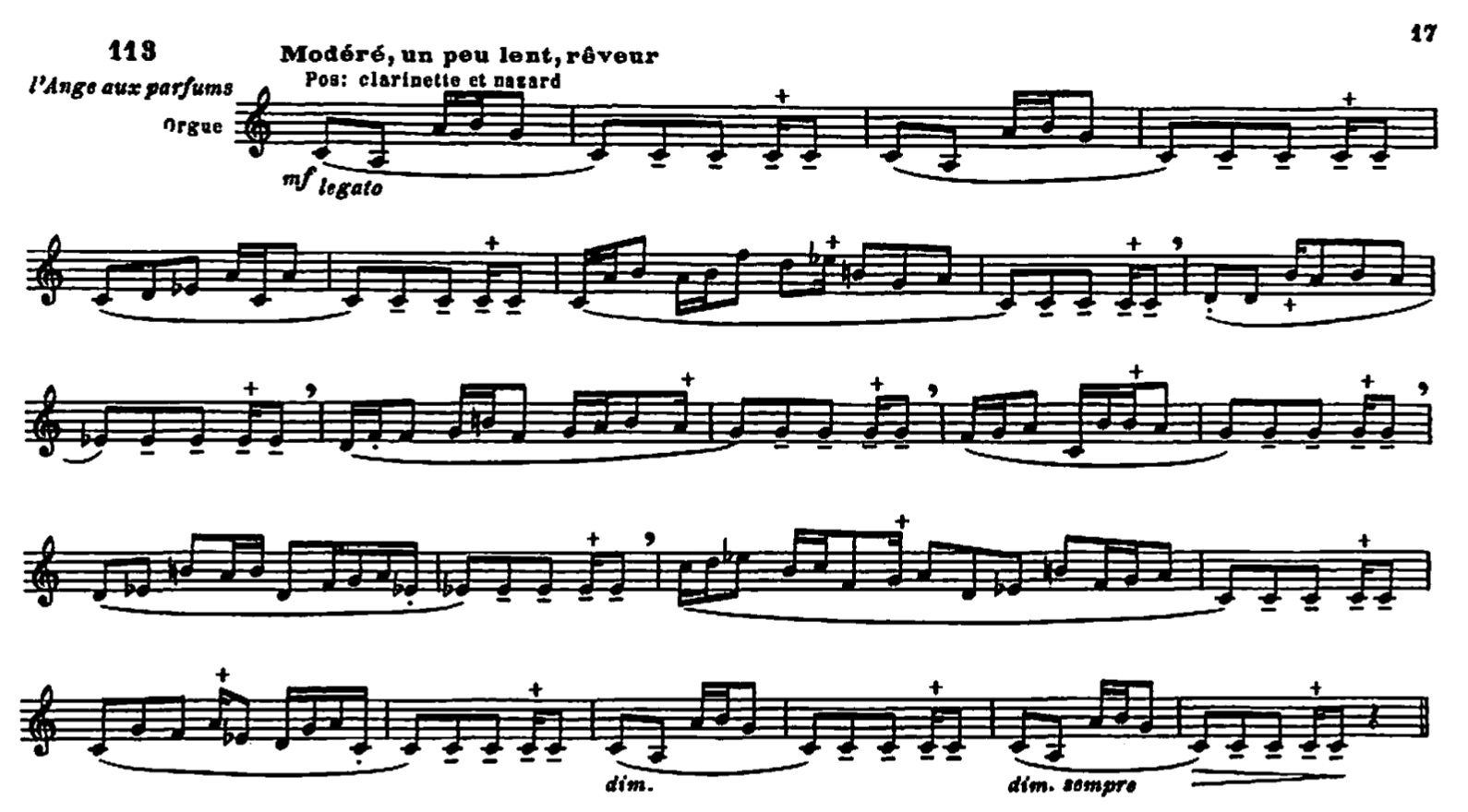
Modern Context: This represents Messiaen's second major engagement with Indian music (after Chapter II's rhythmic focus). His approach to ragas differs from his rhythmic appropriation:
- Rhythmic borrowing (Chapter II): Specific patterns (rāgavardhana) analyzed structurally and transformed into compositional principles
- Melodic borrowing (Chapter VIII): General acknowledgment of raga characteristics and expressive contours without systematic analysis of raga theory
This reflects the complexity of raga systems. Ragas involve:
- Pitch collections: Specific scale patterns (ascent and descent may differ)
- Characteristic phrases (pakad): Identifying melodic gestures
- Ornamentations: Specific gamaka (pitch inflections) and phrase elaborations
- Temporal and expressive associations: Time of day, season, emotional character (rasa)
Messiaen's engagement with ragas appears more impressionistic than his rhythmic borrowing—appreciating their expressive contours and unexpected melodic shapes without systematically analyzing their theoretical structure. This may reflect:
- Available sources: 1940s French musicology provided better documentation of rhythmic structures (Çârngadeva's tāla lists) than raga performance practice
- Complexity of raga system: Performance-based tradition requiring direct study with practitioners
- Melodic vs. rhythmic appropriation: Easier to extract rhythmic patterns as fixed structures than to systematically adapt improvisatory melodic traditions
Later composers developed more systematic engagements with ragas (La Monte Young, Terry Riley, minimalists studying with Indian musicians), but Messiaen's 1944 approach represents an early Western art music acknowledgment of raga as melodic resource.
The combination of added values with "Hindu melodic color" (Example 113) demonstrates cross-parametric synthesis—rhythmic techniques from one tradition (Hindu tāla analysis) combined with melodic characteristics from the same tradition, recontextualized within Messiaen's harmonic language.
Examples: Examples 111–113 demonstrate raga-influenced melodies and their integration with Messiaen's rhythmic techniques.