Intervallic Preferences: Descending Augmented Fourth and Major Sixth
Definition: Specific melodic intervals that Messiaen identifies as particularly expressive and characteristic, forming foundational elements of his melodic language—the descending augmented fourth (tritone) and the descending major sixth.
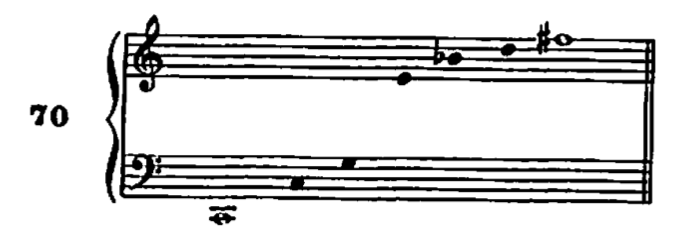
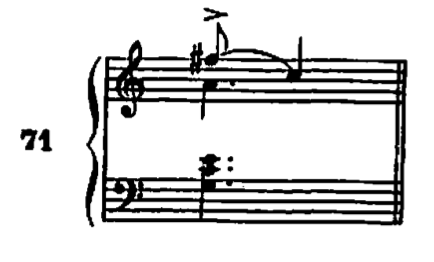
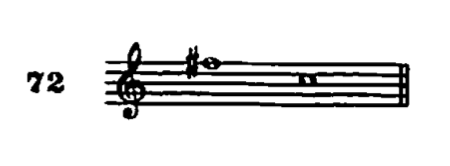
Messiaen's Treatment: Messiaen encroaches upon Chapter XIII's harmonic domain to recall that a fine ear clearly perceives an F-sharp in the natural resonance of low C (Example 70). This F-sharp is endowed with attraction toward C, which becomes its normal resolution (Example 71). This establishes the descending augmented fourth as the first interval to choose (Example 72).
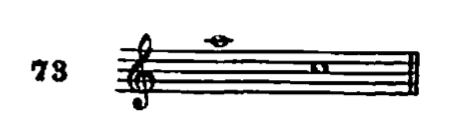
He notes the importance of the added sixth in the perfect chord (foreseen by Rameau and established by Debussy, referenced in Chapter XIII) and that Mozart, "that great melodist," often used the descending major sixth. Therefore, Messiaen chooses that interval anew (Example 73).
Finally, certain returning chromatic formulas would be the joy of Béla Bartók (Example 74).

Modern Context: The intervallic choices reflect both acoustic and stylistic considerations:
Descending augmented fourth (tritone):
- Acoustically justified through the harmonic series—the 11th partial creates a neutral interval approximating the tritone
- Historically significant as the diabolus in musica, requiring careful treatment in traditional counterpoint
- Modernist revaluation—Scriabin, Bartók, and Stravinsky exploit tritone relationships structurally and harmonically
- In Messiaen's system, the descending resolution (F# to C) inverts the traditional augmented fourth requiring upward resolution, creating a distinctive melodic gesture
Descending major sixth:
- The added sixth chord (major triad with added sixth) produces the sixth as a characteristic melodic interval when arpeggiated or when melody moves from root to sixth
- Mozart's frequent use provides historical precedent
- Debussy's impressionistic harmony emphasizes added-note sonorities including sixths
- The interval's open, consonant quality contrasts with the tritone's tension, providing melodic variety
Contemporary pitch-class set theory recognizes both intervals as distinctive sonorities:
- Tritone (interval class 6): Maximally dissonant in traditional theory, divides the octave symmetrically
- Major sixth (interval class 9): Consonant, often functions as upper extension in tertian harmony
Messiaen's identification of these intervals as characteristic reflects his synthesis of acoustic reasoning (harmonic series justification for tritone), historical precedent (Mozart's sixths, Rameau/Debussy's added sixths), and personal preference. The combination of tensional tritone and open sixth provides melodic palette spanning maximum contrast.
The reference to Bartók's chromatic formulas connects Messiaen's practice to contemporary folk-influenced modernism, acknowledging shared interest in chromatic inflection within modal frameworks.
Examples: Examples 70–74 demonstrate the acoustic basis and melodic applications of these preferred intervals.