Inexact Augmentations
Definition: Simultaneous rhythmic layers undergoing different rates of augmentation or diminution, creating complex proportional relationships between voices rather than uniform scaling across all parts.
Messiaen's Treatment: Messiaen distinguishes inexact augmentation from classical canonic technique. In Bach's canons, when one voice presents augmented material, the augmentation applies uniformly—all voices involved in the augmentation scale by the same factor. In inexact augmentation, different rhythmic streams scale independently and by different factors.
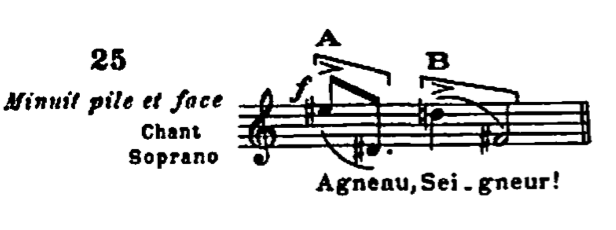
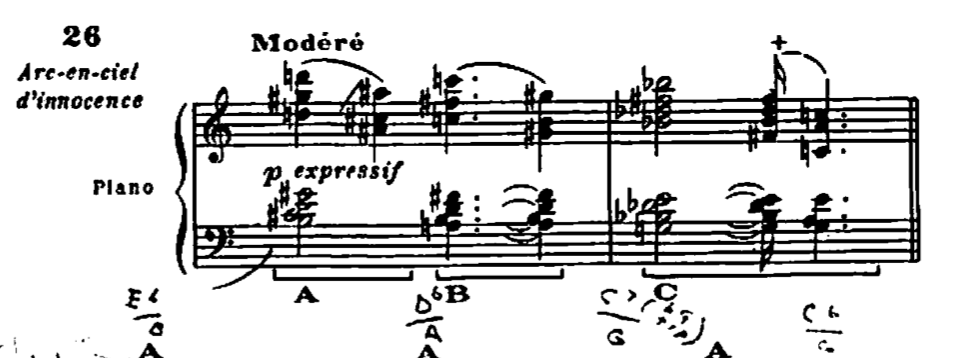
Example 25 demonstrates: rhythm B represents inexact augmentation of rhythm A, where the expected augmentation would produce a dotted quarter-note but Messiaen presents something else. Example 26 shows another instance where the normal augmentation would be straightforward doubling, but inexact augmentation produces different results.
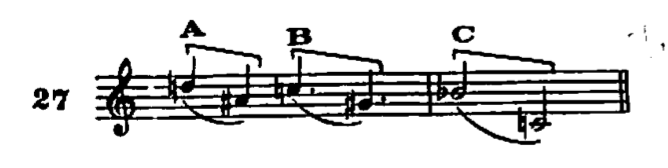
Example 27 presents a more complex case: at the cross marking, an added value appears; rhythm B augments rhythm A while rhythm C simultaneously augments rhythm B. The normal augmentation would follow specific proportions, but inexact augmentation allows independent scaling.
Messiaen notes that very inexact augmentations or diminutions eventually create rhythmic variants rather than true augmentations—when the proportional relationships depart significantly from simple ratios, the connection to the original rhythm becomes attenuated, and the result functions as a new, independent rhythmic pattern rather than a clear transformation of the source.
Modern Context: Inexact augmentation anticipates several later developments:
- Polytempo music: Simultaneous layers at different, often incommensurable tempi (Ives, Nancarrow, Stockhausen's Gruppen)
- Metric modulation networks: Carter's technique of independent tempo streams modulating at different rates
- Temporal canons: Canons where voices proceed at different tempi, creating complex phase relationships (Nancarrow's player piano studies)
- Spectral rhythm: Grisey and Murail's application of spectral proportions to temporal organization
Contemporary music theory recognizes that inexact augmentation creates what might be termed "deformed similarity"—the transformed version maintains some but not all proportional relationships with the original. This generates intermediate states between repetition (exact transformation) and variation (free departure).
Messiaen's observation that extreme inexactness produces variants rather than augmentations proper raises fundamental questions about rhythmic identity and transformation: at what point does a transformation become so extreme that it severs the perceptual/structural connection to its source? This parallels debates in pitch theory about the limits of motivic transformation and variation.
Examples: Examples 25–27 demonstrate various degrees of inexact augmentation, with Example 27 also incorporating added values (Chapter XIII reference indicates harmonic context).