Systematic Table of Augmentation and Diminution Forms
Definition: A comprehensive taxonomy of rhythmic transformation procedures organized by transformation type and degree, providing a compositional reference for generating rhythmic variants.
Messiaen's Treatment: Messiaen constructs a table cataloguing multiple augmentation and diminution procedures applied to a single initial rhythm (long, short, long). The table systematizes transformation options:
Augmentation procedures:
- a) Addition of a quarter of the values (1.25× multiplication)
- b) Addition of a third of the values (1.333× multiplication)
- c) Addition of the dot / addition of half the values (1.5× multiplication)
- d) Classic augmentation / addition of values to themselves (2× multiplication)
- e) Addition of twice the values (3× multiplication)
- f) Addition of three times the values (4× multiplication)
- g) Addition of four times the values (5× multiplication)
Diminution procedures (inverse operations):
- a) Withdrawal of a fifth of the values (0.8× multiplication)
- b) Withdrawal of a quarter of the values (0.75× multiplication)
- c) Withdrawal of the dot / withdrawal of a third of the values (0.667× multiplication)
- d) Classic diminution / withdrawal of half the values (0.5× multiplication)
- e) Withdrawal of two-thirds of the values (0.333× multiplication)
- f) Withdrawal of three-fourths of the values (0.25× multiplication)
- g) Withdrawal of four-fifths of the values (0.2× multiplication)
Each row shows the original rhythm, then the transformation—organized to facilitate quick reference during composition. Examples 23–24 illustrate the table's application: each entry on the left shows the normal rhythm then its augmentation; each entry on the right shows the normal rhythm then its diminution.
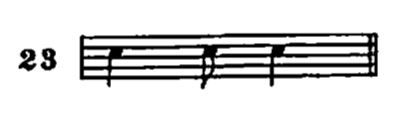
Messiaen notes that he limits the table to avoid excessively long or short values that would be impractical—extreme augmentation produces values approaching stasis, extreme diminution produces values approaching the limits of performability and perceptibility. He bases all transformations on the same initial rhythm to demonstrate the range of variants obtainable from a single source.
Modern Context: This table represents an early instance of systematic transformation cataloguing in twentieth-century composition. Similar systematic approaches appear in:
- Serial technique: Matrices cataloguing all transpositions, retrogrades, inversions, and retrograde-inversions of tone rows
- Transformation theory: David Lewin's formalization of musical transformations as mathematical operations
- Compositional algorithms: Computer-assisted composition using transformation tables and rules
The table also reflects Messiaen's pedagogical orientation—his treatise functions as a composition manual, not merely theoretical description. The systematic presentation invites composers to use the table as a reference, selecting transformation degrees appropriate to specific compositional situations.
The choice of transformation factors (quarters, thirds, halves, doubles, triples, etc.) reflects common mathematical ratios and their musical practicality. These ratios appear frequently in music: 1.5× (dotted notes), 2× (octave doubling, augmentation), 3× (triple meter relationships), etc. Messiaen's systematization makes explicit what composers might approach intuitively.
Examples: Examples 23–24 demonstrate multiple transformations from the table.