The Added Sixth and Added Augmented Fourth
Definition: The two most characteristic added-note sonorities in Messiaen's harmonic vocabulary. The added sixth appears above the root of triads and other structures; the added augmented fourth (tritone above the root) appears in combination with the added sixth to create particularly rich sonorities.
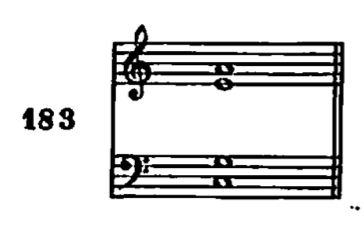
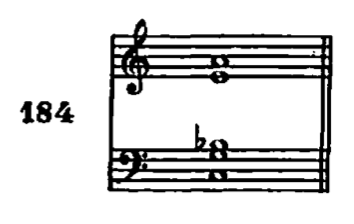
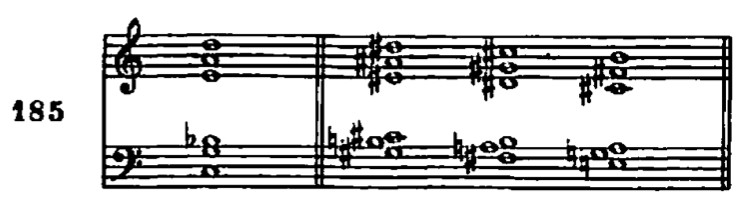
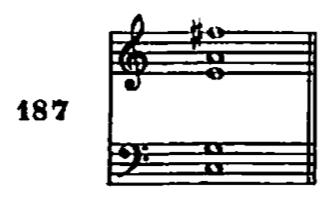
Messiaen's Treatment: Messiaen identifies the added sixth as "the most used of these notes," citing its appearance in works by Rameau, Chopin, Wagner, Massenet, and Chabrier before its definitive installation in the musical language by Debussy and Ravel. The added sixth may appear on the perfect chord (Example 183), on the dominant seventh chord (Example 184), and on the ninth chord (Example 185). When combined with the added augmented fourth, particularly on the perfect chord, the resulting sonority becomes especially significant: it forms the characteristic chord of the second mode of limited transpositions (discussed in Chapter XVI). Messiaen provides examples of this combined sonority on various chord types, demonstrating how the added augmented fourth can function both as a structural member and as an attractive force—for instance, F-sharp in the resonance of C functions simultaneously as an added note in the perfect C chord (already containing an added sixth) and as a pitch that "tends to resolve itself upon the latter" (Example 187–188).
Modern Context: The added-sixth chord anticipates the common jazz and popular music "sixth chord," while the combination of added sixth and augmented fourth produces what jazz theory might call a "major seventh sharp eleven" sonority. The interval content of this combined chord—the tritone, major third, perfect fifth, and major sixth above the root—creates a symmetrical structure that explains Messiaen's association of this sonority with his second mode of limited transpositions. The pitch-class collection {0, 2, 4, 6, 9} (in integer notation with C as 0) exhibits limited transposability precisely because of its interval-class content.
Examples: Examples 183–188