Plainchant Forms: Anthems, Alleluias, Psalmodics, Kyrie, Sequence
Definition: Large-scale formal structures derived from Catholic liturgical chant, particularly the various genres of Gregorian and other plainchant traditions, providing Messiaen with formal models embodying centuries of sacred musical practice and reflecting his spiritual commitments.
Messiaen's Treatment: Messiaen states one can hardly use plainchant themes more and better than Charles Tournemire in his Orgue mystique. Leaving these themes and their melodic contours (Chapter VIII) for a little, he will turn toward the plainchant forms, noting that Alleluias and great ornament anthems will allure us from the very first.
General approach: He applies plainchant formal structures while forgetting their original modes and rhythms in favor of his own (modes of limited transposition, added values, etc.).
(i) Anthem Forms ("Subtilitê des Corps glorieux" from Les Corps glorieux):
A large ornamented anthem in one voice without harmonization, each period terminated by a formula of melodic cadence repeated in echo (Example 170).

Formal structure (periods labeled A, B, C, D, E):
- A: Repeated twice
- B: Repeated twice with second time variants of accent, descent, and curves; restatement of A
- C: Modulating to dominant and concluding on tonic
- A: Varied
- D: Modulating to dominant with varied repetitions in crescendo and great vocalise, ending in period A deprived of its head
- E: Starting upon great vocalise and concluding on tonic, with echoes and rhythmic enlargement
In "Antienne du Silence" (Chants de Terre et de Ciel), principal sentence given to voice upon melody in anthem form, surrounded by quasi-atonal double counterpoint.
(ii) Alleluia ("Résurrection"):
Retains essential part of alleluias: alleluiatic vocalise, whose character music will often have. Example 171: Alleluiatic melody with added values (at crosses) divided into little groups of five sixteenth-notes (prime number); vocalise following accentuates rapid, supple, joyous, triumphant pace of passage.
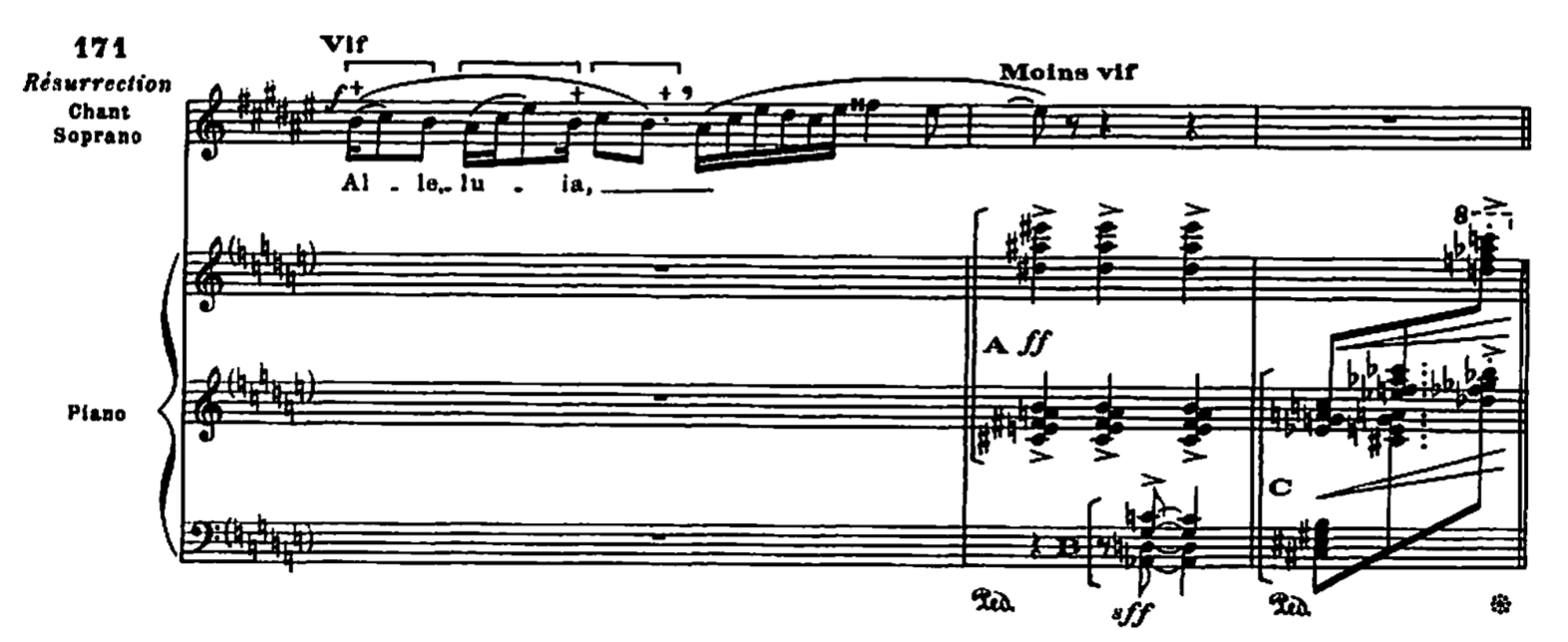
In piano: enormous carillon irradiated, using interpretation of Hindu rhythm rāgavardhana (Chapter II). At A, dominant chord with appoggiaturas (Chapter XIV) provided with effect of inferior resonance at B. At C, chord of resonance with effect of stained-glass window (Chapter XIV). Further on, initial vocalise amplified (at A) (Example 172).

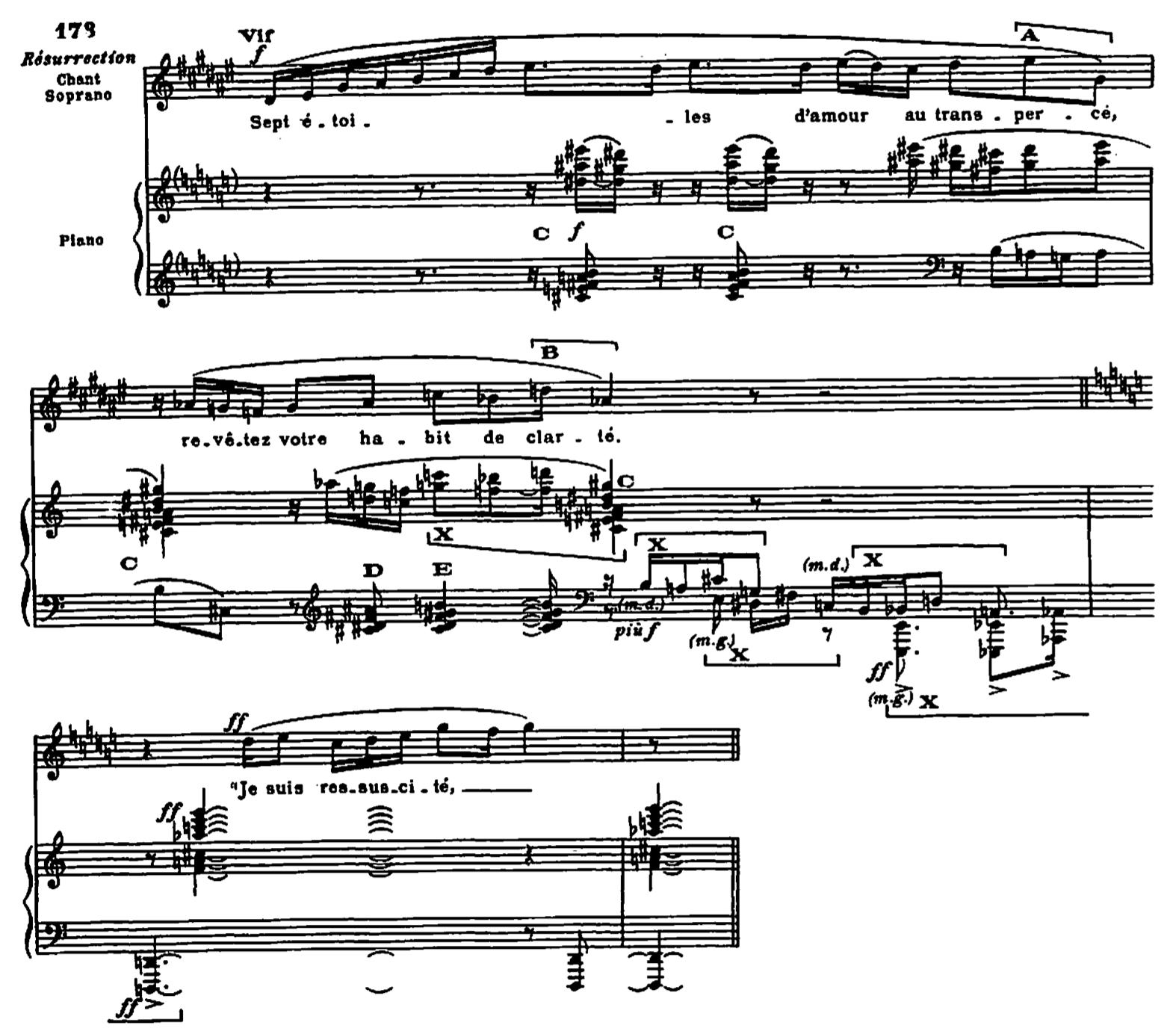
Third jubilatory example (Example 173): Notice intervals of two melodic descents—at A, descending major sixth; at B, descending augmented fourth. In piano, dominant chord with appoggiaturas (Chapter XIV, article 1) used in different inversions at C, D, E. Still in piano: close entrances X, the thematic fragment (first formula of melodic cadence, Chapter VIII) changes rhythm at each entry.
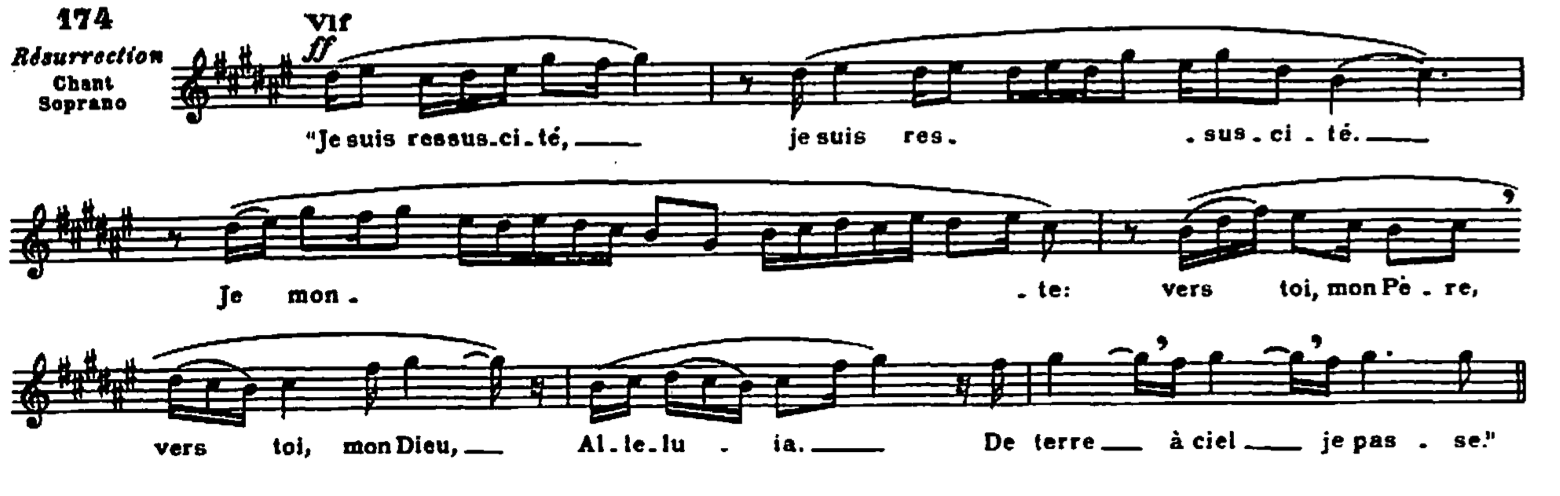
Example 174: Voice turns around melodic dominant (G-sharp) with sunny gaiety more and more delirious. Example 175: Work ends with this last increase of joy.
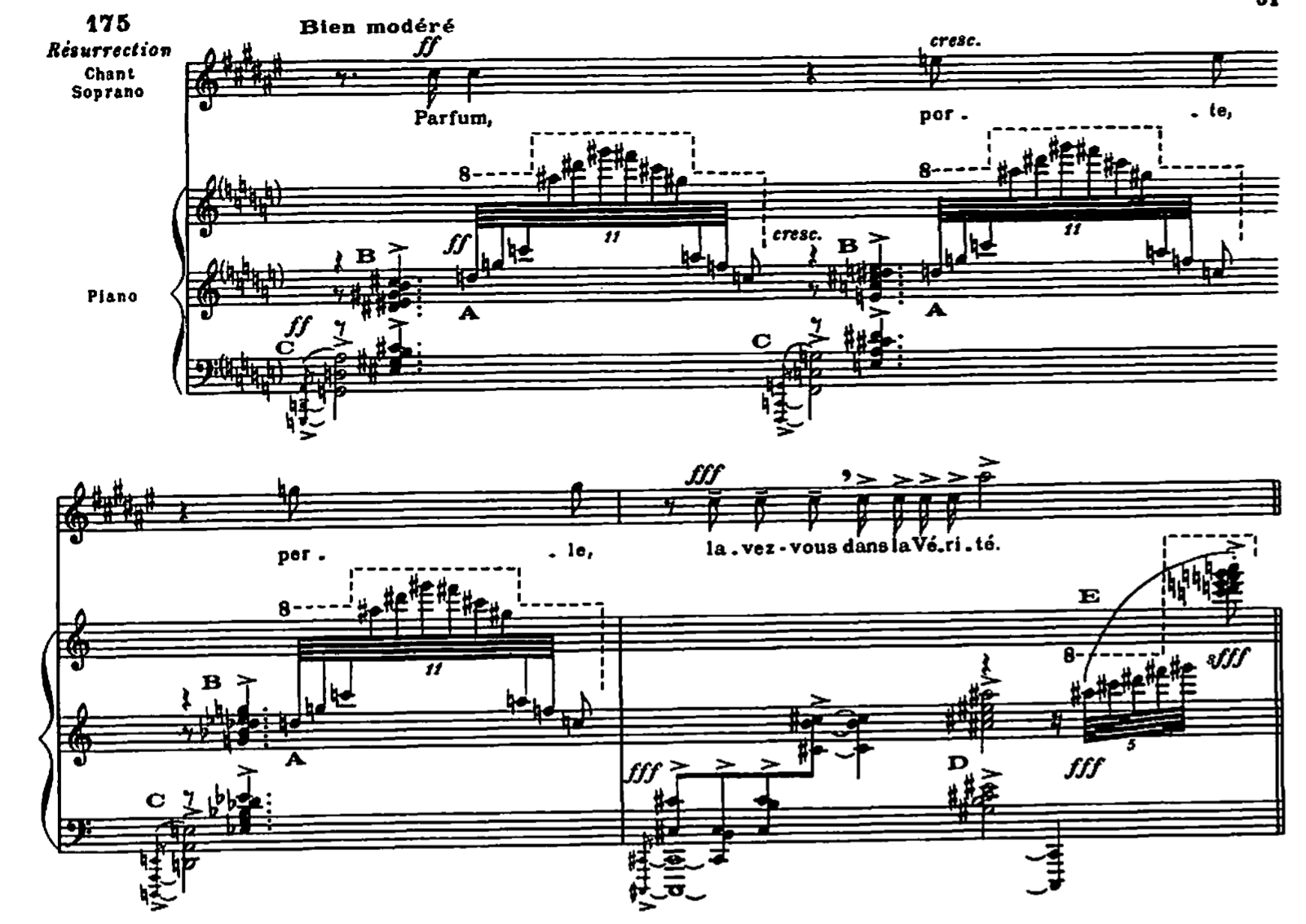
The volleys in bird style (at A) contrast with powerful solemnity of chords B (preceded at C by their effect of inferior resonance). At D, chord of dominant seventh with added sixth (Chapter XIII). At E, last volley like blow of instantaneous light!
Messiaen notes: Let us see now how one can blend alleluiatic vocalise with psalmody. Afterwards we shall study two plainchant forms: the Kyrie and the sequence.
(iii) Psalmody and Vocalise ("Psalmody and Vocalise" section):
Without forgetting that voice should first sing and afterwards turn to exigences of text and imitate inflections of speech, we may occasionally adopt certain system of declamation more easily applicable if we ourselves write poems of our vocal works.
Two domains of recitative:
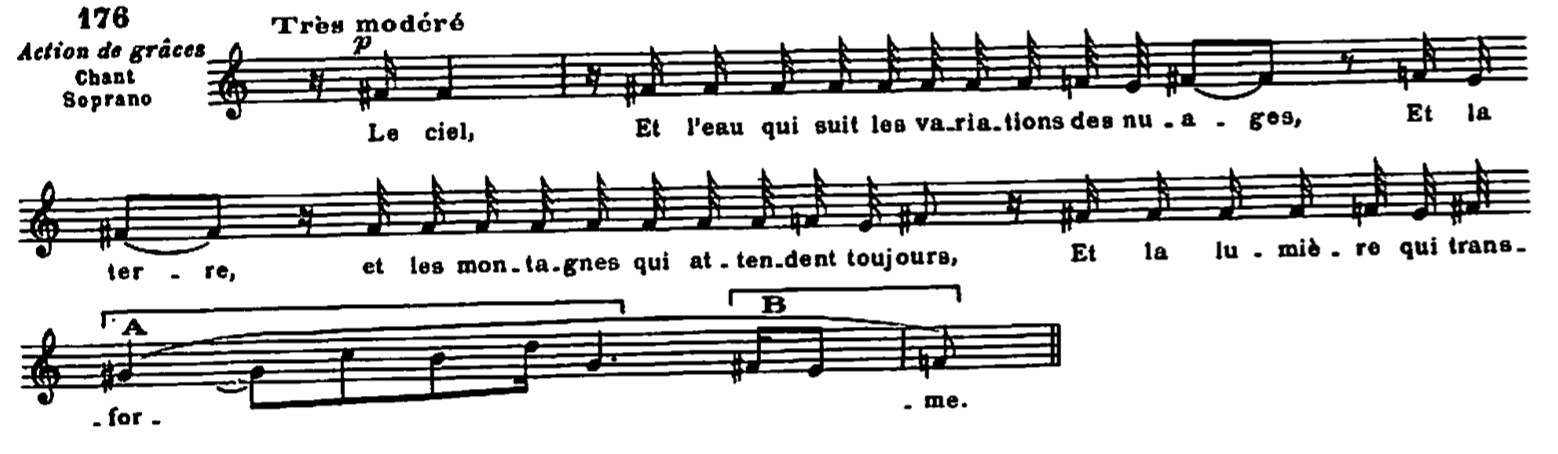
- Psalmody: Words uttered at very rapid pace on repeated note, punctuation underlined by formulas of vocalized melodic cadences
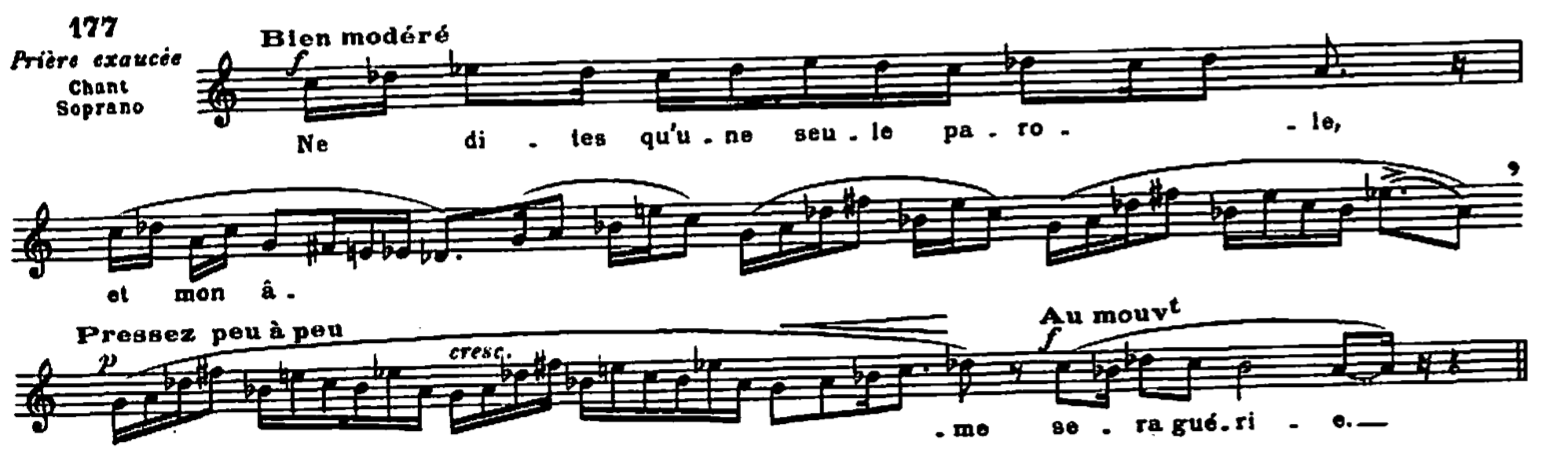
- Important words: Especially important, moving, rich in meaning, adorned with long or even very long vocalise
Example 176 (psalmody): Melodic cadence contains returning chromaticism B and melodic contour A often quoted in this work (Chapter VIII). Example 177: Important word âme (soul that suffers and prays) vocalized at length.
(iv) Kyrie ("Mystère de la Sainte Trinité"):
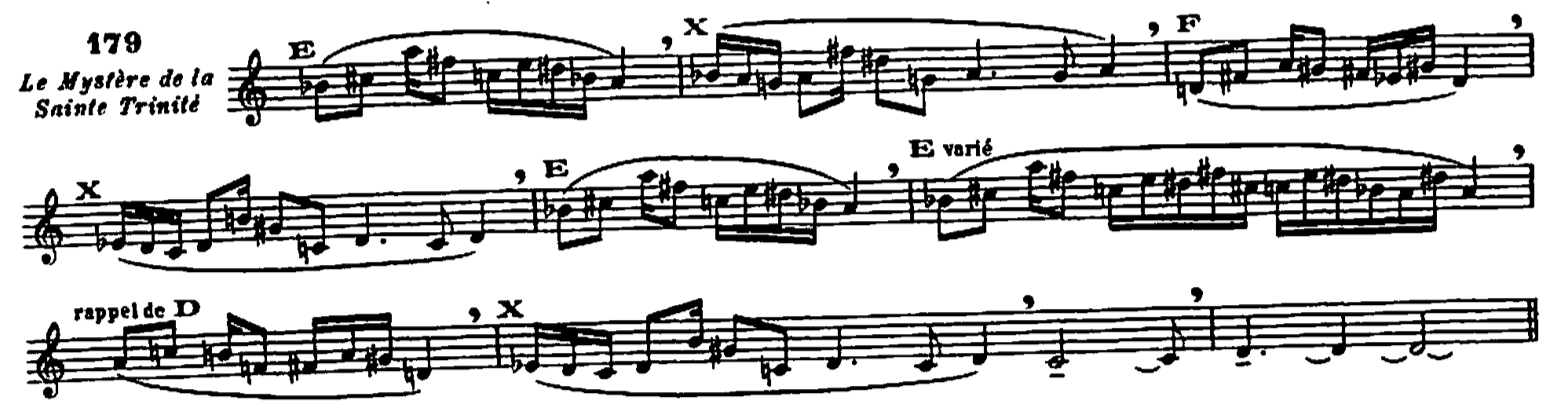
In plainchant masses, some Kyries divided thus: first, Kyrie eleison (Father) three times A, B, A; second, Christe eleison (Son) three times C, D, C; third, Kyrie eleison (Holy Ghost) three times E, F; last Kyrie (longer) takes up period E again, repeating it twice, followed by melodic conclusion. Music assumed at word eleison ("have pity upon us!") remains the same for nine invocations.
Messiaen's "Mystère de la Sainte Trinité" (organ piece written in three voices, supplementary homage to Trinity): Form itself tripartite—three times three. Top voice sings distant counterpoint, quasi-atonal, made of upbeats and terminations; bass unfolds long rhythmic pedal (Chapter XV, example 310, drawn exactly from "Mystère de la Sainte Trinité"). He quotes here only middle voice with principal song (Example 178).

Analysis of first tercet (A, B, A) in D; second tercet (C, D, C) touches upon key of A; third tercet (E, F, E) (Example 179) also begins in A, X being transposed, F is only restatement of A. Then E repeated twice, second time being enlarged by ornamental melodic variant. Conclusion in D recalling period D; X (eleison) in D with rhythmic expansion, to finish.
(v) Sequence ("le Verbe" section):
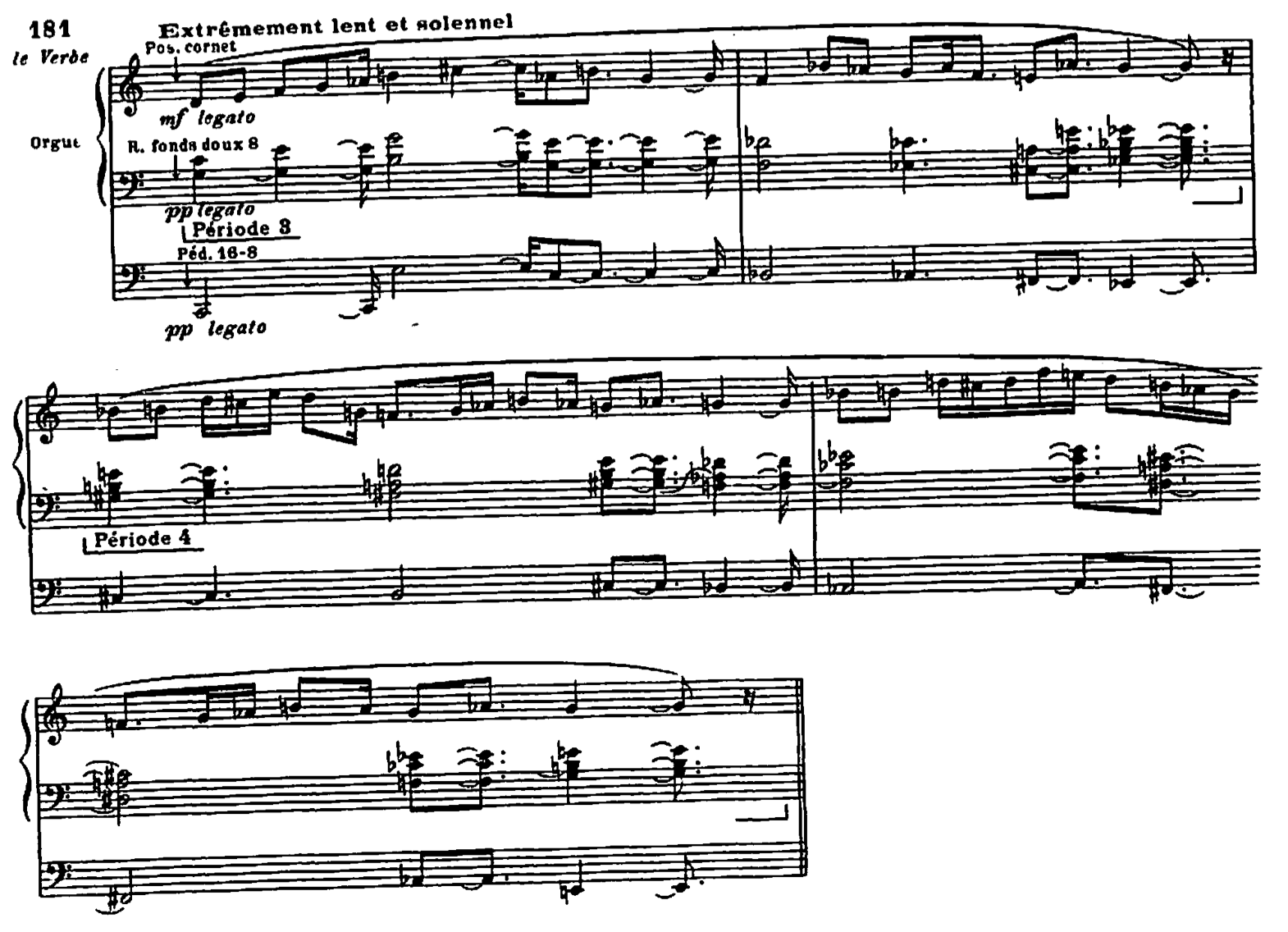
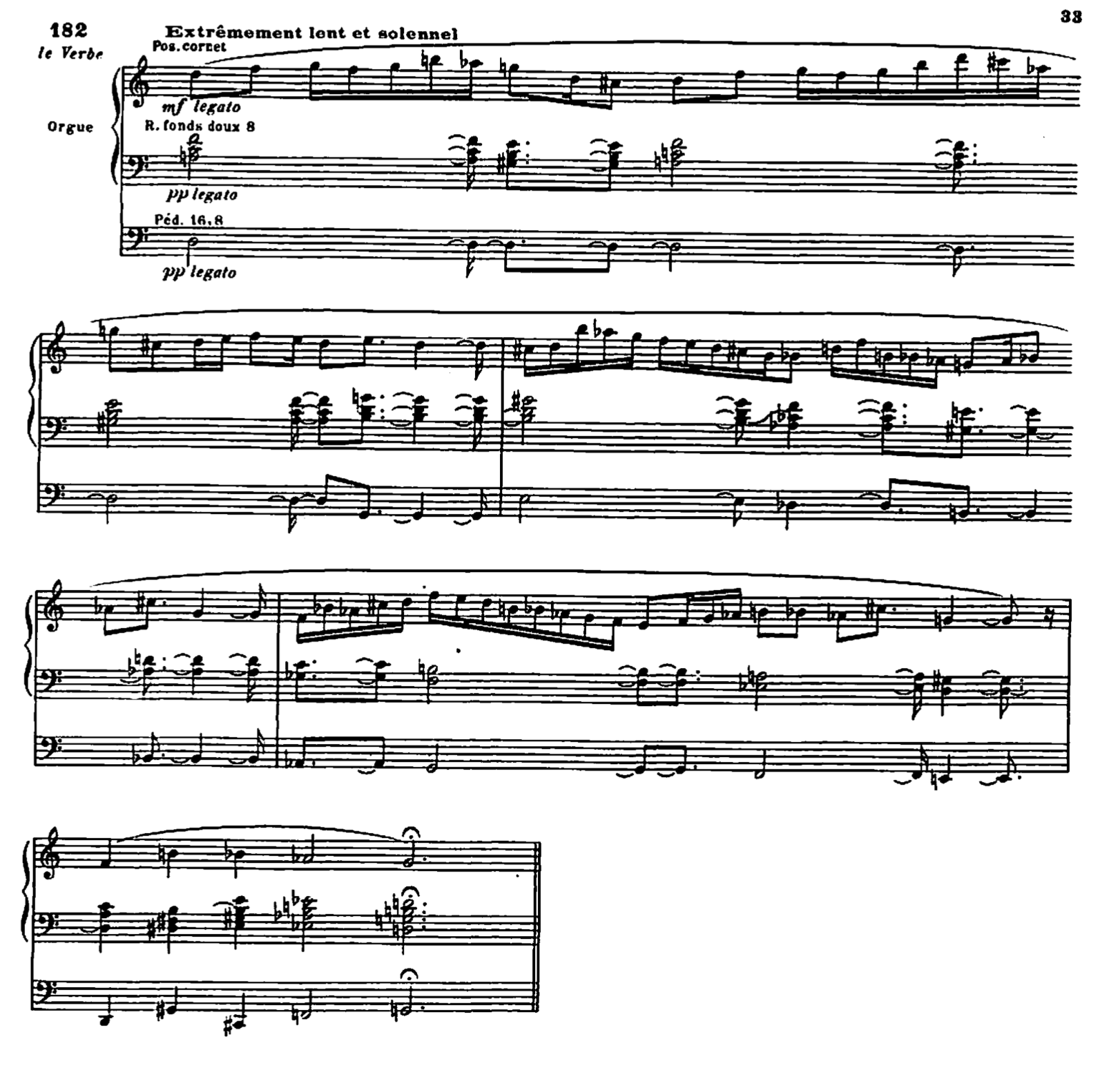
Sequence is canticle of popular style. Each period heard twice, either consecutively or alternately; all end on same note. In "le Verbe" (fourth part of Nativité du Seigneur), very special form simultaneously holds to sequence through its divisions, to Hindu ragas through character, to ornamented chorales of J.S. Bach through expressive and austere arabesques which overload the solemn, long, slow melody.
In it each repetition of period varied, provided with new ornamentation; G (final of each period) in course of sentence harmonized in nine different ways. Mode 2 (melody) mixed with major tonality and seventh mode of plainchant or mode on G (harmonies)—these mixtures will be examined more closely in Chapters XVII and XVIII.
Distribution of periods (Examples 180–182):

- Period 1: Example 180
- Period 2 repeated twice; Periods 3 and 4: Example 181
- Periods 3 and 4 varied: Then restatement of period 2, very much elongated and followed by sort of amen to conclude (Example 182)
Modern Context: Messiaen's engagement with plainchant forms represents distinctive twentieth-century practice:
Historical context:
- 19th-century plainchant revival: Solesmes restoration, scholarly editions
- Cecilian movement: Reform of Catholic church music
- French organ school: Tradition of plainchant-based improvisation and composition (Widor, Vierne, Tournemire)
Messiaen's approach:
- Formal structures retained: Periodic organization, repeat schemes, vocalise patterns
- Melodic/harmonic language transformed: Modes of limited transposition replace church modes
- Rhythmic treatment transformed: Added values and Hindu rhythms replace plainchant rhythm
- Spiritual purpose maintained: Liturgical/theological meanings preserved through formal associations
This differs from other twentieth-century plainchant uses:
- Stravinsky (Symphony of Psalms, Mass): Austere, archaic textures evoking medieval sound
- Poulenc (Figure humaine, sacred choruses): Direct quotation or close stylistic imitation
- Pärt (tintinnabuli style): Radical simplification inspired by early music aesthetics
Messiaen maintains plainchant formal complexity while completely transforming harmonic/rhythmic language—the structure conveys liturgical meaning even when the sound is thoroughly modern.
The extensive treatment of alleluia (Examples 171–175) reflects this form's significance—the alleluia is the most jubilatory, ornamental plainchant genre, embodying spiritual joy through extended melismatic vocalise. Messiaen's alleluiatic vocalises combine bird style (volleys, trills) with liturgical jubilation—natural and sacred joy unified.
The Kyrie analysis demonstrates structural thinking—nine invocations (3×3), tripartite form, Trinity symbolism all embodied in formal organization. Music serves theological meaning through numerology and structural symbolism.
The sequence discussion reveals Messiaen's synthetic method at its most complex: sequence form (medieval) + Hindu raga character + Bach chorale ornamentation + Mode 2 + major tonality + seventh plainchant mode = maximalist fusion serving spiritual expression.
Examples: Examples 170–182 comprehensively demonstrate adapted plainchant forms across multiple genres.