Polymodal Modulation
Definition: The technique of transitioning from one polymodal combination to another, creating large-scale harmonic transformation through systematic change of the modal layers, their transposition levels, or both. This represents the highest level of modal-harmonic organization in Messiaen's system.
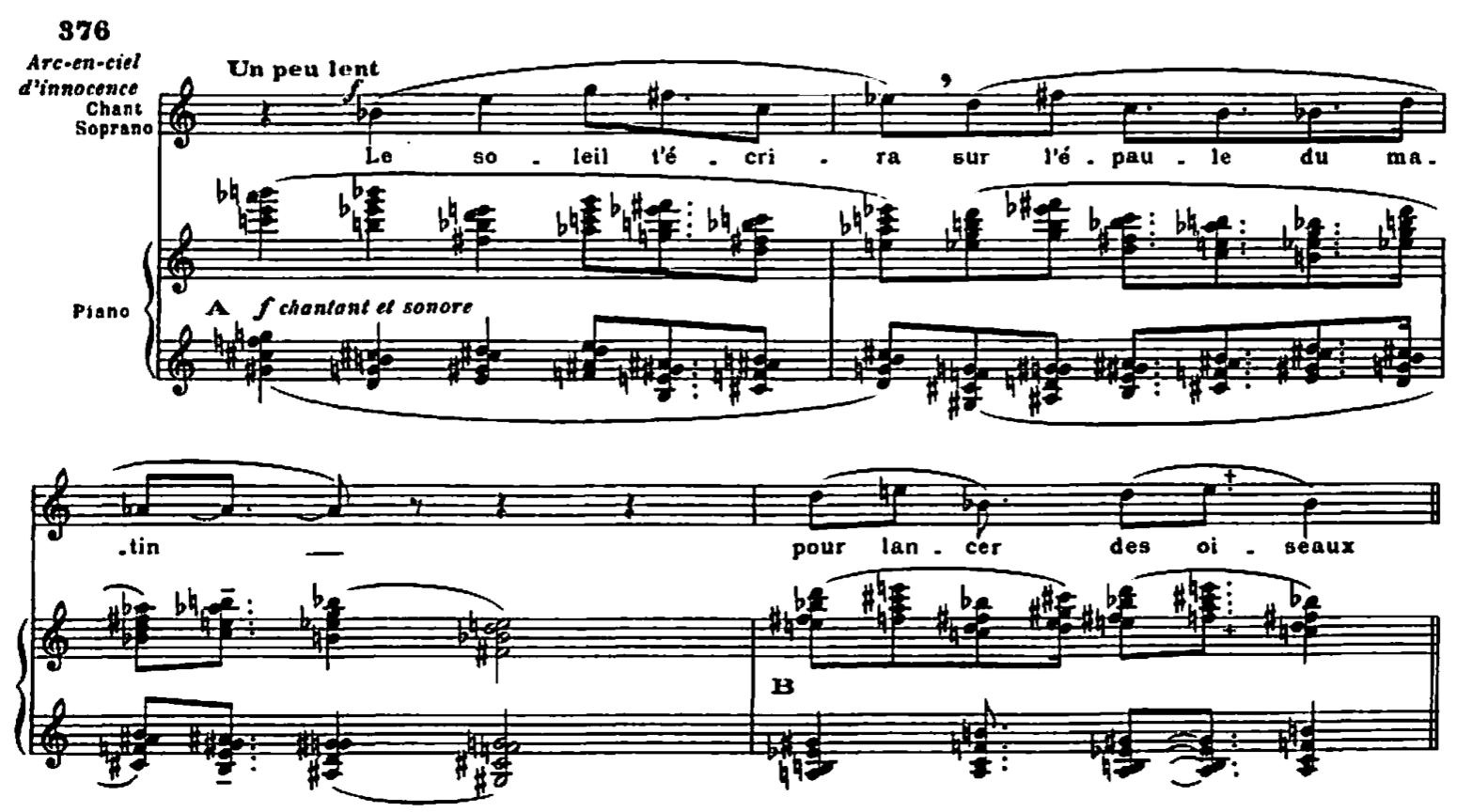
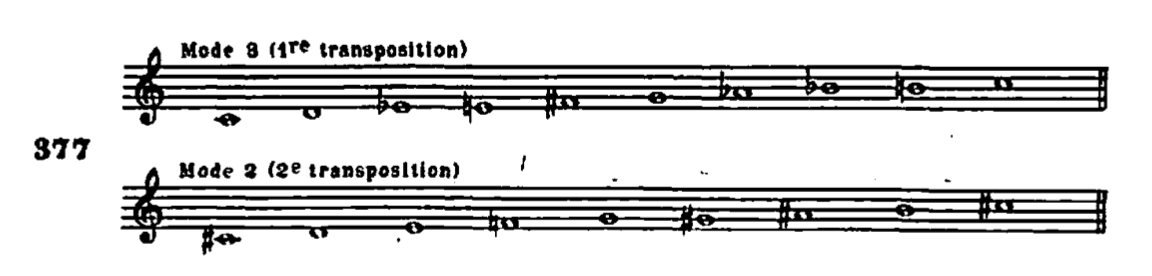
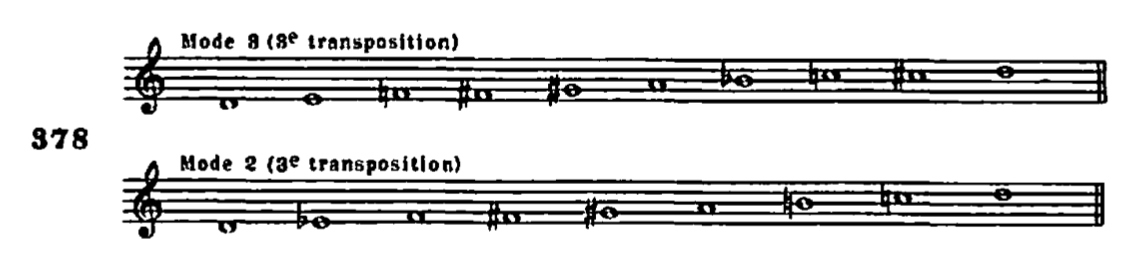
Messiaen's Treatment: Messiaen distinguishes three cases of polymodal modulation. First case: modulation by a change of transposition of the superposed modes (Example 376). At A, Mode 3, first transposition (voice and upper staff of the piano), upon Mode 2, second transposition (lower staff of the piano)—these are the two constituent modes (Example 377). At B, Mode 3, third transposition (voice and upper staff of the piano), upon Mode 2, third transposition (lower staff of the piano)—these are the two modes (Example 378). Messiaen notes that in the last measure of Example 376, at the cross, the lengthening of the rhythmic descent by addition of the dot, and in its first three measures, the use of the often-quoted rhythmic succession (Example 379).

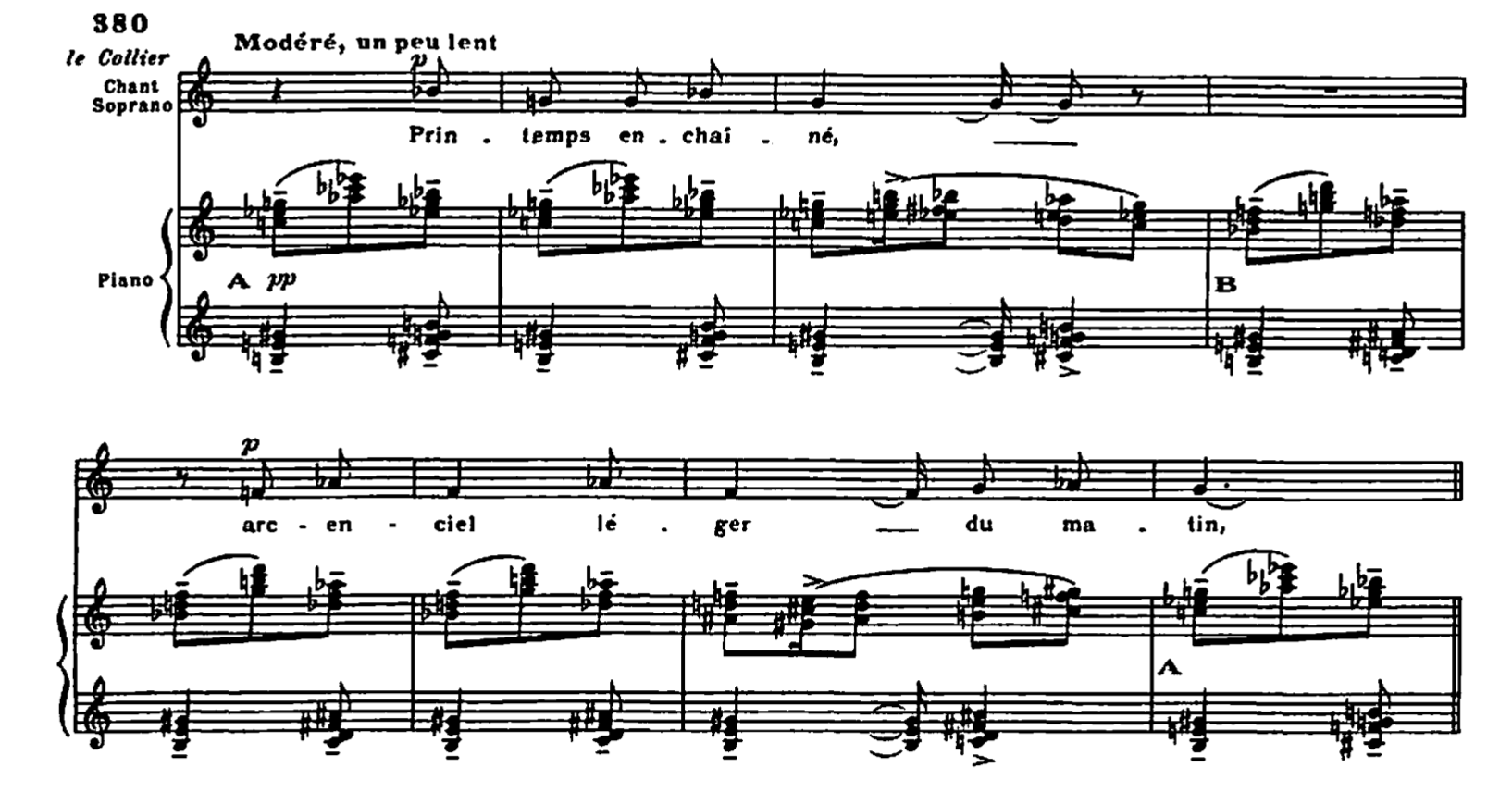
Second case: modulation by inversion of the superposed modes (Example 380). This fragment was already seen in Chapter III, Example 14, concerning preparation of the rhythmic accent elongated by the added value. It superposes at A, Mode 3, first transposition (upper staff of the piano), upon Mode 2, second transposition (lower staff); at B, Mode 2, second transposition (upper staff of the piano), upon Mode 3, first transposition (lower staff). This second polymodality is exactly the inverse of the preceding. In the last measure of the example, a new inversion occurs: the first polymodality is found again.
Third case: modulation to a different polymodality, using at least one new mode (Example 381). To read this example well, Messiaen provides detailed performance instructions: the pedal part sounds an octave higher than the notation, the true bass is the counterpoint in sixteenth-notes of the left hand, and this true bass has a very particular timbre due to the harmonics (fifth and third) which the mixtures give it. As for the chords of the right hand, the sixteen-foot doubles them at the lower octave. The structural analysis: At A, Mode 3 in the hands (first transposition) over Mode 2 in the pedal (first transposition). At B, the same polymodality lowered a semitone—Mode 3 in the hands (fourth transposition) over Mode 2 in the pedal (third transposition). The sixteenth-notes cause some notes foreign to Mode 3 to be heard; in all fragment B, not a single E natural appears—the union of the two modes using all notes of the chromatic scale except one, the E. The arrival of this note will augment the effect of the following modulation. At C, new polymodality—Mode 2 in the hands (second transposition) over the whole-tone scale in the pedal; the sixteenth-notes repeat the expected E.

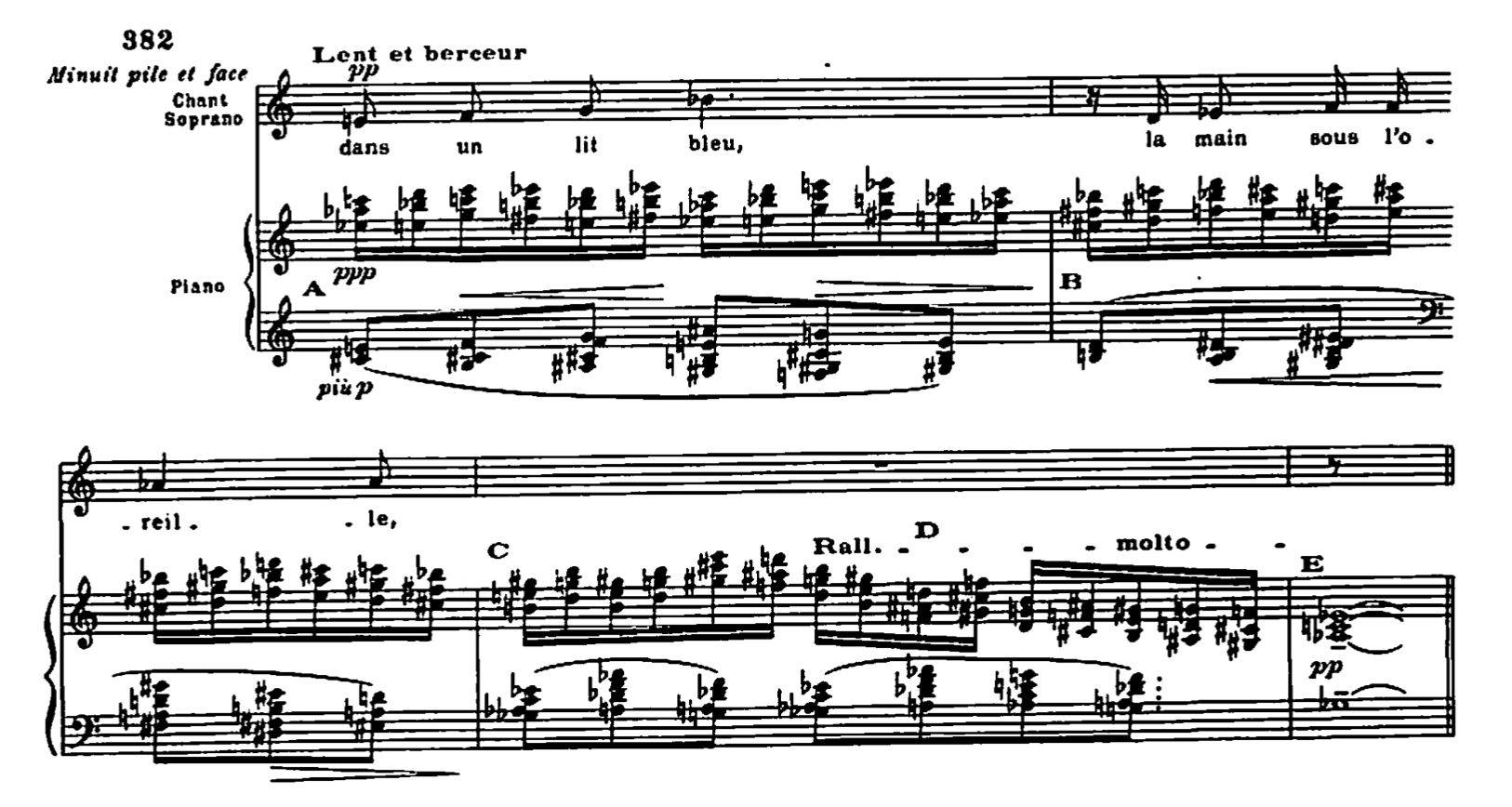
Another example of modulation to a different polymodality (Example 382): At A, Mode 3, first transposition (chords in sixteenth-notes), upon Mode 2, second transposition (voice and chords in eighth-notes). At B, the same thing lowered a tone. At C, new polymodality—Mode 2, second transposition (sixteenth-notes), over Mode 7, first transposition (eighth-notes). At D, the same Mode 2 (sixteenth-notes) over Mode 3, second transposition (eighth-notes). At E, chord of the tritone.
Modern Context: Polymodal modulation represents sophisticated harmonic planning operating at multiple hierarchical levels simultaneously. Contemporary analysis might employ transformational networks or voice-leading graphs to model these transitions, examining how pitch-class content shifts between polymodal combinations and evaluating the voice-leading efficiency of the transformations. The three types of polymodal modulation represent distinct transformational operations: (1) transposition of one or both modal layers while maintaining mode identities; (2) exchange of modal assignments between layers (inversion in Messiaen's terminology, though not pitch-class inversion in the modern theoretical sense); (3) substitution of one or more modes with different modes.
The detailed performance instructions for Example 381 (regarding pedal pitch, true bass location, mixture stops, and sixteen-foot doubling) reveal how timbral differentiation supports polymodal clarity—distinct modal layers receive distinct timbres, helping listeners perceive the stratification. The observation that fragment B uses all chromatic pitch classes except E, with E's arrival augmenting the effect of the following modulation, demonstrates Messiaen's awareness of aggregate completion and pitch-class saturation as compositional resources—the single excluded pitch becomes structurally significant through its absence and subsequent appearance.
The progression of polymodal modulation types from simple transposition changes through layer exchange to complete modal substitution parallels traditional tonal modulation techniques ranging from direct modulation (sudden key change) through pivot-chord modulation (shared harmonic element) to sequential or chromatic modulation (gradual transformation). However, Messiaen's polymodal modulations operate with more complex materials—each "key" (polymodal combination) itself consists of multiple modal layers, creating transformations that affect multiple dimensions simultaneously. The final arrival on "chord of the tritone" in Example 382 suggests reduction from polymodal complexity to simpler harmonic material, functioning as cadential simplification analogous to arrival on tonic harmony in tonal music.
Examples: Examples 376–382 (with references to Examples 14 and 379 from previous chapters)