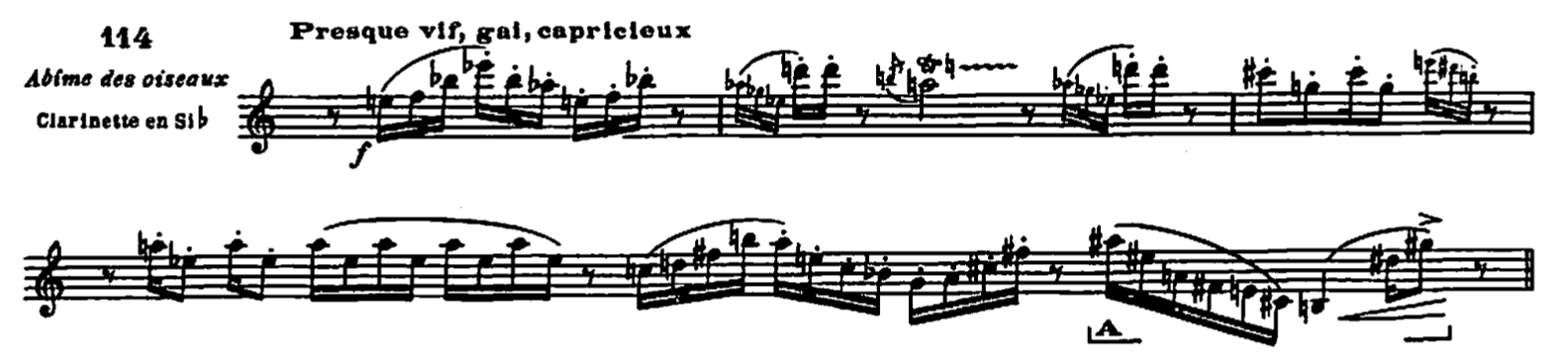
Microtonal Intervals and the Problem of Transcription
Definition: The methodological challenge of notating bird vocalizations that employ intervals smaller than the semitone—pitches falling between conventional Western tuning system's categories, requiring compromise or transformation in transcription.
Messiaen's Treatment: Messiaen notes that birds use "untempered intervals smaller than the semitone," and since "it is ridiculous servilely to copy nature," he intends to give examples of melodies of the "bird" genre which will be "transcription, transformation, and interpretation of the volleys and trills of our little servants of immaterial joy."
This establishes his methodological position:
- Acknowledgment of microtonal reality: Birds sing in intervals unavailable in equal temperament
- Rejection of literal copying: "Ridiculous to servilely copy nature"—transcription requires interpretation
- Three-stage process: Transcription (hearing and notating), transformation (adapting to compositional system), interpretation (creative realization)
- Genre rather than imitation: "Bird" genre—stylistic category inspired by birds, not ornithological documentation
Modern Context: The microtonal problem is fundamental to transcribing non-Western music, natural sounds, and any pitch phenomena not conforming to equal temperament:
Transcription challenges:
- Pitch quantization: Rounding microtonal pitches to nearest semitone loses information
- Temporal quantization: Notating fluid, unmeasured rhythms in conventional notation imposes metric frameworks
- Timbral reduction: Piano or orchestra cannot reproduce avian vocal timbres
Alternative approaches:
- Spectral notation: Representing sounds through frequency/amplitude graphs rather than conventional notation
- Microtonal notation: Using quarter-tones, sixth-tones, or cent deviations (Boulez, Ferneyhough)
- Recording: Electroacoustic works preserve actual sounds without notational mediation
Messiaen's solution—"transformation and interpretation"—acknowledges that transcription is inherently creative, not documentary. The notation represents a human composer's understanding and adaptation of bird vocalization, not the vocalization itself. This reflects sophisticated understanding of notation's limitations and the necessary gap between natural sound and musical representation.
The phrase "ridiculous to servilely copy nature" also positions Messiaen against naive mimesis—art transforms and interprets rather than merely reproducing. This aligns with broader modernist aesthetics rejecting literal representation in favor of creative transformation.
The characterization of birds as "little servants of immaterial joy" reveals theological dimension—birds serve divine creation through their song, and their music participates in spiritual transcendence. This connects to Messiaen's Catholic faith and his view of nature as divine manifestation.
Examples: The transcriptions that follow (Examples 114–119) represent Messiaen's transformations rather than literal bird song transcriptions.