Use of Added Notes in Messiaen's Own Music
Definition: The compositional application of added-note harmony in Messiaen's works, particularly Pelleas and melodic movements.
Messiaen's Treatment: Messiaen provides extensive examples from his own compositions, demonstrating various applications of added-note technique. In passages from Pelleas (Examples 189–191), he shows the genesis and development of added-note harmonies, with the added notes indicated by crosses in the score. Example 192 demonstrates the use of added notes in one of his melodies, "La Maison," where rhythmic values interact with harmonic color: four quarter-notes appear in the first two measures, followed by four dotted quarter-notes in the third measure, with the eighth-note maintaining consistent value throughout—this rhythmic treatment combines with added-note harmony to create the characteristic "nonchalant" quality Messiaen prizes. Example 193 shows a fragment previously quoted in Chapter VIII, where at point A a "passing group" appears (referencing Chapter XV), at point B an added sixth colors a ninth chord, and at point C the second mode of limited transpositions is employed. Throughout these examples (continuing through Examples 194–200), Messiaen demonstrates various applications: added sixths in ninth chords, augmented fourths added to perfect chords, combinations of added notes with dominant seventh chords, and the integration of added-note technique with other modal and rhythmic procedures, including Hindu rhythms (râgavardhana) and the second mode of limited transpositions.
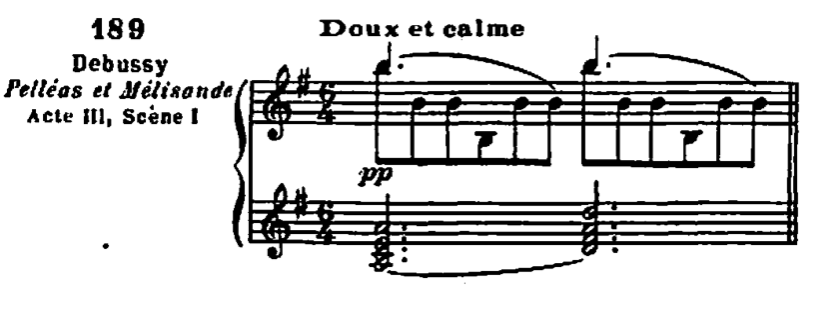
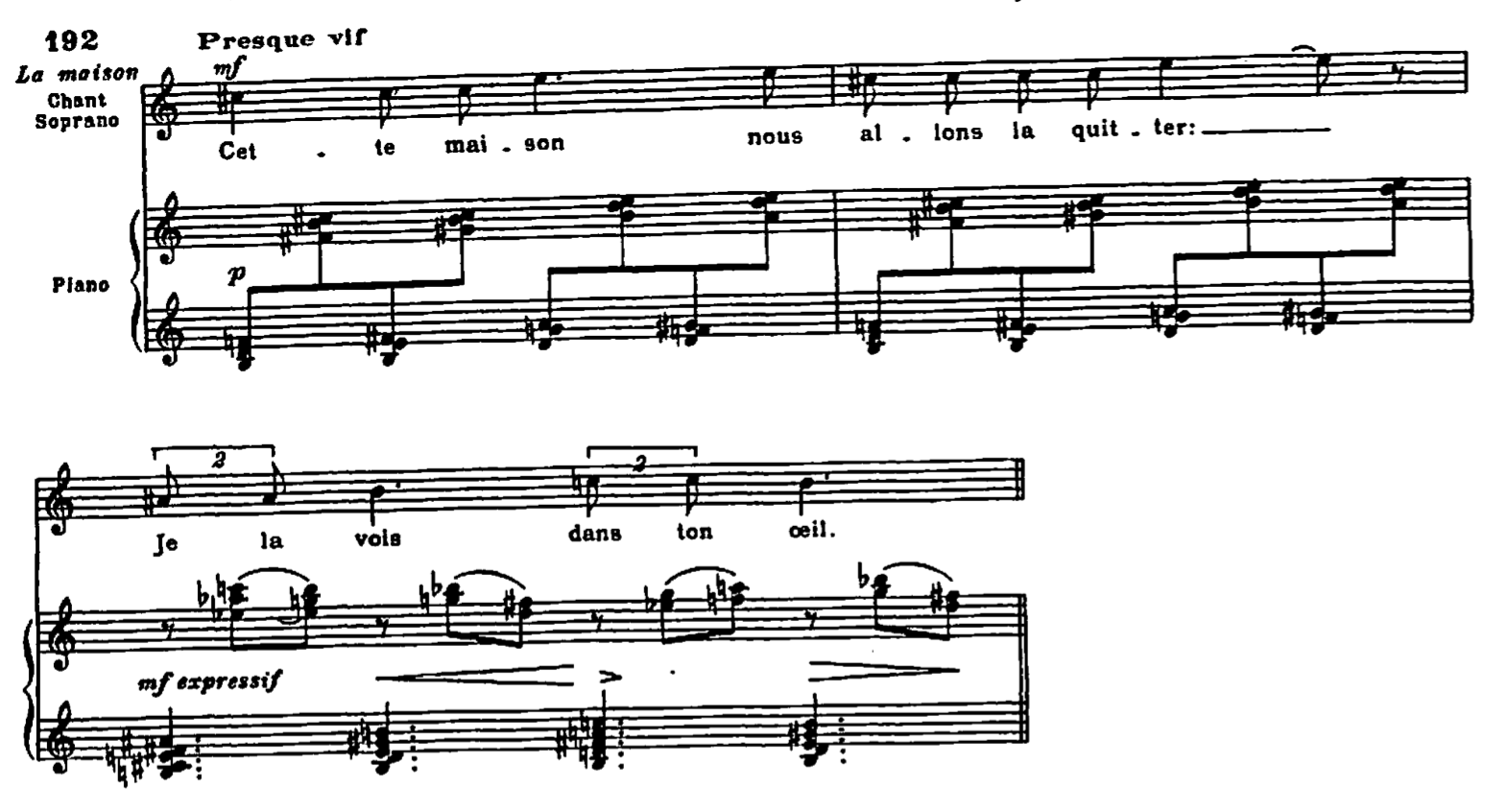
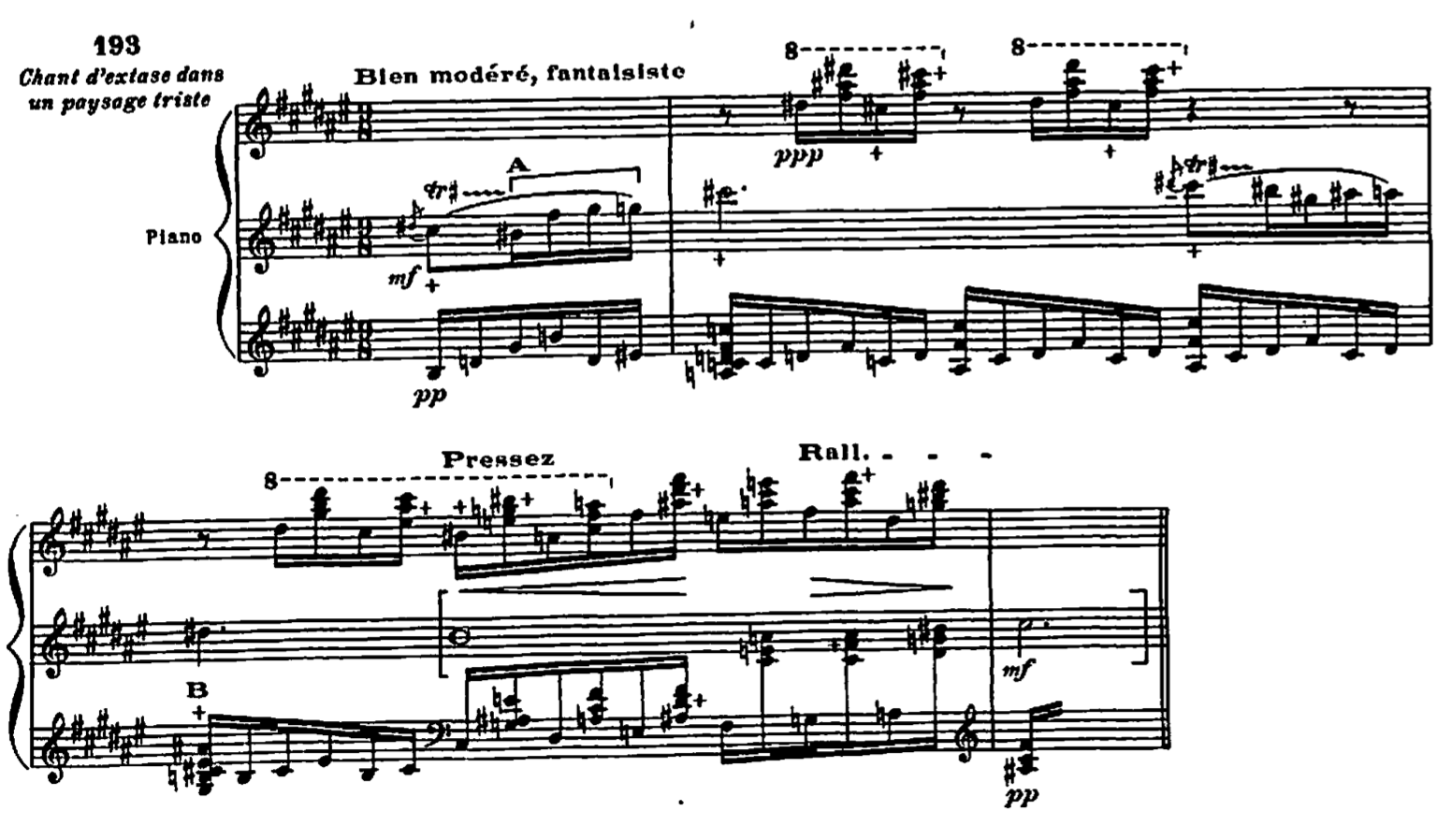
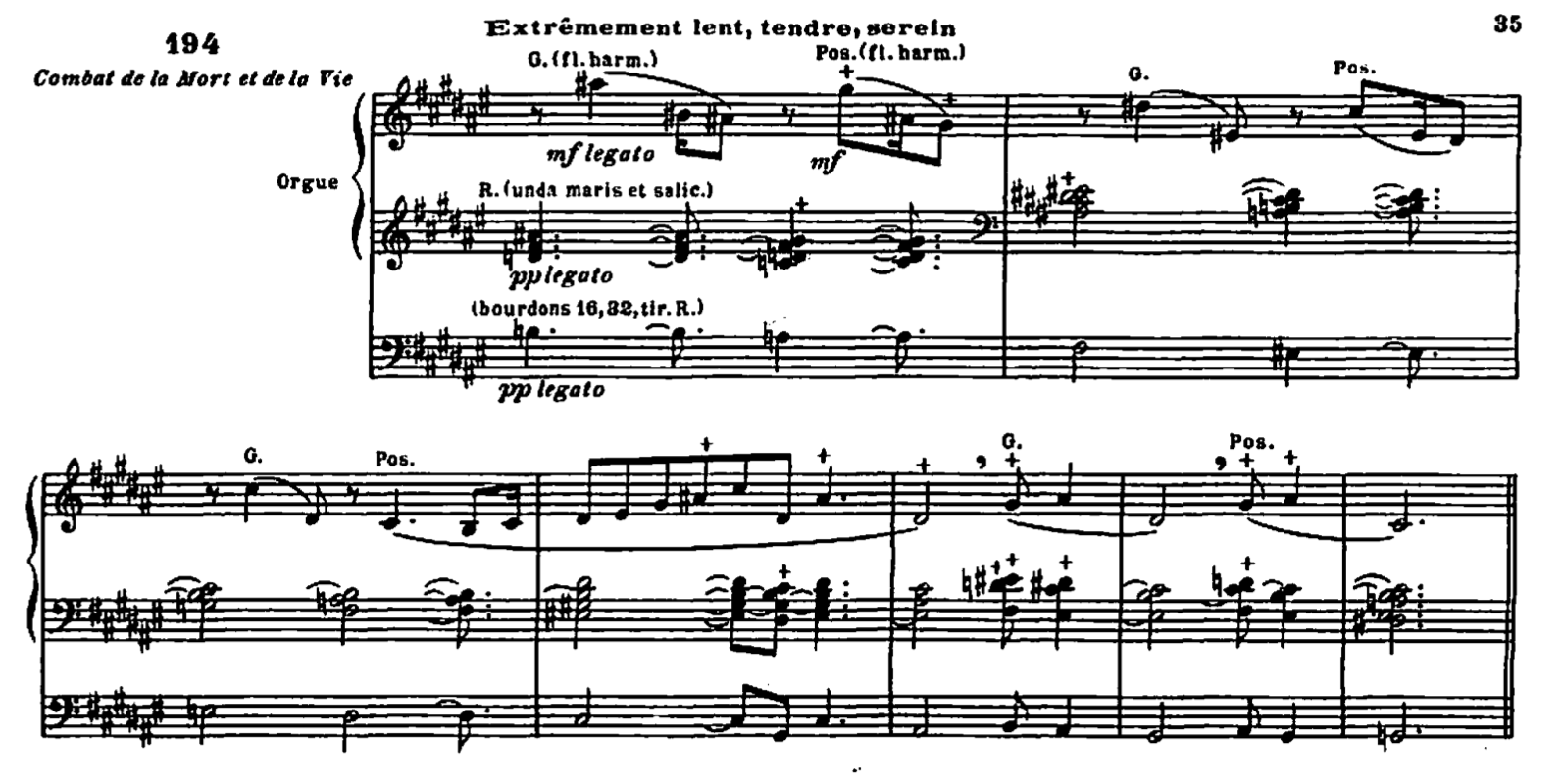
Modern Context: These examples reveal Messiaen's synthetic approach to composition, where added-note harmony does not function in isolation but integrates with rhythmic procedures (added values), melodic technique (passing groups), and modal structures (limited transposition modes). The systematic marking of added notes with crosses in the examples demonstrates Messiaen's pedagogical concern with making harmonic structure explicit—a practice that anticipates the analytical notation used in later twentieth-century theoretical work. The combination of techniques across multiple parameters exemplifies what later theorists might call "parametric integration," where distinct musical dimensions reinforce unified compositional goals.
Examples: Examples 189–200